Author Archives: John S. Walters

Unknown's avatar

About John S. Walters

Writer, editor, sometime radio personality, author of "Roads Less Traveled: Visionary New England Lives."

Let’s Not Fix the Mental Health System and Say We Did

Oh, great. The state’s Department of Mental Health is finalizing a ten-year plan to improve the state’s inadequate mental health care system. The highlights, errrrr lowlights, include:

  • It doesn’t appear to address the system’s biggest shortfall, i.e. the lack of resources for the worst cases.
  • It echoes the approach promulgated by the Shumlin administration and legislature after Tropical Storm Irene. Which, for those just joining us, failed to do what it promised.
  • There seems to be nothing about the lack of resources in the prison system.
  • There’s nothing about providing more funding to put the plan into action.

So there’s that.

The report focuses on linking treatment of mental and physical illness, “eliminating stigma around mental health and expanding community-based treatment programs.” That’s nice. But meanwhile, people with profound mental illnesses continue to be stuck in hospital emergency rooms in greater numbers and for longer periods.

That has nothing to do with “stigma” or “community-based treatment programs.” It has everything to do with Vermont’s lack of capacity to treat our severely mentally ill. That’s been a problem since Irene damaged the state hospital at Waterbury.

Continue reading

Bookshelf: Three Authors in Search of a Scumbag

There are two new books about the Harvey Weinstein scandal: She Said by Jodi Kantor and Megan Twohey, and Catch and Kill by Ronan Farrow. Both are worth reading, for different reasons.

The three authors spent months and months uncovering Weinstein’s criminal sexual conduct, despite the film producer’s thorough, expensive and sometimes illegal efforts to thwart their work.

Oh, I guess I should say “alleged” criminal conduct, since Weinstein won’t go on trial until next month. But c’mon, the guy’s a scumbag. Throughout his movie career, he used his power to exploit women and destroy their lives and careers. These books remind you of exactly how evil he was.

Kantor and Twohey are reporters for the New York Times. Their book is more straightforward, and is a better primer on the scandal and how it turbocharged the #MeToo movement. If you’re going to read one book on this subject, make it She Said.

But after the Times published their Weinstein stories, they moved on to other assignments. The last section of the book, in fact, is about the Brett Kavanaugh/Christine Blasey Ford saga, which the two women also covered for the Times.

Farrow’s book goes deeper into the Weinstein case because he continued to follow the story for The New Yorker after the original stories were published. He also explores the complicity of the media and the legal system in helping Weinstein continue his predatory activities for years. And he exposes the efforts of an international web of operatives who worked for Weinstein in trying to uncover dirt on reporters and victims.

Catch and Kill also, somewhat problematically, presents as something akin to a spy novel. Take this author photo from the back cover.

The Spy Who Reported On Me
Continue reading

Donovan Knew

The Vanishing Wunderkind

If there was any doubt about whether Attorney General T.J. Donovan might run for governor in 2020, he has just eliminated it.

Not by making an announcement, but by making it all but impossible to get the Democratic nomination. The guy’s so radioactive right now, he ought to just lay low for at least two more years.

Because it turns out he played a major role in concealing the scandal at the Chittenden Regional Correctional Facility. We know this thanks to Seven Days‘ Paul Heintz, who has done the near-impossible. He uncovered a major scandal in state government — and then, one week later, he has substantially advanced the story, at a time when every media outlet in Vermont is pursuing this thing. Or should be.

Today’s piece reveals that pretty much everyone in state government knew about widespread abuse at the Chittenden Regional Correctional Facility long before it became public, including officials who loudly expressed their horror and astonishment that there were problems at the prison.

Including, most notably for our purposes, T.J. Donovan, who has known about systematic problems at the prison for two and a half years.

Continue reading

Holcombe Tabs Familiar Face for Campaign Manager

Cameron Russell is ready to give it another try. He served as campaign manager for Christine Hallquist’s gubernatorial candidacy in 2018; now he’s accepted the same post in Rebecca Holcombe’s bid to unseat Republican Gov. Phil Scott in 2020. Russell had previously been a staffer in the Vermont Democratic Party from 2014 through 2016.

“There is no one in the state better positioned to take on this role,” Holcombe commented in a press release, “and I am fortunate to have his experience and knowledge of Vermont’s communities and political landscape as part of my campaign.”

Holcombe began her campaign with staff from outside the state, but had been hoping to attract a manager with Vermont experience. And honestly, there aren’t many of those around.

Continue reading

Donovan mulls outside monitor for women’s prison

The scandal-plagued Chittenden Regional Correctional Facility may need an independent monitor to provide an outside view of its management. Vermont Attorney General T.J. Donovan floated the idea Monday, in an interview from the meeting of the National Association of Attorneys General in Washington.

A report in last week’s Seven Days outlined a years-long pattern of sexual assault and other misbehavior at Vermont’s only women’s prison — and a pattern of covering up or ignoring those abuses. Since then, Gov. Phil Scott has ordered Human Services Secretary Mike Smith to launch an investigation, Smith has assumed managerial control of the prison and House Democrats plan to conduct hearings on the scandal as soon as the new legislative session begins next month.

Donovan said the idea of an independent monitor arose Monday in a side conversation at the NAAG meeting. “This has been done at the federal level with troubled prisons,” Donovan said. “Usually, there’s a list of criteria for compliance that the independent party would monitor.” Donovan isn’t ready to advocate for the move, but he noted that “we may need some sort of independent third party.”

Donovan has not launched his own investigation of the prison; instead, he is assisting with Smith’s probe. There’s also a criminal investigation underway by the Vermont State Police. Donovan defended his decision to stay in a supporting role for now.

Continue reading

Holy Crap, the Free Press just “both-sidesed” the Confederate Flag

As a person who hasn’t gotten around to canceling their increasingly-irrelevant subscription to the Burlington Free Press, I get its daily briefing in my inbox. And today’s edition greeted me with THIS.

That’s right, the former Best Newspaper In Vermont is peddling Stars “N Bars claptrap right out of the Nikki Haley playbook. “Some argue the Confederate battle flag is racist”??????

And to be clear, this isn’t simply a case of some intern carelessly writing a subhead for the daily email. That same idea is peddled throughout the story.

The flag has come under national criticism in recent years, seen at events such as the 2017 white supremacist rally in Charlottesville, Virginia.

Um, exsqueeze me? “In recent years“??????? That rag has been the banner of racist oppression since Appomattox.

The germ of this idea comes from Paul Searls, history professor at Northern Vermont University (which I will always think of as Lyndon Johnson U, don’t @ me). He asserted that the flag may not carry the same overtly racist message up here that it does in the South.

Some Vermonters might view the Confederate flag as a symbol of ideals and their lifestyles, Searls said, and fly as a symbol of resistance against the existing order and outsiders perceived as threats to their well-being.

Yeah, well, those Vermonters are ignorant of their country’s history and shouldn’t be given a free pass for such.

Searls did also describe the battle flag as “a potently provocative symbol,” so there’s that. And the article does finally come down on the side of “the flag is inherently a bad thing.” But in the process, it sets up a false “debate” that the S&B can be anything other than a toxic instigation. Thanks, Free Press!

On the women’s prison scandal

First of all, full credit to Paul Heintz and the Seven Days team for producing a tremendously impactful piece of reporting. You know you’ve hit the mark when you force every political figure in Vermont to stop in their tracks and take action to investigate a scandal.

And scandal it is. An epidemic of sexual assault involving guards and inmates at the Chittenden Regional Correctional Facility, Vermont’s only women’s prison:

“It’s an epidemic at this facility,” said one longtime officer who claims to have faced retaliation for speaking out against it.

“The [officers] lie, have sex with inmates, assault people and have each other’s backs to ensure that nobody finds out,” said Melissa Gaboury, who was released from the prison last week. “They also retaliate against any inmate for speaking about anything.”

Not good. Not good at all. Especially in a time when the federal Prison Rape Elimination Act (PREA) has mandated procedures for curbing sexual assault behind bars. And when the state’s corrections department has supposedly complied with the law.

Yeah, maybe not.

If half the stuff in Heintz’s story, and his follow-up piece, is true, then this is a full-on scandal that ought to rock the state’s corrections system to its core. People should be fired. People should be brought up on criminal charges. And not just guards on the front lines, but top officials who must have been complicit in cover-ups and creating (or permitting) a culture of denial and suppression.

The cherry on this shit sundae: Daniel Zorzi, a corrections officer who was a known drug abuser, and who trafficked in and shared drugs with inmates, was somehow named the DOC’s 2018 shift supervisor of the year. Here he is, embarrassingly enough, posing with then-corrections commissioner Lisa Menard and then-human services secretary Al Gobeille.

Oopsie.
Continue reading

ANR Commish Targets the Messenger

The algae isn’t the problem. The problem is, this picture of the algae.

Vermont Natural Resources Secretary Julie Moore is blaming the media for reporting on Lake Champlain’s water quality problems. Nice.

During a presentation to lawmakers on Wednesday, Moore displayed a series of articles covering outbreaks of toxic blue-green algae on the lake, and blamed those damn reports for a more than 10 percent drop in visits to certain state parks this year.

“It’s headlines like these that probably played no small part in discouraging people from heading to our parks,” she told lawmakers, according to VTDigger’s Elizabeth Gribkoff.

There’s a few problems with this, need I say. First, as you may have discerned from the “probably,” Moore has no actual evidence to back up her assertion.

Second, the drop was reported at eight of Vermont’s 13 lakeside parks. What about the other five?

Third, it’s not cool to blame the media for, you know, doing their goddamn jobs. If there’s a potentially toxic — and spectacularly ugly — algae bloom on the lake, are we supposed to ignore it for fear of inciting tourists to stay away?

Fourth, those blooms have been a regular summertime feature of Vermont life for years and years. Did this past year’s reportage suddenly hit home this year?

Were there more stories than ever before? Moore admitted she doesn’t know.

Continue reading

Bookshelf: Those who forget the past…

Before yesterday, I knew some bare-bones facts about America’s wholesale imprisonment of people of Japanese lineage during World War II. And then I read George Takei’s graphic memoir, They Called Us Enemy. (Available here.)

Takei, best known as Sulu on the original Star Trek, was one of 120,000 Japanese and Japanese Americans who were ripped from their homes in the western U.S. and sent to distant “camps” for the duration of the war. I knew that the internment order was a terrible thing; Takei’s book taught me two important lessons.

First, it wasn’t just a single act. There was a whole series of barbaric actions by the U.S. government that are hard to fathom by modern standards — even given the cruelty of our current administration. And second, the human cost of internment continued long after the war. The story of a single family, told in pictures, brings to life the human dimension of this awful period. Seeing forced relocation through a child’s eyes provides a perspective you can’t get in a history book.

Takei’s story begins with a harsh knock on the door, and an order for his family to vacate their home within ten minutes. They could only take whatever they could carry. Everything else — homes, businesses, possessions — was left behind and lost forever.

America made no effort to determine which people might actually be a threat. All were treated as enemies. Politicians who would become celebrated for their devotion to American ideals — Franklin Roosevelt, Earl Warren — were willing participants in the demonization of ethnic Japanese, fanning the flames of prejudice and advocating legislation that would rob people of their lives, livelihoods, dignity and freedom.

Continue reading

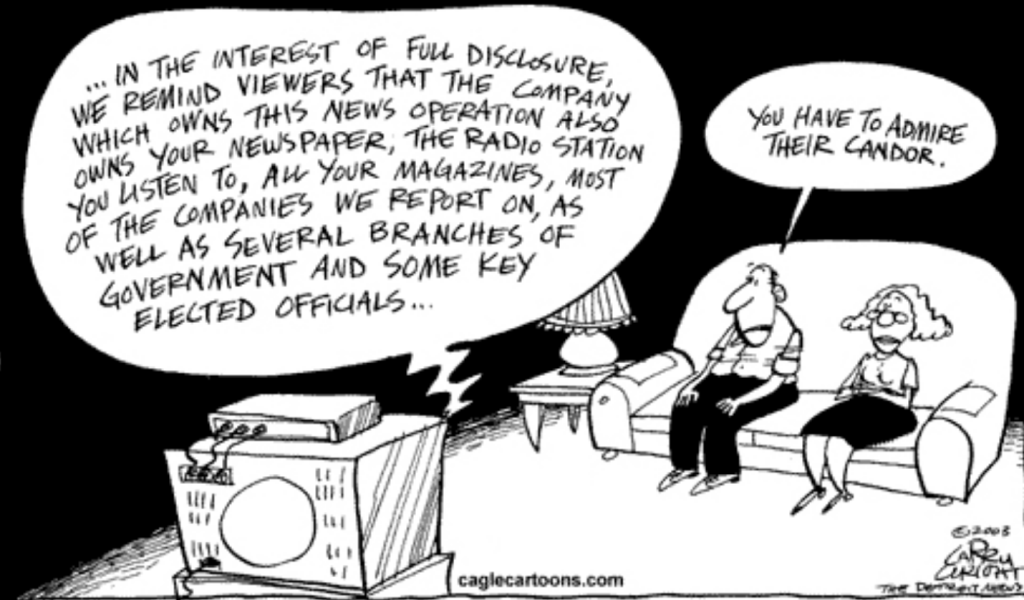
Journalism’s obsession with objectivity

Objectivity is the key to good journalism. So they say. So almost everybody says.

I’m not here to deny the importance of objectivity. It’s one of the sharpest tools available for exploring the truth. But it’s not the only tool, and modern journalism is sorely limited by its strict adherence to objectivity.

I’ve been pondering objectivity for some time, and feeling a sense of disquietude about its dominance in the field of journalism. That sense came into sharp focus after I discovered “The View From Somewhere,” a podcast (and book) by Lewis Raven Wallace, a trans journalist who was fired in 2017 by public radio’s Marketplace over a post on their personal blog entitled “Objectivity Is Dead, and I’m Okay With It.” I highly recommend the podcast for those who care about journalism. Haven’t read the book yet.

Some of the facts and concepts in this post are borrowed, in whole or in part, from Wallace’s work. It’s my own interpretation, of course.

Let’s start with some history. The concept of journalistic objectivity is relatively new — almost exactly a hundred years old, in fact. It emerged, coincidentally or not, at a time when newspapers had become very profitable enterprises bought and sold by rich men and corporations. Objectivity was used by those owners as a cudgel against employees’ efforts to unionize. Reporters were often fired for a supposed lack of objectivity — solely because they were trying to organize their workplaces.

From that twisted acorn did our mighty oak of objectivity spring. That’s not the whole story, but it should be remembered that objectivity has been used, not just as a guideline, but also as a weapon.

Continue reading