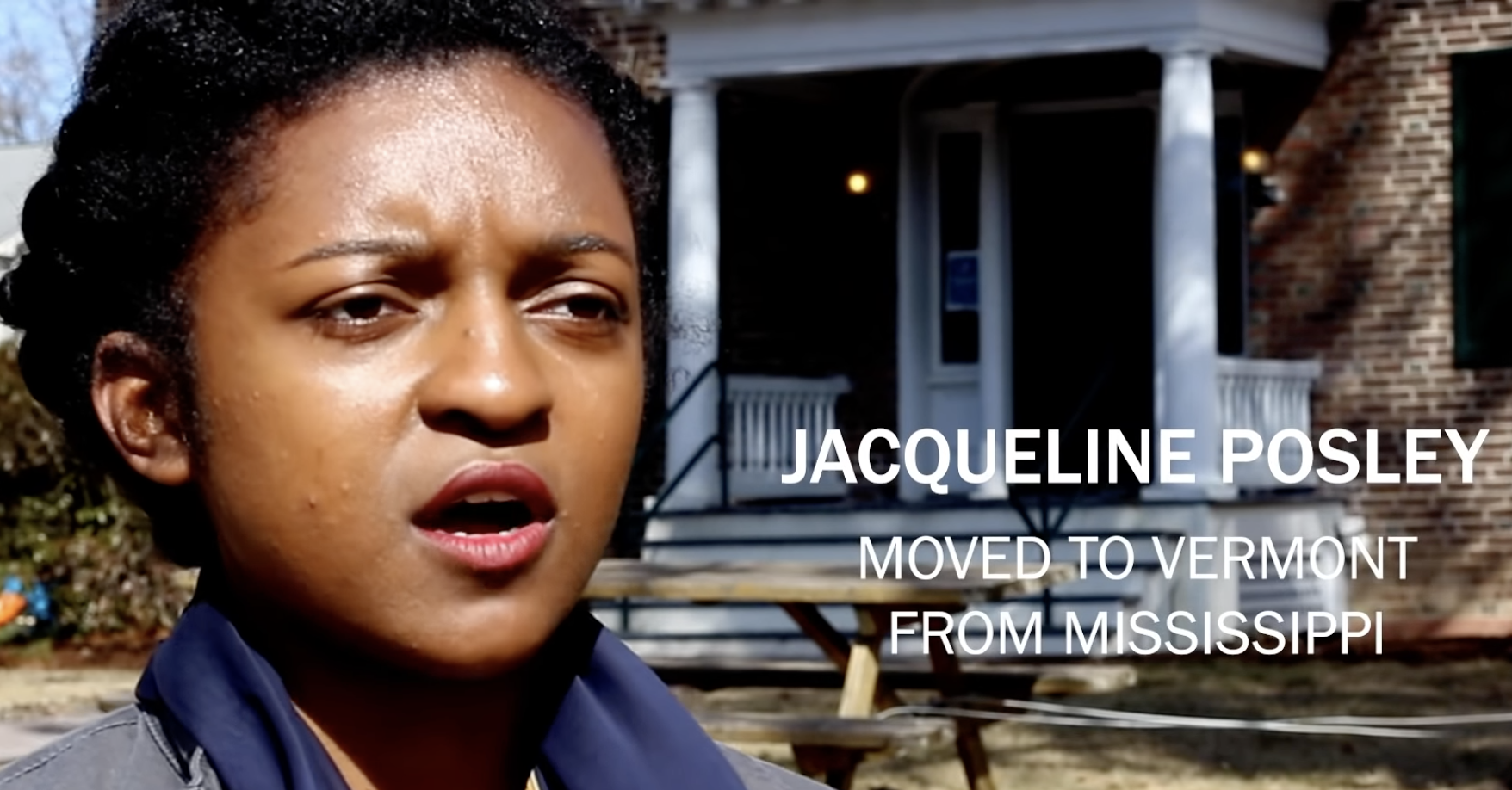
So the person pictured above, Jacq Posley, recently caused a bit of a stir (but honestly, not enough of a stir) with a blistering farewell-to-Vermont letter entitled “My Last Plea As a Black Vermonter,” in which she laid out, in painful detail, all the racism she’s encountered in her five years living in Vermont. Which she found to be no less racist than, uh, Mississippi.
Five years since I left my life in Mississippi thinking NO PLACE could be more racist (tuh). Five years of serving on multiple civic boards that claim they want equity, but build walls in the face of progression. Five years of being called racial slurs with no one to protect me from it and no one to check their white supremacist friends. Five years of confederate flags, don’t tread on me flags, and strategically placed Donald Dump paraphernalia. Five years of watching MANY of my friends and their very young Black children suffer from the same mental anguish I have experienced while existing as a Black person in Vermont. September 16, 2023 should be a time for celebration. Instead, it is a time for reflection as I leave the state to pursue equity work in a place that actually wants it.
She’s right, of course, and we’ll get to that. But first, a note of bitter irony. Posley was one of those attracted to Vermont by Gov. Phil Scott’s much-touted “Stay to Stay” program in which vacationers were connected with potential employers and other resources. The governor is great at this sort of thing: Catchy ideas that ultimately have little to no real impact, but provide some feel-good headlines. See also: the late unlamented remote worker grant program. (“Stay to Stay” now seems to be a shell of its former self. It still has a website, but the content is simply a list of links to available resources. No sign of the special weekends that used to attract such positive press.)
In fact, Posley is the focus of a brief promotional video for “Stay to Stay,” still viewable on YouTube. “No matter which side of the spectrum you land on, you’re welcome in Vermont,” she said in the video. “You’re allowed to be who you are.”
Yeah, that didn’t age well.
Posley’s letter is chock full of anger and frustration, the end product of slamming her head against a wall of ignorance for five years. Vermont-style racism isn’t as overt as Mississippi’s, but she has found it to be no less harmful. And a big part of the problem is Vermonters’ persistent denial that we have a problem and need to do something about it.
The denial is deep and strong in spite of the fact that just about any Black Vermonter (or, like Posley, ex-Vermonter) could tell you stories of, in Posley’s words, “micro-aggression and denial,” “death by 1000 pin pricks.” It might be possible to dismiss one or two accounts, but we’re way beyond that point now.
Let’s cite a few examples. Former state representative Kiah Morris left office because of racist attacks and a complete lack of support from the “justice” system, from the Bennington police all the way up to then-attorney general TJ Donovan. Tabitha Moore felt compelled to move after facing incredible backlash for her activism. Alicia Barrow resigned from the Hartford Selectboard over “blatant bigotry” and, wait for it, a complete lack of support from local police. In this context, it seems more than a bit ironic that we’re getting set to honor Louvenia Dorsey Bright, the first Black woman to be elected to the Vermont House. Because while we’re fine with a now-dead pioneer, we still seem to have trouble enabling people of color to hold elective office.
Then there are all the stories of questionable conduct by Our Men In Blue, from state troopers who crafted overtly racist lyrics in a stupid online “rap battle” game and only got in trouble after the thing became public, to the police chief who continued to defend a blatantly racist traffic stop after it resulted in a drug conviction being vacated by the state Supreme Court, to the “out of control” small-town police chief who failed to keep demographic data on traffic stops, a story that had me wondering how many other chiefs are pursuing similar policies.
Quite a few, to judge by the perennially depressing University of Vermont studies on racial disparities in traffic stops in the state.
Speaking of studies, how about the one showing extremely high incarceration rates for people of color? Or the one showing abysmally low home-ownership rates for Vermonters of color? Or the one showing massive economic disparities for people of color in Chittenden County, which is by far our most diverse?
I could go on, and on, and embarrassingly on, but really, the only thing you need to know is that Vermont has never, ever been a haven of diversity. It has always been overwhelmingly white. Well, it has been since we genocided the Native Americans anyway.
That doesn’t happen by accident. And it’s not that people of color never come here. It’s that they don’t stay here. In the early decades of statehood, we were home to a number of small Black communities. Over time they disappeared. We were a bastion of anti-slavery, but somehow we never made Black folk feel welcome enough that they moved or stayed here in significant numbers. And let’s not even mention eugenics.
History has a deep and ongoing impact. Like the Scandinavian countries who could style themselves models of civility until they became home to significant minority populations, our lack of diversity has insulated us from ever having to openly acknowledge the racist strain in our character. It’s given us plausible deniability. Except when someone like Jacq Posley refuses to go quietly, as have so many other people of color who tried to make Vermont their home before moving on.
“Though Mississippi is stuck in the Jim Crow era, Vermont is bound by colonial-era expectations of race relations,” Posley wrote. She’s right. Our history informs and defines our present circumstances. Our strain of racism is not Mississippi’s. It’s less overt and more polite. But it is no less toxic for the people of color who aspire to become Vermonters in every sense of the word.
 The Vermont Political Observer.
John,
Thank you for calling attention to this situation.
We just published an interesting column that addresses the state’s latest “post-flooding” tourism campaign that only shows white faces in it. Phayvanh Luekhamhan hits the nail on the head. It is a question to ask: Is the state actively promoting whiteness, including not addressing the racism among us?
This is a sad story, yet one that is so true and that we have to hear over and over again. I work on the front lines of Vermont’s tourist business and, in that capacity, have had to personally break up three incidents racism, Vermont style. Every one of them was caused by a Vermonter.
Vermonters need to peel this moldy onion for themselves, but here is a little context.
The following link is to Dorothy Canfield Fisher’s, Vermont Summer Homes – the original Vermont Stay to Stay program which arose out of the Eugenics Survey of Vermont and the Vermont Commission on Country Life – Tradition’s and Ideals Committee which focused on increasing the number of tourist and 2nd homeowners in Vermont so as to encourage the influx of “better breeding”:
“… those men and women teaching in schools, colleges and universities; those who are doctors, lawyers, musicians, writers, artists—in a word those who earn their living by a professionally trained use of their brains.”
Vermont, to this very day, exists as it does because of its 200plus year eugenics mindset. Vermont is still dealing with the exact same problems that it was dealing with during its rampant eugenics era, circa 1931 and its state sanctioned and sponsored eugenical sterilization law in which Vermont sterilized thousands (not hundreds as Dr. Gallagher would have you believe) of its most marginalized and vulnerable state and privately institutionalized citizens, peaking in 1966.
The sterilization law was promoted by another committee of the ESV / VCCL, one of only 3 paid committees out of the 16 Committees of the Commission on Country Life, the Committee on the Handicapped, chaired by William Mayo.
UVM Zoology Professor, Henry Perkins, UVM President Guy Bailey, and Governor John Weeks together charged the ‘Feebleminded’ Committee with ensuring the enactment of eugenical sterilization law via Vermont legislation and legislators, who voted on it unanimously. Chairman Mayo’s committee was successful to that end in 1931 — two years before Herr Schicklegruber enacted a similar law in Nazi Germany.
People like Jacqueline Posley and Alicia Barrow are exactly the kind of citizens that Vermont needs more of in the state. Instead of Vermonters harassing and threatening them and their children, they might consider treating them with respect and common human decency and as strong, independent, caring, compassionate individuals who are willing to stand up for what they believe in and for a state that they once believed in.
So, STOP F&$KING CHASING THEM AWAY!
Nothing ever really changes in Vermont, does it? The only difference is, now we pretend. We are what we do in this world, not what we say we do.
https://www.docdroid.net/EKdbttU/vermont-summer-homes-pdf
Though a phone call to discuss this would have been appreciated prior to mentioning my name, I respect your craft and appreciate you shining a light on the struggles that we face as Black Vermonters. Peace and love far and wide. — Jacq
Ps: I’m neither angry nor frustrated. Just passionate and hopeful. 💜