In allowing a universal school meals bill to become law without his signature, Gov. Phil Scott adopted an interesting philosophical position. Take it away, VTDigger:
He noted that the program will fund free meals for even wealthy students.
“That’s not progressive education funding policy, it’s regressive policy that hurts the very families we are trying to help,” he said.
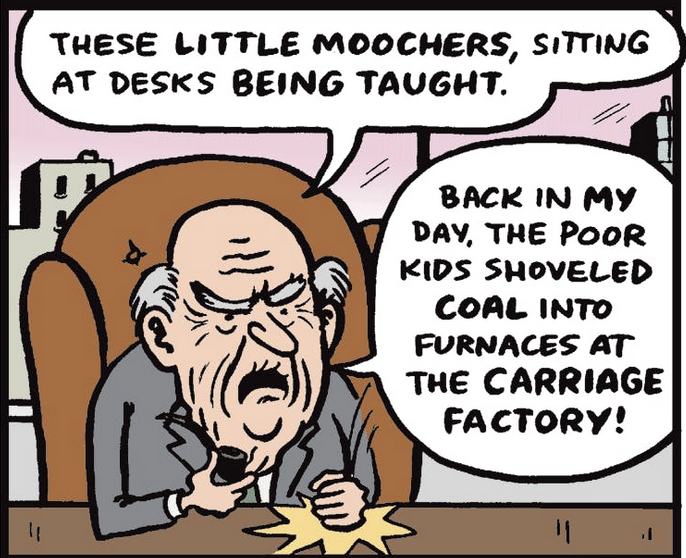
Oh yes, heaven forbid that an undeserving child should receive a free lunch. That would be an abuse of the public purse and — follow closely here, things get a little thick — a punishment on the kids who really need a handout.
As the kids used to say, “lolwut?”
This is another case where the governor can’t say the quiet part out loud — that he doesn’t want to provide free school meals despite their proven benefits — but he still has to register his disapproval, so he comes up with transparently phony arguments like “free lunches hurt poor kids” and “a veto fight would distract me from my neverending fight for better schools.” As if we can’t walk and chew gum at the same time.
I wouldn’t mind if he were in the least bit consistent in this position. But he’s not. In fact, this is the only issue where he argues that a non-means-tested government benefit is a bad thing.
I don’t know exactly what changed their minds, but after months of insisting the motel voucher program was going to end on schedule come Hell or high water, leaders of the House and Senate are working on a deal to extend the program.
My reactions are all over the place. Wow. Finally. Thank goodness. What took you so long?
And… let’s not get carried away until we see the fine print.
Here’s what we know, courtesy of VTDigger’s Lola Duffort. The extension would apply to roughly 2,000 people scheduled to be unhoused in July. It’s an indefinite stay, meant to allow people to stay in motels until state officials can identify “alternate stable setting[s].” There will be a mandate for the Scott administration to regularly update lawmakers, which is embarrassing for Team Scott but utterly necessary due to its complete failure to plan any sort of transition before now.
And it will not apply to anyone unhoused on June 1. So, not only are those people SOL, it also means there will be another mass eviction on Thursday Friday. You may recall that hundreds of June 1 evictees were offered free two-week extensions by some motel owners. Those extensions expire tomorrow Friday. No reprieves on offer for those folks.
I don’t know why leadership is so firm on excluding the June 1 and June 16 unhoused, who number approximately 800. I guess that’s an acceptable level of human suffering.
The city of Rutland is home to a number of, shall we say, budget accommodations. That’s why Rutland has more motel voucher clients than any other Vermont community… and why it has a big problem on its hands with the end of the voucher program.
According to state data cited by VTDigger, nearly 500 households in the voucher program were located in Rutland. Roughly 200 were evicted on June 1; the remainder will be on the streets as of July 1 or July 29. It’s not too great a surprise, then, that part of the city’s plan for dealing with the outflux is to encourage the newly unhoused to leave town. This is part three of the city’s four-part plan for the June 1 cohort, but the same ideas will be in place for future evictees:
Yep, the answer is to ship ’em out of town. This is nothing new; communities across the country have actively sought to export their unhoused. And I understand Rutland’s position; the state took advantage of its cheap lodging supply and isn’t offering any help in dealing with the consequences. But still. This is not going to help people, it’s just going to shuffle them around.
In situations of dire emergency, triage helps guide the use of available resources. When there are no other options, it’s a logical way for those resources to have maximum impact. A battlefield, a weather incident, a disaster of any sort.
But when resources are available or the situation is predictable, triage is not appropriate. And that’s the situation we’ve got with The Great Unhousing. Vermont doesn’t have to end the motel voucher program and throw thousands of people out on the street. We don’t have to create the worst homelessness crisis in living memory.
And yet our official policy, both executive and legislative, is to ignore easily affordable and comprehensive solutions in favor of triaging the unhoused — providing shelter for those with extreme risk factors and leaving the rest to go hang.
In this situation, triage is not only unnecessary. It’s inhumane.
Note: Several hours after this post went live, I got a complaint from someone in Mayor Weinberger’s office that I had mischaracterized his proposal. After multiple text exchanges, I got some additional clarity on his plan. I’ve tried to accurately reflect it with notations to the original post. Newly added text is in bold type.
However, the thrust of the piece is unchanged. Weinberger’s plan would provide for the most at-risk of the unhoused, but not nearly for all of them. Also, it must be said that while Weinberger’s plan would mitigate the worst effects of The Great Unhousing in Chittenden County, I’ve never heard him lobbying for a broader solution. He has not called on the governor or Legislature to restore the voucher program while alternative housing can be brought online. He is one more political leader who’s trying to limit the damage rather than address the whole problem.
Burlington Mayor Miro Weinberger has come out with a plan to deal with most of Chittenden County’s share of The Great Unhousing. His proposal is to create a 50-bed shelter and a day shelter with space for 75 in an empty state office building, and extend motel voucher eligibility for 318 people due to be evicted at the end of July until alternative housing can be found for them.165 households with significant risk factors including families with minor children, adults with disabilities receiving home health and/or hospice services, seniors (60 years+), and pregnant households.
Left off his list: Anyone already evicted on June 1 (almost 200 people in Chittenden County) or about to be evicted on the first of July.
This would include some households that were evicted on June 1 and others due to lose their motel accommodations on July 1 or July 28. But it would far from cover all of those being evicted; the total in Chittenden County, according to Weinberger’s proposal, is 354 households encompassing 512 individuals.
Even so, the estimated price tag for the office building conversion and the extended motel stays is somewhere around $4 million, per VTDigger. The source for that money, if state officials accept Weinberger’s plan? The $12.5 million allocated by the Legislature to make the end of the voucher program slightly less catastrophic.
Perhaps you can see the problem here. If the state says yes, it will have committed one-third of the statewide total for Burlington alone. For a partial solution to Chittenden County’s share of The Great Unhousing.
And according to VTDigger, Weinberger’s is one of 44 proposals submitted to the state on June 1 alone — the first day the state was accepting proposals.
The 2023 Vermont Point-in-Time Report of Those Experiencing Homelessness is out, and it shows an explosion in homelessness over the last four years, including an 18.5% increase from last year — and a 36% hike from 2022 in unhoused families with children.
The latter figure is bitterly ironic considering the Democratic Legislature’s laser focus on helping children this session. Too bad that while they were funding child care programs and universal school meals, they couldn’t be bothered to keep roofs over unhoused children’s heads. (They could still reverse course during the upcoming veto session, which would be nice.)
The PIT Report also makes the Scott administration look even worse, which is quite the accomplishment. The numbers make clear that homelessness was exploding even as Scott was bound and determined to kill the motel voucher program that provides shelter for 80% of Vermont’s unhoused. Well, it did until last week, when the state evicted some 700 voucher clients.
The numbers also shine an unforgiving light on the administration’s failure to make any transition plan whatsoever for ending the voucher program humanely. They had to know this was happening, and yet they did nothing. It was “a crisis outrunning the state’s response,” in the words of Dartmouth College policy fellow Anne Sosin, who spent the 2023 legislative session desperately trying to get state officials and lawmakers to acknowledge the obvious.
The continuing rise in homelessness also belies Scott’s argument that the program was a response to Covid-19 and now that the pandemic is “over,” the program has to end. Problem is, even as the pandemic was waning, homelessness kept on rising dramatically. The real problem was a massive imbalance in real estate markets. There was never a policy adjustment to that change in reality.
It went unnoticed at the time because our media was dominated by stories of the newly-unhoused being evicted from state-paid motel rooms, but last Thursday Gov. Phil Scott announced what he called “continued progress” toward his voluntary paid family leave program.
You remember that, don’t you? It’s the plan he and New Hampshire Gov. Chris Sununu came up with in 2019 as an alternative to universal paid leave plans. It was supposed to be a joint effort, but that quickly unraveled. Instead, each governor set out to establish equivalent programs in their respective states.
Phase 1 of Scott’s plan takes effect on July 1, ironically enough on the next scheduled mass eviction event. On that day, Vermont state employees will be enrolled in a paid leave plan that will offer up to six weeks of leave at 60% of an employee’s average weekly wage for new parents or those dealing with urgent family situations. The state workforce will then serve as a base for a voluntary program to be offered to Vermont employers in July of next year.
Sununu’s plan took effect last year for New Hampshire state employees. The second phase was announced last summer with a $1.9 million state-funded “publicity blitz.” December 1, 2022 was the date that private employers could start enrolling.
And although Sununu officials are furiously lipsticking that pig, the program is, in fact, off to an unimpressive start. So unimpressive that it casts serious doubt on the prospects for Scott’s program.
In case you thought the unhousing of Vermonters from a motel shelter program was a new thing, VTDigger comes along with a history lesson that manages to deepen my anger at and understanding of our current situation. It seems that we went through the exact same thing only 10 years ago.
And apparently we didn’t learn a damn thing, because we’re doing it again.
The circumstances were different, but the outcome was the same. Funding for an emergency motel voucher program was cut, and a large cohort was suddenly tossed out on the street. Some were given tents and sleeping bags in lieu of actual shelter.
One big difference between now and then: The Democrats ran the roost. They held the governorship as well as the Legislature, and they still managed to screw our most vulnerable. That sheds some light on the capacity of today’s Democratic leaders to defund the program and accept the consequences. They’ve done it before, so why not now?
Gov. Phil Scott’s reputation as a sound manager of state government took another hit last week — well, it should have taken another hit — with the publication of Auditor Doug Hoffer’s report on the Agency of Digital Services (downloadable here). In short, Hoffer examined six major IT projects and found that only one was completed on time and under budget. He also found that five the six had such “poorly defined measures” that it was difficult to determine success or failure, and that there were “limited efforts or plans” to ensure the new systems met expectations. That’s, um, not good.
The agency was a centerpiece of the then-newly elected governor’s “overall strategy for modernizing state government.” Scott unveiled ADS in mid-January 2017, just days after his inauguration, as a way to unify and streamline what had been a scattered information technology effort. Hoffer’s audit suggests that the agency has fallen far short of Scott’s promise.
It reminds me of Scott’s much-touted commitment to “lean management.” You may not remember that phrase because it’s been years since he uttered those words, but during his first run for governor he said “lean management” just as often as he said “cradle to career,” “affordability,” or “protecting the most vulnerable.” And he promised that in his first year in office, lean management would save one penny for every dollar spent by the state — or about $55 million in total.
Which never materialized, at all, not even close. That’s why you never hear him talking about it anymore.
Renowned nice guy Gov. Phil Scott has made history — again — by vetoing yet another bill. According to the Vermont State Archives, Scott’s veto of the legislative pay raise bill was the 40th of his administration.
Scott is the first Vermont governor to reach 40, just as he was the first to reach 35, and 30, and 25, and 22. The previous record holder was Howard Dean, who vetoed 21 bills in his 12 years in office. Scott has nearly doubled that total in only seven legislative sessions. And he might rack up another one or two before the books close on the 2023 Legislature.
The State Archives list 184 veto messages by Vermont governors. The first one happened in 1839, when Gov. S.H. Jenison vetoed a bill to establish the Memphremagog Literary and Theological Seminary. Phil Scott is now responsible for 21.7% of all the vetoes in state history. He’s only occupied the office for 2.9% of the time that Vermont has had a governor.
The Scott apologists in the audience may be thinking “Well, of course he’s vetoed a lot of bills. He’s a Republican facing a Democratic Legislature.” Sure, but (a) he’s supposedly a moderate and (b) he’s an extreme outlier by any standard. Jim Douglas had a very contentious relationship with the Legislature, and yet he vetoed only 19 bills in his four full terms in office. He averaged less than two and a half vetoes per year. Scott is averaging almost eight.








 The Vermont Political Observer.