Monthly Archives: February 2015

Maybe now Kevin Jones can find himself a new hobby

Yesterday, the Federal Trade Commission gave a light wrist-slap to Green Mountain Power, telling GMP to “be more clear” in how it advertises renewable electricity while closing the books on a complaint of deceptive marketing.

The allegation had come from the usually reliable folks at the Vermont Law School, and in particular the unreliable Kevin Jones, who’s had a bee in his bonnet for years about Vermont’s SPEED program, which allows utilities to sell renewable energy credits out of state. Jones’ complaint is that selling RECs is basically a shell game, allowing Vermont utilities AND the out-of-state REC buyers to both claim they’re producing “green energy.”

Technically true, but with a couple of giant caveats.

SPEED was designed to encourage development of renewables at a time when they were not financially competitive. Vermont utilities could build renewables and recoup some of their costs through the sale of RECs, thus cushioning the blow to ratepayers. And it was designed from the beginning to be a temporary program; it will expire in 2017, and the legislature is crafting its replacement this year. SPEED is going away on schedule, having achieved its mission.

Jones also ignores the fact that, whether or not RECs were sold, their sale allowed us to adopt renewables more quickly than we could have otherwise. Real power was generated, and it reduced the overall need for fossil fuels.

The complaint also seems to rely on a misperception of electricity generation and consumption. Power enters the grid from all kinds of sources, is distributed through the grid, and consumed — all in real time. Unless you live off the grid, there’s no telling where your electricity comes from at any given moment. GMP can promote its commitment to renewables, but it cannot promise you that your power comes from the solar farm down the road, a hydroelectric dam in northern Quebec, a fossil fuel-burning plant in Massachusetts, or the big nukes at Seabrook. That’s true with our without SPEED.

I wrote about this a couple months ago and you can read more there, so I won’t belabor the point here. Suffice it to say I’m glad to see the FTC close this case. And once the legislature passes the next iteration of power regulation, I wish Mr. Jones luck in finding a new binky.


The Phil Scott Policy Engine gets off to a slow start

In a little-noticed press release, Phil Scott’s Economy Pitch project announced three bills “aimed at growing the state’s economy.”

Little-noticed because of the odd and counterproductive timing: the release was issued on Friday afternoon, the traditional dumping ground for bad news you hope will go uncovered. Well, this one surely went uncovered.

But also little-noticed because the three bills are completely underwhelming in scope. Even if they all sailed through the Legislature, they’d have a negligible effect on the course of Vermont’s economy.

One could charitably assume that the Scott Gang is tactically aiming low: introduce some small incremental ideas first, and get to the real meat later on. After all, the Economy Pitch series is still ongoing: there was a meeting last night in Rutland, and another is coming up next week somewhere in Franklin County. (Location TBA.”) More ideas could emerge. But if that’s the case, don’t oversell.

On the other hand, one could less charitably conclude that this whole project is nothing but classic Phil Scott centrist incrementalism, and that a cattle call for business owners is unlikely to produce anything terribly visionary.

The three bills, and try not to laugh:

— H. 80 would declare a state sales tax holiday on August 29 and 30. Oh, Lord, this again? A sales tax holiday is like a waffles-and-Coke breakfast: a short-term burst followed by an equivalent decline. Sales tax holidays do nothing to grow an economy. All they do is concentrate consumer purchasing into a couple of days.

Well, business purchasing as well. Indeed, I suspect that businesses are best poised to take advantage of a sales tax holiday; they can easily schedule their purchases to take advantage.

— H. 83 would establish a brand marketing effort under the rubric “Vermont: Innovative By Nature.” This would be a combined effort aimed at both economic development and tourism, which is kind of a misfit. How does “Innovative By Nature” appeal to potential tourists?

Beyond that, the bigger problem is the inherent limitation of marketing. You can’t put lipstick on a pig and call it a supermodel. It’s fine and dandy to tout Vermont’s advantages, and we do have quite a few; but a marketing campaign in and of itself will have, at best, a limited long-term effect. It’s far better to address the underlying problems. But that’d cost real money. A marketing campaign is cheap by comparison.

Still, it’s a strange approach for a guy who sympathizes with the struggles and complaints of Vermont’s business community. A marketing campaign does nothing to improve Vermont’s business climate, and I’d think the business community would realize that immediately.

— H. 146 would exempt “software as a service from Vermont’s sales tax.” The so-called Cloud Tax is said to create “an image that Vermont is not a business-friendly place for the technology sector.” Hey, wait — didn’t I read somewhere that Vermont is Innovative By Nature, an excellent place for a high-tech startup?

Mixed messages, people.

Repealing the software tax may or may not be a good idea, but it shouldn’t be done for the alleged, and amorphous, benefit of enhancing Vermont’s “image.” This is a big step with growing ramifications. It should be considered as part of a thorough re-examination of the sales tax in light of changing technology, not as a short-term move to enhance our “image.” (Of course, the urgency behind this move has nothing to do with growing Vermont jobs; it’s all about  Amazon.com’s attempt to bully us into surrendering more of our taxing authority.)

Software used to be a commodity, a tangible item subject to sales tax. Now, increasingly, it’s cloud-based. Should it be taxed? Maybe yes, maybe no. But if we exempt it, we’re closing off a large and growing source of revenue. Is that what we want to do?

Similar questions abound. Vermont already loses an unquantifiable, but significant, amount of revenue thanks to Internet retail. Now, more and more “products” are intangible in the same way as cloud-based software: e-books, audio content, subscription access to news content. Are you actually “buying” anything when the products are intangible and/or access is limited in scope or duration?

Our tax code contains many references to “downloads.” That term is almost an anachronism, and its application to cloud-based content is questionable. Example: At a recent hearing of the House Ways and Means Committee, no one knew whether digital “newspaper subscriptions” were subject to sales tax, or whether newspapers are collecting and paying the tax. I’m sure someone knows, but nobody in that room did, and they’re the ones pondering changes to the tax code.

Enough of that. Color me underwhelmed with the initial product of the Economy Pitch. If there were any creative, original, or far-reaching ideas broached at the first session, they didn’t make it into proposed legislation. We can hope for better things from future pitch sessions.

Talk about a waste of money…

Governor Shumlin appears to have his knickers in a knot over Vermont Information Technology Leaders’ decision to buy ad time during the Super Bowl.

Bear in mind we’re not talking about a Budweiser-level national buy; VITL bought one spot on channel 5 at a cost of $13,000. A waste of money? Arguably, perhaps; but VITL is trying to raise its public profile, and that 13K was part of a $195,000 marketing campaign.

Shumlin told the Vermont Press Bureau’s Neal Goswami that he was “disappointed” by VITL’s move. Well, he put it more grandly: “Many Vermonters joined me in being disappointed that state and federal funds were being used for an advertising buy during the Super Bowl.”

Yeah, “many Vermonters.” Why, just the other day I heard the folks at Coffee Corner’s front table griping about that waste of $13,000.

Not.

And then Shumlin got to the real meat of his objection.

“This should highlight the need for the Green Mountain Care Board to regulate VITL’s expenditures,” Shumlin said Sunday.

Aha, the penny drops. VITL is currently an independent nonprofit organization that “helps health care providers adopt and use IT systems.” Shumlin wants GMCB to have authority over VITL spending. And now he’s publicly scolding VITL for its horrifically wasteful use of… ahem… $13,000.

Smells like a power play to me.

Now, I’d love to have an extra 13 large. It’s nothing to sniff at. But as part of a sizable organization’s marketing campaign? Certainly not worth the Governor’s attention. Let’s say, hypothetically, that GMCB already had the authority. Would it be micromanaging VITL’s budget to that extent? I don’t think so.

Besides, if you want to talk about wasting money, let’s look at the taxpayers’ $2.5 million donation to GlobalFoundries, as ordered by our provident Governor.

GlobalFoundries, you may recall, “bought” IBM’s computer chip operations, including the facility in Essex Junction, for a whopping negative $1.5 billion. Last month, Shumlin announced he intends to hand over $2.5 million in state incentives to GlobalFoundries. That’ll clean out the Vermont Enterprise Fund, which was created last year at Shumlin’s behest. It’s supposed to help encourage large employers to remain or relocate in Vermont, and spending it is a gubernatorial prerogative.

As VTDigger’s Carolyn Shapiro reported, it’s unclear “how the money will be used and what conditions, if any, GlobalFoundries will have to meet.”

If any. Snort.

The Governor said the money “will help the state build a relationship” with its new corporate occupant.

Think of it as a $2.5 million corsage for a prom date.

Because when you’re talking about a giant corporation that does business in billions, $2.5 million is nothing but a gesture. Will it do anything to keep GlobalFoundries in Vermont or get them to expand? No. Corporate decisions will be made with global concerns in mind. On that scale, $2.5 million is a rounding error.

The Governor might as well have taken that money, in bags of small bills, to GlobalFoundries’ front gate and set fire to it, in hopes that the sweet, sweet smoke would appease the corporate gods.

The fundamental problem is, Vermont can’t move the numbers significantly enough to affect decisions at that level. We will always be at the mercy of large employers, and we’ll be playing with a short stack against bigger states (and countries) that can offer much bigger incentives. We’d be better off taking that $2.5 million and investing it in something that might actually make a difference — say, in a revolving loan fund for startup businesses.

Or here’s an idea: A revolving loan fund for students pursuing two-year degrees in technology fields. Why, just the other day one of IBM’s top executives said that GlobalFoundries “is struggling to fill positions because they can’t find enough workers with a two-year technical degree.”

You want to keep them in Vermont and simultaneously grow opportunities for Vermonters? Access to education is much more relevant to GlobalFoundries than a burnt offering at their front gate.

Just spitballing. My point is that there have got to be better, more effective, business-friendly ways to spend that $2.5 million. And that’s a lot bigger waste than VITL’s $13,000 Super Bowl ad.

The drift

The legislature is about a quarter of the way through its four-month session, and Governor Shumlin’s proposals are falling like tin ducks in a shooting gallery. Lake Champlain tax plan? Dead. Education plan? “A place to start the conversation.” Payroll tax to close the Medicaid gap? Flatlining.

Not that this is terribly surprising; the governor exited the 2014 election with significantly diminished political capital. So much so that when Shumlin unveiled his proposals last month, the question wasn’t so much whether they would pass or not, as whether he meant them seriously in the first place or knew from the start that they were doomed.

(Evidence for the latter: an education plan that did nothing to provide near-term property tax relief. That, at least, was a non-starter.)

Not sure what else he could have done after his near-defeat. He could have taken the George W. Bush approach, pressing on regardless of his mandate-free victory, but that’s not who he is. Shumlin likes to talk bold and act incrementally.

Now he’s added deference to incrementalism, and it’s up to the Legislature to generate some vision. The consensus-seeking, conflict-avoidant Legislature. I’m not holding my breath.

I do expect our lawmakers to do some good work; I just don’t expect them to produce anything truly impactful. And we face a bunch of issues that call for some strong, progressive action.

Take, for example, the House Fish, Wildlife and Water Resources Committee, chaired by one of the good people of the Statehouse, David Deen. The committee has already ditched Shumlin’s proposed tax hikes to help pay for Lake Champlain cleanup. The fertilizer fee’s down the tubes because the farmers didn’t like it; the fee for stormwater runoff from developed sites is as good as dead because it would be “difficult to implement.”

Instead, Deen’s panel is looking at a smorgasbord of tax and fee hikes — more numerous than Shumlin’s plan, and less directly tied to the sources of Champlain pollution. The governor’s plan was simpler and made more sense. The committee’s approach will open the door to Republican charges that the Dems are just raising taxes wherever they can. Deen is considering at least four separate tax or fee increases instead of Shumlin’s two.

More important than the specifics of the Champlain plan, though, is the strong signal it sends: Lawmakers — even those who are solid on policy — are loath to take risks. Or, as Deen himself put it:

“There are some very strong voices in the hall opposed to it. And we are reacting to political reality around here,” the Westminster Democrat said Friday.

This session is looking like a big fat lost opportunity given that this is an off-year, and new programs or reforms would have a year and a half to take root before lawmakers have to run for re-election. Ya think next year’s gonna be any better?

This is a typical duck-and-cover reaction, but it plays right into the Republicans’ hands. Let’s say Phil Scott runs for Governor, as everybody believes he’s going to do. He’s strongly positioned as a centrist willing to consider all ideas. And he’s a nice guy to boot.

If voters have a choice between the Democrats’ fear-based centrist incrementalism with a bias toward inaction and Phil Scott’s natural centrist incrementalism with a bias toward inaction, which one do you think they’re going to choose?

I hope I’m wrong about this. It’s still early in the session, and there’s more than enough time to come up with at least one piece of solid small-p progressivism. But I’m not holding my breath.

Ethics, shmethics

Riddle me this, Batman: How is a political blogpost like a roadkill skunk?

The apparent answer: At first their stench makes them unfit for polite company, but after three weeks or so the smell goes away.

See, way; back on January 19, I wrote a piece about a bill before the legislature to establish a Latin motto for Vermont. Over time, the story went viral; it appeared on the Huffington Post, the Daily Kos, Reddit, Fark, and Gawker. It was shared on Facebook more than 10,000 times, and I literally got over 100,000 pageviews out of it.

But nobody else in Vermont media picked up on the story.

That is, until now. The Associated Press’ Dave Gram wrote a piece about it. The Burlington Free Press posted it on their paywalled website; here’s a link to the story on a non-paywalled site.

Nice of Dave to finally notice the story. Don’t know why it took three weeks.

Not so nice: he didn’t credit the Vermont Political Observer as the original source. Maybe the story’s blogorrific stench has dissipated, but the smell still permeates the dread name “theVPO.”

Gawker, that irresponsible gossipmonger, credited me; the local media, I guess, chooses not to.

Now I realize that (a) this is a trivial story, a sidebar to our coverage of politics and policy, and (b) nobody outside of the room I’m sitting in cares whether I get fair credit. But I do. And the giving and receiving of credit is always a lively topic whenever journalists gather; my salaried colleagues are quick to complain when they are slighted by another media outlet.

So here’s my complaint. For the vast majority of you who don’t care, my apologies and I promise something more relevant next time. Just needed to get that off my chest.

RNC leader thinks better of Israel trip

Hmm. Apparently Reince Priebus, the chair of the Republican National Committee, ducked out of that big trip to Israel arranged by the hateful bigoted folks at the American Family Association.

Priebus was one of the many top Republicans, including Vermont’s own Susie Hudson, who were booked on a nine-day trip to Israel paid for, and guided by, officials of the American Family Association and its subsidiary, the American Renewal Project. The voyagers left last weekend, but Priebus was spotted this week in Washington, D.C. after a meeting with Senate Republicans. Talking Points Memo:

His appearance in Washington came as something of a surprise after the founder of the American Renewal Project, David Lane, told the Israeli newspaper Haaretz last week that he would be taking Priebus, Priebus’ wife and about 60 other committee members to the Holy Land.

The trip was scheduled in November, but became a source of controversy last week after the Israeli media outlet Haaretz spilled the inconvenient beans about the AFA’s extreme Christianist positions.

You know, it’s funny how the Republican Party doesn’t mind offending Americans with its close ties to a hate group, but it’s afraid to offend Israelis. Yeah, funny.

I guess Priebus decided that discretion was the better part of valor, and quietly canceled. Hudson and the others made the trip, and are currently getting their heads filled with AFA dogma about Middle Eastern politics. Perhaps when Hudson comes back on Sunday, someone from the Vermont media will ask her what she learned, and about the appropriateness of the Republican National Committee accepting the lavish hospitality of the American Family Association.

Let’s hope so. To date, Seven Days’ Paul Heintz is the only reporter to pursue this story. How about it, VTDigger, Burlington Free Press, Vermont Press Bureau, Associated Press, VPR, WCAX, and WPTZ? The Vermont Republican Party actively distances itself from the more extreme provinces of national conservatism; how do its leaders explain one of their own, who holds a top position with the national party, taking an expensive AFA junket and absorbing its poisonous worldview?

Elections: If it’s broke, don’t fix it

Our Esteemed Leaders seem to be in the process of backpedaling away from a reform measure on the grounds that the problem hasn’t caused widespread mayhem just yet. In this case, it’s our antiquated way of deciding a gubernatorial election when no single candidate wins a majority. The problem slithered out of the dank recesses of Vermont history when Governor Shumlin barely eked out a plurality win over Scott Milne, and Milne refused to concede. Technically, we didn’t have a governor-elect until a couple hours before his inauguration.

Reminds me of my previous post about vaccines. Well, it’s a common theme in the Legislature. I call it Grandfather’s Lightbulb Syndrome, after the classic joke:

“How many Vermonters does it take to change a light bulb?”

“Change it? That was my grandfather’s light bulb!”

To which I would add, “And nobody’s fallen down the staircase yet!”

Several possible changes to our system have been proposed; all are simple, and any one would prevent future occurrences of a losing candidate fighting on or, worst case, a losing candidate actually winning election in the Legislature. Hey, it’s happened before.

So what will lawmakers do about it?  Sad to say, my money’s on Jack Diddly Squat. Because on issue after issue, they respond to potential problems by saying, “Why lock the barn door? We haven’t lost any horses yet.”

Think I’m too cynical? Take a look at this.

The chair of the Senate Committee on Government Operations said Wednesday she’s not so sure Vermont should amend its constitution to limit the legislature’s role in selecting statewide officeholders.

“We are more seriously looking at whether we need to have a change,” Sen. Jeanette White (D-Windham) said.

Well, Senator, what exactly would convince you that we need to have a change? An actual Constitutional crisis instead of a near-miss?

That’s bad enough, but there’s also this:

After the hearing, White said she remained “confused” about her own position.

“Part of me says it’s fine just the way it is,” she said. “It seems to work. People are elected.”

White’s committee has now held three hearings on the issue. And she’s “confused”? Jeezus H. Christ.

Don’t blame me, Senator, when your horse gets stolen or someone falls down the staircase.

Action needed on vaccines, and we’re not going to get it

As the Great Disneyland Measles Outbreak continues to reverberate, attention is rightly turning to Vermont’s permissive rules on opting out of childhood vaccinations. The state allows parents to claim religious, medical, or philosophical grounds for refusing vaccinations; the vast majority of exemptions, according to the state Health Department, are in the undefined “philosophical” category.

Vaxxer responseMost of these are not philosophical at all; they are the result of anti-vaccine propaganda fomented by the likes of Jenny McCarthy and a disgraced former doctor. Their numbers in Vermont are growing, and getting close to the point where “herd immunity” will no longer be effective, and long-banished disease can make a comeback.

This is exactly the problem that caused the Disneyland outbreak, and it’s only a matter of time before it happens here. One brave lawmaker has stepped up to the plate; Sen. Kevin Mullin has proposed a bill to eliminate the philosophical exemption. He also did so in 2012; the Senate passed the bill, but the House backed away like a frightened child when the anti-vaxxers stormed their gilded corridors.

There seems to be little appetite for a repeat of that debate, in spite of the growing risk. Governor Shumlin, who strongly endorses vaccination, wants no part of another exemption debate, according to spokesman Scott Coriell:

The Governor believes that every child in Vermont should be vaccinated against deadly diseases, not only to protect them but also to protect others. …When it comes to the question of forcing those parents who refuse to follow common sense to do so, the legislature had that debate in 2012 and a bipartisan majority in the legislature passed a bill that requires enhanced education for parents and reporting on vaccination rates.

…While the Governor believes there is no excuse to forgo vaccinations, he thinks we need to be extremely careful about passing laws that put the state in the position of making decisions for children without parental consent.

That sounds almost exactly like the statement that just got New Jersey Gov. Chris Christie in hot water:

“All I can say is we vaccinated ours,” Christie said, while touring a biomedical research facility in Cambridge, England, which makes vaccines.

The New Jersey governor added that “parents need to have some measure of choice in things as well, so that’s the balance that the government has to decide.”

You tell me the difference between Shumlin and Christie. There isn’t any.

And hey, here’s a little tidbit that might make some of our leaders think twice about their timidity: they’re making a daily commute right into the heart of a potential measles vector. According to the latest Health Department figures, kindergartners at Montpelier’s Union Elementary School have a Measles, Mumps and Rubella vaccination rate of only 88.7%. The standard for “herd immunity” is 90%.

The Governor and his fellow anti-vaxx coddlers might want to consider wearing facemasks to Montpelier, especially those with some kind of suppressed immunity.

Now, the anti-vaxxers are framing this the same way Shumlin is: as a matter of parental choice.

Problem: this is a matter of choice the same way smoking in enclosed spaces or wearing your seat belt is a matter of choice. On some issues, the public interest trumps individual rights. When parents opt out of vaccination, they are depending on the rest of us to supply their kids with herd immunity. They also pose a direct health threat to children who cannot be vaccinated for medical reasons, and to anyone with a suppressed immune system.

Vermont is trending in the wrong direction on vaccinations. We are needlessly endangering some of our more vulnerable residents and the general public health. But I guess it will take an actual outbreak before our lawmakers put on their grown-up pants and do the right thing.

Well, at least the Free Press dumped its political reporters BEFORE the list came out

A big oopsie from the Montana province of the great Gannett Empire.

On Jan. 28, the Washington Post’s Chris Cillizza released a (deeply flawed and incomplete) list of the “best political reporters” in each of the 50 states. One of the four Big Sky nominees was John Adams of Gannett’s Great Falls Tribune.

Unfortunately for the Trib, only two days after the list came out, Adams declined to go through the mandatory re-interviewing process for all Gannett journalists. He balked because his position — capital bureau chief — was being eliminated, and he didn’t want any of the jobs on offer.

After serious thought and consideration I opted not to apply for any of the positions. I have been very happy in my role as the capital bureau chief for the Great Falls Tribune and would have liked to have continued in that role, but I did not feel any of the available openings in the Tribune’s new “newsroom of the future” were a good fit for me.

Bad timing, Tribbies. By contrast, our local Gannett House O’ News ‘N’ Stuff, the Burlington Free Press, had the sense to jettison its two best political reporters (Terri Hallenbeck and Nancy Remsen) a couple months before Cillizza posted his list. The Freeploid still suffered the lesser embarrassment of having Cillizza name Mike Donoghue and April Burbank as two of Vermont’s top four state political reporters, when Donoghue’s beat is only partly political and Burbank had been on the beat for less than two months.

Well, it ought to be an embarrassment, but the Freeploid is actually proud of its reporters’ “achievement.” But then, it long ago established its reputation as Vermont’s Most Shameless Newspaper Media Organization. Indeed, I wouldn’t be surprised if Cillizza’s source wasn’t someone inside the Free Press and/or Gannett; he depended heavily on reader nominations for states he wasn’t familiar with, and he clearly hasn’t a clue about Vermont. It’s hard to imagine an objective reader nominating Burbank (Donoghue maybe, just on seniority) for the honor. Nothing wrong with Burbank, she hasn’t been covering state politics long enough.


Slicing the baloney with Art Woolf

Expert-for-Sale-or-Lease Art Woolf has outdone himself in this week’s Burlington Free Press column. And that’s saying something, because just about every emission is a small shining jewel of cherrypicked statistics and unexamined dogma.

This week’s, though, hoo boy.

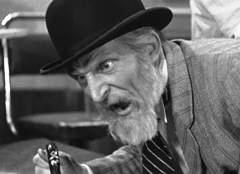
Herr Doktor Professor Woolf. Not exactly as illustrated.

Herr Doktor Professor Woolf. Not exactly as illustrated.

Maybe he’s been reading this blog, because today’s column is a 300-word attack on the idea of taxing the rich. His argument relies on the unlikely, and irrelevant, assertion that rich folks’ incomes are too volatile to be a dependable source of tax revenue.

Which may be true for individual taxpayers, whose incomes shuttle between well-off, rich, and filthy stinkin’ rich depending on the stock market, the purchase or sale of costly assets, and the convenient laundering of wealth to screw the taxman. (Woolf doesn’t mention the many, many tax advantages of being wealthy, and how they might cause volatility in rich folks’ tax payments.)

Woolf spends most of his column puttering around the definition of “rich,” and showing (with carefully chosen numbers) that these folks pay an impressive share of our total income tax revenue.

Well, of course they do. They earn an even more impressive share of our total income.

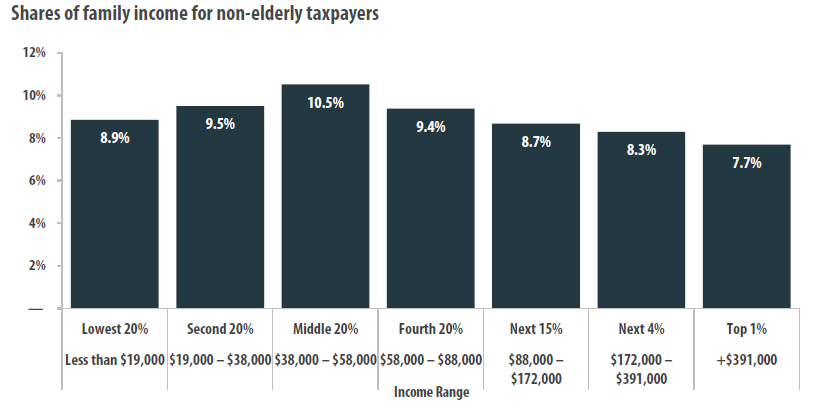
Not to mention that while our income tax system is fairly progressive, our total tax system is not. Sales taxes hit hardest on the poor and working classes; property taxes hit the middle class. And the income tax isn’t as progressive as it should be.  The rich may pay 40% of Vermont’s income tax revenue, but they sure as hell don’t pay 40% of our total (state and local) intake.

Now, if you look at statistics that Woolf conveniently ignores — total taxation as a percentage of income — you see that the rich pay lower effective tax rates than everybody else in Vermont. Here’s a chart from the Institute on Taxation and Economic Policy that I’ve posted before, but it’s relevant here:

ITEP 2014 tax chart


Take all of our state and local taxation together, the richest Vermonters pay a smaller share than anybody else. Woolf conveniently ignores these figures. And he evades the obvious question they pose:

Did they pay their fair share? That’s a question a philosopher, not an economist, can answer.

Wrong, Perfesser. It doesn’t take a philosopher, or even an economist, to look at that chart and conclude that they don’t pay their fair share.

Woolf’s actual premise, that the state can’t depend on revenue from top earners, is irrelevant. Nobody is arguing for confiscatory taxation. Nobody is arguing that soaking the rich should be the foundation of our tax system. The real argument is fairness: are the rich paying enough? The answer, clearly, is no.

The revenue volatility is one of many serious problems caused by income inequality. The solution to the volatility is a fairer economy — one that doesn’t concentrate the wealth at the top end. A fairer economy would also be a stronger and more stable economy, since supply and demand would be in balance.

Why have our economy and our public finances struggled since the Great Recession? Because there are too many people who can’t afford to buy stuff, and consumer activity is by far our strongest economic driver. That’s why programs like food stamps and the Earned Income Tax Credit provide more economic stimulus than any corporate tax break or across-the-board tax cut: when working people get a little extra cash, they immediately fritter it away on things like food, housing, and heat.

But I digress. Woolf’s argument is misleading and intellectually dishonest. His conclusion is irrelevant to the actual public policy question in play. He also leaves us without a hint of an alternative solution to wealth inequality, unfair taxation, and an economy slumping due to a lack of consumer demand.