Tag Archives: VPR

Dick-swinging time

Apologies for the crass title, but it seems singularly appropriate for the early returns on this campaign finance deadline day. Particularly when it comes to Governor Peter Shumlin and, to a lesser extent, Lieutenant Governor Phil Scott.

Shumlin maintained his frenzied fundraising pace during September, and his campaign spending went straight through the roof. He raised a total of $100,875 during the month — three thousand dollars a day, including weekends and Labor Day — which is insane enough, but then you get to the Expenditures line:

$234,898.90.

Congratulations, Governor, for holding the line under $235,000.

The lion’s share of that money went to TV advertising: $215,147.

I recall Scott Milne castigating the Governor for spending $20,000 a week on TV ads. Well, Mahatma was wrong: Shumlin spent twice as much. More than $40,000 a week. Yikes. 

Later Note: That was a mental leap too far. Shumlin’s campaign spent $215,147 on TV in September, but some of that money — perhaps most of it — may have been prepaid for ad time in the coming weeks. So I can’t say how much Shumlin is spending per week. 

At this time two years ago, Shumlin hadn’t even begun to advertise. And he faced a stronger opponent — well, a less sickly opponent, anyway. As of October 15, 2012 (there wasn’t an October 1 report that year), he had spent a total of $160,387. For his entire campaign.

He spent more than that on TV ads alone. In the past month alone.

And he’s got enough cash on hand to keep up the pace through Election Day even if he doesn’t raise another dime, which, ha ha. His campaign fund has a positive balance of just over $400,000. Add in the money left over from his Hulk-Smash victory over Randy Brock in 2012, he’s got more than a million bucks in the bank.

Scott Milne, who hadn’t filed as of 2:30 pm, has told VPR’s Peter Hirschfeld that he’d raised over $80,000 in the past month. Which is impressive by his standards, but still nothing compared to Shumlin’s stash.

Libertarian Dan Feliciano, as I reported earlier today, raised about $3500 in the past month and $17,000 for the entire campaign. And his bottom line is actually underwater. Or it would be if he hadn’t donated $10,000 to his own campaign.

Money-wise, the Governor has nothing to worry about. So, given the fact that his challengers are woefully underfunded and undertalented, why is he spending like a drunken sailor in a state liquor store?

My theory is that he really, really wants to get a pure majority of the vote. And hopefully approach the 57% he received two years ago. If he wins with a mere plurality against puny competition, he’ll enter the big push for single-payer health care a diminished political figure. He doesn’t want that. So expect to keep on seeing plenty of Shumlin for Governor ads on your TV screen.

Phil Scott’s package is nothing like Shumlin’s, but he’s doing just fine by the standards of the Lieutanant Governorship. He did crack the $200,000 mark in total donations, which was his stated goal — to raise as much money the traditional way as Prog/Dem Dean Corren would receive in public financing. And Scott still has more time to raise more money.

And more space, too. He’s getting plenty of money from business groups and PACs, but he’s getting a goodly share of smaller donations as well. Uniquely among Vermont Republicans, Phil Scott actually has something of a base.

He’ll need to keep fundraising if he wants to maintain his spending pace. He’s managed to spend over $150,000 so far. He did enter this cycle with over $42,000 left over from 2012, so he’s up around $100K in cash on hand. But if he’s spent $150K so far, he’s likely to spend a lot more by November 4. The Governor won’t break any campaign spending records, which were set in 2010’s Shumlin/Dubie contest. But Phil Scott must be shattering the previous campaign spending marks for his office. His ceremonial office.

If only he had time left over for his alleged VTGOP-rebuilding project.
The Good Ship Milne runs aground

Oh dear. Oh wow. That debate last night. (The gubernatorial debate on VPR featuring Governor Shumlin, Republican Scott Milne, Libertarian Dan Feliciano, and the Liberty Union’s Peter Diamondstone.)

Lots to talk about, but the main takeaway is this: Scott Milne is losing it. His performance was so bad that, I hear, it sparked some back-channel sentiment among Republicans to get him out of the race and leave it to Dan Feliciano.

I don’t think that sentiment will turn into action, because in the long run it’d be more embarrassing to have no Republican candidate than to have a really bad one. But still, it shows you how bad it was.

How bad was it? The Freeploid’s Nancy Remsen, in referring to a question Milne asked of Governor Shumlin, characterized it as a “strange question.”

And she was right.

It’d be fun to provide a tally of how many times Milne said that an issue was “complicated” or that he was “running a campaign of ideas” without providing any ideas. But a couple of excerpts will, I think, give a more complete sense of the debacle.

After a couple of opening-round questions, the candidates were given the opportunity to ask a question of one of their fellows. Milne made a complete botch of it:

Milne: I’ve heard from four different people that therte was an emergency sort of last-minute called meeting Saturday night after that debate with Democratic leaders in Windsor County that you attended. I’m just curious, at that meeting, how many folks that were there to sort of help you regroup after that debate worked for the state directly or worked for nonprofits or advocacy groups that are funded by state dollars prinarily?

This is the question Remsen called “strange,” and she was dead-on. Shumlin’s response?

Shumlin: Scott, I’m totally unaware of what you’re talking about. I can tell you what I did after the Tunbridge Fair, I went up and spoke with state employees, the VSEA, in Killington, I made one other campaign stop, and I went to the Windsor County Democratic dinner in Hartland. It was a very good event, and I went home. So the meeting you’re referring to did not happen.

Milne: Okay, my bad. Thank you.

Moderator Bob Kinzel: No follow-up question for that?

Milne: Nope.

Do I have to explain how awful that was? In a four-way debate, Milne would get few opportunities for a direct interaction with the Governor. He took is best chance and blew it on a hot rumor he’d heard about an alleged event that didn’t happen, and even if it did, what the hell difference would it make? The best he could have hoped for was that Shumlin would decompensate and admit he’d had a secret powwow to strategize a counterattack against the Milne Menace with a roomful of state employees. And then what would Milne have? A “gotcha” moment that would do nothing to illustrate policy differences between the two.

As it was, he looked like a fool.

Next, Shumlin asked MIlne a question. He noted that Milne repeatedly calls Shumlin “radical and progressive.” He then ticked off several of his initiatives — universal pre-K, college tuition, downtown revitalization, fighting opiate addiction, and the GMO bill, among others — and asked Milne which ones he disagreed with.

And here, in all its incoherent glory, is Milne’s response.

Milne: Since you used all my time asking questions, I’ll try to be brief. I also want to give a shout out to Peter Diamondstone, just so the listeners know, Peter and I are doing this without notes. Dan’s reading questions from a paper, as is Governor Shumlin, so I’m happy to answer questions with my brain, not with what I wrote down ahead of time to bring into the test.

I think the GMO labeling bill is a good example of the radical, progressive management of a bill by your administration.

Shumlin: Would you repeal it?

Milne: I didn’t say I’d repeal it. I’m not entirely positive I would have vetoed it if I was in your shoes.

Shumlin: So you’re against it but you’re for it?

(I have to pause here and just say I really hope, purely for the entertainment value, that there’s a one-on-one debate between Milne and Shumlin sometime during the campaign. It’d truly be a Bambi vs. Godzilla moment.)

Milne: No, no. Um, I could do the flip-flop thing on you. I’m running a debate on ideas, I’m running a campaign of ideas, I’m not doing the sound bite flip-flop stuff. You flip-flopped on, you know, you’re totally doubling down on single-payer on Tuesday when you’re with your Democratic announcement, then you’re on a statewide radio program three days later, and you’re not going to go forward with it unless it’s goig to be good for the economy, so if you want to do the sound bite kind of campaign, we can do that.

What I said very clearly is, you managed that bill in a radical, progressive way. We could have gotten the same results in a much more business-friendly way that would have done great things to contributing to a business-friendly environment in Vermont which would be good for business, which would be good for government, because government is funded by business.

Yyyyyyyeah.

All I can say is, if you can listen to that mess and conclude that Scott Milne is your man for Governor, then I’ve got no words.

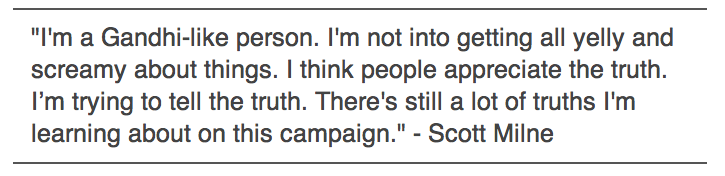
Mahatma Milne Reveals Himself

Aww, sheeeeit. 

Screen Shot 2014-09-10 at 9.50.14 PM

The above quote is from Milne’s interview today on VPR’s Vermont Edition. 

Where do you start? 

I’d say “self-absorbed, egotistical, and deluded,” but I suspect the real answer is “clueless and maladroit.” In his very brief time in the spotlight, Scott MIlne has already established a reputation for verbal blunders, malapropisms, abrupt changes of subject, and a weird combination of aggression and passivity. (Example: On the one hand, excoriating Vermont Health Connect as radical experimentation; on the other, refusing to rule out the even more progressive single-payer system.) 

When he wasn’t elevating himself to the highest ranks of humanity, Milne spent a lot of time failing to define himself or his candidacy, per VPR’s Jane Lindholm: 

 “I’m not talking about what my plan is today,” he said. “I’ll be very clear, and I’ve been very consistent from the beginning, that what we need is a health care system that offers access to everybody.”

Milne is short on details on other issues as well. He believes that property taxes are too high and getting higher in many towns around the state. He said we need to reform our education system to keep costs down. When questioned on Vermont Edition, Milne backed away from a prescription for a fix. 

… “Stay tuned,” he said.

C’mon now, Mahatma. It may go against every fiber of your pacifist, meat-eschewing self, but sometime, someday, you do have to start revealing policies of your own.

Back in late July, Milne laid out a two-part strategy: August was for criticizing Governor Shumlin’s record, and September was for his own policy rollout. 

Hey, Mahatma: September began a week and a half ago. Time to shit or get off the pot.

Milne campaign shifts into… er… second gear

About a week ago, I wrote a piece lambasting the Scott Milne campaign for scheduling an un-grand total of two days’ worth of campaign events in an entire week. 

Well, the schedule’s out for this week. And the good news is, it’s a vast improvement in the week before. Monday 9/8 is the only day that’s unscheduled, and there are multiple events almost every day.

Details in a moment, but first a word about his alleged running mate, Lieutenant Governor Phil Scott. He’s maintaining a busy schedule of his own, and none of it includes Scott Milne. As far as I know, the Lite-Gov hasn’t made a public appearance with Milne since Milne’s campaign launch — and then, Phil Scott stayed in the background. He didn’t say a word. Unlike Jim Douglas, who has made dutiful appearances on Milne’s behalf. I realize that Phil Scott has to fend off Dean Corren, and he seems completely preoccupied with that task. But if he’s trying to build a more inclusive VTGOP, shouldn’t he be doing everything he can to prop up Milne? He’s probably Milne’s only hope for building a positive public image. And he ain’t lifting a finger to help anybody but Phil Scott. 

Okay, back to This Week In Scott Milne. He spent much of the weekend at the State Fair in Rutland, presumably pressing the flesh and kissing babies or whatever it is that politicians do these days. (Pretending to enjoy deep-fried foods? Wearing funny hats?) 

He also found time to attend Republican events in Barre Town and Essex, plus a Private Reception (open up your wallets, good people) in Hartford. Tuesday will be spent in Newport, visiting businesses and the hospital, taping an interview on community access TV (which is kinda sad, in and of itself), and holding another Private Reception in Derby. 

Wednesday’s mostly a Washington County day; meeting with veterans, visiting Norwich University and the Barre American Legion, plus doing VPR’s Vermont Edition and hanging out with the Vermont Grocers Association in Burlington. 

Thursday and Friday are devoted to the Tunbridge Fair; he’ll also do a Meet and Greet (wallets, people) in Killington. 

Good stuff. 

Of course, it’s the kind of good stuff he should have been doing last year, if he had serious hopes of building a statewide movement. Holding fundraisers, meeting with Republican groups and businessfolks, touring different parts of the state. 

By now, he ought to have built grassroots support and name recogniation, and should be spending more time holding news conferences and doing media interviews wherever he can find a camera or microphone, and making the rounds of every daily and weekly newspaper in the state. There are only two media events thee ntire week — VPR, which is good, and NEK-TV, which is, all due respect to community access television, not. A major-party candidate for Governor should be getting his face on the big three TV stations, not on community access cable.

Of course, in order to hold news conferences, he’d need to have some news to announce. We’re now into the second week of September, and we’re still waiting for Scott Milne to start unveiling his platform. What does he want to do about health care, taxation, the economy, school governance and funding, energy, the environment? How would he refocus Act 250 and balance development with conservation? 

We… still… don’t… now. It’s now less than two months until Election Day, and Scott Milne is still a policy cipher. His attacks on Governor Shumlin have been strong and tough at times, and milktoast at times. And sometimes in the same paragraph. 

His number-one problem remains his lack of money, and his apparent inability to raise funds outside of his immediate friends and family. But beyond that, he’s got serious trouble with defining himself and building name-recognition. Things that, again, should have been done months and months ago.

Pope Sal Spreads the Gospel of His Omniscience

Hey, remember Salvatore Matano, former Catholic Bishop of Burlington? He got promoted to the bishopric of Rochester, New York last year, and he’s already making waves in his new parish even as the effects of his Vermont tenure continue to reverberate. 

Matano is described thusly by the National Catholic Reporter

Matano is a classmate and friend of Cardinal Raymond Burke. Burke is well known for a certain rigid legalism during his tenure in St. Louis. In 2008, he was appointed prefect of the Apostolic Signatura, the church’s highest canonical body, and would eventually become a member of the Congregation for Bishops. In this capacity, Burke had a hand in appointing his former classmate to Rochester.

Funny thing: Burke thrived under the legalistic papacy of Benedict, but was quickly tossed from the Congregation by Benny’s successor, Pope Francis. 

Back to Our Pal Sal, whose Vermont tenure featured a stout defense against any and all claims in the clergy sex-abuse scandal. Foot-dragging, denial of responsibility, pleas of poverty… Sal used the entire playbook. 

Well, now VPR’s Steve Zind reports another choice tidbit from the Matano Era. While Sal was still here, the Vatican issued a survey to gather input from the faithful and “encouraged bishops to disseminate it as widely as possible, including at the parish level.”

Instead, according the Concerned Catholics of Vermont, Our Pal grabbed the survey and filled it out himself. And is refusing to disclose the nature of his responses. CCOVT says: 

Vermont Catholics have no notion what was reported to Rome about how we access the surveyed issues and, given no information about the consultation undertaken, we have no grounds for knowing whether the report was accurate.

The survey covered hot-button topics like birth control, divorce, and marriage equality, and was meant to gather the views of Catholics in advance of an “extraordinary synod of Bishops” next month. 

Well, thanks to Matano, the views of Vermont Catholics are shut out of the process. 

Meanwhile, in his new posting in Rochester, Matano is imposing regressive policies. The NCR:  

Bishop Salvatore Matano, the new bishop of Rochester, N.Y., is in the process of ending a 40-year custom of permitting lay ministers to preach at Mass. Most are women commissioned to preach by the former bishop, Matthew Clark. All have advanced degrees in theology and all have served for many years in various diocesan leadership positions.

“Well, they might be tremendously gifted and qualified,” I can hear Matano saying, “but… but… they’re WOMEN! They have LADYPARTS! God forbid we should sully our pulpits with vaginal juices!” 

Yeah, semen stains on the robes are fine, but we can’t let GIRLS in our clubhouse!

The National Catholic Reporter sees Matano’s elevation to Rochester as part of Benedict’s efforts to promote conservative doctrine. Let’s hope Francis is paying attention to Sal’s medieval policies, both in Vermont and in Rochester. 

If you can’t improve your product, get a better salesman

Let’s start with the thesis (for once): I still don’t understand why Doug Racine was fired. I have some guesses, but the official story doesn’t wash. 

From Governor Shumlin, we’ve heard the usual “time for a change” bullcrap. From Racine, we’ve heard that the Administration wanted more of an “ambassador,” while he’d been keeping his nose to the grindstone at the Agency of Human Services. Racine offered the following comments in a Wednesday interview on VPR’s Vermont Edition: 

They mostly focused on style. [They said it wasn’t about the troubles at the Department of Children and Familes, and never mentioned Vermont Health Connect.] I had been focused on the Agency… What they said they wanted was somebody who was going to be out there a little bit more, in front of the media, and in front of local groups and constituent groups, and just to be talking more publicly about the good work of the agency. They said I wasn’t the right person to do that.

Well gee, Doug Racine spent a lot of years in politics. I’d think he could be an effective “ambassador” if needed. And if he believed in the product. Besides, a problem with “style” doesn’t seem urgent enough to warrant the sudden and immediate dismissal of an original cabinet member. Hell, Racine cleared out his desk right after his firing: they wanted him gone, and gone NOW. They didn’t want him wiping his hard drive or stealing office supplies. 

I don’t have any inside information, but here’s what I think. The Shumlin Administration knew it would be cutting the budget, and that most of the cuts would happen at AHS. They knew the agency was already overstretched, and that Racine had long believed it was badly under-resourced. 

I look at the ratios, I look at the work they do, I talk with a lot of the workers. They’re very stressed. They’re dealing with families in exceedingly difficult situations.They need more people, there’s no question about it.

And then Racine said something I found telling: 

 I met with some of the [DCF staffers] who testified [at Tuesday’s legislative hearing], I met with them last week, and I urged them to go and tell their story to the Legislature. …I’m glad that they were there, I’m glad they testified, and I hope the Legislature was listening.

That hearing gave voice to the frustration and despair among DCF staffers. In the context of this week’s budget cuts — which Racine had to know about last week — their testimony was a big fat warning shot across the Administration’s bow. And he encouraged them to speak out. Not very ambassadorial, that. 

When Doug Racine ran for Governor in 2010, concern about Human Services was one of his top priorities. As AHS Secretary under Shumlin, he has tried to stretch the available resources as far as he could. He was a loyal soldier, trying to preserve human services programs in very tough times and not complaining in public. 

And then came another round of cuts, and the primary targets, per VTDigger, were (1) the already overextended DCF, and (2) Shumlin’s pet project for 2014: substance abuse treatment. 

Do you think that might have forced a confrontation with Racine? It looks to me like the Administration not only wanted him to swallow more bad news, but wanted him to get out in public and actively promote the budget. He could have done the former, but he couldn’t bring himself to do the latter. 

Again, no inside information, just educated inference. 

The only explanation I can think of for the timing is (1) the pending budget cuts, and (2) the election campaign. Shumlin wanted a cheerleader, and Racine wouldn’t pick up the pom-poms. 

Meanwhile, the interim AHS chief, Dr. Harry Chen, is by all accounts a good guy and an able administrator. But when I read Terri Hallenbeck’s story in the Freeploid, I saw some obvious holes in Chen’s game. First of all, he describes himself as very much a hands-on manager coming to a job where that might not be possible: 

Chen… said the management style he brings to the job includes lots of interaction with staff. 

“I wander the halls,” Chen said, acknowledging that as secretary of an agency that oversees such a vast array of services, there may be too many halls to wander in too many far-flung buildings.

And Senator Kevin Mullin pointed out that “two key areas where Chen may lack expertise the agency sorely needs is in information technology and child protection issues.” Which happen to be the two biggest challenges facing AHS. 

Dr. Chen’s interim appointment expires at the end of the year. He’s got four months to “wander the halls” and, he says, make recommendations about changes in the agency. In his first day on the job, reports Hallenbeck, he met with central office staff to give them reassurance. But he’ll have to make some tough decisions in a hurry. Sort of like his former job as an emergency room doctor: get as much information as you can as quickly as you can, and then do what you have to do. 

Might be more blood on the floor in the not too distant future. And I suspect that when Dr. Chen isn’t wandering the halls, he’ll be facing the cameras and telling the people of Vermont something that sounds a lot like this: “These are challenging times but the Agency is up to the task, and the Shumlin Administration is giving us all the resources we need.”

Rah, rah, sis boom bah. 

Extreme Makeover, Freeploid Edition

Gannett is taking the inevitable next step in its pursuit of profit: spinning off its newspaper business, formerly the heart and soul (such as it was) of the corporation. The publishing arm will start with a clean slate, unlike some other spinoffs that loaded corporate debt onto the new entity; but it also strips away whatever fiscal protection was offered by Gannett’s moneymaking broadcast properties.

For readers of the Burlington Free Press wondering what its future will look like, I suggest media coverage of its sister paper, the Tennesseean. The Nashville daily is being transformed into a “beta” newsroom, a new-world model for affiliated papers to follow. The topline looks good: The Tennesseean promises a larger reporting staff and more local journalism.

But the attic is full of spiders, and if I were a senior Freeploid employee, I’d be preparing to be “future endeavored” into a lousy job market. The best summary, with plenty of links, comes from the Poynter Institute. And it includes such gems as:

— The newsroom will, indeed, have more reporters — but fewer others, including far fewer editors. The total staff will shrink from the current 89 to 76. That’s a 15% cut.

Every newsroom staffer will have to reapply for new jobs and no one is guaranteed a new gig. Out goes seniority! I bet those redefined jobs will offer lower pay and lousier bennies. Also, senior staff had better be as up-to-date with the digital world as your average twenty-something J-school grad, or they’ll be out on their ears. With, according to Nashville Public Radio, “a small severance package.” Lovely.

— The lack of editors will put the onus on reporters to produce “publication-ready copy” because there won’t be enough editors to give stories a second look. Expect a lot more typos, bad grammar, and stories rushed to publication.

Every reporter I know has seen stories ripped to shreds by unskilled, or agenda-driven editors. But there’s a reason that traditional journalism demands mediation between writing and publication: it’s the quality control. It is, literally, the most significant difference between traditional media and the likes of Yours Truly. I write what I know and feel, based on experience, and I can post anything I want to. The editorial system breeds a certain level of professionalism, which is why the Freeploid can expect to be paid for its content and I cannot. (I’d like to be, hint hint, but I can’t expect it.)

“Audience analytics” will rule the roost. Executive Editor Stefanie Murray, the Tennesseean’s own Jim Fogler, says “We’re going to use research as the guide to make decisions and not the journalist’s gut.” Wonderful; we’ll be setting our journalistic priorities based on pageviews and reader surveys. Er, I mean “audience surveys,” because “reader” is so 20th Century.

I realize that newspapers face a difficult future. Their old sources of advertising are drying up, and digital ads don’t fill the gap. Unless you’ve got something else going for you, like donor support (VPR, VtDigger) or a healthy, ad-rich print operation (Seven Days), you’re dependent on ad revenue. (The traditional paper got at least two-thirds of its revenue from ads, not readers.) The Tennesseean is one more experiment in creating a sustainable future. But the minions of Gannett are furiously lipsticking this pig — presenting the “new” Tennesseean as a model of intensive, community-oriented journalism. It’s not. It’s another effort at slashing costs to maintain profit margins.

The Freeploid has a whole lot of experienced senior staffers who work very hard. Their experience can lend context and depth to their reporting. If the Tennesseean’s “beta” test goes well, in terms of profitability, expect the winds of change to blow strong through the Freeps’ offices in the near future.

VPR gives Peter Welch a big fat sloppy wet kiss

Well, that’s four and a half minutes of my life I’ll never get back again.

This morning, VPR’s Bob Kinzel delivered himself of a lengthy (by modern public radio standards) piece devoted to a subject that was already in the realm of clear, obvious, unquestioned fact: Congressman Peter Welch likes to work cooperatively with people from both parties.

Everybody knows that. It’s an occasional source of irritation to Vermont liberals, who’d like to see a bit more fire and brimstone from the guy. So why did we need a news story exploring a settled question?

The host’s intro to the piece was all you needed to hear:

Congressman Peter Welch has one of the most liberal voting records in Washington. At the same time, he’s one of the few Democrats to work closely with some of the most conservative Republicans in the House. VPR’s Bob Kinzel has the story.

What followed was four minutes and thirty-eight seconds that added nothing to the above statement. It was one person after another complimenting Welch on his bipartisan spirit and willingness to work with even the most conservative tea-party nutbars in the Republican caucus.

This piece took a great deal of effort on Kinzel’s part. He got quotes from former Governor Jim Douglas, two very conservative Republican members of Congress, and a Congressional correspondent for the beltway publication Roll Call, plus some file tape of Welch at a committee hearing. You don’t often hear that many different people in a single public radio piece.

And for what? To re-establish a universally known fact?

Who came up with this story idea anyway? And how did it get through VPR’s notoriously painstaking editorial process? There was no “news hook” — no current event that shines a spotlight on Welch’s collaborative proclivities.

Plus, it seems inappropriate to send an unvarnished love letter to a person who’s currently running for re-election, for God’s sake. If I were Mark Donka, I’d be complaining vociferously to VPR for broadcasting what amounted to a lengthy advertisement for Peter Welch’s political virtue.

But most of all, it was a complete waste of time for a skilled reporter, VPR editors, and me, the listener.

So, maybe health care reform is working?

For those of us who practice compassionate liberalism (which is actually a thing, unlike compassionate conservatism), the primary reason for health care reform is to ensure that everyone can access the services they need. But reform isn’t going to work unless it meets another goal: containing the costs of health care, which were out of control under the old system.

And here’s some good news on the green-eyeshade front, courtesy of VPR:

Vermont’s 14 hospitals have submitted budgets for the fiscal year starting Oct. 1 that increase by just 2.6 percent over the current year’s budgets, the smallest annual increase for the Vermont health care delivery system in four decades.

… The 2.6 percent inflation figure follows on the heels of a 2.7 percent jump in the current year. Taken together, the performance of the hospital system should be considered a positive augury in the coming debate over Gov. Peter Shumlin’s single-payer reform initiative.

Kudos to VPR’s Hamilton Davis for slipping “positive augury” into his script. Few radio reporters would dare so much.

Anyway, yeah, two consecutive years of low cost increases for Vermont hospitals. In fact, as Davis reports, those increases are roughly one-third the rate of increase since the year 2000. And this year’s figures came in under the Green Mountain Care Board’s target of 3 percent. GMCB chair Al Gobeille pronounced himself “very pleased” with the submissions.

It’s still early days in health care reform, but something is obviously working. And this is a “positive augury” because state law requires the government to demonstrate an ability to control costs in order for Governor Shumlin’s single-payer health plan to go forward. So far, so good.