Tag Archives: Vermont Health Connect

Health care reform: the election issue with no teeth?

Interesting thing happened last week. Vermont CURE, an advocacy group for single-payer health care reform, cut ties with Tess Taylor, the former House Assistant Majority Leader who resigned from the Legislature to sign on with CURE only about six months ago. In the middle of the 2014 legislative session.

Taylor had been brought on board in the expectation that there’d be some heavy lifting to do in the 2014 campaign, and her political chops would come in handy. Seemed like a good bet at the time, and an even better one after a spring and summer full of trouble for Vermont Health Connect. Surely, went the conventional thinking, the failures of VHC would mean trouble for Governor Shumlin.

Well, maybe not. Bram Kleppner, chairman of the V-CURE board, speaking with VPR’s Peter Hirschfeld: 

“We were expecting a strong candidate to oppose Gov. Shumlin. We were expecting a wave of strong  candidates coming in to run against supporters of (single-payer). So we brought Tess on, obviously because of her deep expertise in the Vermont political process,” Kleppner says. “But it became clear to us after the primaries that that political and legislative opposition that we were expecting really just hadn’t materialized.”

So, rather than a campaigning challenge, V-CURE will focus on a PR effort to convince the general public that single-payer is the best way forward. Taylor’s experience is less germane to that.

This ties in with an email chat I recently had with fellow blogger (and former Burlington City Councilor) Ed Adrian. He wanted to know how my blogposts about health care reform were doing in terms of readership. He’d noticed that anytime he wrote about health care reform, his numbers were “dismal.”

So I checked my numbers and found that, for whatever it’s worth, the same is true for theVPO. Health care stories just don’t attract many pageviews.

Now, theVPO’s audience is a very select, and self-selected, slice of the general public: those with a strong interest in Vermont politics. You can’t safely generalize from them to the entire electorate.

But you’d think that, if anything, my readers would be more interested in health care than everybody else.

Ed pointed out that a sizable majority of Vermonters have never had to interact with Vermont Health Connect because they get their health insurance elsewhere. For them, VHC’s failings are basically an abstract concern.

I wouldn’t have placed much value in the pageviews of a couple of blogs. But combine it with V-CURE’s move, and i have to wonder: is health care reform a lot more sizzle than steak? Is it mainly of interest to insiders and the political media?

It’s hard to tell from the course of the campaign to date. Scott MIlne hasn’t made a dent in Governor Shumlin’s armor with his attacks on VHC incompetence; but is that because of the issue, or because of his terrible campaign?

Then there’s Dan Feliciano, who’s gotten a lot of insider buzz with his devout opposition to single-payer. But his fundraising has been terrible and his 48-hour fundraising blitz came and went without any news — which has to mean it was a complete failure. Is he getting anywhere with a frontal attack on single-payer? It’s impossible to tell, since he hasn’t been included in recent polls. But his fundraising numbers certainly don’t reveal any groundswell of support.

There’s reason to believe that the failures of VHC may not be that politically harmful to Shumlin. I suspect that property taxes would have been a better issue for the Republicans. They still wouldn’t have beaten the Governor; but only a small portion of Vermonters have interacted with VHC, while pretty much everybody pays property taxes, either directly or indirectly.

It’s worth pondering, anyway.

Why state IT projects fail: a much-overlooked factor

Oliver Olsen, the once and (perhaps) future State Representative from southern Vermont, recently wrote an essay entitled “Why IT projects fail.” It was, more specifically, about why state-contracted IT projects fail.

Olsen began with the question, why can’t we bulid a software system when we manage to build large-scale complicated stuff like highways, bridges, and suchlike. His explanation: while the basics of civil engineering have been in place for quite a while, the world of high technology is young and ever-changing. And it’s harder to deal with the intangible world of IT than with the steel-and-concrete world of construction.

Good enough, as far as it goes, and I recommend reading the piece.

But I’d add one big factor that no one else seems to have noticed.

One of the problems throughout the history of the Affordable Care Act and Vermont Health Connect is a lack of competition for IT contracts. CGI was the big dog, by a long shot. Vermont chose CGI in large part because it had won so many other ACA contracts that it seemed the clear choice. Turned out, of course, that CGI wasn’t really up to the job. And when Vermont went to find a replacement, the only real choice was Optum, upon which our hopes are now pinned.

So the question: Computers and software are huge growth industries, and the US excels at both. Why can’t we get more, and smarter, companies to bid for health care exchange contracts?

I’d turn that question around: why are so many high-tech companies staying away?

Could it be because public-sector projects are complicated, fraught with peril, and more likely to yield failure than success?

Just looking at how the market moves, I have to conclude that it’s a lot more profitable to build newfangled gadgets, computer games, and smartphone apps. And the cost of failure is a whole lot lower: you put out a device or a game or an app. If it fails, you move on to the next one and write off the development costs. If you’re trying to build a health care exchange, you’d better damn well get it right. You can’t just walk away in the middle, and you can’t unilaterally postpone the launch.

Also, whereas a game or an app is pretty much a stand-alone item (as long as it plays nice with the operating system), public-sector IT projects are complicated systems that have to interface with other complicated systems.

There are lots of things IT experts can do that are higher-return and lower-risk than public-sector IT projects. Which is why most of them stay away from the business, and the public sector is left with a relative handful of bidders.

And somehow I doubt that those bidders represent the best and the brightest of the IT world.

VHC and the NFL

The National Football League, the unstoppable beast of modern sports, is having a bad time of it. Commissioner Roger Goodell, team owners, and players are under scrutiny for what appears to be an epidemic of bad behavior toward women and children, and a casual attitude toward violent offenders.

In actual fact, there are no more or fewer incidents than there have ever been. The problem is the league’s hypocrisy, backtracking, dishonesty, and double-dealing. Or, as we learned from the Watergate scandal — well, we should have learned it — it’s not the crime that gets you, it’s the cover-up. If the NFL had gotten out in front and taken plausibly strong action, its current PR crisis would never have happened.

Which brings me to Vermont Health Connect, our long-troubled and (temporarily?) sidelined health care exchange. And particularly the need for a heavy dose of the best disinfectant: sunshine.

To begin with the takeaway: Please, let there be no more surprises. If there are unrevealed problems, call a news conference ASAP and get all the bad stuff out in the open at once. No more dribs and drabs, no more Friday afternoon newsdumps; just a public accounting for everything. Take heed of the NFL’s tribulations, made worse every time new information comes out or a prominent figure sticks his foot in his mouth.

Maybe there’s no bad news left. Maybe we know it all. That would be great, if true. But the Administration’s recent track record doesn’t fill me with confidence.

Go back, first of all, to the Friday afternoon newsdump to end all Friday afternoon newsdumps: the release of the Optum report detailing serious problems with the state’s oversight of the VHC website’s construction. Not problems with the technology or software; but serious management shortcomings by Shumlin Administration officials. The report was released the Friday before Labor Day, so maybe you missed it.

At the time, the words of responsible officials were not reassuring. Health care reform chief Lawurence Miller said the Optum report would help chart “the best way forward,” which seemed to preclude any accounting for past maladministration. And Health Access Commissioner Mark Larson, who has since been sidelined from VHC oversight, allowed as to how his takeaway from the report was that “we have worked hard with our vendor partners.”

Well, yeah, hard. But not effectively.

On September 15 came the temporary VHC shutdown. It was first announced as a way to streamline repairs and upgrades in advance of the next open enrollment period. It made sense, and I praised it at the time: stop futzing around, get it fixed, and set the stage for the single-payer debate.

Since then, a couple things have happened that cast doubt on my sunny interpretation. A few days later, VTDigger’s Morgan True reported that the VHC shutdown had as much to do with a site-security crisis as with a sudden onset of managerial diligence.

Over the summer the federal government provided a timeline for reducing security risks, which expired 10 days ago…

Miller and Harry Chen, the secretary of the Agency of Human Services, decided to take down the website last weekend because the state was unable to meet a Sept. 8 federal deadline for security controls; the determination was not the result of a security breach or a specific threat.

“Rather than asking for more time, we decided to disconnect from the federal hub,” Miller said.

Miller could not rule out the possibility that the feds might have ordered a VHC shutdown if the state had failed to act.

Which puts quite a different complexion on the shutdown. And Miller didn’t reassure much when, speaking about security issues, he had trouble with verb tenses:

… it needs to be a high priority; it needed to be a higher priority than it was.

A curiously passive tone, methinks.

The very next day, we learned that top state lawmakers were displeased that they learned of the VHC shutdown through the media. Sen. Ginny Lyons, chair of the Senate Health Care Oversight Committee, said “We’re legislators, so we need to know.” Miller’s response? Officials kept it quiet for security reasons.

“The nature of the announcement was also an abundance of caution. Security advisers say when you’re going to do something for security reasons you do not telegraph that ahead of time.”

Uh, sorry, but no.

The federal government has crafted ways to share top-secret information about things like war, terrorism, and intelligence with appropriate members of Congress. I think Shumlin’s people could have passed a quiet word to, say, legislative leadership and the chairs of the health care committees. I think those people could have been trusted to keep a secret, for a couple of days, for good reason.

Miller’s explanation, of course, implies that lawmakers cannot be trusted. I think if I were Ginny Lyons or Mike Fisher, I’d be insulted by that.

And next winter, when Shumlin starts the push for single-payer, he’s going to need the support, good will, and trust of those leaders. Well, Miller as much as said he didn’t trust them.

I sincerely hope we’ve emptied out the Pandora’s Box of VHC. If there are still some dark, unexamined corners and crevices, then I implore the Administration to throw open the lid and let the sun shine in.

The most significant thing about Governor Shumlin’s first TV ad of 2014

The Shumlin campaign has taken to the airwaves with a 30-second commercial that features real-life Vermonters who have benefited from Shumlin initiatives. The aim of the ad is to remind viewers of the administration’s many accomplishments — to counteract the stream of bad news about Vermont Health Connect and the Department of Children and Families, and to remind liberal voters that the Governor has, indeed, delivered on many of his promises.

All he needs is rainbows and unicorns.

All he needs is rainbows and unicorns.

Pretty standard stuff, and it’s been duly reported in the media. But they haven’t noticed* the most significant thing about the launch: its timing.

*Correction: All but one of them failed to notice. Sevan Days’ Paul Heintz reported it two days before I did. That’s why they call him The Huntsman.

In 2012, the Shumlin campaign didn’t take to the airwaves until roughly two weeks before Election Day.

This year, the campaign hits your TV screens almost a full month earlier.

According to campaign finance reports, the Shumlin camp spent $125,000 on ad buys in 2012. Campaign manager Scott Coriell isn’t saying how much they’ll spend this year, but it figures to be a lot more.  They’ll be filling airtime for six weeks instead of two, so it’s fair to guess that they’ll triple their spending this year. Or more.

So, why?

In 2012 Shumlin faced an underfunded, underorganized, mismanaged opponent. Shumiin’s re-election was never in doubt. This year, he faces one opponent who’s far worse in all three categories, and another who represents a fringe viewpoint with a proven track record of appealing to a sliver of the electorate. Recent polls (and deeply flawed polls at that) notwithstanding, his re-election is once again in the bag.

But the Governor isn’t aiming his campaign at the broad electorate. He’s trying to pump up the base and generate higher turnout by core Democratic voters. Hence the reminders of popular Democratic initiatives.

If he can get a pure majority of the vote — at least 50% plus one — he’ll have a lot of political capital to spend in next year’s debate over single-payer health care.

But if he wins with a plurality and, worse case, he gets fewer votes than the Republican and Libertarian candidates combined, he’ll have a lot less pull with the Legislature. And right now, he’s polling in the mid-40s. He needs a boost.

Plus, of course, the higher his vote total, the more Dems and Progs will ride his coattails to victory. And he’ll need every liberal vote he can get, if single-payer is to pass next year.

That’s the significance of the early TV launch this year.

Shumlin’s strategy is focused on 2015

The Shumlin Administration’s decision to shut down the Vermont Health Connect website drew the predictable response from his opponents.  “Catastrophic failure,” said Scott Milne. “I still think it’s going to be a disaster,” said Dan Feliciano. And VTGOP chair “Super Dave” Sunderland floated a conspiracy theory: VHC “will be shut down for repairs until after the election” (Italics mine), implying that Shumlin is trying to run out the clock and put off his Day of Reckoning until after he is safely re-elected.

Sorry, not buying it. The timing appears convenient, and Sunderland is well within his rights to make as much hay about it as he can. But the timing makes perfect sense in a non-conspiratorial way: Harry Chen came on board as Human Services Secretary a month ago. His top priorities were (1) trouble in the Department of Children and Families, and (2) review of VHC implementation. He’s had a month, and now he’s got a plan.

But even more importantly, the mid-November relaunch has far less to do with the election than with the open enrollment period. The VHC website has to be back online by November 15.  Repairs have to happen either before then, or after the enrollment period closes in February. It’s a lot easier to do repairs during a shutdown.

Besides, the truth is, Republican (and Libertarian) attacks are irrelevant. The Governor knows he’s going to win the election, and he doesn’t care what they say. His goal is the 2015 legislative session, when he will (finally) roll out his single-payer health care plan.

And in order to do that, he needs to have a functional VHC website. He can’t wait until February to start the repairs because that’s when he’ll be trying to convince lawmakers to vote for single-payer — and he can’t expect them to take that step if VHC is still dysfunctional.

The Governor does, to be sure, have a goal for the campaign: he has to activate the Dem/Prog base. He needs a decent margin of victory and, more crucially, he needs as many Dems and Progs in the Legislature as possible. As Vermont Pundit Emeritus Eric Davis points out, his worst enemy is an enthusiasm gap.

A fully-functional VHC website before Election Day would be the best thing for his base. But failing that, a robust response to its problems and an action plan with a completion date is second best. That’s what Shumlin has delivered. And, Republican snark notwithstanding, I’ll bet you dollars to donuts that the Administration will have very good news to report before Election Day. In fact, I expect to see a VHC relaunch on or about November 1.

That requires solid progress on the IT front, of course. But I’m sure that’s the plan.

Thanks to the organizational decrepitude of the VTGOP, the ineptitude of Scott Milne, and the fundamentally fringey nature of Dan Feliciano’s appeal, Shumlin doesn’t have to worry about re-election. He can’t say so, of course; but his goal is to activate his base and set the stage for the single-payer debate next year.

By that standard, the VHC shutdown is a short-term tactical setback, but it makes all the strategic sense in the world.

What the Governor needs to do

Finally, Governor Shumlin has begun campaigning for re-election. For those of us who’ve yearned for the relative brevity of a parliamentary-style campaign, the Governor has delivered the closest thing we’re going to get. 

Given the state of the opposition, this should be more victory lap than competitive contest. But still, there’s a lot he needs to accomplish in order to set the stage for a productive third term. Here’s my short (and probably incomplete) wish list. 

— If he really wants single-payer, this is a crucial election. He’ll need to show skeptical Democrats that he still enjoys broad public support. The bigger his margin of victory, the more agreeable the Legislature will be in 2015. 

— He also needs to stump hard in marginal constituencies and elect as many pro-reform lawmakers as possible. That includes money: he has more than enough, not only to fight this election but for a solid foundation for 2016. He should tell some of his deep-pocketed supporters to give to House and Senate campaigns. Or make some donations himself. 

— He should have a very clear explanation for the failures of Vermont Health Connect and the slowness of his Administration’s response. Honesty is better than defensiveness, even if it hurts. And as I’ve written earlier, he might need to fire some folks to show he’s unhappy with the results so far. 

— He also needs to own up to other Administration failures and explain how things will be different next time around. Again, honesty and engagement are key.Maze_Finish

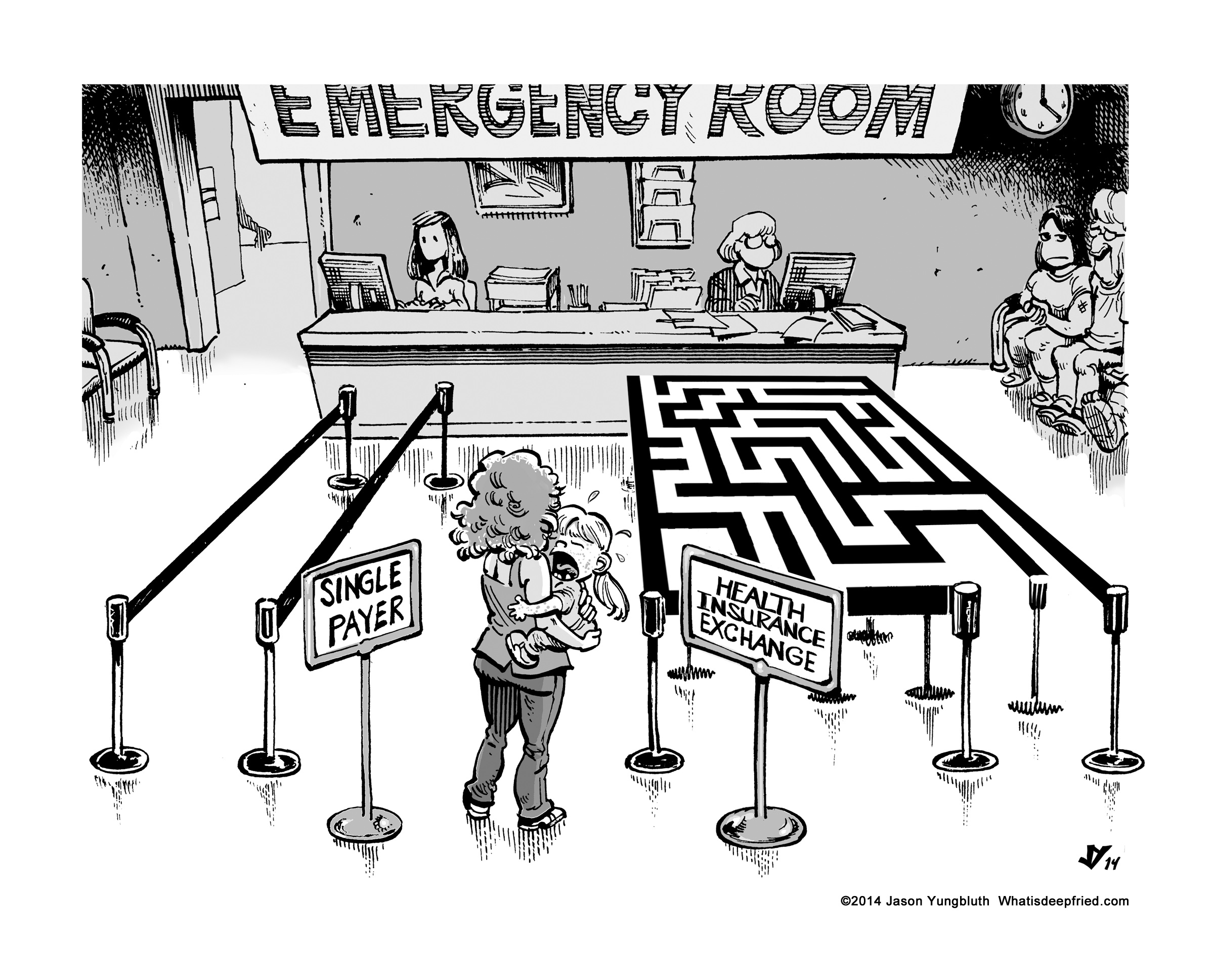
— He should present a convincing case that single-payer would be simpler than Obamacare, which was a cobbled-together compromise package. (Accompanying cartoon by Jason Yungbluth, provided to theVPO by the estimable Dr. Deb Richter.) 

— He should get strongly behind Dean Corren’s bid for Lieutenant Governort, including a lot of joint appearances. And he should urge the Democratic Party to do whatever it can to help Corren. A vote on single-payer in the Senate may well come down to a tiebreaking vote from the presiding officer. If you favor single-payer, do you want that vote cast by Phil Scott or Dean Corren?

— Turning, finally, from health care reform, the Governor needs to present ideas and show he has the energy to tackle other issues that are actually more pressing in the minds of voters: economic growth, school governance and taxation, and the general tax burden. 

— In gubernatorial debates, he needs to press Scott Milne (and Dan Feliciano, when he’s on hand) on the issues. He shouldn’t try to float above the fray, as if his opponents don’t matter. This is not so much for his own benefit, as for the cause of liberalism. He needs to remind people why they should vote for Democrats and Progressives. Too often, he has invoked conservative talking points to justify his moves to the center. He needs to cut that out. 

I think that covers it. I don’t want to see any prevent defense, and I don’t want even a hint of lofty entitlement. No taking the voters for granted. I want a strong, cogent, and relatable message that upholds the principles of modern liberalism and addresses the needs of Vermonters.

The Friday Afternoon Newsdump of the Year

Gee, what a co-inky-dink. A new report on the rumblin’, stumblin’, fumblin’ rollout of Vermont Health Connect was released on Friday afternoon. 

Before Labor Day weekend. 

When Governor Shumlin was hundreds of miles away, at his vacation home in Nova Scotia. 

Ah, leadership. 

The report is pretty damning, and should have been tackled head-on by the Governor instead of being shuffled quietly out the door on a holiday weekend. It’s not too late; he could come back to work, express dismay at the report’s conclusions, take repsonsibility for administrative failures, promise to learn lessons and do better in the future, and maybe even fire a few people. 

Now, that would be leadership. And it would allow the Governor to launch his re-election campaign next Monday in a strong, purposeful, and accountable manner. Do I think that will happen? Eh, probably not. But it’d be nice. 

The report was written by Optum, the consulting firm that’s trying to fix the mess left behind by former contractor CGI. Topline, per VTDigger: 

A lack of leadership at Vermont Health Connect left the tech firm CGI unaccountable for work it was supposed to complete on the state’s health care exchange, according to a consultant’s report released Friday.


The state “ceded” responsibility for the project’s success to CGI, …and as a result, “CGI has not met its commitments.”

This is bad. This is not a technology issue in a super-complicated new system, as the Administration has insisted; it’s a failure of management on the part of Administration officials who should have been riding herd on CGI. Instead, the Vermont Press Bureau’s Neal Goswami says, 

Optum found that accountability for program management is unclear. “Neither (the state) nor CGI believe they are accountable for project outcomes,” the report says.

Am I the only one who’s appalled by that? CGI was fired for poor performance; but state officials failed to make CGI “accountable for project outcomes.” As any business-school professor could tell you, that’s fucked up. And if CGI deserved to be fired, so do the government officials who played a big part in its failure.

And none of those officials are named “Doug Racine.” 

Optum recommended that the state hire a project manager with experience in handling large-scale IT projects. State health care reform chief Lawrence Miller says the state is about to hire such a person. 

Well, huzzah. That’s a little bit late, isn’t it? 

In March, TIME Magazine published a cover story about how the federal health care exchange was on the brink of complete failure last fall. The Obama Administration realized, belatedly, that while they had a lot of policy expertise, they were woefully short in IT. So they basically called the Geek Squad: a team of IT experts from Silicon Valley “dropped what they were doing… and came together in mid-October to save the website. … Washington contractors had spent over $300 million building a site that didn’t work, this ad hoc team rescued it and, arguably, Obama’s chance at a health-reform legacy.”

You’d think, after all of that, the Shumlin Administration would have known it had a huge challenge on its hands, and that it required both IT expertise and intensive management oversight to fix the health care exchange. 

Instead, only now are we hiring an IT expert. 

On Friday, in the Governor’s absence, Lawrence Miller and Health Access Commissioner Mark Larson released the Optum report. And their statements were not at all encouraging; they downplayed the significance of the report and the need for further action. Miller called the report “something of a snapshot,” although as Goswami says, “the findings… are similar to previous assessments by independent parties.” In other words, this report may have been a snapshot, but the picture has stayed pretty much the same over time. 

Miller also said the Administration would use the report “to make decisions about the best way forward with the project.” Well, that’s half right. But you should also use the report to assess the failings of the past — so that you stop repeating them. 

For his part, Larson was even more determinedly lipsticking the Optum pig: 

“On a broad level what we have taken, generally, from this report is that we have worked hard with our vendor partners to create a foundation for Vermont Health Connect.” 

I’m sure they’ve all worked hard. But I’m not convinced that they have worked well or effectively. In fact, if the Optun report is accurate, a lot of the hard work has been wasted or misdirected thanks to a lack of accountability and oversight. Working hard is not an excuse for failing to deliver the goods. 

Oh, and the other news from the ultimate Friday afternoon newsdump: on Optum’s advice, Vermont Health Connect has stopped working on fixing the system. Instead, it will try to make the incomplete system more customer-friendly in advance of the November-February open enrollment period. Further work on fixing the system won’t resume until after open enrollment. 

Great. Even as Governor Shumlin is unveiling his single-payer health care system and asking the Legislature to approve it, Vermont Health Connect will still be an unproven work in progress. 

You know, if I were a lawmaker, I’d refuse to take any action on single-payer until Vermont Health Connect is fully functional. The Governor can’t, in fairness, ask lawmakers to vote for a huge new system as long as the health care exchange isn’t working. 

I’m fully aware that single-payer will actually be simpler than Vermont Health Connect. On a policy level it makes perfect sense. But on a political level, you can’t take the next step in the process until you’ve successfully finished the previous one. 

Beyond the immediate situation, bad as it is, I have a more existential concern. Governor Shumlin earned a reputation as a capable manager in his first term, thanks largely to his response to Tropical Storm Irene. The endlessly-troubled health care rollout threatens his reputation for good management. And that’s why I’d advise him to step up strongly and take his medicine. And, yes, fire  the people who failed to hold CGI accountable. 

If he doesn’t, I fear the best days of the Shumlin Administration may be over. When you’ve been in office for a while, and the opposing party is in disarray, there’s a natural tendency to relax a bit, start seeing yourself as invulnerable, and pay more attention to your image than to the quality of your work. That is the beginning of the end for great leaders everywhere throughout history. Is it the beginning of the end for Peter Shumlin? 

And for single-payer health care?

A head has rolled

Shocking, but not surprising news this morning out of the capitol city. Paul “The Huntsman” Heintz:

Gov. Peter Shumlin has dismissed onetime political rival Doug Racine as secretary of the embattled Agency of Human Services.

“These decisions are difficult, but the governor felt a change in leadership at AHS was needed at this time,” Shumlin spokeswoman Sue Allen said Tuesday morning.

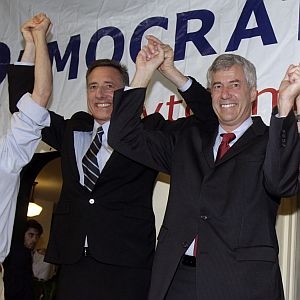
Doug 'n Pete in a happier moment. (Photo from VPR)

Doug ‘n Pete in a happier moment. (Photo from VPR)

Laura Krantz at VTDigger writes it as a Racine departure, not a firing. Which makes me wonder if the last straw was last week’s emergency budget adjustment, with its calls for further cuts in an already-overstretched agency. Maybe Racine stood up for his people, and got shot down for his trouble. I have no inside information on that point, but the timing certainly fits.

Whether a push or a jump, the shock is the suddenness of it all and the fact that the scythe took its first cut at the top level rather than, say, taking a Mark Larson or a Robin Lunge. It’s not surprising because sooner or later someone in state government had to take the fall for Vermont Health Connect’s continued troubles.

I say so not because any one of the three is more or less culpable for the VHC mess, but because Larson and Lunge were more directly involved. And because a cabinet member is a key gubernatorial appointment, this is a more direct reflection on the Governor himself.

But as Heintz points out, the trouble isn’t all health care-related. AHS’ Department of Children and Families has also come in for criticism following the deaths of two young children under its supervision. In that context, Racine was the most relevant target.

Health Commissioner Dr. Harry Chen will be interim AHS chief, with an appointment through the end of the year.

My take, and I have absolutely no knowledge of how AHS works or doesn’t: It was an almost impossible job. In fact, when Shumlin appointed his chief political rival to the post, I wondered whether it was an honor or an exile. AHS is a big, complicated operation that’s usually overtaxed and underresourced. Racine took the job after years of Jim Douglas-mandated cuts, and the disastrous implementation of Challenges for Change. It was the kind of job that was almost certain to leave Racine with a tainted reputation as a manager, especially with the Governor’s aversion to tax hikes and obsession with cost-cutting. And on top of all that, AHS was home base for health care reform and its myriad pitfalls.

It was a thankless job, and Racine kept at it for almost four years. And did his job largely out of the public spotlight, with a dignity and dedication that speaks well of him.


The curious incident of the dog in the night-time

So yesterday, your top three Republican officeholders held a well-timed dog and pony show on the subject of Vermont Health Connect. Lt. Gov. Phil Scott, Senate Minority Leader Joe Benning, and House Minority Leader Don Turner praised Governor Shumlin for finally pulling the plug on the troubled CGI contract, but called for a thorough “scrubbing” of the process and perhaps the firings of some Shumlin Administration functionaries.

Standard stuff, and a sound political move. The Administration deserves all the criticism it gets until it delivers a fully-functional VHC. But what struck me most about the event was a conspicuous absence: Republican gubernatorial candidate Scott Milne, the party’s putative standard-bearer, was nowhere to be seen. Or, in Sir Arthur Conan Doyle’s immortal words:

Gregory (Scotland Yard detective): “Is there any other point to which you would wish to draw my attention?”

Holmes: “To the curious incident of the dog in the night-time.”

Gregory: “The dog did nothing in the night-time.”

Holmes: “That was the curious incident.”

Scott Milne, the dog that did nothing.

According to a reporter who attended the event, the three addressed Milne’s absence by saying that they were discussing legislative action and Milne’s not in the legislature.

To which I say nope, not buyin’ it.

I don’t necessarily think they were lying. But I do think there are three possible explanations, none of which involves the imaginary line between politics and legislation.

First of all, a few facts. The CGI termination was announced on Monday, so it made sense for the Big Three to have a presser on Tuesday. And, according to Milne’s campaign schedule, he was in the Bennington area most of the day. So attendance at a Statehouse event would have been difficult.

But still. Milne is the head of the VTGOP’s ticket. Wouldn’t it have been nice to give him a share of perhaps the biggest single spotlight of the campaign so far?

I can see why the event had to happen shortly after the CGI announcement. But couldn’t they have, oh, found a way to work it out? Fit the presser into Milne’s schedule, or have Milne shuffle his? Or, failing any of that, have Milne there by Skype or videoconference? There were ways to make this work.

Back to my three explanations, none especially flattering.

1. They truly saw this as a purely legislative event and didn’t think of inviting Milne. That’s called not seeing the forest for the single tree of an ersatz principle. This was a great opportunity to present a unified front on one of Shumlin’s greatest vulnerabilities.

2. Milne was invited and chose not to shuffle his schedule. Which would be a political fumble of the kind all too typical of his nascent campaign.

3. The Big Three didn’t really want Milne there. Which would be the most damaging option. It’d be a strong indication that the VTGOP already sees Milne as a lost cause and a liability.

Take your pick.

The Democrats run something called the Coordinated Campaign, in which candidates contribute to a central fund that helps pay for all kinds of organizational goodies, like compiling voter data, managing volunteer activities, shared mailings and other campaign materials, GOTV, etc., etc. And whenever there’s a media event featuring Governor Shumlin, appropriate Democrats are part of the action.

At best, the Republicans are running an Uncoordinated Campaign and missed a golden opportunity to showcase their top man. At worst, Scott Milne is an isolated, doomed figure and nobody wants to be seen with him.