Tag Archives: Tom Kavet

Trump’s Canada Policy Has Had the Predictable Impact on Vermont Tourism

Back at the beginning of this year, when Donald Trump was spouting his “51st State” nonsense and threatening a tariff war with Canada, there were concerns about the effect on Vermont’s tourism economy. Well, we’re almost a year into the second reign of King Manbaby, and the numbers show that Vermont has, in fact, suffered greatly from Trump’s cold war with our neighbors.

Canadian tourism is down. Way down.

Canadian credit card spending in Vermont is down even more.

This is only one of the many negative effects of Trump on Vermont. Tariffs have bedeviled many Vermont industries and businesses, and have hit housing construction especially There are real and potential losses in federal funding, including the rampant politicization of disaster recovery aid. There’s the chilling effect on migrant workers, which is putting a real hurt on our construction and agricultural sectors.

I can’t quantify those effects. But I’ve got a bunch of numbers regarding Canadian tourism. And man, do they ever make for some grim reading.

Continue reading

Phil Scott Loses His Binky

For months and months, Gov. Phil Scott has been setting the stage for a Big Austerity Year where he could issue a rousing call to Live Within Our Means Like a Family Around the Kitchen Table, and slam the Democratic Legislature as mouth-foamin’ tax-and-spenders. After all, the federal Covid relief money has been spent, so the state will have to rely more heavily on its own coffers. And as the federal tide recedes, the knock-on effect will be a slowdown in Vermont’s economy. Of course. It all made perfect sense.

And then state economists Jeffrey Carr and Tom Kavet came along yesterday and pissed in the punchbowl. Take it away, VTDigger:

Despite last year’s hand-wringing over an anticipated downturn of Vermont’s economy, one year later, state economists on Thursday were notably optimistic about where the state’s finances stand.

Vermont’s favorite stats ‘n charts duo delivered the surprising good news to the Emergency Board, which consists of the governor and the four legislative “money committee” chairs. The Carr and Kavet economic forecast (downloadable here) will provide the basis for budget deliberations for the fiscal year beginning July 1.

And Scott just lost a fair bit of leverage in those deliberations. I’m sure that as a person, he’s glad to see Vermont doing so well. But c’mon, despite his protestations to the contrary, Phil Scott is a politician. He’s been in politics for more than 20 years. This, speaking purely in political terms, is a setback for his planned austerity offensive.

Continue reading

State Economists: Smooth Sailing for Now, Storm Clouds on the Distant Horizon

All smiles for another 12-18 months

Thursday marked the semiannual Festival of Numbers that is the consensus economic forecast, prepared as always by Vermont state economists Tom Kavet and Jeffrey Carr. The topline: Happy times will continue for another year and a half or so, but after that there’s tremendous uncertainty and huge downside risk.

Or, to put it in purely political terms, Phil Scott will enjoy smooth financial sailing through fiscal year 2024 (assuming he wins another term, and there’s no reason to think he won’t), but whoever is governor in 2025-26 may have a real mess on their hands.

The very short-term forecast is for even more money to flow into Vermont’s coffers. Carr and Kavet upgraded their revenue forecast for the rest of FY2022 (ends June 30) by $44 million.

The reason: Vermont’s economy and state revenues continue to be buoyed by the flood of federal Covid relief dollars — more than $10 billion in all. “We had a [fiscal] hole and we’re filling it five times over with federal stimulus,” said Kavet. Those dollars will continue to flow for 12-18 more months. Then comes a return to Earth, and a landing that might be soft, or… a splat on the landscape.

“There is no playbook from the last time the feds dropped $10 billion on our economy,” said Carr, meaning that it’s never happened before. When the money dries up, Carr said, “the amount of risk, especially on the downside, escalates… The economy will transition into something new and different.”

And while the short-term outlook is rosy in the aggregate, that doesn’t mean everyone is doing well. “One hand’s in boiling water, one’s in ice water,” said Carr. “On average, you’re okay.”

Continue reading

The Luckiest Man in Vermont

Gov. Phil Scott issued his budget address today (YouTube video here). It was an astoundingly pain-free occasion, considering that we’re in the throes of a pandemic that’s been holding our economy hostage for almost a year now. In fact, rather than proposing painful cuts, Scott offered a generous scattering of funds for a wide variety of programs that, he said, will put Vermont on a sounder footing going forward.

How? Simple. The tsunami of federal Covid relief money. Scott’s budget includes $210 million in one-time money from the feds. As we heard from state economists Tom Kavet and Jeffrey Carr last week, federal money has prevented an economic collapse and even contributed to a boom in some sectors.

Throughout his political career, Phil Scott has benefited from little-known and/or underfunded Democratic opposition in races for state senate, lieutenant governor and governor. In his six races for statewide office, the closest result was the 2010 contest for lieutenant governor — seven percentage points over Steve Howard. He gets credit for being an appealing political figure, but he sure hasn’t had to fight very hard.

And now, once again, he’s the luckiest man in Vermont. You’d think a shattering pandemic would lead to massive cutbacks, but no. Scott could once again boast of a budget that wouldn’t increase taxes or “existing fees.” And according to Kavet and Carr, the state economy will continue to be buoyed by federal infusions for the next two fiscal years. Which will make it a lot easier to craft a pain-free state budget again next year and, if he runs for a fourth term, he may well be unbeatable once again.

Continue reading

“The Tom and Jeff Show”

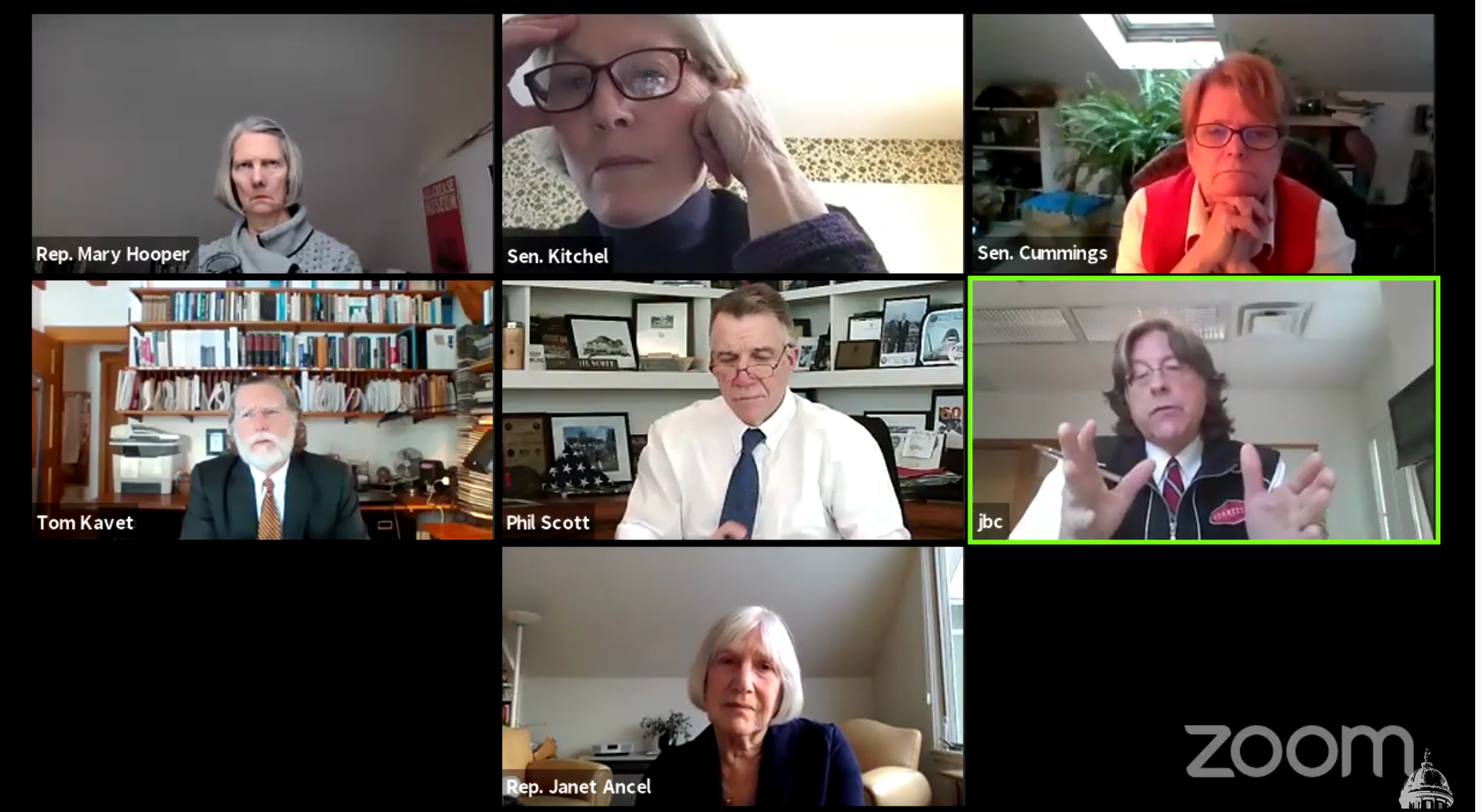
Best: Gov. Scott, great lighting, busy but effective background. Worst: Pretty much everybody else.Extra demerits for “Redshift” Cummings and “Tiny” Hooper.

Vermont’s Emergency Board, an obscure but highly influential entity, held its twice-yearly meeting Tuesday afternoon to receive an updated revenue forecast from state economists Tom Kavet and Jeffrey Carr. Or, as the governor dubbed it, “The Tom and Jeff Show.” (The E-Board includes Gov. Phil Scott and the chairs of the Legislature’s four “money commitees” — House and Senate Appropriations, House Ways & Means, and Senate Finance. All of whom are women, it should be noted.)

Their report is posted as a downloadable file on the Legislative Joint Fiscal Office website. It’s recommended reading; it’s full of economic information beyond the basic tax projections. Video of the E-Board meeting available here.

Considering the pandemic and all, the news is astonishingly good. The new outlook for FY2021 predicts a very slight dropoff in total revenue, about $20M in all. That’s peanuts compared to earlier dire predictions. For FY2022, which begins in July, the new forecast predicts $77M in additional revenue. Carr and Kavet also predict a big increase in revenues for FY2023.

(Now, if you’re concerned about the federal deficit, it’s not all good news. Since 2018, deficit spending has gone from 105 percent of GDP to 135 percent. Covid relief is one driver of the increase; the other is the Trump tax cuts of 2017.)

How can this be? One simple explanation: A tsunami of federal recovery funds. And with Democratic control of the presidency and Congress, Carr and Kavet expect at least one more big infusion. (President-elect Biden has proposed a $1.9 trillion relief package.) So far, federal relief funds to Vermont account for a stunning 20 percent of the state’s gross domestic product.

“Without the federal money, I’d be declaring a five-alarm fire on Vermont’s economy,” said Carr. “We’re all Keynesians now. If we throw enough money at a problem, we can mitigate the damage in the aggregate.”

Continue reading

VEGI: A step in the wrong direction

Sometime this week, the state senate will take up S.138, an economic development bill that includes a taxpayer-funded incentive for businesses to create crappy jobs.

Tough assessment? I don’t think so. The bill allows employers to pay its workers less and still qualify for state job-creation incentives. Currently, cash awards from the Vermont Employment Growth Incentive program (VEGI) require that employers pay at least $14.64 per hour. S.138 would lower that minimum to $13.00 per hour — the Joint Fiscal Office’s standard for a “livable wage.”

Well, that’s the livable wage with significant caveats. VTDigger’s Erin Mansfield:

The $13 per hour figure assumes two adults living together in a two-bedroom home, who share expenses, have no children, and have employers that pay 80 percent of health insurance costs.

Problem: that description doesn’t apply to an awful lot of working Vermonters. The consequence: those state-funded jobs leave full-time workers poor enough to “qualify for thousands of dollars in annual assistance,” according to economist Tom Kavet in a report to the legislature’s Joint Fiscal Office.

So we’d be paying companies to put workers on public assistance. This is… progress?

The downward expansion of VEGI is “expected to cost the state between $10 million and $25 million.” Your Tax Dollars At Work.

Kavet’s report leaves no doubt about the dubious value of that public investment:

The Shumlin administration’s plans, Kavet said, “serve to diminish the public return on investment from this program by lowering standards, eliminating basic fiscal controls, or allowing public subsidies when they would not previously have been allowed.”

Commerce Secretary Pat Moulton defends the proposal with the kind of language you usually expect to hear in Texas or Mississippi:

Moulton said she would rather employ a Vermonter at $13.50 per hour than let the jobs go elsewhere. Employees can move up from lower-paying jobs, she said.

“We’re competing globally for jobs. We’re competing regionally for jobs,” Moulton said.

I understand the harsh economic realities of our troubled times, but if you ask me, this is a bad idea. I don’t want my tax money being spent to underwrite dead-end jobs. And I’d love to know what kind of corporate lobbying went into this ill-considered proposal.