
Vermont’s SPEED program is in the news again. And, as is usually the case, much of the coverage misses the point. As does all of the criticism.
SPEED, for those just joining us, is short for Sustainably Priced Energy Enterprise Development. It was enacted by the legislature in 2005; its aim was to encourage development of renewable energy, which at the time was in an embryonic stage and suffered from competitive disadvantages.
(It was more expensive than fossil fuels. Which, of course, benefit from tax credits and other forms of government largesse, and the harm they do to the environment is not factored into their pricing, so they are much cheaper than they ought to be.)
As I explained in a nice long 2013 thumbsucker on Green Mountain Daily:
SPEED was designed to surmount the chicken-or-egg problem with renewables: the upfront investment is relatively large, making renewables uncompetitive at the beginning. Over time, their costs drop dramatically because, well, they’re renewable: no need to keep on buying fuel. SPEED provided a market-based solution to the initial-investment problem by allowing utilities to sell long-term contracts for renewable power. Without SPEED, adoption of renewables in Vermont would have been much, much slower.
The program’s critics say the trading scheme means that our renewables are, in effect, enabling the use of dirty energy elsewhere. In particular, SPEED’s been used as a punching bag by opponents of wind and solar power.
Today, there are stories on VTDigger (pretty good) and VPR (not so good) about the Shumlin administration definitely (VTDigger) or possibly (VPR) planning to phase out SPEED in 2017.
Well, hell. That was the plan from the very beginning. SPEED was meant to goose the renewables market. And it’s worked: according to VTDigger, “The state has built wind, solar and other renewable power generation that could supply about 15 percent of the state’s electric retail sales.” That’s substantial progress.
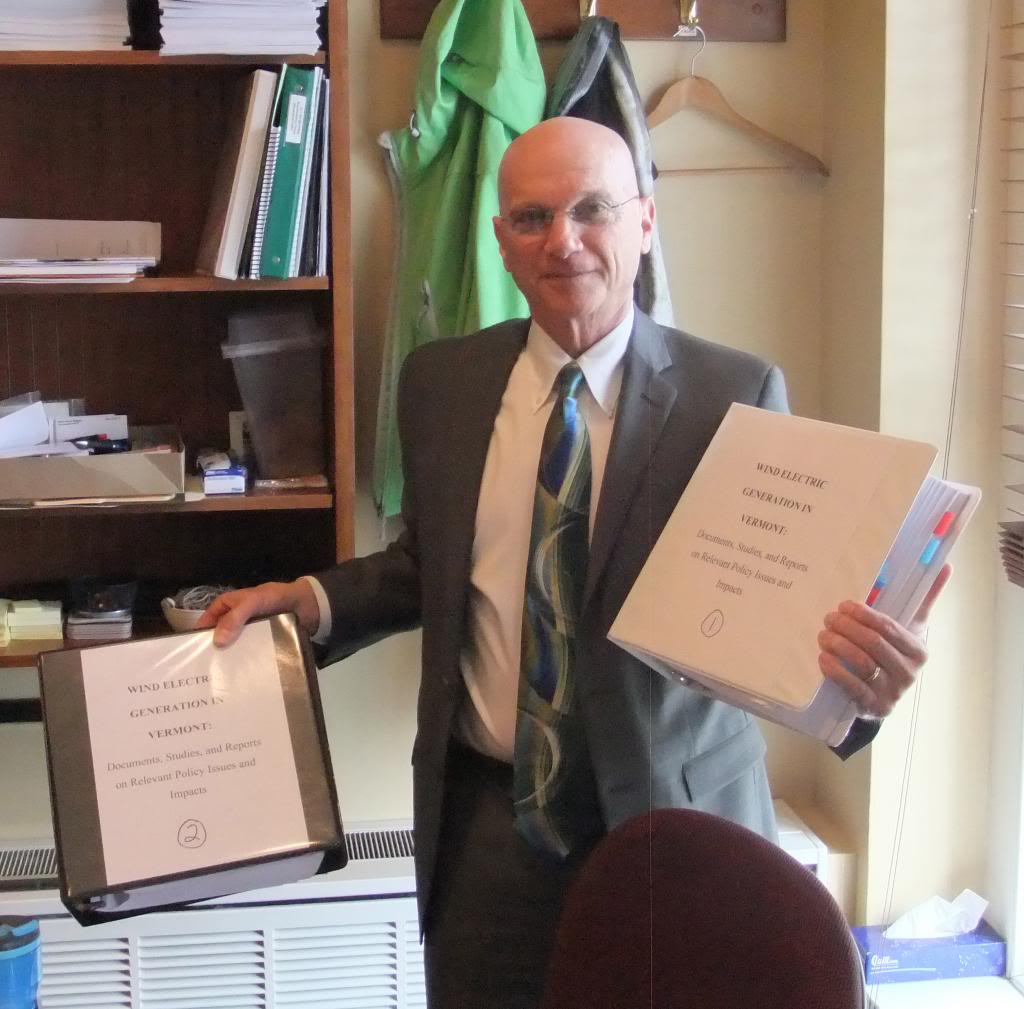
Rep. Tony Klein, D-East Montpelier, displays some of his vast knowledge.
SPEED was designed to be temporary, and was set to expire in 2017. It could have been extended, to be sure; but one of the House’s top energy people, my own state representative Tony Klein, has been saying for a long time that SPEED would sunset on time.
And on Saturday, Governor Shumlin told the House Democratic caucus that SPEED would be scuttled on schedule. VPR’s John Dillon somehow missed this; he has the administration merely considering a change to SPEED. (The VTDigger story has the administration “calling for an end” to SPEED, which is closer to the mark but not quite there.) In his story, Dillon gives extensive time to the Vermont Law School’s Kevin Jones, who’s had a bug up his butt about SPEED for a long time.
“For me, it’s at least a step in the right direction for the Public Service Department and the Shumlin administration for finally acknowledging that the SPEED program does not work in terms of providing any climate mitigation,” he said. “As a matter of fact, it has increased Vermont’s carbon footprint, by something, according to their analysis, like 70,000 tons in greenhouse gas emissions in 2013 alone.”
Jones’ interpretation is ignorant at best, disingenuous at worst. The DPS and administration are not “finally acknowledging” anything; they are letting SPEED expire on schedule.
And the purpose of SPEED was not to immediately mitigate Vermont’s carbon footprint; it was to hasten development of renewables so our longer-term footprint would decrease.
Also, SPEED may have “increased Vermont’s carbon footprint,” but only technically: the renewable credits were sold out of state, but the energy was still being produced, thus reducing the region’s carbon footprint while — again, technically, and only in the short term — increasing our own.
Finally, a misperception from VTDigger’s article:
The state’s goal is to generate 20 percent [of electricity via renewables] by 2017, but there is no requirement in state law that this power is to be sold to Vermont customers.
This reflects a fundamental misunderstanding of electric markets. In the absence of large-scale storage technology, electricity is produced, transmitted, and consumed all at the same time. The power grid is a regional creature, networked to the national grid. There is no way to tease out which energy came from where and ensure its consumption within the state of origin. Such a “requirement in state law” would be technologically laughable.
Vermont’s power — renewable, dirty, Vermont Yankee, whatever the source — goes into the grid at the same time as power from out-of-state sources; it’s shunted around the grid to where it’s needed at that moment, and consumed. It’s like taking a cup of your tap water, pouring it into a bucket of water, and then wanting to take back your own water. Can’t be done.
Which is at the heart of the anti-SPEED absurdity. The renewable energy whose development was fostered by SPEED went into that big bucket. Whether or not it was immediately credited to Vermont’s account, it exists, and it helps reduce the region’s dependence on dirty energy.
The SPEED program has had a purpose. It has served that purpose well. Now it’s time to move on. And we will.
 The Vermont Political Observer.