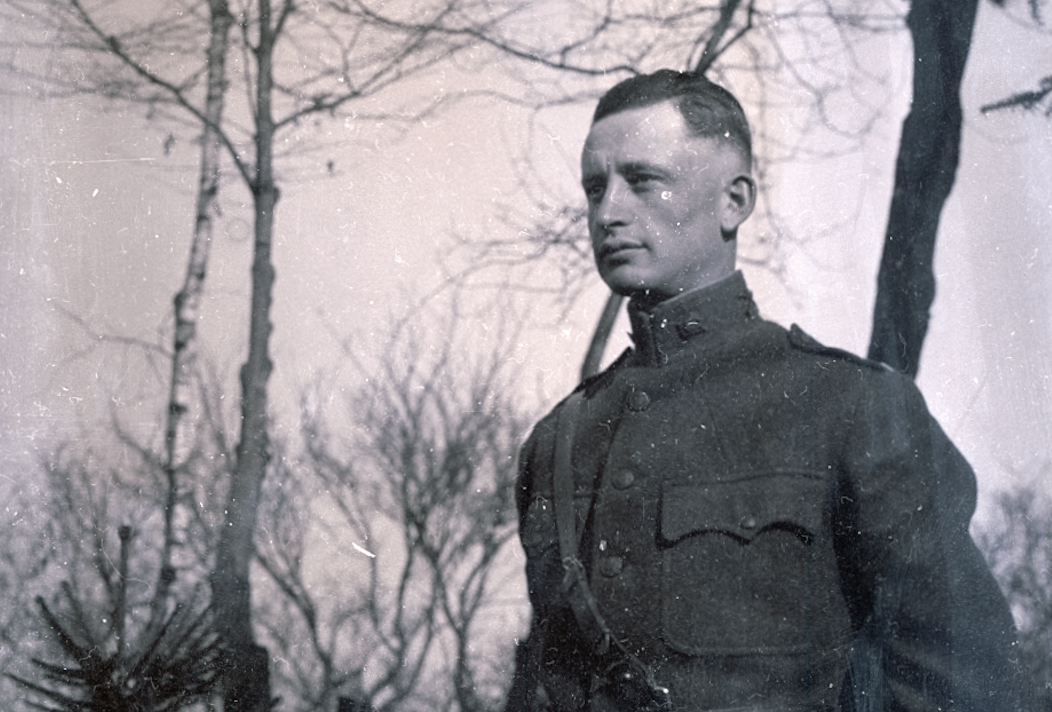
On July 15, 1917, a young man I’ll call W. reported for duty with the 4th Ohio National Guard. He was an executive with a bright future in the Goodyear Tire and Rubber Company; he had gotten married only two months earlier. But the Allies were desperate for help against Germany, and the United States was mobilizing as quickly as it could. W., a veteran of the 4th Ohio’s campaign against Pancho Villa the previous year, was a Second Lieutenant.
At the time, the U.S. had the merest shadow of a standing military, so the Guard troops were pressed into service. The 4th Ohio was folded into the new 42nd (Rainbow) Division of the U.S. Army, which included Guard troops from several states. (Hence “Rainbow.”) After training in Ohio and New York, the men shipped out to Europe in mid-October. They suffered a very rough two-week crossing in a hastily refitted cargo ship that had formerly carried fruit from South America. It was only the first of many privations they would endure.
The war was not going well. After three years of stalemate on the Western Front, Germany was winning elsewhere. Russia was collapsing, and Italy was in retreat. Soon, Germany would be able to concentrate its forces in the West. The poorly trained and outfitted Americans were desperately needed to prevent the Germans from overrunning the battered French and British forces.
The winter of 1917-18 was one of the coldest on record. The men of the 42nd trained, marched, and bivouacked in extreme discomfort. But that would seem mild in comparison to the harsh fighting of the spring and summer, as the Germans mounted an all-out offensive and the Allies desperately fought to turn the tide.
In mid-February, the 42nd was ordered into the front lines. On the transport train, Lieutenant W. began to suffer intense pain. From his diary:
“Rt. upper bicuspid which had nerve killed, formed abscess. Grew extremely painful so had Bill Seamans our dentist try to yank it out. He pulled and hauled and then broke it off. Wow! But that relieved the pressure on the abscess, and I was able to sleep a bit.”
His stoicism would serve him well. From late February to late June, Lieutenant W. and his men served in the trenches of the Western Front, a scene of unimaginable devastation.
Continue reading →
 The Vermont Political Observer.