Tag Archives: Phil Scott

Is the ground buckling under Phil Scott’s feet?

Lately, there have been signs aplenty of passengers taking their leave of the Good Ship Moderate Republicanism, helmed since last November by Captain Phil Scott and first mate “Super Dave” Sunderland. Or maybe Scott’s the admiral and Sunderland is captain, whatever works.

Scott and friends came away from last November’s VTGOP meeting with a rather conditional mandate to broaden the party’s base. Make it more attractive to moderate and undecided voters, and the pragmatic business types who’ve made their peace with the Democrats under Governor Shumlin.

It seemed a promising direction. Indeed, the only possible direction, since the Vermont electorate wasn’t suddenly going to turn Texas red. The conservative VTGOP of “Angry Jack” Lindley et al. had hit a glass ceiling at about 35% of the vote.

But it was going to be a tough job for Scott, previously not known for his willingness to tackle tough jobs. He was, by dint of his elective office, the only person who could credibly take it on; but he also, by dint of his personality, seemed unsuited for the task. And even if he rose to the occasion, the odds seemed to be against him. Shumlin and company have done a really good job of co-opting the center, and it’d be a hell of a job for Scott to win back all those voters and supporters without moving so far to the center that he completely alienates the easily alienated conservative base.

It’s only been about nine months, and the Good Ship Moderate Republicanism looks to be taking on water. Recent signs include:

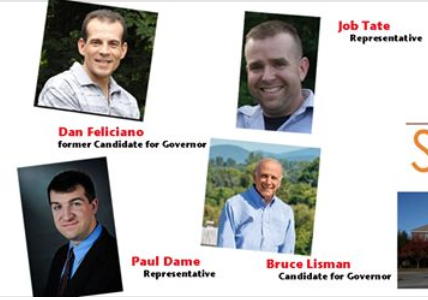
Bruce Lisman’ decision to forego any sort of alignment with the VTGOP, even after he stepped away from leadership of Campaign for Vermont, the self-described nonpartisan policy shop.

Lisman’s brief and pointless flirting with a run for Governor this spring, which lasted just long enough to force State Rep. Heidi Scheuermannf (a Lisman ally) out of the race.

The continued activity of Campaign for Vermont. Its members do include people from across the political spectrum, but the group still tilts substantially toward the right. And many of its key supporters are the kind of people who used to be mainline Republicans.

Roger Allbee’s decision to run for State Senate as a Democrat. The former Douglas Administration cabinet functionary and self-described liberal Republican could have been a powerful ally for Scott. Instead, he’s hoping for a place on the other ticket.

— Former State Rep. Oliver Olsen’s decision to run again for his old seat, but this time as an Independent. In the 2011-12 biennium, Olsen was one of the more vocal and effective members of the House Republican minority; this time, he seems to believe that he’s better off without the “R” next to his name.

— Last week’s VTGOP campaign finance report which, as I reported in this space, was truly horrific. A quarterly fundraising total — during a campaign season, mind you —  of only $7,500. The bulk of that came from a few party insiders. And over the past year, the VTGOP has drawn virtually no small donors, a sign that so far it’s failing to reach the grassroots. In spite of Sunderland’s repeated claims that the people of Vermont are waking up to the failures of the Shumlin Administration. Well, they haven’t awakened enough to write any checks, that’s for sure.

What that dismal report means is that the VTGOP has lost some of its hard-core, ideologically driven donors, but has yet to even begin to attract a new donor base. Nor has it even begun to convince former Republican stalwarts to come back home.

— And finally, this week’s formation of Vision to Action Vermont (V2AVT), a “bipartisan” PAC aimed at supporting candidates who are focused on improving Vermont’s economy. Its co-founder is Scheuermann herself, and her decision to create this independent group is an interesting one. You’d think that Scheuermann would be one of Phil Scott’s most trusted lieutenants, with a bright future in Republican politics. But as with Allbee and Olsen, she has apparently decided that the Republican brand is too toxic to advance her goal of electing lawmakers who are focused on economic issues.

Take all these events together, and it seems like the Republican center-right is fragmenting in all directions rather than coming together behind Scott and Sunderland. That, I think, is a very bad sign for Scott’s effort to broaden his party. The people who might have been part of a new, broader, more vibrant VTGOP are channeling their energy in other directions.

It may seem unfairly early to declare Scott’s project a failure. After all, it’s been less than a year, and it took quite a few years for the VTGOP to get so badly screwed up. But Scott’s party has no resources and few candidates; if he fails to make any headway in Legislative elections, a substantial portion of the party will be ready and eager to unseat Scott’s team and return the party to its former course: down an ideological dead end.

The VTGOP: It’s worse than it looks

While poring over the campaign finance filings from this week, I couldn’t help noticing that — in sheer fundraising terms — the Republican Party has slipped into the #3 position. Yep, they’re being out-fundraised, quite handily, by our humble friends in the Progressive Party.

The numbers: VTGOP raised $7,500 for the most recent period (mid-March to mid-July) and $61,000 for the entire election cycle. The Progs, by contrast, raised $16,000 for the period and $89,000 for the cycle. (All numbers rounded off, thanks.)

See, it’s not even close. The Progs are a solid number 2.

This isn’t because the Progressives have enhanced their drawing power; their numbers are roughly on track with the same time frame in the 2012 cycle. It’s just that the Vermont Republicans are simply terrible at fundraising. Really, really, bad.

But wait — it’s worse than that.

In its mid-March filing, the VTGOP reported raising more than $45,000. This, presumably, reflects the take from the big Chris Christie fundraiser in December. That’s a really nice number, but it’s a whole lot lower than what party leaders were projecting before Christie’s visit. And it didn’t set the party on a new, healthier course; it merely provided a temporary jolt, like treating a pneumonia patient with Red Bull. Judging by its latest report, the VTGOP can’t draw flies without a big event. $7,500 is a wretched total for a “major” party entering a statewide election campaign. (It may help explain why short-term party staffer Brent Burns has departed to set up his own campaign shop; I suspect that either he wasn’t getting paid regularly, or it was made clear to him that the party couldn’t continue to pay him. Instead, we have Jeff Bartley as the party’s “Victory Director.” And I’m pretty sure that’s a part-time gig.

But wait — it’s even worse.

That $7,500 for the most recent period included $2,000 from Lt. Gov. Phil Scott’s campaign fund, $1,000 from Phil Scott’s construction company, and another $1,000 from State Rep. Heidi Scheuermann’s campaign fund. Plus $1,000 from Jani-Tech, a janitorial services company. Jani-Tech’s owner, Dawn Terrill, is the VTGOP’s new finance chair. Plus $800 from Greenleaf Metals, owned by party treasurer Mark Snelling.

So the bulk of that pathetic fundraising total came from a handful of insiders. Without Scott, Scheuermann, Terrill, and Snelling, the party would have received a measly $1,700 over a three-month period. A three-month period in which the party ought to have been marshaling resources for intensive campaigning.

What’s worse than pathetic? Abysmal?

One final note of despair. The GOP’s campaign bumpf is generously festooned with references to the state’s political elite, by which they mean the Democrats. But if the Republicans are trying to appeal to the common folk, the working man, Joe Sixpack, they are failing completely. In the past year, the Vermont Republican Party has taken in only 15 individual contributions of less than $100. What little money they’re raising is being given by the usual handful of insiders and well-connected business types.

Of course, a big part of the Republicans’ problem is that they’re getting a lot less from those business types than they used to. Many businesspeople and wealthy donors of centrist orientation, or of a practical bent, have abandoned the Republicans and are either sitting on their money, sending it out of state, or giving it to the Democrats.

But the takeaway here is, the Republicans have no appeal for the general public. At least, not enough appeal for individuals to open up their wallets.

See, it’s even worse than it looks.

When public policy becomes personal

Let’s look at the two guys likely to headline the Republican ticket, such as it is, in Vermont this year: gubernatorial candidate Scott Milne, and incumbent Lieutenant Governor Phil Scott. Both are men of moderate reputation and widely seen as “nice guys.” Both have shown a disinclination to take hard-and-fast political stances.

But for each of them, there’s one exception to the general tone of moderation. Milne and Scott have each spoken loudly and strongly on one issue respectively. For each, it’s an issue that has left the realm of abstract policy and directly impacted their own fortunes. In the case of our Lieutenant Governor, it’s public campaign financing; for Milne, it’s the approval process for new developments, most especially Act 250.

It’s funny how a personal stake can turn a moderate into a firebrand. But it does call into question their ability to govern dispassionately. One of the most important things I want to know about candidates is this: Can they make decisions based on the public good, even if they’re going against their own personal interest? Can they set their interests aside?

Both top Republicans are in danger of failing that test.

As for Scott, after years of building a politiical career on being inoffensive and avoiding the tough call, he has become a late-blooming opponent of public campaign financing. When he was a state Senator, Scott wasn’t particularly against the idea, and he had his chances. And during his tenure as Lieutenant Governor, he’d never spoken out about it.

Until now, when a publicly-financed candidate threatens to give him a real race. Now he’s decided that public financing is an unfair burden on taxpayers, forcing them to effectively support a candidate they may personally oppose. Which ignores the whole social-good function of publicly financing ANYTHING — roads, welfare, education, police, military. Every one of us pays taxes to support something that we personally would not choose to spend money on. Public financing is a drop in that particular bucket.

As for Milne, he’s hot and bothered over the development approval process because of his big personal stake in Quechee Highlands, a proposed housing/retail project slated for a large parcel near Exit 1 of I-89. (This story was broken earlier this week by my colleague BP at Green Mountain Daily.) How hot and bothered? In an essay published last August in the Valley News, his opening salvo was:

All who care about Vermont’s future, fairness in government and how communities settle disputes should pay heed to what is happening a few miles from the Connecticut River at Quechee Highlands.

Wow. That’s putting it pretty strongly. “Vermont’s future” depends on Milne getting his way on this project. Lacking in perspective much?

He goes on to slam the regional planning commission for denying an Act 250 permit for the project. In the process, he reveals substantial ignorance about the mission and workings of those commissions. Most notably, he wrote that the commissions’ purpose “should be to help promote development that creates a foundation for economic health.”

Er, Scott. Hate to break it to you, but those Act 250 bodies are meant to balance development with conservation, not to promote development. And your little project, I have to say, would be built in an area with precious little road infrastructure. The corridor between Exit 1 and Woodstock is already a mess, and the vicinity of Exit 1 is especially bad. The original proposal was for an entirely retail project, which would have been a traffic nightmare. Milne and co. later revised it to mixed-use, residential plus “less than 37 percent retail.” Which is still quite a lot of retail in a 168-acre development. (The retail is clearly aimed at cashing in on the proximity to I-89. The site is less desirable for housing because of freeway noise.)

At the time, one of the pillars of Milne’s argument was that while the regional board had said “no,” the town of Hartford was in favor of the project. And he asserted that the town’s view should have greater weight.

Since then, Hartford has changed its tune. In May, the Hartford Selectboard amended its master plan to bring it into compliance with the regional commission’s plan. Before the Selectboard’s vote, Milne warned that QH would be “dead” if the changes were adopted. He’s already pursuing appeal of the regional commission’s ruling; he’s now threatening to take Hartford to court as well:

“I’m going to try to figure out if I’m going to do anything, and if I do, it’s probably going to involve more lawyers, and it’s just going to continue to brand Vermont as a bad place to do business,” said Milne.

Sheesh. Rejection of Milne’s project will “brand Vermont as a bad place to do business”? Mr. Milne seems to have an awfully… shall we say, expansive… view of himself and the importance of his project.

And it wasn’t long after the Selectboard action that Milne began publicly mulling a run for Governor, having previously given no hint of ever desiring a political career.

Now, I don’t think Scott Milne wants to be Governor so he can save Quechee Highlands. But it’s clear from his own statements that he has very strong pro-development views. And if he were to become Governor, he’d clearly push for substantial changes in the Act 250 process that would shift its focus from conservation to, in his own words, “help promote development.”

That’s a pretty radical take on Act 250, is it not? It’s looking like Milne is not that much of a moderate, at least on this very crucial issue. It calls into question his ability to dispassionately consider issues in which he has a personal interest. It also calls into question the entire foundation of his campaign, which portrays him as a centrist who can build bridges and work with the Democrats.

Cronyism and disloyalty in the State Senate

So the Democrats (and Prog/Dems) have a supermajority in the Vermont Senate. They rule the roost. And they’re almost certain to retain a big edge next year; even the Republicans are hoping to win no more than two or three seats.

Which makes me wonder why the two Democratic members of a key committee, plus the chair of a very important committee, have endorsed a Republican for one of Vermont’s highest offices, and are likely to get away with this bit of disloyalty.

I’m talking about John Campbell and Dicks Mazza and Sears. The first two sit on the Senate’s Committee on Committees along with their favorite Republican, Lieutenant Governor Phil Scott. Sears chairs the Senate Judiciary Committee. All three have endorsed their buddy Scott and turned their backs on the likely Democratic standard-bearer* and only liberal in the race, Progressive Dean Corren, in spite of the fact that Governor Shumlin has given public support to Corren.

*Corren has to win the Democratic primary as a write-in. He should be able to do that, but it’s no sure thing; Mazza’s openly talking of a write-in campaign for Scott. Which would lead to a goddamn embarrassment for Vermont’s dominant party: a Republican in the #2 spot on its ticket. 

If these men keep their privileged positions, it’ll be a disgrace. And, based on past history, it’ll almost certainly happen.

The Committee on Committees is an obscure bit of Senate hierarchy, with one big exception. Every two years, they select all the chairs and members of all the Senate committees. That is one big moment of muscle-flexing for an otherwise quiescent body.

The three members of the CoC are: the Senate President (Lieutenant Governor), the President Pro Tem, and a Senator elected by the entire Senate. For many years now, Dick Mazza has been rubber-stamped into this position — even though this is far from the first time he’s endorsed a top Republican. He supported Brian Dubie for Governor in 2010, and has backed Phil Scott every time he’s run for Lieutenant Governor.

The lopsided Democratic majority could eject Mazza in a hot minute and instead reward a more faithful member of their party. They could also choose a President Pro Tem who’s more in step with the party’s mainstream. And the new CoC could replace Sears on Judiciary. But, given the hidebound, clubby nature of the Senate, I fully expect that all three will retain their influential positions this fall.

There’s no good reason for this. The explanation, of course, is the mutual respect of Senators and their unwillingness to publicly embarrass a colleague. Which is not a good reason, just a dearly-held rationale in the hearts of our solons.

Campbell, Mazza, and Sears do not deserve to be rewarded for their disloyalty. If there’s anything like party discipline within the one-sided majority, the Senate’s Committee on Committees will get a makeover. And, ideally, somebody else will wield the gavel come January.

But, as I said, I don’t expect it to happen. The Senate’s too damn clubby for that.

(It’s not often these days that Vermont Republicans get to enjoy a laugh at the Dems’ expense. They must be blowing chortle-bubbles in their Scotch glasses over this.)

The Campaign Finance Report Day That Was: more miscellany

I’m going to put off a couple items till tomorrow, if you don’t mind: The full impact of Governor Shumiln’s money tsunami, and the Curious Case of the Local Republican Committees. For now, let’s clean out the ol’ inbox.

— If dollars are any indication, the Windham County Democratic Senate primary is definitely taking shape. Incumbent Jeanette White hasn’t submitted a report, which most likely means she raised and spent little or nothing. Okay, so she’s the incumbent. Two other Dem candidates posted relatively meager totals: Joan Bowman and “The Artful Roger” Allbee. The financial powerhouse in the race is Becca Balint, who raised more than $10,000 and spent about $4200. Her many donors include one Jane Lynch of Los Angeles, California, who kicked in a cool grand. Would this be the Jane Lynch of Glee fame? Don’t know.

But most of Balint’s money came from within the county. Which is a sign that the local money is on her side, and she’s off to a sizeable lead over her competition. (Recap: there are two Senate seats in Windham County. Jeanette White’s running for re-election, and Peter Galbraith is, praise the Lord, not. There are four candidates on the Dem primary ballot, fighting for two spots. No Republicans have entered the race, unless you count former Douglas Administration functionary Allbee, who’s running as a Dem.

— As far as I can tell, the most well-endowed (please hold the locker-room yucks) Senate candidate is one Dustin Degree of Franklin County. He’s raised over $15,000, including $6,000 from members of the Vallee family. One notable expense: $1700 to the St. Albans Messenger for what Degree’s filing calls “print adds.” A bit of remedial spelling is in order chez Degree.

Phil Scott has picked up his fundraising pace, now that he has to deal with the publicly-funded Dean Corren. Our Lieutenant Governor carried forward a $41,000 balance from his yawnfest of a win over Cass Gekas; he’s raised $61,000 and spent a chunk of that, leaving him with a current cash balance of $78,000. He vows that he will match Corren’s $200,000 in public-financing dollars with at least that much of his own. A lot of his contributions, natch, are from corporations and business-friendly PACs.

— Two years after losing to Bill Sorrell in the Democratic primary, TJ Donovan has finally closed out his campaign account. He’s folded virtually all the remaining funds — more than $4,600 — into his campaign for re-election as Chittenden County State’s Attorney. Which is probably $4,599 more than he will need to win. I guess he can always open up a new Attorney General campaign committee and shift the money back over.

— Donovan’s campaign filing for State’s Attorney had one interesting donation: $1,000 from Thom Lauzon, the Republican Mayor of Barre. 

— Lenore Broughton’s colossal waste of money, Vermonters First, looks to be inactive for this season. The SuperPAC is carrying a balance of roughly $3,000, but there was virtually no activity during the most recent reporting period. If Broughton is gearing up for another push, she’s hiding it well. (Oh, and her new Minion of Record is Robert Maynard, best known as a writer for the useless True North Reports. Her former Minion, Tayt Brooks, landed himself a new gig with the conservative movement-building enterprise American Majority.)

FedEx may be unfriendly to union organizing, but it seems to like Democrats — at least in Vermont. The FedEx PAC gave $4,000 to Governor Shumlin’s campaign, plus $1,000 each to the Vermont Democratic Party and the Dems’ House Campaign Committee. And not a sou for the GOP. Sad.

That’s it for tonight. Tune in tomorrow for the last two big items from filing deadline day. And thanks for reading; this site set a new record for single-day pageviews, and I appreciate the traffic and the implied respect.

Early afternoon thoughts on campaign finance filing day

First, a couple newsworthy Tweets from VPR’s Peter Hirschfeld. He reports that the Scott Milne campaign will report roughly $20,000 in contributions, and that Phil Scott will report about $50,000. Milne’s total is awfully pitiful; Scott’s still got a ways to go to catch up with Dean Corren, who qualifies for up to $200,000 in public financing.

As of 1 p.m., neither candidate had actually filed. Other notes:

— The aforementioned Corren reported just under $20,000 in donations from 862 donors. No single donation is worth more than $50. That’s an impressive show of organization and appeal.

— If you want a snapshot of the relative financial pull of the Democrats and Republicans, take a look at their respective House campaign operations. The Dems have raised a daunting $108,000 for their House campaign kitty and spent almost all of that. Notable on the expense ledger are salaries for two campaign staffers — just for the House campaign. (The Repubs, at last check, had one paid staffer for the entire state party. Might be two.) The Republicans’ House campaign operation has raised a paltry $12,000 and spent about 5K.

— Most of the House Dems’ money has come from two sources: State Representatives financially supporting a joint campaign, and corporations and their PACs. Big bucks from MVP Health Care, the Association of Vermont Credit Unions, the Vermont Realtor PAC, New England Cable and Telecommunications Association, and the Corrections Corporation of America (yuck), among others.

— You know which PAC has taken in more money than the Republicans’ House campaign? The Common Sense Leadership PAC, the brainchild of House Minority Leader Don Turner. He’s raised $26,000 for this cycle and spent $12,000. None of it on donations to House candidates. He has paid $2700 to consultant Shayne Spence, and $900 to Johnston Consulting. Why he’s wasting money on Darcie Johnston’s “expertise” only he can say. Turner raised $10,000 of his money in $2000 increments from two stalwart Republican families: the Vallees and the Pizzagallis.

— In the closely-watched State Senate race in Windham County, Joan Bowman has reported donations totaling $1500. But about three-quarters of that is from herself or her family. Bowman is one of four Democrats running for two Senate nominations in August: the others are incumbent Jeanette White, former Douglas Administration cabinet member “Artful” Roger Allbee, and newcomer Becca Balint. It’ll be interesting to see how much Balint takes in; from the outside, it looks like she and Bowman are in a face-off for the non-White, non-Allbee votes.

Bill Doyle doesn’t have to lift a finger, and isn’t. He’s sitting on a balance of $6,500 from previous campaigns. He’s raised $100 this year and spent nothing. I think he’s rightly confident.

Pat McDonald, the former Republican State Rep who’s now running for one of Washington County’s three seats, has racked up a noteworthy $10,000 in donations. She’s spent about half of that.

Doug Hoffer has raised a modest $4400 and spent most of it. Well, he is essentially unopposed in his bid for a second term as Auditor. The bulk of his spending was in two contributions to the state Democratic organization: $1500 to the party, and $2250 to the Dems’ “coordinated campaign.” I guess Doug’s taking this “Prog running as a Prog/Dem” thing seriously.

— Former Republican Representative Oliver Olsen, on the comeback trail as an Independent, is raking in the cash (by House standards). He’s raised $5,700, and spent almost nothing.

— Who hasn’t been a candidate in four years, but keeps on filing campaign finance reports? Matt Dunne, that’s who. He filed as “not a candidate” and reported a carry-over surplus of $2,856.54.

— Former Democratic State Senator Bill Carris, who resigned for health reasons in 2012 (Eldred French was appointed to fill out his term), has liquidated his campaign funds. He had $9400 on hand, and distributed it to a variety of candidates and the state Democratic Party. Notable gifts: $2000 to Senate President Pro Tem John Campbell, $1000 to French’s re-election campaign, and $1800 to his son William Tracy Carris, who’s also running for a Democratic nomination in Rutland County, which has a total of three Senate seats.

— Perhaps the most active of Republican groups so far, at least in terms of supporting candidates, is the Green Mountain Republican Senatorial Committee, which has raised over $15,000 and given healthy start-up contributions of $1500 each to Senator Kevin Mullin and Senate candidate Brian Cullamore, both of Rutland county; and $1,000 apiece to Senator Norm McAllister and Senate hopefuls Dustin Degree, Pat McDonald, Joy Limoge, and Bob Frenier.

I’ll be watching the filings all afternoon. (What a life.) More updates later. Stay tuned!


Meet Windham County’s Favorite Republicrat

One of the bigger surprises of last month’s filing deadline was the appearance of an old face in a new place: Roger Allbee, Ag Secretary under Jim Douglas and self-described “liberal Republican,” is running for the State Senate in Windham County.

… as a Democrat.

Well, last Wednesday I guest-hosted the Mark Johnson Show on WDEV*, and I booked Allbee as one of my guests. I thought it worthwhile to try to pin him down on his move to the Democratic side.

*For those unfamiliar with the show, Mark frequently does in-depth interviews with key figures in politics and government. He posts his more noteworthy interviews in an online podcast, available anytime for people outside of WDEV’s range or who can’t listen live between 9-11 a.m. because they, y’know, have to work and stuff. The podcast is a bit out of date right now because Mark’s been on vacation. But it’s worth bookmarking. 

The result, such as it was, has earned Allbee a nickname: The Artful Roger.

He bobbed and weaved, ducked and parried, and determinedly changed the subject at every opportunity. In a very genial way, I should add. It wasn’t at all contentious; he simply wouldn’t say much about it. If you’re a Windham County Democrat wondering about the sincerity of his party switch, well, you can keep on wondering. The Artful Roger didn’t lay any doubts to rest. Indeed, my conclusion is that he hasn’t changed a bit: he’s still a moderate Republican, and his positions are more or less in line with the likes of Phil Scott.

His case for his candidacy as a Democrat: “People who know me know that I have always worked in a very bipartisan manner, and even when I was Secretary, to bring things together.”

Want more?

I’m passionate about Vermont and the values of our community, and believe that with my knowledge of the state and my reputation for working with people on all sides of the aisle in a very bipartisan way, that I can bring my great passion and knowledge to the Senate. I know how it works, and have been there as Secretary and think that my values, my skill and my background can help make a difference.

Prospective slogan: “Vote for Allbee: He’s Very Bipartisan.” Alternatively: “Allbee: ‘Some of My Best Friends Are Democrats.'”

He says he hasn’t moved, but the GOP has moved away from him:

When I grew up in Brookline many years ago, party labels really didn’t mean much. People voted for the individual, and for what the individual believed in. I still believe that, but the Republican Party that I’ve known in the past, the Aiken party, the Dick Snelling party, that party has certainly moved in a way that it doesn’t represent my views today.

True enough, but with Phil Scott trying to make the party more inclusive, this seems like exactly the wrong time for a liberal Republican to jump ship. Allbee replied that he respects Scott, but still believes his views “haven’t been included as much as they should be” in the party. Which doesn’t really answer the question.

Then again, he gave no indication that he has actually jumped ship. When I asked about switching to the Democratic Party, he replied, “I can’t say I really did switch parties.”

As quickly as he could, The Artful Roger launched into a lengthy explication of what he sees as the three big issues facing Vermont: Health care reform, the public school system and how to fund it, and economic development. An explication that lasted more than five minutes.

And it sounded like the kind of stuff you’d hear from Phil Scott (or, Lord help us, Bruce Lisman): long on exploration, short on specifics, plenty of talk about “concerns” with current policies but no outright criticism, and invocations of a more balanced approach to stuff like taxes and regulation.

I redirected the conversation by noting that Allbee should expect skepticism about his candidacy, and asked him to convince me it wasn’t sheer opportunism — his only way to win in a very liberal constituency. His answer was more of the same.

I think people who know me and know what I’ve done and how I’ve worked collaboratively with others and know my personality and my values, know that it’s not opportunism, but it’s using my experience. Obviously there will be some who say that. So be it. I think I have a history of working with all sides, and supporting candidates like Pat Leahy and Peter Welch and working with them, even Bernie Sanders. Governor Shumlin asked me to stay on [as Ag Secretary], because I had the reputation of being collaborative and working on the issues. So some will say that, but my history demonstrates otherwise.

“Even Bernie Sanders.” Nice touch.

My conclusion: Allbee’s a nice enough guy with a lot of experience and knowledge. I think he’s more or less honest about running as a Democrat, although there’s clearly an element of opportunism at work. He’s running in a solidly Democratic county at a time when one of the two incumbents is stepping down, leaving an open seat.

Still, he’d be a fine Republican candidate — from somewhere else, like Rutland or Caledonia. But Windham? One of the most liberal counties in the state shouldn’t be represented by a neo-centrist.

Besides, the State Senate already has too many of these types, both Democrats and Republicans: centrists or center-rightists who’ve helped block a lot of progressive legislation during the Shumiln years. We really don’t need another Dick Mazza, do we?

Postscript. There hasn’t been any coverage of the Windham County race in the statewide media (except my own stuff on Green Mountain Daily), which surprises me. I realize the primary isn’t until late August, but this is a slow time for political coverage and Allbee’s entry sets up perhaps the most intriguing primary race in Vermont: a four-way run for two Democratic nominations, including one incumbent (Jeanette White), two newcomers (Becca Balint and Joan Bowman), and Allbee. And with no declared Republican candidates, the winners of the Dem primary will waltz their way into the Senate.

Phil Scott’s turning out to be a right whiny li’l bastard

Update: He’s also whining — a lot — about Governor Shumlin. See below. 

For the first time in his Lieutenant Gubernatorial life, Phil Scott faces an honest-to-goodness, fully-financed candidate who can match him dollar for dollar.

And how does Everybody’s Buddy react to the situation?

Kicking, screaming, and griping, pretty much. 

Our Lieutenant Governor. (Not exactly as illustrated)

Our Lieutenant Governor. (Not exactly as illustrated)

As reported by VTDigger’s Anne Galloway, Scott’s recent speech to a Republican gathering was full of complaining about Dean Corren’s publicly financed campaign.

Scott bemoaned the notion that the money for public financing will come out of the state budget.

“It’s coming out of our tax dollars in some form,” Scott said.

Well, yes and no. As debated and approved by the State Legislature, the money is set aside for the purpose of financing any candidate who qualifies for it — which is a very difficult thing to do. Corren had to amass more than 750 donations from registered Vermont voters, none of which could be over $50. He did it in a little over a month. This system’s been in place for quite a few years, and Scott never uttered a peep of protest until now, when the system is aimed squarely at his precious sinecure.

This isn’t the first time Scott has whinged about public financing since Corren qualified. Indeed, so far, it seems to be the major running theme of his campaign.

Which could be a matter of principle. But there’s a distinct whiff of sour grapes about the whole thing. If Scott continues down this very unappealing trail, he could lose a lot of his bipartisan appeal.

Also, he said one thing that prompts a Serenade For Tiny Violins:

“I receive letters from people who said I can’t afford to send you money, I’m living on a fixed income. I support your cause, I support you. Please help us, please make the state more affordable so we can all live here.”

See, Phil Scott’s at a disadvantage because all of his potential supporters among Vermont’s poor and retiree population can’t afford to underwrite his campaign. And it’s all because of Dean Corren’s heartless raid on the public treasury, forcing their tax burdens ever higher.

But that’s not the end of Scott’s bellyaching. He’s also repeating, ad nauseam, his displeasure with Governor Shumlin’s endorsement of Corren. The Freeploid’s Terri Hallenbeck:

Scott said he was surprised that though Shumlin has said he will steer clear of his own re-election campaign until September, he decided to weigh in on the lieutenant governor’s race. “I thought he made up his mind he wasn’t going to campaign until Labor Day. I guess he didn’t include me in that,” Scott said.

Awww. Poor baby.

Although I’d dearly love to see a campaign featuring the whiny bastard side of Phil Scott, it’d be best for our public discourse and for the dignity of the Office Of The Lieutenant Governor if he would stop complaining and face up to the task at hand. You know, roll up his sleeves and get to work.

He’s supposed to be good at that, isn’t he?

Holy moly, are Dick Mazza’s knickers in a twist

Crossposted at Green Mountain Daily.

Apparently the race for Lieutenant Governor won’t entirely be the Prog/Dem kumbaya sing that seemed likely when Governor Shumlin endorsed Progressive Dean Corren. Because here comes Dick Mazza, putative Democrat and close friend of Phil Scott, pissing in the communal punchbowl.  Peter “Mr. Microphone” Hirschfeld:

Among Corren’s Democratic detractors is state Sen. Dick Mazza, a political power broker from Grand Isle who will attempt to use his sway to thwart Corren’s bid for the nomination.

… After Democratic Gov. Peter Shumlin expressed support for Corren’s candidacy last week, Mazza says he was flooded with calls from angry pro-Scott Democrats. The result is a newly sprouted coalition of Democrats that Mazza says will work hard to deliver Scott to a third term.

Mazza is talking about an active organization to raise money for Scott and even write him in on the Democratic primary ballot.

Which would be an absolute disgrace.

I detect two strains of thought behind Democrats’ prospective betrayal. First, and relatively understandable, is that some moderate Dems would feel more ideologically at home with Phil Scott than Dean Corren. I can accept that.

What I can’t stomach is the other thing: that some Dems just hate the thought of supporting a Prog, even if there’s broad agreement on the issues.

Look, I realize I’m not a member of this Mutual Aggravation Society that some Dems and some Progs are part of. Because of past slights, real or imagined, they just can’t stand the other guys. A couple years ago a local Democrat wrote a letter to the Times Argus complaining that Shumlin had had the gall to appoint a Progressive to some state commission, and that this Dem would never again vote for Shumlin.

That kind of attitude astounds me.

Maybe if I were part of the long history of the Dem/Prog competitive coexistence I’d get it. But in this day and age, when the two parties work closely together on many issues — and many campaigns — it seems remarkably retrograde. Which is as good an adjective as any to describe Dick Mazza, Senator For Life and Friend Of Phil.


What Scott Milne should do

The New Candidate For A New Millennium, Scott “Mr. Bunny” Milne, is off to an inauspicious start. He doesn’t have a campaign website yet, so there’s no established way for supporters to, like, give him a campaign contribution. He has yet to hire a single staffer. And he acknowledges that he has yet to formulate positions on some key issues.

Plus, at last Saturday’s VTGOP confab, he was a tad underwhelming. The Freeploid’s Terri Hallenbeck:

He then launched into a story about raising rabbits as a kid and how his out-of-state relatives enjoyed watching them breed, prompted by the premise that he got his rabbit cages in Wolcott, the town where Berry lives. In the parking lot afterward, Milne wondered how well the rabbit story had gone over with his audience. He has three months before the primary to weed the rabbits out of his political speeches.

Aww, bunnies.

So the novice candidate is off to a bumpy start. Understandable, but time is a commodity in short supply chez Milne. So what should he do? How can this longshot candidate elevate his slim-to-none chance of upsetting Governor Shumlin, or at least help to promote a new, more inclusive type of Vermont Republican Party? I’ve got ideas, and as usual, I doubt he’ll take ’em.

First thing: attach himself at the hip to popular Lt. Gov. Phil Scott. Do joint campaign appearances as often as possible. Announce common initiatives and policy ideas. Scott usually likes to hoe his own row, but he should be amenable to a little partisanship this year, since Governor Shumlin done left him at the altar and endorsed Progressive Dean Corren.

He should spend a lot of time talking with key business leaders. But not the Usual Suspects, no sirree. I’m talking about Vermont Businesses for Social Responsibility. I’m talking about some of the relative centrist business types who’ve abandoned the VTGOP in favor of Shumlin. I’m talking about Bruce Lisman; for all his faults, he does have a solid good-government orientation. Heck, he even has a few good ideas. Milne ought to make an overt play for the Campaign for Vermont crowd, and point out where the Shumlin Administration has fallen short on their key issues.

In terms of policy, he’s done a good thing by proclaiming himself a single-payer skeptic instead of an outright opponent. He would do well to refine his message by taking a stand in favor of universal coverage as a goal in some form or other. He should talk more about that, and less about cost concerns.

There’s lots of room for criticism of Governor Shumlin on health care. But it should be put in terms of managerial competence, not the usual tax-and-spend bumpf. Milne can legitimately question Shumlin’s ability to deliver, based on past and current track record. He can position himself as a champion of responsible governance in the tradition of George Aiken. That’s the true heart of moderate Republicanism, and it’s a message that could appeal to centrists and independents.

On many issues, I’d argue that Milne doesn’t have to develop specific proposals. As a general principle, he can position himself as a competent manager willing to work with the almost certain Democratic majority to find solid, responsible solutions. This is different than the VTGOP’s constant call for “balance in Montpelier.” This is a call for a new, inclusive approach to government.

Milne could even slip to Shumlin’s left on taxation. The Governor is a resolute foe of raising taxes on the wealthy. Milne could outline a thorough tax-reform plan including the school funding mess and a rebalancing of the entire system. Some new revenues could be drawn by cutting loopholes and deductions for top earners. If those revenues are balanced by lower taxes elsewhere (a plan promoted by the Democratic legislature in 2013 but blocked by the Governor), Milne would probably offend some of the dead-enders, but he’d gain respect across the board.

And yes, as I’ve written before, the wealthy get off relatively cheaply in Vermont’s current tax structure. If you include all taxes on working-age Vermonters, the wealthy pay a smaller percentage of their incomes in taxes than any other group — including the bottom 20%.

On some issues, Milne can articulate a more traditionally conservative view if he establishes himself as an independent thinker in other areas. For instance, he could posit a more balanced cost/environmental approach to renewable energy — but only if he acknowledges the truth of climate change and our responsibility to address it in tangible, concrete ways.

He can continue the good-management theme on a variety of smaller trouble spots, such as the current DCF mess (but please don’t talk about Challenges for Change) and the whistleblower brouhaha: part of being a good, sharp-eyed manager is to welcome the input of employees with valuable perspective.

Any of these suggestions can be modified or swapped out for better-fitting parts. But I think I’ve outlined a way for Scott Milne to establish himself as a credible alternative to Governor Shumlin, and as the harbinger of a new and more appealing VTGOP.