Tag Archives: Phil Scott

He labored mightily, produced a mouse, and looks on it with pride

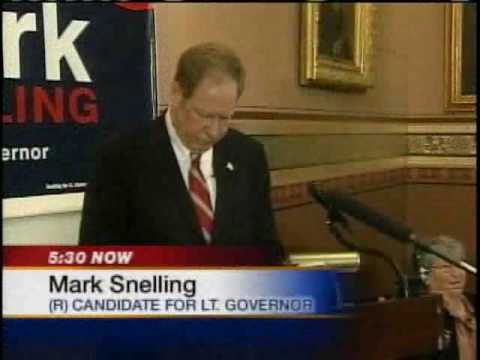
Mark Snelling, about to be mollywhopped by Phil Scott in 2010.

Mark Snelling, about to be mollywhomped by Phil Scott in 2010.

In a move likely to improve the financial condition of the Vermont Republican Party, Mark Snelling has stepped down as treasurer.

Okay, that first part was added by me. But Snelling’s four-year tenure has seen the party’s finances plunge from “healthy” to “dismal” and then slowly rise to “pathetic.”

And he’s proud of that.

During his time as treasurer, the party’s budget rose from a $50,000 deficit to a $50,000 surplus, Snelling said, adding that he does not take credit for that improvement.

Well, if that ain’t a big fat slice of humblebrag. He points out an improvement during his tenure, but good golly, he’s not claiming credit.

Beyond that bit of disingenuousness, there’s a bigger question: Accepting his numbers at face value, is improving a nearly bankrupt party’s finances by $100,000 in four years that much of an accomplishment? $25,000 per year? Really?

To be fair to Snelling, the treasurer isn’t in charge of fundraising; he keeps the books. But party officers do play a crucial role in beating the bushes for money, and Snelling is a (presumably) well-connected scion of one of Vermont Republicanism’s royal families.

His four-year cutoff is highly convenient. In the time just before he took office, the Republicans and Democrats were on more or less equal financial footing. The Dems had the electoral edge, but the GOP had the business community and other deep-pocketed denizens. In the 2010 Dubie/Shumlin gubernatorial campaign, the two men raised basically the same amount of money — in the range of $1.5 million.

Coincidence or not, while Snelling was party treasurer, the money shifted almost entirely to the Democrats. He wasn’t responsible for that, but he sure didn’t make it any better. And improving the fortunes of a major party by $25K per year, at a time when it had nowhere to go but up, is nothing to brag about.

Plus c’est la même chose, plus c’est la même chose

If you’d been harboring any faint hopes for change in the State Senate leadership, you were quite reliably disappointed by Saturday’s Democratic caucus.

With only the tiniest hint of dissent, the status quo was maintained in Our Most Stagnant Deliberative Body. John Campbell? Yep, President Pro Tem again, along with Phil Baruth as majority leader, Claire Ayer as whip, and… the earth would tremble and the skies would be rent asunder if they failed to re-elect Dick Mazza as “third member” on the organizationally influential Committee on Committees, where he will rejoin the Phil Scott Fan Club with Campbell and Scott himself.

Maybe someday there’ll be a real Democrat on that panel.

Seven Days’ Paul Heintz, ever the pot-stirrer, introduced me to Mazza before the caucus convened. And the Eternal Member gave me a hearty greeting, making it clear that he knew what I’ve written about him and that it didn’t make a damn bit of difference. Baseball players used to refer to beat reporters as “flies,” and that’s how Mazza sees me: a fly buzzing around his shit. Didn’t even bother to flick me away.

So the fix was in. There were no competing nominees for any of the four posts, and there was only the slightest bit of dissent: Anthony Pollina voted “no” for Campbell and Mazza without explanation. Afterward, he spoke to Heintz:

“I would like to see the ability for more people to be involved in leadership, quite frankly, and I think that it would be more healthy for the caucus to have some conversation about who’s going to be the leader, and we don’t seem to have that conversation.”

Yeah, we certainly don’t. The organizational meeting was a hearty session of hands-around-the-campfire, we’re-all-friends-here. Any ill feelings were kept resolutely in check. In fact, there was one moment of unintentional gallows humor, when a senator who I didn’t recognize* nominated Mazza for “third member” by praising the past work of the Committee on Committees; he said that everyone had been happy with the committee assignments made by the CoC.

*Subsequently ID’d as Tim Ashe, putative Prog/Dem and studious ass-kisser to the Senate power structure. Gah. 

Somehow, Ginny Lyons and Ann Cummings didn’t scoff loudly. Both veteran lawmakers were screwed out of committee chairmanships by the CoC last time around. Lyons was replaced on Natural Resources by climate change skeptic Bob Hartwell, and Cummings was removed from Finance, presumably because she had the temerity to stage a brief challenge to Campbell’s leadership in 2012.

The CoC’s smackdown had its intended effect, as no one rose to challenge the same-old, same-old. The Three Kings will soon return to their secret undisclosed location to dole out the committee goodies. We’ll see if they behave themselves this time — but only after the fact, since Campbell has declared that the CoC is not subject to open meetings law. Paul Heintz, last February:

When Seven Days happened upon its three members — Lt. Gov Phil Scott, Senate President Pro Tem John Campbell (D-Windsor) and Sen. Dick Mazza (D-Grand Isle) — convening to discuss the matter last Thursday in Scott’s Statehouse office, Campbell declared, “It’s not a public meeting.”

“My understanding,” he elaborated, “is it’s a private, deliberative meeting of one of the committees of the Senate and therefore, you know, not open to the public.”

“So committees can just close the doors when they’re deliberating?” Seven Days asked.

“I believe this one, yeah,” Campbell said. “My opinion is that.”

Following that dismal exchange, the CoC held a closed-door confab with Senate Secretary John Bloomer and chief legislative counsel Luke Martland, who then produced a convenient bit of legal mumbo-jumbo to cover Campbell’s backside. When asked why Senate rules, which strictly limit closed committee meetings, don’t apply to the CoC, this laughable exchange took place:

Said Bloomer, “This, in my opinion, doesn’t apply because these are standing committees. The Committee on Committees has no function to take evidence.”

Added Campbell, “The Committee on Committees is totally different. It’s kind of a misnomer using that name, ‘committee.’”

The Committee on Committees isn’t a committee, eh?

Pardon me if I feel completely justified in my cynicism about the CoC.

Let me somewhat belatedly make clear that I have no beef with Ayer or Baruth, aside from their willingness to be part of a leadership team with an inconsistent record for upholding the principles (and candidates) of the Democratic Party. Baruth offered a tepid explanation for the lack of change, telling me that it was going to be a difficult session, so continuity of leadership would be a positive.

“We can’t change captains now,” said the First Mate. “The Exxon Valdez is in trouble.”

Campbell introduced his new aide, former Shumlin Administration functionary Erica Wolffing, fresh off her gig at the Democratic Governors Association.  And he made brief reference to his poor performance as Pro Tem in 2011, which led to Cummings’ challenge and the hiring of Rebecca Ramos as his top aide/nanny. Wolffing will now fill that role, helping him lift that big heavy gavel, and she’ll probably be very good. She’s likely to keep communication lines open between Campbell and the administration, and help keep things running smoothly in the Senate chamber.

After his re-election, Campbell gave a short speech laying out the top four priorities for the coming session, which he said would be “one of the most difficult bienniums in decades.” Which, he added, means “there’s a chance the work we do will be historic.”

Mm. The Hindenburg was historic.

Three of Campbell’s Big Four priorities were predictable:

— Health care. Trying to overcome his past public skepticism about single payer, he promised a full and open consideration of Shumlin’s plan. “We have an obligation to the administration to hear what they have to say, and to the public to deal with the rising cost of health care.”

There’s also that social-justice part of it, but Campbell didn’t mention that.

— The budget. He said the likely $100 million deficit was “not pie in the sky,” and lawmakers will have to look closely at revenues and state functions, prioritize services, and look for efficiencies and duplications. By funding too many “good ideas,” he said, “we’ve spread ourselves very thin.” He called for a tight focus on “what is our obligation to business and to citizens,” as opposed to what we’d like to do. (Yes, he said “business” first.)

In short, No New Taxes. And don’t expect any new money for anything.

— Education funding and governance. “We will have to look at what we need to educate our kids, and what we don’t.”

The fourth priority was a bit surprising:

— Lake Champlain, which he first called an “economic driver” and then called it “iconic.” Priorities.  “It’s not just because the EPA has said we must act; we have an obligation.” What that means remains to be seen, with all the talk of cutting government and focusing on the essentials and no new spending. It was nice to hear Campbell put Champlain at the top of the list, but I suspect we’re not going to get much more than lip service or possibly tokenism.

It’s looking like a dispiriting biennium for liberals. The Senate remains safely in the death grip of The Usual Suspects, now armed with what they see as an electoral mandate to cut and cut and cut. Shumlin himself, in remarks to the House and Senate caucuses, made it clear that his response to his near-defeat will be a predictable tack to the center. (More on that in an upcoming post.)

And so we beat on, boats against the current and all that.

A slight but perceptible bend in the glass ceiling

The House and Senate Democrats will caucus tomorrow (Saturday) in Montpelier to choose their nominees for leadership positions. It’s been radio silence on the Senate side, which I take as a bad sign, but some news has come out of the House.

And for gender equity fans, the news is good.

As you may recall, Vermont does very well on gender equity in the House, less well in the Senate, and very poorly in statewide elective office and Congressional seats. Like, for instance, we’ve never sent a woman to Congress. Which is, well, shameful.

Back to the House, where Shap Smith will return as Speaker; but the new House Majority Leader, according to Seven Days’ Paul Heintz, will be Sarah Copeland Hanzas of Bradford. What’s even better for equity’s sake is that the other candidate for the post was also female: Kesha Ram of Burlington. Having two women in line for the House’s number-2 slot is a very good sign.

Ram dropped out, per Heintz, citing the need for geographic balance. She will apparently fill a new post, “caucus election chair,” which is being created to sharpen Democratic messaging and lend a hand to House candidates.

Those developments, plus Kate Webb returning as Whip, mean that women will be heavily represented on the House leadership team. And whenever Shap gets tired of herding cats, the next Speaker may well be a woman.

Over in the Old Farts’ Club, er, I mean the Senate, I’m not feeling the gender-equity love. I’d be very happy to be proven wrong, but I’m expecting the leadership in Vermont’s Most Stagnant Deliberative Body to remain pretty much the same.

I love my little gavel, but this job is sooooo hard.

I love my little gavel, but this job is sooooo hard.

By all accounts, John Campbell will keep the job as President Pro Tem in spite of the fact that he isn’t very effective unless he has a nanny to keep him in line. After the disastrous 2012 session, he hired Rebecca Ramos as his chief of staff, and things improved. She’s now a lobbyist, and according (again) to Paul Heintz, Erika Wolffing will take the job.

Wolffing was a Shumlin administration fixture who went to the Democratic Governors Association when Shumlin became its chair. Now that Shumlin is out at the DGA, Wolffling will reportedly become the hand that rocks Campbell’s cradle.

Which leaves me wondering why we let him hang around when he (a) apparently can’t handle the job without a lot of help and (b) openly supported Republican Phil Scott and seized every opportunity to shit on Dean Corren. But maybe that’s just me.

I’m sure the status quo will remain in the Phil Scott Fan Club, er, I mean, the Committee on Committees, the body that makes all the committee assignments. Phil Scott himself is a member by law, as is Campbell. The third, elected by the full Senate, is, was, and ever shall be Dick Mazza, a putative Democrat who was extremely vociferous in his support for Phil Scott.

Which leaves me wondering why, when the Dems have a nearly 2-1 majority, we have to settle for nominal Democrats on that very powerful committee.

The Democratic caucus will see some change with the none-too-soon departures of Bob Hartwell and Peter Galbraith, but I’d be surprised to see much happen with the leadership. It’d be nice, but I ain’t holding my breath.

Finally, for those who think I’m too mean to Mr. Campbell, here’s a little tidbit from last March. Campbell had stuck his foot in his mouth by openly doubting the prospects for single payer health care and talking about pursuing some alternative plan. (Bear in mind that Shumlin was still riding high at that point.) This reportedly enraged the governor. And a few days later, Campbell appeared on WDEV”s Mark Johnson Show and tried to walk back his earlier statement.

It was a complete fiasco. At one point Johnson asked him this question: “You dropped something of a bombshell this week that you want to start pursuing an alternative to the Shumlin health care plan. Why?”

And here, really and truly, was his answer in all its obfuscatory glory.

First of all, I guess it’s a question of how you define what my “bombshell” is. I think some people have taken it to mean what they really, what they want to hear from what I said. And basically, my, uh, my position is this, is that we are headed right now as far as the Legislature, we are going to be focusing on making sure that we have a publicly-financed, universal access to health care in this state, and that’s known as Green Mountain Care. As far as I’m concerned, I consider it Green Mountain Care, it’s a universal access program. Um, um, I charged my, in fact we spoke about it here on this program at the beginning, I think at the beginning of the session, how I had asked all of my committees with jurisdiction to start doing their due diligence under Act 48, which was the, back in 2011, which actually started Green Mountain Care or our, ah, our, ah, move to that.  And so what I did was, I asked each one of the committees that would have jurisdiction, which were five of those committees, and they were to um look and see what exactly is in Act 48 and can we actually achieve what our goal is?

And if they found things that um, through their, uh, their research and through taking testimony, that could either change this into a direction and put us in a direction that we were going to uh have this Green Mountain Care would be sustainable, then I wanted to hear about it and I thought that’s really what the Senate is doing now. So uh the fact of the matter, uh, I believe there was a statement was, um, regarding the funding, and whether or not I believed that, I think I said that, uh, the $2.2 billion dollar package that’s been put on there right now, I said I do not think that that was sustainable or viable in this, uh, current legislative — uh, Legislature. And I stand by that.

And what it, what I’m talking about in that, and people always take that $2.2 billion dollar figure, and they believe that that’s all new money. And it’s not new money. What it is is partially savings that would be found, uh, by way of not having the premiums, um, by cost savings, and so I stand by the fact is that once we find out what this financing package is, which would also first identify what the product is gonna be, um, if we do not have sufficient — if that money, um, is new money, then there’s gonna be a problem. But if we show, and we’re able to demonstrate that the money in that $2.2 billion is currently already in the system, and that Vermonters are already paying, uh, and on top of that, that we find those costs for any new money that’s — cost savings for any new money that’s coming in, then we’re, we have, I think, ahh, what we envision, all of us envision, that is to make sure that every Vermonter has full access, or access to. uh, uh, to great health care here in the state.

Good God almighty. What a statesman.

We have all failed Bruce Lisman

Our favorite Wall Street panjandrum turned everyman policy expert knows what the 2014 election was all about: it was about our collective failure to heed the wisdom of Bruce Lisman.

And he’s mad as hell about it.

We’ve just re-elected a government that has made bad ideas, bad management, and bad leadership seem ordinary.

… We want [our leaders] to take seriously the embedded philosophy of Vermont that would offer a helping hand or a comforting hand to those in need but balanced with those other great Vermont characteristics, frugality and commonsense.

The latter phrase taken, word for word, from previous Lisman bumpf. The rest of the column is of a piece: the lesson of this election is that Bruce Lisman is right and everybody else (especially the Democrats who, as a figleaf of nonpartisanship, are not identified as such) is wrong. Wrong! WRONG!

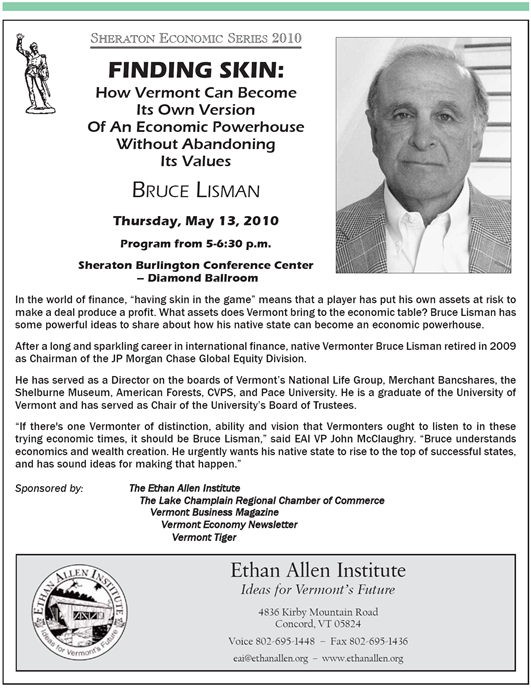
Hide your children. good people; he's searching for skin again.

Hide your children. good people; he’s searching for skin again.

What is it with you people, failing to heed the words of Bruce Almighty?

The rest of the column is more of the same, except there’s a new edge to Bruce’s tone. He’s getting angry. And he’s moving to the right. Sounding more and more like John McClaughry, in fact.

The (unnamed) Democrats’ policies? “bad ideas executed badly,” “a special hell for Vermonters.”

Democrats’ ideas for school spending and organization: “like someone breaking your leg and then offering you a crutch.”

“Our leaders… make decisions blindly.”

Vermont Health Connect? “a catastrophe of major proportion.” Too bad, Bruce: you wrote those words before the successful relaunch of Vermont Health Connect.

But you look at Lisman’s laundry list, and you wonder how in hell the Democrats got a single vote, let alone a sizeable majority.

Which maybe is why Bruce has a bug up his butt. The people of Vermont are eschewing his wise counsel.

Well, okay then. But riddle me this, Lisman: if you felt so strongly about all this, why did you almost entirely sit out the 2014 election? We barely heard from you. We never saw you alongside Scott Milne or Phil Scott or your Campaign for Vermont colleague Heidi Scheuermann.

Now that I think of it, last time we heard from Bruce, he was torpedoing Scheuermann’s nascent gubernatorial bid with some poorly-timed and pointless musings of his own. After that, a conspicuous absence of Lisman.

The man’s policy insights may be arguable, but his political acumen is not: he has none. I wrote about this on Green Mountain Daily in May, but his post-election rage makes it freshly relevant.

Bruce Lisman could have made a substantial difference in the election. All he had to do was drop the mask of nonpartisanship and openly declare himself an ally of Phil Scott and company. He could have helped bankroll the party and a real live gubernatorial candidate. Say, Heidi Scheuermann.

His active backing would have helped the VTGOP recruit candidates. Its failure to field anything like a full slate limited its ability to gain seats in the legislature.

Is his increasingly-tattered nonpartisan image that important to him? When his rhetoric is in the same ballpark as conservative Republicans’, who does he think he’s fooling? Just because he doesn’t say “Democrat” or “Shumlin” doesn’t make it any less obvious.

If Lisman felt this strongly about the direction of Vermont, he could have done something about it. He chose not to, by all visible evidence. So whose fault is it that Vermont failed to heed his (inaudible) warning?

The self-bigotry of low expectations

This should be a very good day for Vermont Republicans in legislative races. It won’t be, of course, and therein lies the rub.

Earlier in the campaign, Lt. Gov. Phil Scott talked about picking up double-digit seats in the Legislature, putting a perceptible dent in the Dems’ substantial majorities. But now?

“I will be happy if we gain one seat,” [Senate Minority Leader Joe] Benning said. “It means that the Republican Party is moving in the right direction.”

“If we pick up one seat we’re moving in the right direction,” said House Minority Leader Don Turner, R-Milton.

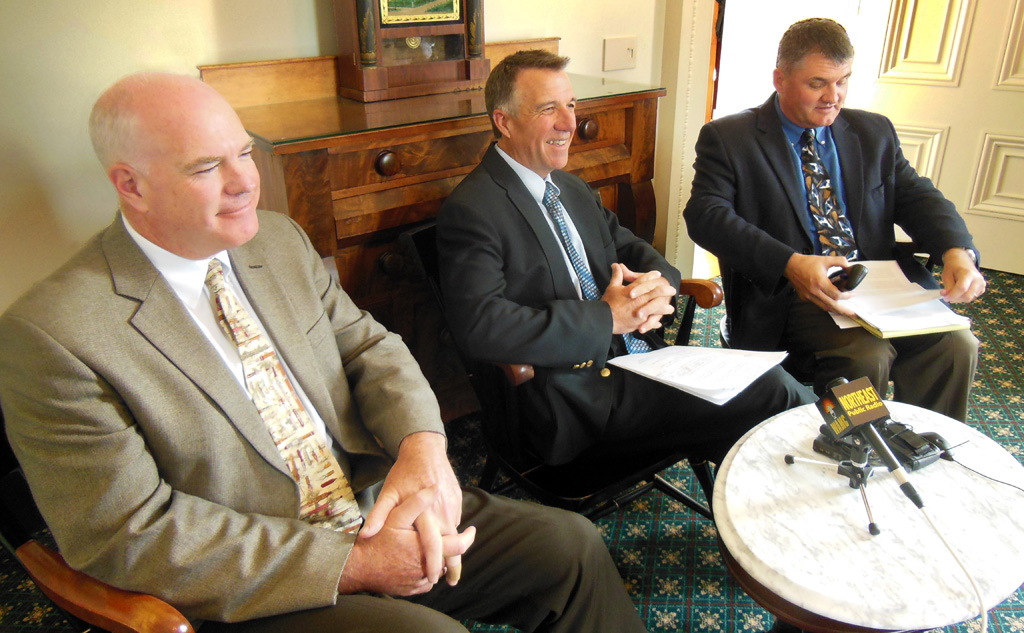
Joe, Phil and Don, smiling through their tears.

Joe, Phil and Don, smiling through their tears.

Gee, ya think they’re reading from the same script?

The above quotes are from a story by Neal Goswami, published in the Sunday Mitchell Family Organ and produced as a (shorter) radio piece by VPR. (VPR’s website has the full text of Goswami’s print article, available without paywall.)

The Republicans are hoping for more than two seats. But they’re clearly trying to set the bar as low as possible so they can claim some sort of victory no matter what happens.

Which means that in their minds, it’s quite possible that the VTGOP will do no better than a token advance. And that’s bad news for the Republicans’ future in Vermont, for two big reasons. First, from Senate Majority Leader Phil Baruth:

“Pickups, frankly, would be pretty tough,” Baruth said. “Last election we expanded pretty much to the limits of what we could reasonably hope for.”

So, if the Democrats are at the theoretical limits of their legislative hegemony, why can’t the Republicans make a significant comeback in 2014? Especially when this campaign represents “a perfect storm” of opportunity, according to Joe Benning himself.

The ingredients of that “perfect storm” include the continuing perils of Vermont Health Connect, fears about single-payer health care, widespread anger over rising property taxes, a sputtering economy, and early signs of Shumlin fatigue among voters.

On top of that, there’s no Presidential or U.S. Senate race to drive Democratic turnout; the races for Congress and Governor are uncompetitive; and Republicans have failed to mount credible races for the other four statewide offices. (Sorry, Shane-O-Mac.) Democratic voters have every excuse to sit this one out.

With all that going for them, the Republicans will be happy with a handful of gains. Leaving them, still, in a very weak minority position.

And that shows you how far away the VTGOP is from being truly competitive.  There are a whole lot of legislative seats that are simply uncompetitive. There are too many liberal and moderate voters who see nothing attractive in the Republican Party — even when they’re feeling dyspeptic about the Governor.

Plus, the Republicans are at a huge organizational disadvantage. The Dems have a well-organized, well-resourced ground game and world-class voter data. They were able to out-recruit the Republicans because of their organizational edge, so they have strong candidates in some vulnerable districts.

And they have poured their resources into the most competitive battlegrounds, like Rutland and Franklin Counties. Because the Republicans are uncompetitive in so many places, the Dems can, as the Governor would say, “focus like a laser” on the most crucial contests.

Which is why, even in a “perfect storm” of Republican opportunity, the Democrats are poised to hold onto virtually all of their vast legislative territory.

And that tells you all you need to know about the magnitude of the task facing Vermont Republicans.

A new nominee for the Most Dangerous Republican award

Last December, around the time of the fabled Chris Christie fundraiser for the Vermont Republican Party (projected take, a quarter mill or so; actual take, less than 50K as far as I can tell from the party’s financial filings), I posited that there was one figure in the downtrodden VTGOP who could pose a threat to the Democrats as a statewide candidate. It wasn’t Phil Scott; it was the closest thing we have to a Chris Christie — a short-tempered, get-things-done, “willing to work with both sides” kind of guy named Thom Lauzon, Republican Mayor of Barre. 

I still think he’s a solid potential statewide candidate, should he ever choose to climb the ladder. But another name has been suggested to me, and it’s an excellent choice. In fact, offhand I’d have to say he’s an even better Most Dangerous Republican than Lauzon.

I’ll give you the name, but first it’s Story Time, kids!

Starting in 2002, Craig Benson spent two disastrous years as Republican Governor of New Hampshire. While he was Governor, he appointed a little-known lawyer named Kelly Ayotte to the post of Attorney General. (In NH, the AG is an appointed position with a five-year term.) By the time her first term had come to an end,  John Lynch was Governor. He was a Democrat but he liked to play the bipartisan game, so he nominated her for a second term.

Before she served out that term, she resigned to run for U.S. Senate. And she won. And she’s now the only Republican member of NH’s four-member Congressional delegation.

The key moment in her ascendancy was her renomination by John Lynch. If he’d appointed a Democrat and sent her packing as a one-term Benson functionary, she would’ve had a much harder time continuing her political career. I firmly believe that there would never have been a Senator Kelly Ayotte if not for John Lynch being too clever for his own good.

Thus endeth the lesson. Back to Vermont, and the new nominee for Most Dangerous Republican.

Neale Lunderville.

At one time, he was the chief hothead on Jim Douglas’ team. He and Jim Barnett, who’s gone on to a very unsuccessful career as a balls-to-the-wall campaign manager, were dubbed “the Nasty Boys” by the late great Peter Freyne for their skilled knifework in Douglas’ campaigns.

Since then, little Neale has grown up — and gotten two great big helping hands from Democratic officeholders. Governor Shumlin chose him to be recovery czar after Tropical Storm Irene, and now Burlington Mayor Miro Weinberger has engineered his hiring as interim head of the Burlington Electric Department.

In the process, the Nasty Boy has acquired a solid nonpartisan reputation as the go-to guy when trouble strikes. He’s been chosen by not one, but two, top Democrats to take on big administrative challenges.

Okay, here’s a hypothetical for you. In the next biennium, the Shumlin administration will unveil its plan for single-payer health care. It’ll be big, expensive, controversial, and a tough sell, even in a lopsided Democratic legislature. Win or lose, Shumlin will expend a lot of his political capital in the fight.

He also faces the whole issue of school funding and organization. Whatever he and the legislature do, more enemies will be made and more people will be alienated.

At best, Shumlin would enter 2016 having fought two extremely tough battles. Even if he wins on single-payer, he’ll be in that very dangerous period between passage and implementation, where everybody will be aware of the cost and the controversy but won’t have experienced any benefit from the new system. And if the implementation process for single payer OR school reform is difficult, contentious, or includes any stumbles, the Governor’s managerial reputation will take more hits.

And now comes, on a shiny white horse, Neale Lunderville.

Well, Lunderville 2.0, New and Improved with a track record for working under Democratic executives and managing the biggest challenges. In short, he’s Vermont’s Mr. Fix-It. The Governor won’t be able to depict Lunderville as a partisan ideologue because, after all, he chose the guy to manage the aftermath of Irene. At the same time, Lunderville will have solid Republican credentials from his tenure in the Douglas Administration. He’ll be more appealing to the conservative base than a Phil Scott will ever be.

The VTGOP won’t be in any shape to challenge the Democrats’ overall  dominance in 2016. But Lunderville could do what Scott Milne can’t do and Randy Brock couldn’t: topple Governor Shumlin.

Farfetched or believable? Just remember, if it happens, you can thank Peter Shumlin and Miro Weinberger for making Governor Lunderville a possibility.

Is the ground buckling under Phil Scott’s feet?

Lately, there have been signs aplenty of passengers taking their leave of the Good Ship Moderate Republicanism, helmed since last November by Captain Phil Scott and first mate “Super Dave” Sunderland. Or maybe Scott’s the admiral and Sunderland is captain, whatever works.

Scott and friends came away from last November’s VTGOP meeting with a rather conditional mandate to broaden the party’s base. Make it more attractive to moderate and undecided voters, and the pragmatic business types who’ve made their peace with the Democrats under Governor Shumlin.

It seemed a promising direction. Indeed, the only possible direction, since the Vermont electorate wasn’t suddenly going to turn Texas red. The conservative VTGOP of “Angry Jack” Lindley et al. had hit a glass ceiling at about 35% of the vote.

But it was going to be a tough job for Scott, previously not known for his willingness to tackle tough jobs. He was, by dint of his elective office, the only person who could credibly take it on; but he also, by dint of his personality, seemed unsuited for the task. And even if he rose to the occasion, the odds seemed to be against him. Shumlin and company have done a really good job of co-opting the center, and it’d be a hell of a job for Scott to win back all those voters and supporters without moving so far to the center that he completely alienates the easily alienated conservative base.

It’s only been about nine months, and the Good Ship Moderate Republicanism looks to be taking on water. Recent signs include:

Bruce Lisman’ decision to forego any sort of alignment with the VTGOP, even after he stepped away from leadership of Campaign for Vermont, the self-described nonpartisan policy shop.

Lisman’s brief and pointless flirting with a run for Governor this spring, which lasted just long enough to force State Rep. Heidi Scheuermannf (a Lisman ally) out of the race.

The continued activity of Campaign for Vermont. Its members do include people from across the political spectrum, but the group still tilts substantially toward the right. And many of its key supporters are the kind of people who used to be mainline Republicans.

Roger Allbee’s decision to run for State Senate as a Democrat. The former Douglas Administration cabinet functionary and self-described liberal Republican could have been a powerful ally for Scott. Instead, he’s hoping for a place on the other ticket.

— Former State Rep. Oliver Olsen’s decision to run again for his old seat, but this time as an Independent. In the 2011-12 biennium, Olsen was one of the more vocal and effective members of the House Republican minority; this time, he seems to believe that he’s better off without the “R” next to his name.

— Last week’s VTGOP campaign finance report which, as I reported in this space, was truly horrific. A quarterly fundraising total — during a campaign season, mind you —  of only $7,500. The bulk of that came from a few party insiders. And over the past year, the VTGOP has drawn virtually no small donors, a sign that so far it’s failing to reach the grassroots. In spite of Sunderland’s repeated claims that the people of Vermont are waking up to the failures of the Shumlin Administration. Well, they haven’t awakened enough to write any checks, that’s for sure.

What that dismal report means is that the VTGOP has lost some of its hard-core, ideologically driven donors, but has yet to even begin to attract a new donor base. Nor has it even begun to convince former Republican stalwarts to come back home.

— And finally, this week’s formation of Vision to Action Vermont (V2AVT), a “bipartisan” PAC aimed at supporting candidates who are focused on improving Vermont’s economy. Its co-founder is Scheuermann herself, and her decision to create this independent group is an interesting one. You’d think that Scheuermann would be one of Phil Scott’s most trusted lieutenants, with a bright future in Republican politics. But as with Allbee and Olsen, she has apparently decided that the Republican brand is too toxic to advance her goal of electing lawmakers who are focused on economic issues.

Take all these events together, and it seems like the Republican center-right is fragmenting in all directions rather than coming together behind Scott and Sunderland. That, I think, is a very bad sign for Scott’s effort to broaden his party. The people who might have been part of a new, broader, more vibrant VTGOP are channeling their energy in other directions.

It may seem unfairly early to declare Scott’s project a failure. After all, it’s been less than a year, and it took quite a few years for the VTGOP to get so badly screwed up. But Scott’s party has no resources and few candidates; if he fails to make any headway in Legislative elections, a substantial portion of the party will be ready and eager to unseat Scott’s team and return the party to its former course: down an ideological dead end.

The VTGOP: It’s worse than it looks

While poring over the campaign finance filings from this week, I couldn’t help noticing that — in sheer fundraising terms — the Republican Party has slipped into the #3 position. Yep, they’re being out-fundraised, quite handily, by our humble friends in the Progressive Party.

The numbers: VTGOP raised $7,500 for the most recent period (mid-March to mid-July) and $61,000 for the entire election cycle. The Progs, by contrast, raised $16,000 for the period and $89,000 for the cycle. (All numbers rounded off, thanks.)

See, it’s not even close. The Progs are a solid number 2.

This isn’t because the Progressives have enhanced their drawing power; their numbers are roughly on track with the same time frame in the 2012 cycle. It’s just that the Vermont Republicans are simply terrible at fundraising. Really, really, bad.

But wait — it’s worse than that.

In its mid-March filing, the VTGOP reported raising more than $45,000. This, presumably, reflects the take from the big Chris Christie fundraiser in December. That’s a really nice number, but it’s a whole lot lower than what party leaders were projecting before Christie’s visit. And it didn’t set the party on a new, healthier course; it merely provided a temporary jolt, like treating a pneumonia patient with Red Bull. Judging by its latest report, the VTGOP can’t draw flies without a big event. $7,500 is a wretched total for a “major” party entering a statewide election campaign. (It may help explain why short-term party staffer Brent Burns has departed to set up his own campaign shop; I suspect that either he wasn’t getting paid regularly, or it was made clear to him that the party couldn’t continue to pay him. Instead, we have Jeff Bartley as the party’s “Victory Director.” And I’m pretty sure that’s a part-time gig.

But wait — it’s even worse.

That $7,500 for the most recent period included $2,000 from Lt. Gov. Phil Scott’s campaign fund, $1,000 from Phil Scott’s construction company, and another $1,000 from State Rep. Heidi Scheuermann’s campaign fund. Plus $1,000 from Jani-Tech, a janitorial services company. Jani-Tech’s owner, Dawn Terrill, is the VTGOP’s new finance chair. Plus $800 from Greenleaf Metals, owned by party treasurer Mark Snelling.

So the bulk of that pathetic fundraising total came from a handful of insiders. Without Scott, Scheuermann, Terrill, and Snelling, the party would have received a measly $1,700 over a three-month period. A three-month period in which the party ought to have been marshaling resources for intensive campaigning.

What’s worse than pathetic? Abysmal?

One final note of despair. The GOP’s campaign bumpf is generously festooned with references to the state’s political elite, by which they mean the Democrats. But if the Republicans are trying to appeal to the common folk, the working man, Joe Sixpack, they are failing completely. In the past year, the Vermont Republican Party has taken in only 15 individual contributions of less than $100. What little money they’re raising is being given by the usual handful of insiders and well-connected business types.

Of course, a big part of the Republicans’ problem is that they’re getting a lot less from those business types than they used to. Many businesspeople and wealthy donors of centrist orientation, or of a practical bent, have abandoned the Republicans and are either sitting on their money, sending it out of state, or giving it to the Democrats.

But the takeaway here is, the Republicans have no appeal for the general public. At least, not enough appeal for individuals to open up their wallets.

See, it’s even worse than it looks.

When public policy becomes personal

Let’s look at the two guys likely to headline the Republican ticket, such as it is, in Vermont this year: gubernatorial candidate Scott Milne, and incumbent Lieutenant Governor Phil Scott. Both are men of moderate reputation and widely seen as “nice guys.” Both have shown a disinclination to take hard-and-fast political stances.

But for each of them, there’s one exception to the general tone of moderation. Milne and Scott have each spoken loudly and strongly on one issue respectively. For each, it’s an issue that has left the realm of abstract policy and directly impacted their own fortunes. In the case of our Lieutenant Governor, it’s public campaign financing; for Milne, it’s the approval process for new developments, most especially Act 250.

It’s funny how a personal stake can turn a moderate into a firebrand. But it does call into question their ability to govern dispassionately. One of the most important things I want to know about candidates is this: Can they make decisions based on the public good, even if they’re going against their own personal interest? Can they set their interests aside?

Both top Republicans are in danger of failing that test.

As for Scott, after years of building a politiical career on being inoffensive and avoiding the tough call, he has become a late-blooming opponent of public campaign financing. When he was a state Senator, Scott wasn’t particularly against the idea, and he had his chances. And during his tenure as Lieutenant Governor, he’d never spoken out about it.

Until now, when a publicly-financed candidate threatens to give him a real race. Now he’s decided that public financing is an unfair burden on taxpayers, forcing them to effectively support a candidate they may personally oppose. Which ignores the whole social-good function of publicly financing ANYTHING — roads, welfare, education, police, military. Every one of us pays taxes to support something that we personally would not choose to spend money on. Public financing is a drop in that particular bucket.

As for Milne, he’s hot and bothered over the development approval process because of his big personal stake in Quechee Highlands, a proposed housing/retail project slated for a large parcel near Exit 1 of I-89. (This story was broken earlier this week by my colleague BP at Green Mountain Daily.) How hot and bothered? In an essay published last August in the Valley News, his opening salvo was:

All who care about Vermont’s future, fairness in government and how communities settle disputes should pay heed to what is happening a few miles from the Connecticut River at Quechee Highlands.

Wow. That’s putting it pretty strongly. “Vermont’s future” depends on Milne getting his way on this project. Lacking in perspective much?

He goes on to slam the regional planning commission for denying an Act 250 permit for the project. In the process, he reveals substantial ignorance about the mission and workings of those commissions. Most notably, he wrote that the commissions’ purpose “should be to help promote development that creates a foundation for economic health.”

Er, Scott. Hate to break it to you, but those Act 250 bodies are meant to balance development with conservation, not to promote development. And your little project, I have to say, would be built in an area with precious little road infrastructure. The corridor between Exit 1 and Woodstock is already a mess, and the vicinity of Exit 1 is especially bad. The original proposal was for an entirely retail project, which would have been a traffic nightmare. Milne and co. later revised it to mixed-use, residential plus “less than 37 percent retail.” Which is still quite a lot of retail in a 168-acre development. (The retail is clearly aimed at cashing in on the proximity to I-89. The site is less desirable for housing because of freeway noise.)

At the time, one of the pillars of Milne’s argument was that while the regional board had said “no,” the town of Hartford was in favor of the project. And he asserted that the town’s view should have greater weight.

Since then, Hartford has changed its tune. In May, the Hartford Selectboard amended its master plan to bring it into compliance with the regional commission’s plan. Before the Selectboard’s vote, Milne warned that QH would be “dead” if the changes were adopted. He’s already pursuing appeal of the regional commission’s ruling; he’s now threatening to take Hartford to court as well:

“I’m going to try to figure out if I’m going to do anything, and if I do, it’s probably going to involve more lawyers, and it’s just going to continue to brand Vermont as a bad place to do business,” said Milne.

Sheesh. Rejection of Milne’s project will “brand Vermont as a bad place to do business”? Mr. Milne seems to have an awfully… shall we say, expansive… view of himself and the importance of his project.

And it wasn’t long after the Selectboard action that Milne began publicly mulling a run for Governor, having previously given no hint of ever desiring a political career.

Now, I don’t think Scott Milne wants to be Governor so he can save Quechee Highlands. But it’s clear from his own statements that he has very strong pro-development views. And if he were to become Governor, he’d clearly push for substantial changes in the Act 250 process that would shift its focus from conservation to, in his own words, “help promote development.”

That’s a pretty radical take on Act 250, is it not? It’s looking like Milne is not that much of a moderate, at least on this very crucial issue. It calls into question his ability to dispassionately consider issues in which he has a personal interest. It also calls into question the entire foundation of his campaign, which portrays him as a centrist who can build bridges and work with the Democrats.

Cronyism and disloyalty in the State Senate

So the Democrats (and Prog/Dems) have a supermajority in the Vermont Senate. They rule the roost. And they’re almost certain to retain a big edge next year; even the Republicans are hoping to win no more than two or three seats.

Which makes me wonder why the two Democratic members of a key committee, plus the chair of a very important committee, have endorsed a Republican for one of Vermont’s highest offices, and are likely to get away with this bit of disloyalty.

I’m talking about John Campbell and Dicks Mazza and Sears. The first two sit on the Senate’s Committee on Committees along with their favorite Republican, Lieutenant Governor Phil Scott. Sears chairs the Senate Judiciary Committee. All three have endorsed their buddy Scott and turned their backs on the likely Democratic standard-bearer* and only liberal in the race, Progressive Dean Corren, in spite of the fact that Governor Shumlin has given public support to Corren.

*Corren has to win the Democratic primary as a write-in. He should be able to do that, but it’s no sure thing; Mazza’s openly talking of a write-in campaign for Scott. Which would lead to a goddamn embarrassment for Vermont’s dominant party: a Republican in the #2 spot on its ticket. 

If these men keep their privileged positions, it’ll be a disgrace. And, based on past history, it’ll almost certainly happen.

The Committee on Committees is an obscure bit of Senate hierarchy, with one big exception. Every two years, they select all the chairs and members of all the Senate committees. That is one big moment of muscle-flexing for an otherwise quiescent body.

The three members of the CoC are: the Senate President (Lieutenant Governor), the President Pro Tem, and a Senator elected by the entire Senate. For many years now, Dick Mazza has been rubber-stamped into this position — even though this is far from the first time he’s endorsed a top Republican. He supported Brian Dubie for Governor in 2010, and has backed Phil Scott every time he’s run for Lieutenant Governor.

The lopsided Democratic majority could eject Mazza in a hot minute and instead reward a more faithful member of their party. They could also choose a President Pro Tem who’s more in step with the party’s mainstream. And the new CoC could replace Sears on Judiciary. But, given the hidebound, clubby nature of the Senate, I fully expect that all three will retain their influential positions this fall.

There’s no good reason for this. The explanation, of course, is the mutual respect of Senators and their unwillingness to publicly embarrass a colleague. Which is not a good reason, just a dearly-held rationale in the hearts of our solons.

Campbell, Mazza, and Sears do not deserve to be rewarded for their disloyalty. If there’s anything like party discipline within the one-sided majority, the Senate’s Committee on Committees will get a makeover. And, ideally, somebody else will wield the gavel come January.

But, as I said, I don’t expect it to happen. The Senate’s too damn clubby for that.

(It’s not often these days that Vermont Republicans get to enjoy a laugh at the Dems’ expense. They must be blowing chortle-bubbles in their Scotch glasses over this.)