Tag Archives: Peter Shumlin

The Eternal General Strikes Back (Warning: SATIRE)

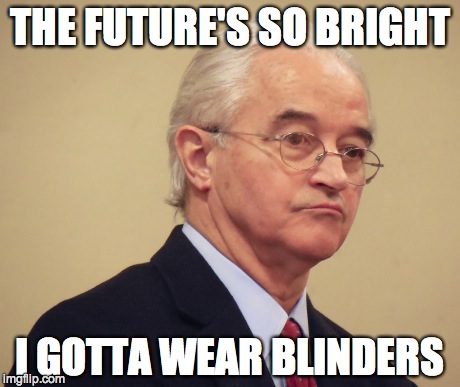
Y'know, this picture works with almost any song lyric.

Y’know, this picture works with almost any song lyric.

Vermont Attorney General Bill Sorrell, having come under intense criticism for his handling of campaign finance prosecutions and his own questionable compliance with the law, came out in true Two-Fisted Attorney General fashion late Friday.

(Warning: SATIRE.)

In a hastily-called news conference, Sorrell announced the filing of several new accusations against Dean Corren, last year’s Democratic and Progressive candidate for Lieutenant Governor.

Sorrell had previously charged Corren with violating the state’s public financing law by accepting tangible assistance from the Democratic Party, namely an email blast with an estimated value of $255. Sorrell’s proposed punishment for this crime: a total of $72,000 in fines and reimbursements.

“I have been accused of excessive zeal in this prosecution,” said Sorrell, a brace of assistant and deputy Attorneys General forming a semi-circle behind him. “To the contrary, I have uncovered even more violations by Mr. Corren. Taken together, they paint a clear and unmistakable picture of a rogue campaign.”

Among the new charges against Corren:

— At a Democratic State Committee meeting, Corren sneezed and a party official loaned him a handkerchief. “A tissue would have been within the bounds of the law,” noted Sorrell, “but a piece of haberdashery is clearly a significant gift that Mr. Corren could have potentially used throughout the remainder of his campaign.”

(Warning: more SATIRE… after the jump.)
Continue reading

Have we just reached the tipping point on Bill Sorrell?

SorrellBlindersSurprising, and rather shocking, news out of the Statehouse today, courtesy of Paul Heintz:

The Vermont Senate is considering stripping Attorney General Bill Sorrell of his powers to prosecute campaign finance violations. Replacing him, according to lawmakers who support the idea, would be an independent elections oversight commission.

… “The fact that the attorney general is charged with investigating him or herself is clearly ridiculous,” says Sen. Anthony Pollina (P/D-Washington), a member of the committee.

Those wanting to strip Sorrell of his authority include Dems, Repubs and Progs. No partisan witch hunt here. Two thoughts:

— This shows the breadth and depth of the Sorrell-hatred among the political class. To even propose such a slap in his face is a big deal. For all this to happen in a matter of days is pretty extraordinary. It’s like a dam breaking under pent-up pressure.

— If the Legislature has time to think about this and even write a bill, how can Governor Shumlin go on saying he’s too busy to think about it?

Sorry, a third thought: Continue reading

It’s time for an outside probe of our Eternal General

Brady Toensing, D.C. attorney and vice chair of the VTGOP, has sometimes operated as the political equivalent of an ambulance chaser — taking legal actions with an obvious partisan motive. He comes by it honestly; his mother and stepdad are notorious conservative attack dogs.

But this time, I’m with him 100%. Toensing has sent a letter to Eternal General Bill Sorrell, asking him to appoint an independent counsel to investigate Sorrell’s campaign activities.

SorrellRehabThis is the second time Toensing has made this request. The first was in October 2012, in the midst of the election campaign — which was reason enough to dismiss it as a partisan stunt. But now, the time has come. There’s enough smoke around Sorrell’s campaign activities to warrant an objective fireman. Especially since Vermont’s campaign finance law makes Bill Sorrell the sole judge and arbiter of whether Bill Sorrell has violated the law. Which Bill Sorrell assures us is not the case. Indeed, he has already rejected Toensing’s request, insisting again that he’s done nothing wrong. We just have to take his word for it, I guess.

This stinks, and if any situation required an outside probe, it’s this one.

Toensing cites four allegations:

— “Coordinated expenditures” in the hotly-contested 2012 primary. Sorrell received a late blast of money (200 G’s) from the Democratic Attorneys General Association (by way of a third party superPAC). As Toensing’s letter says: “This record-setting expenditure was controlled and directed by former Governor Howard Dean, who, at the same time, was an active, high-level agent of your campaign.”

That money was almost certainly the deciding factor in Sorrell’s whisker-thin victory over TJ Donovan. And as Toensing notes in his complaint, one month before the primary, Sorrell “revers[ed] his office policy to allow PACS to accept contributions in excess of the state limit of $2000 and still make unlimited campaign expenditures in Vermont. This action cleared the way for the unprecedented expenditures made on General Sorrell’s behalf during the primary.”

— Failure to comply with campaign finance disclosure laws mandating that a candidate report “each expenditure listed by amount, date, to whom paid, for what purpose.” As Paul Heintz has reported, Sorrell’s reports for personal-expense reimbursement have included numerous vague and incomplete entries.

— A joint appearance with Dean Corren, candidate for Lieutenant Governor, on September 15, 2014. While Sorrell has aggressively pursued Corren for accepting an email blast from the Vermont Democratic Party, he has denied any wrongdoing in his appearance with Corren. He has, in fact, claimed that the appearance was not a campaign event — which is laughable to the point of bitter tears.

— Sorrell has routinely given state business to outside law firms that have contributed heavily to his re-election campaigns. Sorrell denies any quid pro quo, but Toensing cites legal precedent that indicates “In cases involving government officials, a jury can infer guilt from evidence of benefits received and subsequent favorable treatment.”

By that standard, Sorrell’s own denials are clearly inadequate. Given his refusal to investigate himself, as Toensing says, “the appointment of an independent counsel is necessary to restore and maintain the integrity of your office.”

I fully expect Bill Sorrell to refuse this very reasonable request for an objective probe of Bill Sorrell. At that point, we will turn to other Democratic officeholders for leadership. Governor Shumlin has repeatedly ducked questions about Sorrell’s activities, while Secretary of State Jim Condos has said his office lacks the standing to investigate.

Well, standing or no, Shumlin and Condos have their bully pulpits. It’s time to put them to use. They don’t have to throw Sorrell under the bus; all they have to do is say “There are questions that deserve answers, and the only way to restore public trust is through an independent counsel.”

Heck, if they want to, they can even throw in a gratuitous “I’m sure the investigation will show that General Sorrell acted properly.” The important thing is, it’s time to put the heat to Sorrell’s backside and get answers to all of these questions.

Governor? Mr. Secretary? Mr. Speaker? Mr. Pro Tem? We’re waiting.

The Quango Follies

Funny little piece of news, strikes me as just a bit off.

Mike Smith, former Douglas Administration functionary, then president of FairPoint and briefly co-prez of Burlington College, has a sweet new gig. He’ll be paid $70,000 for a six-month consultancy at the Emergency 911 Board.

This comes after the extremely sudden retirement of longtime E-911 chief Douglas Tucker. Smith’s brief is, curiously, both comprehensive and vague.

Smith will examine staffing and call volumes, and assist the interim executive director with day-to-day management issues.

… Smith will be responsible for developing a process to recruit and hire a new executive director. He will need to prepare a report for the E-911 board about how emergency telephone services should be organized in Vermont, and what models “could result in efficiencies.”

Now, the E-911 Board is what the Brits call a “quango” — a quasi-autonomous non-governmental organization. It’s an entity with a public purpose but not directly answerable to central government authority. Quangos can perform critical functions; they can also be dumping grounds for hangers-on who need to be parachuted into a well-paid but not terribly demanding job. (See the classic “Yes, Prime Minister” episode, “Jobs For the Boys.”)

The E-911 Board didn’t have to get approval for the Smith contract from the Shumlin administration. And the contract is an interesting move for a number of different reasons:

— Smith is a notable Republican who serves as part-time “political analyst” for WCAX-TV. He has also written some unflattering opinion pieces about the Democratic administration.

— The E-911 Board faces a substantial budget cut that would force consolidation of its four call centers into two.

— The Shumlin administration has proposed folding the Board’s responsibilities into the Department of Public Safety, which would bring an end to its quango status.

— Because of his tenure at FairPoint, Smith “will not involve himself in any matters concerning FairPoint in order to avoid any perceived conflicts of interest.” Well, considering that FairPoint is in the middle of implementing an $11.2 million state contract for a new E-911 system, Smith will have to recuse himself from an awful lot of Board activities. If he keeps his promise, it seems to me that his ability to fulfill his duties will be limited.

Know what this looks like to me? An independent but publicly-funded agency, under pressure to cut costs and submit to administrative controls, has hired a prominent Shumlin critic to look for ways out of its situation — thus inflating its spending in the short run. If Smith comes up with savings comparable to the proposed call center cuts, then the Board will have grounds for insisting that the cuts don’t have to be made and its independence doesn’t need to be taken away.

Yeah, kinda smells a little.

Lifestyles of the affluent and connected

Both halves of one of Vermont’s top power couples are on the move. Eric Miller is in line to be the next U.S. Attorney for Vermont, while loyal spouse Liz Miller just announced her exit from Governor Shumlin’s office, destination TBA.

Eric M. will presumably take a hefty pay cut in his move from principal at Sheehey, Furling & Behm to Humble Servant of the People. Liz is about to forego her six-figure salary as a H.S.O.P., but could presumably have her pick of lucrative jobs in lawyerin’, lobbyin’, or corporate fixin’.

In announcing her move, Liz M. said something that could be taken one of two ways:

Liz Miller said Thursday that the two moves are coincidental. But she said the timing was good for her to leave a grueling job as he prepares to begin one.

“It would be difficult on the bill-paying and the dog, if nothing else,” she said.

I’m pretty sure she meant “difficult on the bill-paying” as a simple statement of time management: if both of them are burning the midnight oil as H.S.O.P.s, who tends to the duties of home and hearth?

LizMillerOn the other hand, if she meant it’d be hard for a childless couple with Ivy League law degrees and a costly home on Lake Champlain, plus extensive experience and connections in Vermont’s corridors of power, to make ends meet… well, no sympathy here.

At risk of losing my License to Blog, I’m willing to accept the less silver-spoony interpretation. Although I will point out that, whatever job Liz Miller takes next, they could probably afford to hre a part-time secretary/dog walker. Hey, jobs for Vermonters.

Oh, those wily Republican budget hawks

So this just popped up on Ye Olde Facebooke:

Paul Dame hypocrite

Ahem. This would be the stout conservative Paul Dame who’s been Tweetbragging about his anti-tax votes in the House. And now he’s Facebragging about a vote that would add six million bucks to the budget. (Correction: I’ve been told it would have added three million, not six. I guess that makes Dame only 50% of the hypocrite I thought he was.)

Myself, I’m all for maintaining LIHEAP. It’s one of several budget cuts that will hit Vermont’s poor and working poor the hardest. But Paul Dame has no business bragging about a vote to increase spending.

This is part and parcel of the House Republicans’ two-faced game on the tax and budget bills. They’ve fought hard against tax increases and painted the Democrats as the tax-and-spend party, but they’ve also fought against many of the budget cuts proposed by Gov. Shumlin and House Dems. And, as reported earlier, House GOP leader Don Turner negotiated spending INCREASES in exchange for Republican votes on the big bills.

So maybe James Ehlers wasn’t such a nut after all.

Not too long ago, most of Vermont’s environmental groups were lining up to give Gov. Shumlin a pat on the back for a strong Inaugural Day commitment to cleaning up Lake Champlain. The notable nonparticipant in the cheerleading was James Ehlers of Lake Champlain International, who saw the plan as inadequate and almost doomed to failure.

Vermont’s waters need more science and less politics. That is what we have taken away from the governor’s inaugural address and the subsequent media events.

… We need and want his plan to succeed. But, sadly, it won’t.

For his trouble, he was cast as the outsider unwilling to accept a pretty good plan that was probably the most that could be hoped for, given current political and fiscal realities. Well, that might have been the nicest way it was put:

To his admirers, Ehlers is a fearless crusader for water quality, willing to speak truth to power — even if that pisses off political officials and establishment environmental groups in the process.

To his detractors, Ehlers is, at best, a bombastic ideologue. Some doubt his motivations, wondering privately if he’s fueled more by ego than environmentalism.

But now, here come the “reasonable” enviros sounding an Ehlers-like alarm.

Shumlin’s [Inaugural] message was celebrated by environmentalists. But two months later, many of the same supporters say the state’s cleanup plan is insufficient to achieve state water quality standards.

“It really doesn’t do much of anything to deal with the several agricultural problems that are present in the most polluted watersheds in Lake Champlain,” said Chris Kilian, vice president and director of the Conservation Law Foundation.

Kilian and others are upset over the Agriculture Agency’s handling of farm-related water quality issues. Ag Secretary Chuck Ross has refused a petition to impose “best practices” on farms near impaired sections of Lake Champlain, and seems more concerned with concocting excuses for inaction than for pushing ahead with an aggressive enforcement plan.

Maybe that’s no surprise, considering that his agency is more of an encourager — and enabler — of the ag industry than an environmental enforcer. As Kilian says, “there is no demonstrated track record that we do share the same goal.”

It’s easy to conclude that the Shumlin administration is ambivalent about Champlain; if not for the threat of the EPA hanging over its head, we’d almost certainly still be in “speak loudly and carry a toothpick” mode. The administration’s goal seems to be devising a plan that will barely be enough to mollify the feds.

Ehlers, of course, was saying so all along. He should be forgiven if he indulges in an ironic chuckle.

The long and winding (and circular) road

It’s been a very long week at the House Appropriations Committee, which has been trying to close the remaining $18 million or so in the budget gap for Fiscal Year 2016. In today’s session, members tried everything they could think of, and then some, to balance the budget while avoiding some of the “big uglies” — the proposed cuts that nobody wanted to make.

Shall I cut to the chase? After advancing through the five stages of grief, they ended up accepting pretty much the entire list, including $6 million from LIHEAP, $2 million from a Department of Children and Families weatherization program, a $1.6 million hit to Reach Up, a million-dollar cut for the Vermont Veterans Home, a reduction in state funds for Vermont PBS, and $817,000 from Vermont Interactive Television.

This list was dubbed a “wish list” by the committee — not because they wanted to cut the items, but precisely the opposite: their wish was to avoid having to cut these items that were put on the chopping block in Gov. Shumlin’s budget proposal.

There were a couple of adjustments. As reported in my previous post, the committee adopted Rep. Maty Hooper’s plan to phase out the state prison at Windsor and devote some of the savings to re-entry programs aimed at reducing the inmate population and avoiding the export of more inmates to out-of-state prisons. And a $500,000 cut to the judiciary system was technically made a one-time cut, with the understanding that the system will reform itself in the coming year to generate equivalent savings in future years.

All the “wish list” cuts adopted by Appropriations added up to a little over $14 million in savings, mainly from the Agency of Human Services. Which is almost inevitable; the committee was looking for cuts only in General Fund programs, which leaves out a significant share of state spending. Most General Fund spending is in Human Services, so that’s where the cuts had to come from.

Mind you, nothing was finally decided today. Some committee members still hope to restore some of the cuts, but in order to do so, they’ll have to find equivalent cuts elsewhere. (Appropriations has no authority to increase revenues; it only oversees the spending of state funds.) As they put it, “buy back” some cuts. That seems unlikely, however; at day’s end, the committee was still $1.93 million short of a balanced budget. So in order to restore any of today’s cuts, they’d have to find more than $2 million in savings elsewhere.

Appropriations Chair Mitzi Johnson looking for cuts of any size, large or small.

Appropriations Chair Mitzi Johnson looking for cuts of any size, large or small.

And they tried really hard today. Most of the committee’s Democratic majority did not want to impose Shumlin’s cuts. Committee Chair Mitzi Johnson repeatedly invited members to come up with their own substitutes. And they all looked high and low, with almost no success.

At one point, Johnson asked members to split up into “unlike pairs” to discuss the “wish list” and other possible cuts. That session lasted almost an hour, and ended with several members making cellphone calls in pursuit of information on possible savings. Items of as little as a few thousand dollars were offered.

In the end, they wound up back at the “wish list.” In the absence of any alternatives, and with guidance from House leadership that only a certain amount of new revenue would be available, the Appropriations Committee bit the bullet and tentatively approved all the cuts on the “wish list.” It also approved a couple million in additional savings that weren’t on the “wish list.”

Watching all this made me appreciate how hard it is to find savings in the budget. For all the conservatives’ cries of waste and abuse and lavish spending, Republican members had no more success than Democrats in finding fat to trim. In the end, committee members of all stripes were reluctantly united behind a budget proposal that will bring painful cuts to many areas of government. There were no easy calls.

This is an early step in the process. The budget has to get through the full House, where trouble may loom in the form of a Republican/liberal coalition that opposes the budget for very different reasons. If it gets through the House, it’ll have to make its way through the Senate’s often weird and unpredictable gauntlet. But the Appropriations Committee tried and tried and tried; and in the end, it couldn’t find more palatable alternatives to Gov. Shumlin’s budget proposal.

Let’s hope nothing else goes sideways at the Retreat

Thanks to Governor Shumlin, this is a fact:

The [Brattleboro] Retreat is home to the Tyler 3 unit, the only child and adolescent inpatient psychiatric unit in Vermont.

It was Shumlin who wanted to decentralize inpatient services, despite his own experts’ call for a new improved Vermont State Hospital after Tropical Storm Irene. Now, any time we have a child or teen with severe mental illness, they’re off to Brattleboro.

The place where three teens have attempted suicide — two of whom died as a result — in the past 14 months. This comes to mind today because the family of one of those teens is suing the Retreat for negligence.

The patient in question tried to kill herself on May 5 of last year, by hanging herself over a door with a pair of jeans. The brief remainder of her life?

The teen suffered “serious, painful and permanent injuries” including strangulation, unconsciousness, cardiorespiratory arrest, lack of oxygen to the brain, prolonged coma, physical pain and suffering and eventual death, according to the family’s lawsuit.

These days, inpatient psychiatric facilities are carefully designed to eliminate ways for a patient to harm him/herself or others, which is always a high risk. Furniture is soft and rounded, large items are built-in or bolted down, no sharp edges or blunt implements or long ropey things allowed, doors are angled downward so you can’t, say, hang yourself over one of them. Every possible precaution is taken.

The Retreat has, to put it mildly, a checkered history for diligence in patient care. Not to mention financial and administrative competence. And every time there’s a screwup, we hear the same refrain: We’re making improvements, we’ve got a plan, we’ll make things better.

On behalf of every troubled child or teen in Vermont, I sure as Hell hope so. Every tragedy is another black mark on the Retreat’s record — and on the Governor’s.

Now, I know the old VSH had its own troubled history, but its problems were largely in the past. A new State Hospital could have provided a state-of-the-art facility and an expert staff, almost certainly for a lower cost than the current multi-site system. The Governor wanted a decentralized system and ignored the advice of his own people in the field. Now he, and we, are stuck with the Brattleboro Retreat. Let’s hope they make it work from now on.

For health care expansion and SSBT, a long road ahead

Last week brought some relatively cheery news for fans of better access to health care and of the sugar-sweetened beverage tax. The House Health Care Committee passed a fairly wide-ranging bill that would help close the Medicaid gap, provide more assistance to working-class Vermonters seeking health insurance and encourage more primary care providers, among other things. To pay for all that, the Committee opted for a two-pronged approach: the revised 0.3% payroll tax proposed by Gov. Shumlin, plus the two-cents-per-ounce tax on sugar-sweetened beverages.

A good package, a nice bill. But is it a meaningful step, or simply a McGuffin? When you read between the lines of Committee chair Bill Lippert’s statement, and see the slightly shopworn look on his face, well, you start thinking the latter.

I have no illusions that what we propose will be a final product at the end of the session, but it was our responsibility… to identify and articulate priorities that could make a difference now and could be investments for the future, even in a time of tight budgetary constraints.

Glass half full, or glass half empty? I hear a guy resigning himself to the inevitable disembowelment of his bill.

Enough inference. The next stop is the Ways and Means Committee, where opinion is split on the SSBT and there’s widespread opposition to the payroll tax. After that, well, there’s a lot of room for pessimism.

There’s little appetite for raising taxes in Montpelier — or should I say “raising more taxes,” since tax increases will almost certainly be part of a budget-balancing deal. (Front runner: Ways and Means chair Janet Ancel’s plan to cap itemized deductions at 2.5 times the standard deduction.) There’s also the EPA-mandated Lake Champlain cleanup that needs funding. In this climate, it’ll be hard to justify funding the health care package as well.

Regarding the SSBT specifically, Governor Shumlin and House Speaker Shap Smith don’t like it. Really, there aren’t many real fans; some just see it as the least bad option. Most lawmakers seem allergic to the payroll tax, even in reduced form. But let’s say, just for the heck of it, that the Health Care Committee’s bill passes the House. What awaits in the Senate, that notorious den of centrism where liberal House bills go to die?

“I wouldn’t predict what a vote today would be,” says Senate Finance Committee chair Tim Ashe (more D and less P with each passing day). “I’d say they both start in difficult places in terms of a Senate vote. Individual committees may be more or less favorable, but in the whole Senate, both would struggle to pass at this time.”

Gulp. Well, I guess I shouldn’t be surprised. So I guess that leaves us with no money for enhancing our partially-fixed health care system?

“That’s an open question,” says Ashe. “There are the resources to pay for new initiatives or increased support for existing initiatives can come from existing sources or new revenues.”

Oh really? You’ve found a pot of money somewhere?

“I’ll mention just one resource. …This year, Vermonters without insurance are going to ship about six million bucks to the federal government in a penalty. Next year that money goes up to 12 to 14 because the penalty basically doubles.

“So 23,000 Vermonters will be shipping all that money to Washington, and they will get nothing for it. Question is, is there a way to help them NOT send the money to Washington and get nothing for it, but to keep the dollars here and give them something for it? I don’t know what the answer to that is, [but] it makes you scratch your head and say, ‘Well, jeez, wouldn’t it be easier if they just had insurance here?'”

Nice to see the Senator thinking outside the box, BUT… he himself admits he doesn’t know the answer to that. And even if we could somehow funnel the penalty money into health insurance, we’re talking “about six million bucks” this year and 12 mill the year after that. That’s a far cry from the Health Care Committee’s $70 million a year.

Six million, or even 12, isn’t going to buy you a whole lot of improvement. The Medicaid gap would remain painfully wide, and good-quality insurance would remain out of reach for many working Vermonters.

But that’s the kind of year we’ve got. Best to ratchet down expectations.

Of course, we’re now looking at budget gaps in the $50 million range for each of the following two years. Substantial health care reform keeps receding further over the horizon. And universal access? Rapidly approaching pipe dream territory.