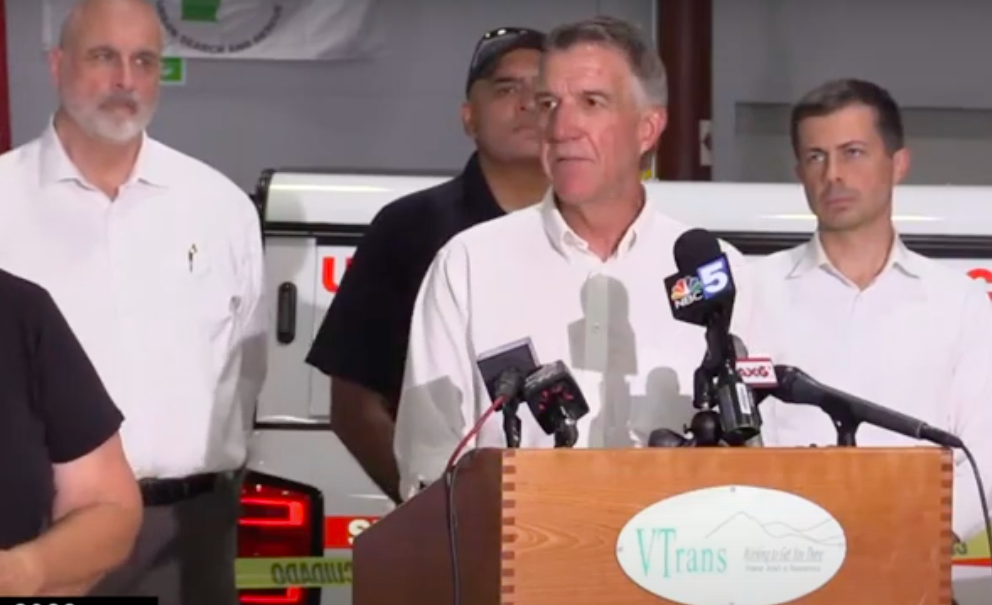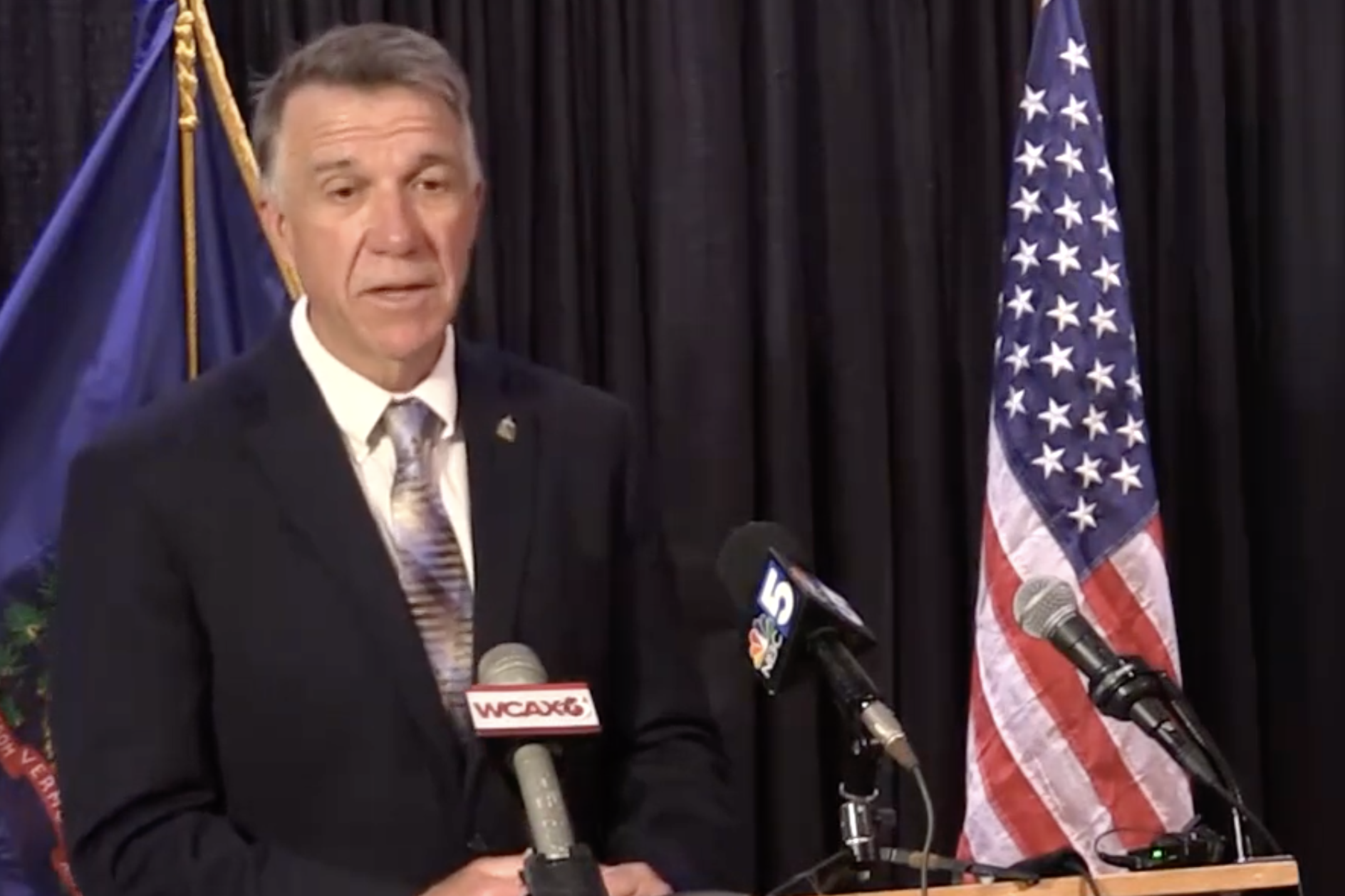
Gov. Phil Scott is getting positive reviews for standing tall in the public eye, projecting an aura of confidence and strength, displaying leadership in a time of crisis.
All good things, to be sure. But I remember in 2011 when his predecessor Peter Shumlin got the same kind of plaudits for his handling of Tropical Storm Irene. But it turned out that Shumlin was a much less skillful administrator in the absence of a crisis. From this I learned that crises are not the true test of a leader. You need definite skills in such moments, but they are not the same skills that make someone an effective manager in “normal” times or a visionary who can steer the ship of state in a positive direction.
Phil Scott’s true test will come after the immediate crisis, when he will have to learn the right lessons from the Flood of 2023 and craft policies to minimize the chances of similar disasters in the future. And to do so even if it means re-examining his own beliefs and preconceptions, something that hasn’t been his strong suit in the past.
Congrats to former governor Peter Shumlin, who will be spared the indignity — and potential legal peril — of testifying under oath about the EB-5 scandal, thanks to the state’s universal settlement of lawsuits by investors in the fraudulent scheme.
Regrets for the rest of us, who’ve been wondering for years what he knew and when he knew it
At the same time, hopes arise for the fullest possible disclosure of documents hitherto barred from public disclosure because of the state’s legal exposure. Well, that threat has been removed, right? So now we can expect a big press conference any day now where state officials will pull a curtain away from a mountain of documents and eliminate all the suspicions.
Now that Crossover Day has come and gone, it’s now official: State lawmakers will consider giving themselves health care coverage but won’t consider the same for all the rest of us.
On the Senate side, S.39 has emerged from the Government Operations Committee. It would significantly increase lawmakers’ pay from its current pittance to an amount that’s not absolutely insulting. There would be other improvements, all overdue, but the big one is coverage under the state employees’ health insurance system.
I’ve got no problem with any of that. However…
On the House side, a bill to put us on a path to universal health care was quashed without even the briefest of consideration. This, despite the fact that it had 59 co-sponsors.
Fifty-nine. More than one-third of the House.
Even so, the House Health Care Committee stuck it to the wall and left it there to die. No hearings, no votes. The contrast cannot go by without comment.
When he was governor, Peter Shumlin made a big push on health care reform. It didn’t end well for reform or for Shumlin. Since then, the system has become less functional and more expensive but there’s been no appetite for another push.
With one major exception, and that’s OneCare Vermont. It has soldiered on in its effort to rein in health care costs by paying providers for outcomes rather than treatment. It has spent a tremendous amount of money, but so far there’s not much evidence of impact.
That’s troubling, and it’s more so when you read VTDigger’s piece about the latest Green Mountain Care Board meeting. Beyond that, there’s a broader critique of our health care system in a recent series of essays by journalist and health care policy analyst Hamilton Davis. Taken together, it looks like a huge sector of our economy (upon which our physical and financial well-being depends) is drifting along with a bunch of people who call themselves “Captain” staying as far away from the helm as they can.
The Digger article makes the leaders of OneCare look like The Gang That Couldn’t Shoot Straight. The GMCB, especially its new members, were asking questions that shouldn’t have been tough to answer. For instance, do you have any evidence that your system is working? Can you point to measurable results in terms of cost savings or improved outcomes?
OneCare leaders seemed to be taken aback by this line of questioning.
Gov. Phil Scott’s re-election campaign has been sleepwalking through the 2022 campaign, barely bothering to raise money and spending very little.
Until now.
The Scott campaign’s recent financial disclosures show that, with very little time remaining, Team Scott has seriously kicked it into overdrive.
Between October 27 and November 4, the Scott campaign filed five Mass Media spending reports, totaling $63,471. That’s more than they’d spent on mass media in the entire cycle before then. The media buys break down like this: $45,086 for TV, cable and streaming ads, $1,142 for Facebook ads, and $7,513 for newspaper ads.
In the six weeks before that big splurge, the Scott campaign had spent less than $10,000 on mass media.
Why spend so much so late? In fact, almost too late? The impact will be limited because so many have already voted. Did they get a bad poll?
Gov. Phil Scott has, in many ways, lived a charmed life in the corner office. There haven’t been any scandals — or at least none that have been uncovered by our anemic press corps. He has, by general acclamation, kept his image as Gov. Nice Guy in spite of his outbreaks of verbal dyspepsia in press conferences and All Those Vetoes. And his greatest challenge has come with an incredible upside.
That would be the Covid-19 pandemic, which caused huge disruptions but was actually a strong net positive for the Vermont economy. A flood tide of federal relief aid meant there was no need for tough budget battles in the Statehouse and there was plenty of capacity for new investments. The money had the usual multiplier effect on disposable income, economic activity, and tax receipts. The latter eliminated any budget pressure that might have been left over from the direct federal infusions.
He had to make some tough calls on controlling the pandemic, for which he got plenty of praise and almost none of the criticism he, at times, deserved. Overall, the pandemic made his job a hell of a lot easier.
This isn’t the first time a crisis has elevated a governor. The high point of Peter Shumlin’s tenure was the aftermath of Tropical Storm Irene, when he got to look strong and resolute and was able to throw money around and be a hero without anyone asking any inconvenient questions. Given the rest of his record, I wonder what we’d find if somebody did a deep dive on the Irene response, but that’s water under the bridge, pun intended. And Dick Snelling is fondly remembered for accepting tax hikes in order to pull Vermont’s economy out of the gutter, and not so much for being an asshole.
But that tide of federal aid is starting to recede, and budgets are about to get very tight around these parts.
Second in a series on the July 1 campaign finance reports. The first installment covered the race for lieutenant governor.
We’re livin’ in an upside-down world, I tell ya.
There are six campaigns for statewide office. Second from the bottom, from a fundraising perspective, is the race for governor.
Yep.
Gov. Phil Scott and Brenda Siegel have raised a combined total of $82K. The only cheaper campaign is Auditor Doug Hoffer’s bid for re-election. He has raised precisely zero dollars in the past year. He carried forward a $1,115 surplus from 2020; he’s spent $862 of that, including a $200 donation to the Vermont Democratic Party. I guess he’s not worried about taking on H. Brooke Paige or whatever patsy the VTGOP digs up to take Paige’s place.
Otherwise? The six candidates for lieutenant governor have raised a combined $324K, including a paltry $16K for the two Republicans. The two Democrats running for attorney general check in at $154K. The three Dems competing for Secretary of State have raised a combined $120K. And good ol’ MIke Pieciak, running all by his lonesome for the Democratic nomination to succeed Beth Pearce, has raised $106K.
Meanwhile, the race for governor tootles along below the radar.
The Vermont Senate’s seniority-heavy lineup is about to become a serious problem. That’s because current Senate President Pro Tem Becca Balint, seen above possibly contemplating the task of herding the caucus cats, is leaving the Senate to pursue a bid for Congress. And win or lose, she won’t be in the Senate beyond this term.
Which means the Senate will have to replace her no later than next January. And I’m here to tell you exactly how shallow the talent pool is. And that’s because so many senators have overstayed their sell-by dates.
Out of the 30 senators, a full 16 are basically too old to step into the top spot*. They’re not necessarily too old to be effective lawmakers, but they’re clearly on the downslope and I doubt that any of them would even want the job.
Before I get accused of ageism, let me expand on that cold assessment. Most of the senior senators are comfortable in their roles. They are not looking to take on a new level of responsibility. Heading the Senate caucus is a big, troublesome job. You’re always putting out fires or facing the press or twisting a fellow senator’s arm. It’s also something you tend to take on when you’re set on climbing the political ladder, not when you’re fat and happy.
Look at the last several Pro Tems. John Campbell was 47 years old when he assumed the office. Peter Shumlin and Peter Welch were in their primes, and clearly had their eyes on higher positions. There were a couple of short-time Republicans in the mid-90s; John H. Bloomer served from 1993-95; Stephen Webster succeeded him for a single term. Bloomer was 63 when he became Pro Tem; he had had a successful political career and would certainly had continued if he hadn’t been killed in a car crash in January 1995. Webster was 52 when he succeeded Bloomer; he would continue his political career well beyond his time as Pro Tem.
Before them, and four years of Peter Welch, there was Doug Racine, a relative youngster when he became Pro Tem. Tim Ashe was in his early 40s, and Balint was 53. All these folks, save Webster, were far younger than today’s cohort when they led the chamber. It’s no job for old men. It is a job for the ambitious. Of the past seven Pro Tems who survived their tenures, only two (Webster, Campbell) did not seek higher office. And Campbell got the job largely because of his lack of ambition; senior Senators had a very free hand under his, cough, “leadership.”
Doug Racine, the former lieutenant governor, state senator and Human Services secretary, is considering a third run for the state’s top job. Racine had been considering a candidacy for lieutenant governor, but that field has gotten crowded. He told methat as he was gauging potential support for an LG run, he was encouraged to set his sights higher.
His willingness to run, he said, depends on assurances that he’d have the necessary support from state and federal Democratic donors and organizations. “The question is, is it a viable race or not?” Racine said. “The answer depends on the level of support.” He said he’s getting “a lot of enthusiasm” for his potential candidacy, but “that doesn’t pay the bills.” Especially since, he pointed out, the Republican Governors Association has spent millions on behalf of Gov. Phil Scott in 2016 and 2018.
Although, he said, there’s bit of uncertainty on that front. “I don’t know if Trump would let them” spend on Scott’s behalf, Racine said. “Phil is not the most popular guy in Republican circles.”
“Others who have explored a run for governor have something to lose,” he noted. “I’m retired. It’s not like I’d have to leave my job.” That’s a very real consideration for many — especially since a race against Scott is a risky endeavor.
The 69-year-old Racine was the Democratic candidate for governor in 2002; he lost narrowly in a three-way race with Republican Jim Douglas and independent Con Hogan. He sought the party’s nomination again in 2010, but lost a squeaker of a five-way primary to eventual governor Peter Shumlin, whose margin of victory was a mere 197 votes. He was Shumlin’s human services secretary from 2011 to 2014.
Way, way back in January 2015, I proposed an addition to then-governor Peter Shumlin’s executive team: the post of Shitkicker-In-Chief. “The duties would include pointing out the flaws in administration reasoning, deflating egos when necessary, and the occasional loud guffaw,” I wrote.
Despite his brush with electoral disgrace in the 2014 election, Shummy quickly reverted to the kinds of bad habits that helped derail his once-promising administration: “One of his worst is his almost-complete inability to admit that he was wrong about something — even if it’s something trivial. It makes him appear small-minded, overly defensive, duplicitous, and condescending.”
Gee, that sounds a hell of a lot like his successor, doesn’t it? Phil Scott, the former Nice Guy, is now prone to dismiss any questioning of his Covid policy, make demeaning remarks about those who disagree with him, and make transparently false statements. (His latest: his contention that he hasn’t changed his position on emergency housing when, in fact, he’s shifted considerably from his former demand that the program be ended by a date certain.)
So, it’s time for Scott to hire a shitkicker. He needs someone willing to tell him inconvenient truths such as “You’re wrong” or “That’s stupid” or “Bullshit, Mr. Governor.”