The good news first: Contrary to what I wrote in my last post, legislative leadership appears to be fully committed to approving PR.4 and giving it a spot on the statewide ballot this November. The measure would add an equal protection clause to the state constitution, mandating “equal treatment under the law” for nine protected classes, including race, sex, disability, gender identity and sexual orientation.
This is great news given efforts by the Heritage Foundation, the Trump administration, and red-state legislatures to make life as difficult as possible for transgender Americans. Vermont cannot depend on mere tradition to preserve trans rights within its borders. They must be enshrined in our constitution.
Now, I should explain how I came to write. incorrectly, that PR.4 seemed to be sinking without a trace this year after winning overwhelming approval in 2024.
Note: Important update posted a few paragraphs down. More to follow.
Well, they’re saying the quiet part out loud. This week Keith Roberts, the president of the Heritage Foundation, went on a conservative podcast and embraced the goal of outlawing all gender-affirming health care for everyone. Not just minors — everyone.
A reminder that the Heritage Foundation is the force behind Project 2025, the transformational playbook that Donald Trump disavowed when he was running for president but immediately began to implement upon taking office.
People like Roberts occupy the seats of power in the federal government. And the idea of banning gender-affirming care and kneecapping trans folk’s ability to live their lives is gradually taking hold in red states across the country. Roberts knows he can’t take such a radical step right now, but he wants to keep hammering away until trans people effectively lose the right to exist. He calls it “radical incrementalism,” and it’s happening all around us.
Meanwhile, here in exceptional little ol’ Vermont, a measure that would protect the rights of trans folk is apparently dying of neglect.
Update: Apparently it’s not. Scroll down to see a Comment posted by Sen. Nader Hashim, chair of the Senate Judiciary Committee. He says the measure moved out of his committee and is headed to the Senate floor. Good to hear. Why didn’t I find it? I searched for the bill and portions of its title on the Legislature’s website and found no trace of the bill whatsoever. It’s the first time the search function has failed to produce any sign of a bill.
A crowd big enough to attract the ire of any passing fire marshal jammed into the Statehouse’s normally placid Cedar Creek Room for an event that was inspiring, worrying, and kind of all over the place. (More on the curious backstory of this event later. Stick around if you can.)
Technically it was a press conference led by state Senate leadership, but about 300 people packed into the room to cheer on the speakers as they called for due process under law, freedom for Mohsen Mahdawi, unlawfully detained by U.S. Immigration and Customs Enforcement, and a fight by any nonviolent means necessary against Donald Trump’s assault on democracy and justice.
There were statements and there were questions from the press, like any normal press conference. But there was also an awful lot of enthusiastic response from the crowd. And for maybe the first time at such an event, the featured lawmakers acknowledged that working through the legislative process would be far from enough. “What it’s going to take is slowing ICE down and coming close to illegal interference,” said Senate Majority Leader Kesha Ram Hinsdale.
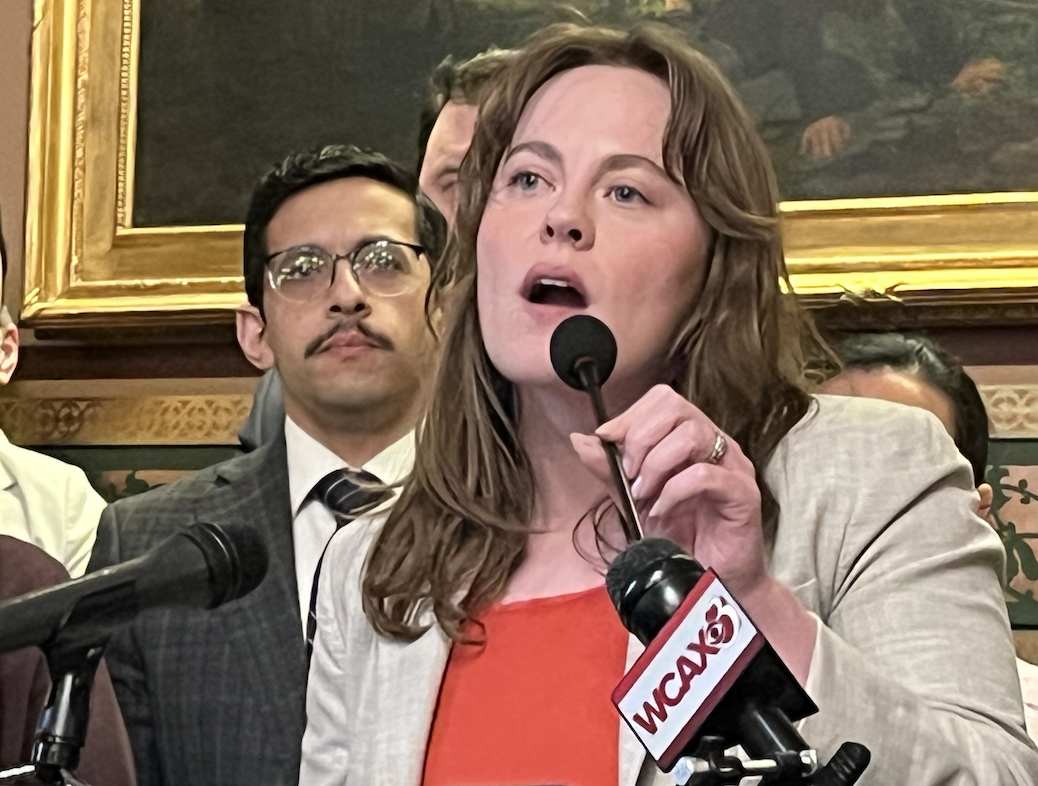
State Sen. Becca White, pictured above, led the crowd in “an oath of nonviolence and peaceful protest.” The voices filled the room as she led a brief call-and-response:
Yesterday’s installment of “Doing Something,” my daily report on Doing Something Every Day in response to Trump’s assault on the government, democratic norms, and the rule of law, was about emails I had written to the chairs of the Vermont House and Senate Judiciary Committees. I suggested that one or both of the panels should hold hearings on how various state agencies and departments cooperate with (or are complicit in, your choice) Trump’s crackdown on people of color who are in the United States legally. I provided a starter list of questions and state agencies that should be included in such hearings.
Credit to both chairs, Sen. Nader Hashim and Rep. Martin LaLonde, for getting back to me within hours. More is likely to come, but I wanted to report back on what I’ve learned so far. Which is that neither of them needed my encouragement to become actively engaged on these issues.
Another daily report on my effort to Do Something Every Day about Donald Trump’s assault on government, free speech, and the rule of law. Today I sent emails to House Judiciary Committee chair Martin LaLonde and Senate Judiciary Committee chair Nader Hashim repeating an idea I explored in my most recent blogpost: That one or both committees hold wide-ranging hearings on the state’s immigration-related relationships with the feds. Cut-and-pasting the message to Sen. Hashim:
Sen. Hashim:
Hi, John Walters here. Not a constituent, but an interested party. You may have read my most recent blogpost about Gov. Phil Scott’s, shall we say, measured response to the illegal detention of Mohsen Mahdawi. It included a suggestion which I am repeating here because it involves the Senate Judiciary Committee.
The events surrounding Mr. Mahdawi’s kidnapping and detention raise a number of questions regarding state/federal cooperation beyond the fact that he is being held in a state prison. Cut-and-pasting a passage from the blog, in which I call for a hearing of the House or Senate Judiciary Committees or possibly a joint hearing to raise these questions with appropriate state officials.
“We know the motorcade that whisked Mr. Mahdawi away had Vermont license plates. What can the DMV say about that? Can it reveal who registered the vehicles? How does it facilitate this unAmerican secrecy? Do state or local police agencies participate in or offer any support to the Trump regime? What rules do sheriff’s departments operate under, if any? How does the Department of Corrections interact with the feds? Are federal agents allowed access to detainees in state prisons? Do they interrogate detainees in state facilities?
“That’s a starter list of questions. Such a hearing wouldn’t disrupt the system, but it would put useful information on public record and perhaps lead to legislation limiting state interaction with the feds.”
I think this would be a relevant and appropriate legislative response to Mr. Mahdawi’s detention. I hope you agree.
Many, many, many words were spoken in Tuesday’s confirmation hearing for Education Secretary Zoie Saunders before the Senate Education Committee, most of them by Saunders herself. And then, after nearly two hours of jibber-jabber, her nomination was approved on a 5-1 vote, with Senate Majority Leader Kesha Ram Hinsdale on the short end of the ledger.
The full Senate will have the final say (its vote is scheduled for Thursday), but we all know where this is going. Saunders will be confirmed less than a year after the 2024 Senate rejected her on a lopsided 19-9 margin. Immediately following that vote, Gov. Phil Scott effectively overrode the Senate’s power to advise and consent by installing Saunders as interim secretary. And once the Legislature was safely adjourned for the year, Scott named her permanent secretary. That move was challenged, fruitlessly, in the courts, so she continued to serve. And she will continue into the indefinite future.
I can’t really blame the Education Committee for voting yes. It was a profoundly weird situation, having to confirm a nominee who’s already been in office for almost a full year without major missteps or scandals, at least none that we know about. It’s too long a time to suddenly decide she should be here at all, and too short a time for a true accounting of her tenure. (Nor was there any chance to hear from other witnesses who might have offered alternative views of Saunders’ effectiveness.) In a lengthy opening statement larded with the arcane language of bureaucracy, Saunders ticked off a laundry list of initiatives, every one of which was a work in progress with few if any measurables on offer.
Neither is there any evidence, in this very limited hearing, to kick her out. Ram Hinsdale’s vote was more a token protest than anything; it was clear from the opening stages of the hearing that a majority of the committee would approve Saunders. The only other possible holdout, Sen. Nader Hashim, made it clear in his first statement that he would be voting yes “unless something totally bonkers happens in the next 45 minutes.” Committee chair Sen. Seth Bongartz, the third Democrat on the six-member panel, said almost nothing until the very end of the proceedings, and then he opined that “The governor has the right to appoint the people he wants… unless something egregious emerges.” The fix was in, and had been from the moment the Senate’s Committee on Committees created an Education Committee evenly split between Democrats and Republicans, and brushed aside last session’s vice chair, Sen. Martine Laroque Gulick, in favor of the obviously pliant Bongartz.
I haven’t written about the Legislature’s newly reconstituted committees because there’s been a lot of other stuff going on. But there’s one committee that really caught my eye, and that’s the Senate Education Committee. Since education funding and structure are likely to be the dominant (and most contentious) issues in the new session, this panel will play a key role.
The Senate’s Committee on Committees chose to split the panel right down the middle — three Democrats and three Republicans. It’s pretty unusual. for the majority party to voluntarily relinquish its customary right to occupy most of the seats. Senate President Pro Tem Phil Baruth said the intention was to create a committee that would “put out bipartisan bills.”
Sounds noble. It also puts the Republicans on the spot. They can’t just sit back and vote “No” on Democratic proposals. If they don’t come to the table and negotiate, then nothing will get done.
Still, the Democrats are ceding power when they didn’t have to. Usually, a policy committee would craft bills favoring the majority’s agenda and then see the bills get watered down as they meander through the legislative process. In this case, the compromising will begin immediately. But that’s not what’s bothering me the most about the education panel.
A little late night catch-up. You may recall that the Scott administration was having a little trouble finding a site for its fourth temporary shelter. They had been looking in Bennington but then, at the last minute, they switched their focus to Brattleboro.
Or, to be more precise, the greater Brattleboro area. Because the site they identified, late yesterday, according to the Brattleboro Reformer, is a building formerly used by Entergy Nuclear when it operated the Vermont Yankee nuclear power plant.
Which closed, it says here, ten years ago.
Oh boy.
Just to be clear. They’re taking an office space that’s apparently been out of use for a decade, and they had one single day to set it up as a congregate shelter.
Tell me, is the Scott administration deliberately trying to make these shelters as dire as possible, or is it more of an Inspector Clouseau situation?
In the above photo, Sen. Bobby Starr is expounding on the moral failings of the “able-bodied” poor lazing around in taxpayer-funded motel rooms while his colleagues try to conceal their discomfort. It was just one of many dispiriting passages in Friday afternoon’s meeting of the Senate Appropriations Committee, in which the panel briefly took up and immediately dismissed one last effort to extend the motel voucher program (the one that currently provides shelter to 80% of Vermont’s homeless) beyond the end of June.
Well. Now that I’ve dropped you directly in the middle of the story, let’s go back and set the stage. After the full Senate on Thursday gave preliminary approval to an FY2024 budget that would end the voucher program on schedule, two first-term solons — Nader Hashim and Tanya Vyhovsky — did something very unusual for a pair of rookies in the seniority-heavy upper chamber: They tested the patience of their superiors by submitting a last-minute amendment that would have dedicated another $20 million to the voucher program. (It would have also defunded the detestable remote worker grant program, but that was just a bonus.)
The figure was based on conversations with housing advocates, who believe it’s the minimum amount required to prevent a large-scale unsheltering of voucher recipients. But multiple members of the committee, including chair Jane Kitchel, dismissed the number as inadequate. Kitchel said the $20 million would run out by year’s end, meaning the program would require a midyear injection of funds. She refused to engage in what she called “deficit” budgeting.
Hashim, who presented the amendment to the committee, didn’t have the information needed to counter Kitchel’s assertion, and no one else was given a chance to testify. Committee members also claimed that spending more on vouchers would mean fewer dollars for permanent housing, as if it was impossible to shift money from elsewhere in the budget or even — horrors! — raise revenue to cover the cost. So you see, they said with a metaphorical shrug of the shoulders, they had no choice but to end the voucher program.
I could go on, and I will, but let’s get back to Bobby Starr. You won’t want to miss this.
Seems like I’ve been waiting forever for the Vermont Senate to undergo a demographic shift. Every two years there’s been talk of a retirement wave, but it never materializes. Senators consider stepping aside, then realize they’re indispensable. (They’re not.) And the voters rarely eject an incumbent except in cases of overt criminality (Norm McAllister) or advanced senescence (Bill Doyle).
The shift has been painfully incremental until this year, when almost one-third of all senators decided to bow out. The nine incomers are younger, five of them are women, and one is a person of color: Nader Hashim joins Kesha Ram Hinsdale and Randy Brock as the three non-white members of the upper chamber.
(The tiny Republican caucus managed to get older and no less male. Its two youngest members, Corey Parent and Joshua Terenzini, will be replaced by a couple of old white men.)
Got more numbers to plow through, but here’s the bottom line. The Senate is on the verge of a historic shift, but it’s happening in slow motion. We might reach the tipping point in two years’ time. We’re not quite there yet.
There are still plenty of tenured members in positions of power. They account for most of the committee chairs. But only — “only” — eight of the 30 senators will be 70 or older. At least 13 will be under 65, which doesn’t sound like a lot but in the Senate it definitely is.
The incoming Senate President Pro Tem, Phil Baruth, straddles the age divide. He’s only — “only” — 60. But he’s entering his sixth two-year term, so he’s familiar with the Senate and the elders are comfortable enough with him to make him their leader. As a senator he’s been a strong policy advocate unafraid to ruffle feathers, but as Pro Tem he’ll know he can’t push his caucus too far too fast.








 The Vermont Political Observer.