Tag Archives: marijuana legalization

Planet Norm’s increasingly erratic orbit

Any time a reporter has a few minutes to spare and wants to buy the Vermont media equivalent of a lottery ticket, all they have to do is give once-and-maybe-future-Senator Norm McAllister a call. If he answers the phone, he’s almost certain to say something dumb or offensive or both.

This week’s winner was Terri Hallenbeck of Seven Days, who wrangled a juicy quote from Good Ol’ Norm, whose internal exile has, unsurprisingly, failed improve his perspective. In fact, he’s showing signs of outright conspiratorialism.

The context: Hallenbeck was previewing this week’s Senate vote on marijuana legalization. At the time, it was looking like a very close thing — maybe one vote either way. Which prompted Hallenbeck to observe that this was “the second of two recent legislative initiatives on which [McAllister] might have swayed the results.” (The other one was the paid sick leave bill.) That is, if he hadn’t been suspended in January because of those pesky sexual assault charges.

Take it away, Norm…

Reached at home in Highgate, McAllister said he would have voted against both measures. “I got an idea that’s probably why some people didn’t want me there.”

Yeah, solid thinking. It wasn’t the multiple felony charges or the pending trial or the embarrassment of having an accused felon in their midst. The Real Truth is that Norm McAllister was simply too dangerous and had to be silenced! 

Continue reading

The VPR Poll: Everything You Know Is Wrong

Previously in this space, I looked at The VPR Poll’s reading of the race for governor. To encapsulate: Phil Scott has a huge early lead, Bruce Lisman’s in the crapper, and the two Democratic candidates are still trying to build identities with a largely uninvolved electorate.

The poll is an important snapshot of the race — really, our first since last fall, when the field was still a work in progress. But even more interesting are the issues results, which campaign builders ought to be examining closely. Because the message, as Firesign Theater once put it, is

Everything You Know Is Wrong

Well, maybe not everything, but a whole lot of things.

Issues that are supposed to be driving forces in 2016? Eh, the voters don’t much care.

Positions that could make or break a campaign? Over and over again, The People fail to conform to conventional wisdom.

Darn people!

Generally, the poll depicts a populace that’s more or less okay with how things are going and not especially engaged in politics. This, despite an ongoing barrage of doom-and-glooming by Republicans and certain interest groups.

Examples: A broad desire to stay the course or go even further on health care reform; widespread acceptance of large-scale renewables; strong endorsement of Vermont’s efforts on climate change; healthy support for the state’s school consolidation efforts; and huge majorities in favor of modest gun-control measures.

After the jump: the details.

Continue reading

A big step forward for legalized pot, but don’t get your hopes up

This hasn’t been a great month for marijuana legalization in Vermont. Sure, we had Governor Shumlin’s conditional endorsement in his State of the State address; but since then, we’ve had a parade of skeptical comments from influential voices in the House and Senate.

This week brought the best news for legalization since the State of the State: Shumlin and Senate Judiciary Committee chair Dick Sears reached agreement on a legalization bill. And since the issue wasn’t going to go anywhere without Sears’ buy-in, this was an important development.

But if you ask me, I say it ain’t happening this year. Eventually, yes. 2016, no.

The Sears/Shumlin deal has raised hackles in the pro-pot community because it would ban grow-your-own. Sears is opposed because it complicates law enforcement, a legitimate concern. If this is the bill’s biggest flaw, then I’d say take the deal, get it into law, and shoot for further changes in the future.

The bill does have a number of positive features, aside from the crucial fact of Sears’ imprimatur. A strong positive: it would ensure that Vermont’s marijuana industry would be small and local. A breath of fresh air after Ohio’s unfortunate experience, where a cadre of high rollers got a measure on the ballot that would have handed the business over to a handful of large companies.

I could go on, but an in-depth evaluation is kind of pointless because it’s not going to pass. There are too many obstacles along the way, and far too many other issues on the table this year.

Continue reading

Not looking good for legalized pot

A lot of lawmakers are throwing stones at the idea of legalizing marijuana in Vermont this year. A lot of influential lawmakers. The latest, and perhaps most dispiriting: the brontosaurus of the State Senate, “Democrat” Dick Mazza. He’s chair of the Senate Transportation Committee, which is one of the committees that would have to pass the bill, because reasons. In an interview to be broadcast this Sunday on WCAX-TV, he sent loud signals that he’s prepared to put the kibosh on the idea. Bottom line?

… I say let’s not hurry it. I don’t think a year or two will make a difference, but let’s answer all these questions with our eyes wide-open.”

In addition to that cheery comment, he also argued that public-safety funding needs a boost before making pot legal. His reasoning:

“Public safety always has some sort of shortfall. The reason they do is because we are asking public safety to do more, more and more. There are a lot more crimes in Vermont, so before you burden them with a service, let’s make sure that they are fully funded on their existing services that they are providing today.”

Not sure what he means by “burden them with a service.” I could infer that he expects more trouble for the police if marijuana is legal. This is a common sentiment among law enforcement types and lawmakers looking for reasons to vote “No,” but the evidence is decidedly mixed, where evidence exists at all.

Continue reading

State of the State: Tough sledding

Governor Shumlin’s State of the State address wasn’t quite the nothing-burger you might expect from a lame duck. But if early returns are anything to go by, the actual impact of his address may be a lot closer to a nothing-burger.

There were a few notable initiatives and ideas, but most of them got slapped around almost as soon as he left the podium. And I’m not talking about the predictable Republican naysaying; I’m talking about Democratic criticism. In past years, Shumlin has had a very hard time rescuing high-profile initiatives that get off to a rocky start at the Statehouse, and that’s likely to be even more true in his lame-duck year.

Other ideas are sure to garner opposition on January 21, when the Governor delivers his final budget address. That’s when he’ll have to explain how he wants to pay for new or expanded programs that cost money. (As opposed to, say, paid sick leave, which won’t cost the government a dime.) In the past, the Legislature hasn’t reacted kindly to Shumlin’s budget-cutting suggestions (see: Earned Income Tax Credit, 2013), and he hasn’t reacted well to legislative alternatives.

We can break down the new stuff into two categories: items that will cost money, and those that won’t. At least they won’t cost the state any money.

Continue reading

A watershed moment for legalization in Vermont

This year, the state legislature did its best to tippy-toe around the issue of marijuana legalization. We heard the usual excuses — the time is not right, it needs more study, we’ve got too much else on our plate — and ended with an expensive consultant’s report sitting on a shelf.

Since then, two rather dramatic things have happened. Two weeks ago, Corrections Commissioner Andy Pallito called for the legalization of marijuana and the decriminalization of personal use of other drugs.

I always knew that guy was a hippie! (Photo from his Facebook page.)

I always knew that guy was a hippie! (Photo from his Facebook page.)

And now, we have a pro-legalization essay by the top Republican in the State Senate, Joe Benning. His piece, posted today on VTDigger, said legalization is inevitable, that marijuana is a useful and “widely popular consumer product,” that legalization would result in “a safer product,” and — here comes the Republican part — it would create “a legitimate, properly regulated industry [that] can only lead to more real, good-paying jobs.”

Well.

Sen. Benning can’t swing the vote on his own since his caucus numbers a mere nine*. The next step in marijuana law is up to the many Weebles in the Democratic majority, who’ve been painfully hesitant on the issue.

*Originally I wrote “seven,” but the good Senator corrected me. Must have stumbled upon outdated numbers in my expert Googling.

But I’d think that Benning’s advocacy would give them an opening to advance legalization. Democrats tend to be thoroughly spooked by the threat of Republican counterattacks on crime issues. And although Benning is only one Republican, he’s a very influential one. His stand ought to inoculate Democrats from GOP attacks.

It’s hard not to see this as a big step toward the death of the costly and ineffective War On Drugs, or at least the death of its most ineffective component, the war on Weed.

Shumlin: “We have a structural deficit” and other happy tidings

The Governor addresses the multitudes. (The bearded man begging for change is Dave Gram of the Associated Press.)

The Governor addresses the multitudes. (The bearded man begging for change is Dave Gram of the Associated Press.)

An uncharacteristically subdued Governor Shumlin held an agenda-free news conference this morning. I emphasize “agenda-free” because his past practice has been to piggy-back news conferences onto photo opportunities or policy announcements, leaving much less time for general questions.

Today there were a lot of questions and a lot of substance. In no particular order…

The Vermont Health Connect website will go back online this Saturday, which happens to be the first day of open enrollment. So the relaunch will come on the last possible day. Gee, hope things go right; there’s no margin for error.

Shumlin pronounced himself “optimistic,” saying “I’m encouraged by what I’m hearing.” But given how often he, and we, have been burned in the past, he was reluctant to make any predictions. “I’m always hoping it will work.”

— He dismissed Republican calls to shut down VHC and go with the federal exchange, and he had several good arguments. First of all, it’s far too late to make the change this year, so we’d be limping along with VHC for another year in any case. And there are signs it’s finally getting on track. “We’re turning a corner,” he said. “Why not give it a chance?”

There’s also the fact that the federal exchange’s premium subsidies aren’t as generous as Vermont’s. Switching to the federal system would mean higher premiums for thousands of Vermonters who earn between 100-300% of the poverty line.

And, as he pointed out, the US Supreme Court may well strike down federal subsidies, in which case only states with their own exchanges will be able to offer subsidies.

— Get ready for a slam-bang legislative session. Shumlin is still talking about the next step in health care reform (see below), the legislature is hell-bent on property tax and/or school funding reform, Shumlin is talking about significant changes to energy policy, and perhaps worst of all, the quote atop this post: “We have a structural deficit at this point.” Meaning huge challenges in fashioning a budget. That’s a hell of a lot of big, contentious issues to tackle.
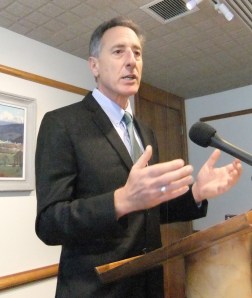
Temba, his arms wide.

Temba, his arms wide.

— Speaking of the budget, Shumlin acknowledged that Vermont and many other states “thought the recovery would be more robust,” and its weakness has caused revenue shortfalls. He’s talking about a second round of rescissions in this year’s budget, although he said nothing is final just yet. And he’s talking about major changes in next year’s budget in order to put an end to annual budget crises.

He wants to put the state on a more sustainable path. Which must be making a few Republicans chuckle, since they’ve been preaching this for years. On the other hand, Shumlin has a valid point: the recovery has been weak. If we’d had a normal recovery with decent wage gains, our tax revenue would be stronger and we wouldn’t be facing this dilemma. The big news on this front is that the Governor now believes we’re facing years of sluggishness, and we need to ratchet down the budget to make it sustainable.

When asked whether this might mean tax increases, he didn’t rule them out, but he made it clear that his first choice is to rein in spending.

— On the push for single-payer health care, he repeated his longstanding support for the idea, but acknowledged that in the wake of the election, everything is on the table. He is aiming for a system that combines affordability with universal access to health care. His preference remains single-payer, but it’s looking like we might settle for less than that.

— He made it clear that yes, he won the election, and he has no doubt that he will serve a third term. He pointed to Vermont’s long tradition of electing the top vote-getter when no one wins a majority: ‘The person who gets the most votes, wins.” He cited the 2002 election for Lieutenant Governor, in which he and Progressive Anthony Pollina combined for a liberal majority but Republican Brian Dubie won the most votes; he and Pollina urged lawmakers to elect Dubie, which they did.

— On school funding and organization, he declared “We have a spending problem,” with high per-pupil costs and administrative structures. In some cases, he said, small class sizes can be harmful to achievement rather than helpful. He’s not in favor of mandatory school consolidation, but it’s clear he will push for consolidation by trying to convince local districts that it’s in their best interest.

He did mention the idea of “prioritizing funding to schools that voluntarily consolidate.” That kind of legislative payola may be effective, but it kinda stretches the definition of “voluntary.”

— In a less wide-ranging news conference, his comments on energy policy might have made headlines. They’re likely to get lost in today’s news. He noted the pending sunset of the SPEED program, which has helped spur the renewables industry in Vermont but has also created controversy because it allows the sale of “green” energy credits in other markets. He and the legislature are working on “ideas to replace SPEED.”

He was asked about the prospects for a carbon tax with offsetting cuts in other taxes — a plan likely to be announced tomorrow by a coalition of environmental groups. He was cool to the idea, saying “It’s tough for a small rural state to do it alone,” and pointing particularly to its impact on gas stations near our state borders. He prefers a regional carbon tax instead; but he said he’s had no conversations with other northeastern governors about the idea. Methinks the enviros will have a hard time gaining traction, when you combine Shumlin’s reluctance with an extremely busy legislative session.

— Finally, he was asked about marijuana legalization. He said he wants to wait until the release of a report on the idea in January before proceeding, but noted that “I support legalization. The question is “when.”

The universal Milne

The Scott Milne campaign has a number of albatrosses around its neck.There’s the newbie candidate’s inept performances on the stump and in debates. There’s his apparent allergy to fundraising. There was, of course, his late start. There’s the devastated, improverished infrastructure of the Vermont Republican Party. (Tickets Still Available for the Congressman Peter King fundraiser tonight!) (Please buy a ticket!) (Pretty please?) There’s the fact that he still hasn’t managed to articulate actual positions on the issues.

And on top of all that, there’s his remarkably incoherent political positioning. Because, you see, Scott Milne is trying to be all things to all people. He’s simultaneously opening his big-tent flap to conservatives, moderates, and even liberals.

Scott MilneLiberals?

Yup.

He’s trying to present himself as a thoughful, moderate leader who will consider all points of view, including the most progressive. He’s depicting Governor Shumlin as a bad manager; his pitch to liberals is, “If you replace Shumlin, state government will work better and you’ll see more of your policy dreams come true.”

It’s an impossible balancing act to maintain. And Scott Milne is definitely not the man for the job.

Look at his runaround on the GMO labeling bill during this week’s debate.

First, he said the GMO bill was “a good example of the radical, progressive management of a bill by this Administration.” Then he said he wouldn’t repeal it. Then he couldn’t say whether he would have vetoed it if he’d been Governor. And finally, he returned to the theme of “managing the bill,” saying that if Shumlin hadn’t been so ham-fisted about it, the bill could have been passed “in a much more business-friendly way.”

To sum up: the bill itself isn’t necessarily bad. In fact, it could even be a positive. But Shumlin’s “management of the bill,” whatever the hell that means, was the problem.

If only Scott Milne had been Governor, we would have gotten the same outcome with completely different results. The liberals would have gotten their way, but we would have remained somehow “business-friendly.” Or something like that.

My theory also explains his odd stance on health care reform. Vermont Health Connect was a radical, progressive program — but single-payer health care is NOT necessarily radical. It could turn out to be the best option. Milne ain’t saying.

What he is trying to say to us liberals is, Shumlin’s made a mess of Vermont Health Connect. Elect me, and I’ll make it work so smoothly that it’ll pave the way to single-payer. Maybe.

On issue after issue, Scott Milne is trying to appeal to everybody at the same time. On school funding, he wants to cut costs but he also wants to retain local control. He wants a freeze on the statewide property tax, but he apparently doesn’t want schools to suffer any cuts. And he’s unwilling to even hint at a new school-funding plan. Because he doesn’t want to lose a single vote.

Many issues are simply too “complicated,” and all he promises is to work with the Democratic Legislature on the details. To conservatives, the message is: I’ll hold the line. To liberals, it’s I’ll let you have your way a lot of the time. Somehow he’s not convincing any of us.

Most telling of all is his stance on legalizing marijuana, which sounds like it came from a chronic doper:

“It is a bad idea but if I get a bill, I’ll sign it.”

In the words of the candidate himself, Holy Shamoley.

I realize the man thinks he is “Gandhi-like,” but even the original Mahatma couldn’t have pulled this off.