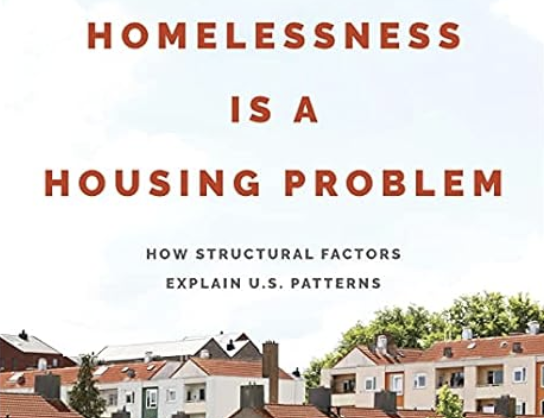
I have to say, it’s the first book I’ve ever read that gave away the conclusion right there in the title. I also have to say this isn’t the best-written book ever published — but it’s also an absolutely vital contribution to the discourse. In a fairly slim volume (204 pages plus extensive notes), co-authors Gregg Colburn and Clayton Page Aldern examine the various theories about the causes of homelessness and, with comprehensive evidence, dismiss all of them but one: as the title says, Homelessness Is a Housing Problem.
It’s not crime or mental illness or opioids or laziness or liberal policies or conservative policies or family strife or poverty or unemployment. Homelessness becomes an issue whenever and wherever there’s a shortage of housing. Like, for instance, here in Vermont.
The latest edition of “Brave Little State,” Vermont Public’s question-answerin’ podcast, addresses a widely-held belief that our homelessness problem is largely caused by people moving to Vermont to take advantage of our motel voucher program. And addresses it poorly, incompletely, and at great length.
The episode is entitled “Is Vermont’s motel program a ‘magnet’ for out-of-staters experiencing homelessness?” There is no evidence for the notion. In fact, there is a body of research showing that people in distress don’t cross state lines in any real numbers in hopes of accessing better benefits. Reporter Carly Berlin, whose work is co-published by Vermont Public and VTDigger, gets there eventually, but takes a godawful long time to do so. In the process, she manages to distort the basic issue, omit crucial aspects of the story, and get some key facts wrong.
The fundamental problem isn’t with Berlin or her many co-producers and overseers. (A total of seven Vermont Public staffers are cited in the closing credits.) The problem is that the issue was subordinated to the format. This wasn’t a story about homelessness and benefits; it was A Reporter’s Journey In Search Of Truth, filtered through the highly developed process of long-form public radio storytelling pioneered by Ira Glass’ “This American Life” and refined in this age of public media serial podcasting. The end goal of the production is more esthetic than journalistic.
This question can easily be resolved, but that’s not how you build a podcast. A long-form narrative needs a build, a measure of suspense, unexpected twists and turns, even if the actual path is pretty straightforward. Which is how you wind up with a 38-minute-long piece of audio that kind of bungles the assignment.


 The Vermont Political Observer.