Tag Archives: Burlington Free Press

Tweetblocked by a Hero Of Journalism™

Funny thing happened sometime in the past 18 hours or so. Burlington Free Press deputy editor (and Chief Assistant Gannett Cheerleader) Adam Silverman (a.k.a. @Wej12) blocked me from his Twitter feed.

I guess it was only a matter of time; I smack around the Freeploid pretty regularly, and he’s apparently the touchiest guy in the building. So, what finally broke the camel’s back?

Judging by the chronology, it was a series of replies I made to SilverTweets from the Newspaper Association of America “mediaXchange” conference in Nashville.

(Note the trendy non-traditional capitalization. That’s a sign of a desperate industry seeking new-century relevance. Kind of like when big corporations fill their Tweets with millennial slang like “bae” and “on fleek.”)

Silverman was liveTweeting from conference workshops. I couldn’t help but respond to some of them. First, a harmless jape:

After that, Silverman sent a couple Tweets I found darkly humorous. First:

And second:

A little background there. The Free Press is notoriously stingy with crediting other news organizations for original stories. Especially when it comes to Seven Days, which the Free Press likes to pretend doesn’t exist.

Anyway, I guess I stepped on some tender toes. Since then, I haven’t seen any Tweets from Silverman and I just discovered I’ve been blocked. So disappointing; I was learning so much from him about the joyless, soulless state of 21st Century Journalism.

Gannett honors cashiered Free Press writer

Ohh, this is sad, even by Burlington Free Press standards.

Last Friday, the Gannett newspaper chain announced its “Best of Gannett” awards for the company’s best journalism in 2014. Among the big winners were the Arizona Republic, the Des Moines Register, the Palm Beach (CA) Desert Sun, and the Staunton (VA) News Leader.

This being a media awards thing, there were dozens upon dozens of winners. (Journalism awards are kinda like participation ribbons. I speak as a past winner of dozens myself.)

So where, oh where, can the Freeploid be?

Scroll down. Keep scrolling. More. More. Keep going. Further. Go on.

Okay, there. The Free Press’ one and only prize is a Third Place award in the category of “Narrative Writing/Voice,” which aims to honor “powerful and tightly written news and feature stories… and any examples of evocative writing regardless of platform.”

And your winner? Oh, this is embarrassing.

Tim Johnson. 

Yes, the Tim Johnson who was abruptly fired last fall after 16 years on the job.

Gee, somehow the Free Press never bothered to report this great victory. And it’s usually so quick to brag about any honor it wins, no matter how trumped-up.

Here’s a final indignity: The awards come with cash prizes. Unfortunately for Tim, the money goes not to the writers, but to their employers. Or, in Tim’s case, ex-employer.

That’s Gannett for ya, giving the prizes to itself and screwing the talent. *Correction; see second Postscript below.

Postscript. I’ve heard through the grapevine that Johnson learned of his award through this blog. Nobody at the Free Press or Gannett bothered to inform him. That’s not just sad; it’s shameful. Even if the Free Press was going to keep the check, they could have at least given him a certificate or something. 

Post-postscriptA commenter notes that I made a mistake in reading the Gannett press release. The newspapers do pocket the cash for the Public Service awards, but the writing and reporting prizes are supposed to go to the individual staff. Presumably the Free Press will be scheduling a nice presentation ceremony for Johnson. Hahahaha.

Will the last one off the seventh floor please turn out the lights?

The institutional memory at the Burlington Free Press, Vermont’s Shrinkingest Newspaper, has taken another big hit. 28-year veteran reporter Molly Walsh is leaving the Freeploid for the friendlier confines of Seven Days.

It’s a body blow to the Free Press’ diminishing ability to cover the news. And the timing couldn’t be worse, since Walsh has been reporting the Burlington mayoral race. Not quite as bad as Terri Hallenbeck and Nancy Remsen leaving on Election Day, but not helpful. It’s also one more indication of Seven Days’ growing dominance in the Chittenden County news market, and its seriousness about positioning itself as a vital news source.

Better days…

Better days…

Walsh was diplomatic about the lifeboat she’s swimming away from:

There’s been a lot of change. I think some of the changes are for the better and some are questionable.

But her actions speak louder than her words. Can you imagine, at any earlier point in history, an established reporter voluntarily leaving an established daily newspaper for an alt-weekly?

Strange but true: Seven Days is a better place to work than the Freeploid, with its reporters expected to write clickbait-friendly articles, produce endlessly, create and market their “brand,” provide video and photography as well as copy, work with the sales department and key advertisers, and live on the high-wire of editing their own stories.

About the last point. One of the Freeploid’s sister Gannett papers, the Cincinnati Enquirer, was inundated by reader complaints about the quantity of mistakes in the Sunday paper. Most of the errors were minor, but every one undercuts a newspaper’s credibility. The Enquirer, like the Freeploid, is an example of Gannett’s Newsroom of the Future, which includes little or no copyediting.

The Sunday foofaraw was so bad, it prompted chief editor Carolyn Washburn to write a memo to news staff emphasizing the need for them to “take full ownership of your own clean copy.” Meaning, “don’t expect the editors — pardon me, Producers and Coaches — to be your backstop.”

Now, you’d think an average reporter would be capable of producing literate copy, but it’s not nearly as simple as you’d think. This former copyeditor can tell you that mistakes are like cockroaches in a New York City apartment: no matter how hard you try, it’s almost impossible to stamp ’em out. And it gets harder with every re-reading of a story: after two or three scans, your eyes inevitably start to glaze over. That’s why media outlets have traditionally had copyeditors: the more eyes you have on a story, the more likely you are to weed out the errors.

In sum, the Free Press has got to be a really hard place to work these days, and it’s only going to get worse. Walsh’s departure is one more signpost on the Free Press’ road to irrelevance.

Ethics, shmethics

Riddle me this, Batman: How is a political blogpost like a roadkill skunk?

The apparent answer: At first their stench makes them unfit for polite company, but after three weeks or so the smell goes away.

See, way; back on January 19, I wrote a piece about a bill before the legislature to establish a Latin motto for Vermont. Over time, the story went viral; it appeared on the Huffington Post, the Daily Kos, Reddit, Fark, and Gawker. It was shared on Facebook more than 10,000 times, and I literally got over 100,000 pageviews out of it.

But nobody else in Vermont media picked up on the story.

That is, until now. The Associated Press’ Dave Gram wrote a piece about it. The Burlington Free Press posted it on their paywalled website; here’s a link to the story on a non-paywalled site.

Nice of Dave to finally notice the story. Don’t know why it took three weeks.

Not so nice: he didn’t credit the Vermont Political Observer as the original source. Maybe the story’s blogorrific stench has dissipated, but the smell still permeates the dread name “theVPO.”

Gawker, that irresponsible gossipmonger, credited me; the local media, I guess, chooses not to.

Now I realize that (a) this is a trivial story, a sidebar to our coverage of politics and policy, and (b) nobody outside of the room I’m sitting in cares whether I get fair credit. But I do. And the giving and receiving of credit is always a lively topic whenever journalists gather; my salaried colleagues are quick to complain when they are slighted by another media outlet.

So here’s my complaint. For the vast majority of you who don’t care, my apologies and I promise something more relevant next time. Just needed to get that off my chest.

Well, at least the Free Press dumped its political reporters BEFORE the list came out

A big oopsie from the Montana province of the great Gannett Empire.

On Jan. 28, the Washington Post’s Chris Cillizza released a (deeply flawed and incomplete) list of the “best political reporters” in each of the 50 states. One of the four Big Sky nominees was John Adams of Gannett’s Great Falls Tribune.

Unfortunately for the Trib, only two days after the list came out, Adams declined to go through the mandatory re-interviewing process for all Gannett journalists. He balked because his position — capital bureau chief — was being eliminated, and he didn’t want any of the jobs on offer.

After serious thought and consideration I opted not to apply for any of the positions. I have been very happy in my role as the capital bureau chief for the Great Falls Tribune and would have liked to have continued in that role, but I did not feel any of the available openings in the Tribune’s new “newsroom of the future” were a good fit for me.

Bad timing, Tribbies. By contrast, our local Gannett House O’ News ‘N’ Stuff, the Burlington Free Press, had the sense to jettison its two best political reporters (Terri Hallenbeck and Nancy Remsen) a couple months before Cillizza posted his list. The Freeploid still suffered the lesser embarrassment of having Cillizza name Mike Donoghue and April Burbank as two of Vermont’s top four state political reporters, when Donoghue’s beat is only partly political and Burbank had been on the beat for less than two months.

Well, it ought to be an embarrassment, but the Freeploid is actually proud of its reporters’ “achievement.” But then, it long ago established its reputation as Vermont’s Most Shameless Newspaper Media Organization. Indeed, I wouldn’t be surprised if Cillizza’s source wasn’t someone inside the Free Press and/or Gannett; he depended heavily on reader nominations for states he wasn’t familiar with, and he clearly hasn’t a clue about Vermont. It’s hard to imagine an objective reader nominating Burbank (Donoghue maybe, just on seniority) for the honor. Nothing wrong with Burbank, she hasn’t been covering state politics long enough.


Slicing the baloney with Art Woolf

Expert-for-Sale-or-Lease Art Woolf has outdone himself in this week’s Burlington Free Press column. And that’s saying something, because just about every emission is a small shining jewel of cherrypicked statistics and unexamined dogma.

This week’s, though, hoo boy.

Herr Doktor Professor Woolf. Not exactly as illustrated.

Herr Doktor Professor Woolf. Not exactly as illustrated.

Maybe he’s been reading this blog, because today’s column is a 300-word attack on the idea of taxing the rich. His argument relies on the unlikely, and irrelevant, assertion that rich folks’ incomes are too volatile to be a dependable source of tax revenue.

Which may be true for individual taxpayers, whose incomes shuttle between well-off, rich, and filthy stinkin’ rich depending on the stock market, the purchase or sale of costly assets, and the convenient laundering of wealth to screw the taxman. (Woolf doesn’t mention the many, many tax advantages of being wealthy, and how they might cause volatility in rich folks’ tax payments.)

Woolf spends most of his column puttering around the definition of “rich,” and showing (with carefully chosen numbers) that these folks pay an impressive share of our total income tax revenue.

Well, of course they do. They earn an even more impressive share of our total income.

Not to mention that while our income tax system is fairly progressive, our total tax system is not. Sales taxes hit hardest on the poor and working classes; property taxes hit the middle class. And the income tax isn’t as progressive as it should be.  The rich may pay 40% of Vermont’s income tax revenue, but they sure as hell don’t pay 40% of our total (state and local) intake.

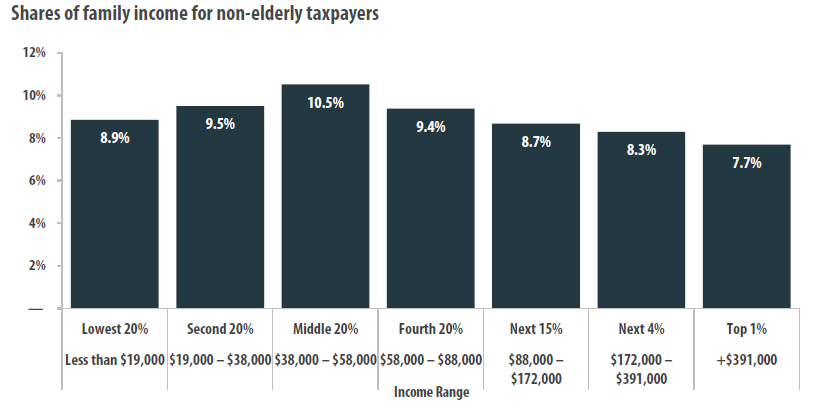
Now, if you look at statistics that Woolf conveniently ignores — total taxation as a percentage of income — you see that the rich pay lower effective tax rates than everybody else in Vermont. Here’s a chart from the Institute on Taxation and Economic Policy that I’ve posted before, but it’s relevant here:
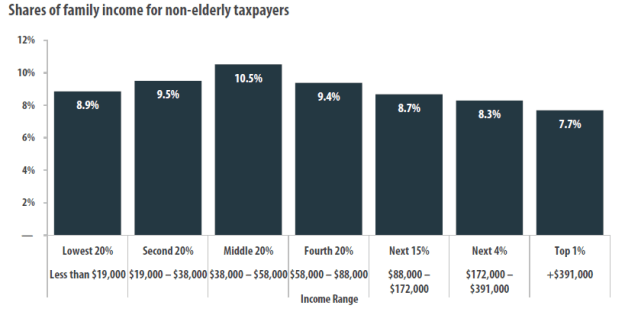
ITEP 2014 tax chart


Take all of our state and local taxation together, the richest Vermonters pay a smaller share than anybody else. Woolf conveniently ignores these figures. And he evades the obvious question they pose:

Did they pay their fair share? That’s a question a philosopher, not an economist, can answer.

Wrong, Perfesser. It doesn’t take a philosopher, or even an economist, to look at that chart and conclude that they don’t pay their fair share.

Woolf’s actual premise, that the state can’t depend on revenue from top earners, is irrelevant. Nobody is arguing for confiscatory taxation. Nobody is arguing that soaking the rich should be the foundation of our tax system. The real argument is fairness: are the rich paying enough? The answer, clearly, is no.

The revenue volatility is one of many serious problems caused by income inequality. The solution to the volatility is a fairer economy — one that doesn’t concentrate the wealth at the top end. A fairer economy would also be a stronger and more stable economy, since supply and demand would be in balance.

Why have our economy and our public finances struggled since the Great Recession? Because there are too many people who can’t afford to buy stuff, and consumer activity is by far our strongest economic driver. That’s why programs like food stamps and the Earned Income Tax Credit provide more economic stimulus than any corporate tax break or across-the-board tax cut: when working people get a little extra cash, they immediately fritter it away on things like food, housing, and heat.

But I digress. Woolf’s argument is misleading and intellectually dishonest. His conclusion is irrelevant to the actual public policy question in play. He also leaves us without a hint of an alternative solution to wealth inequality, unfair taxation, and an economy slumping due to a lack of consumer demand.
Tomorrow’s Burlington Free Press might be a bit thinner than usual

Today’s a Big Day for Gannett’s Newsroom of the Future initiative. See, Gannett has signed a big-ass contract with the Poynter Institute to provide virtual re-education camps for its rapidly dwindling cadre of newsies.

Shiny happy journalists.

Shiny happy journalists.

The Gannett-Poynter Training Partnership has its official kickoff today at 1:00 with an Employee Town Hall Webcast featuring Gannett President/CEO Gracia Martore “highlighting recent company news and a discussion about what’s ahead.” Expect a load of happy talk about how recent transitions (read: layoffs) have repositioned the corporation for a bright future.

Attendance, I suspect, is mandatory. I hope there’s no big news this afternoon.

After the launch party, staffers will undergo “four to seven modules that address a specific training need,” all with a goal of enhancing Gannett’s digital footprint and engaging the audience (they used to call us “readers”).

Poynter’s “training opportunities” include a bunch of courses in audience analytics, “building your brand,” “developing your social media voice,” promoting content online, and effective Tweeting. (I strongly suggest Michael Townsend sign up for that one.) Other notable “content modules” (they used to call them courses) include…

“Business Models and Strategies” — “innovative ideas that can bring new streams of revenue to your operations.” Which means partnering with sales staff and working with advertisers.

“Best practices for working with citizen journalists” and “How to Tell Great Investigative Stories with Dwindling Resources.” Meaning, we can’t afford reporters anymore.

“Cleaning Your Copy: Grammar, Style and More.”  Meaning, we can’t afford editors anymore.

“The Camera With You: How, and When, to Shoot with a Smartphone.” Meaning, we can’t afford photographers anymore.

Modules for the newly minted position of Content Coach include Managing Creative People (those damn crazy reporters), Dealing With Difficult Conversations (I’d think Gannett managers would already be experienced at this), and Language of Coaching (please stop yelling at the reporters).

Some of this is cringeworthy, and reflects a desperate industry making a last-gasp effort to maintain some sort of relevance. Or at least keep the profit streams flowing as long as possible. But to be fair to Gannett, a lot of this will help journalists and editors adjust to new realities being forced upon them. And when, sooner or later, they find themselves jettisoned by their corporate masters, they’ll be better equipped to bushwhack their way through our brave new media landscape where Content is King, but Content Providers are peons. And where salesmanship is at least as important as quality.

A little shameless, and ironic, self-promotion by the Freeploid

Okay, so the Washington Post’s Chris Cillizza puts out a list of the best political reporters in each of the 50 states. He describes the list as a combination of reader recommendations and his own knowledge. It’s fair to assume that the farther away he gets from Washington, the more dependent he is on his readers.

Take Vermont, for instance. Cillizza’s list was sadly incomplete and, in two instances, ironically off-target.

He names four reporters. Paul Heintz of Seven Days; no problem there. Kyle Midura of WCAX; he does a fine job by TV standards.

The other two: Mike Donoghue and April Burbank of the Burlington Free Press.

Hahahahaha.

Nothing against either of them; they’re perfectly cromulent reporters. However…

— Neither is primarily a political reporter. Both are on the Freeploid’s vaguely-named Accountability Team. The Free Press draws heavily on the Associated Press for its political coverage.

— It was only a couple months ago that the Free Press jettisoned its political reporters, Terri Hallenbeck and Nancy Remsen. Both would be better choices for Cillizza’s list than Donoghue and Burbank.

The thickly-laden irony isn’t stopping the Free Press from celebrating its dubious honor. Three Freeploid functionaries have Tweeted the big news; here’s one of them.

Nice, Aki. I’m sure your former colleagues are sharing a bitter laugh.

As for Cillizza, he clearly doesn’t know much about Vermont media. He completely ignores VTDigger and VPR, two of the three best outlets for state political news. The Digger diss isn’t surprising, since he named it the Best Political Blog in Vermont two years ago. Small problem there: VTDigger isn’t a blog. It’s a professionally staffed news operation.

Cillizza does acknowledge the possible incompleteness of his list, and he has added people to it since he first posted it. I’ve sent him an email with my suggestions, and perhaps he’ll include them.

My top three noms: Anne Galloway of VTDigger, Peter Hirschfeld of VPR, and Neal Goswami of the Vermont Press Bureau. If I expanded things a bit, I’d include Dave Gram of the AP, Stuart Ledbetter of WPTZ, Bob Kinzel of VPR, and Mark Johnson of WDEV. Mark doesn’t report as such, but his daily radio show is the best single platform for discussion of state politcs and policy.

On the subject of Vermont’s true Best Political Blog, modesty forbids me.

Art Woolf To The Rescue!!!

Throughout the history of its big pipeline project, Vermont Gas has been its own worst enemy — alienating landowners, indulging in ham-fisted PR, and repeatedly raising its cost estimates for pipeline construction.

Nonetheless, the odds are still in VG’s favor. Well-meaning protests notwithstanding, if VG can make a plausible economic case, the thing’s gonna get built.

And who’s helping them build a plausible economic case, according to VTDigger?

The construction of the project will create as many as 444 direct and indirect jobs, according to a report by the Vermont consulting firm, Northern Economic Consulting, Inc.

That’s the consulting firm co-owned by our least-favorite economist Art Woolf, he of the reliably awful “How We’re Doing” column in the Burlington Free Press.

Yes, Art’s a professor at UVM, but I suspect he makes a lot more money from NEC than he does for his academic work. His consulting firm has a number of revenue streams:

— Consulting to a variety of high-paying clients, mostly of the corporate persuasion.

— Providing expert witness services for civil suits of all kinds. (“Have you been hurt in a slip and fall accident? Dial 1-800-CALL-ART for expert testimony on your financial losses.”)

— Running an annual Vermont Economic Outlook Conference. The most recent conference was a five-hour affair, with admission priced at a cool $170/person.

— Publishing a monthly Vermont Economy Newsletter, subscription a mere $150/year.

In short, Woolf is more hired gun than objective expert. Which might explain why his weekly columns, more often than not, come across like they were written on behalf of the Associated Industries of Vermont. George W. Bush once told a roomful of wealthy supporters that they were his base; well, the Vermont business sector is Woolf’s base.

So, about his rosy estimate of the pipeline’s economic impact. Without doubt, the vast majority of those 444 “direct and indirect jobs” are temporary, construction-related jobs.

TransCanada has claimed that the Keystone Xl pipeline would create tens of thousands of jobs. But almost all of those are temporary, appearing and disappearing during the projected two-year construction cycle. Operating the pipeline, once it’s built, would take about 50 workers.

As far as I can tell, nobody’s asked Woolf about the quality or duration of those 444 pipeline jobs. But if his math is similar to Keystone’s, then we should expect no more than a handful of permanent positions at Vermont Gas.

Don’t blame Woolf; he’s only doing what bespoke experts do for their money: putting forth the best possible case for his client.

One more thing. The identifier that accompanies Woolf’s column in the Freeploid mentions only that he’s a faculty member at UVM. Nothing about his corporate clients, nothing about the subscriber base for his costly publication. Considering how many business interests are paying Woolf, how often do you suppose there’s been a direct or indirect conflict of interest that’s gone conveniently undisclosed?

Oh, one more one more thing. There’s a typo in the title of last Thursday’s “How We’re Doing.” In the TITLE, for God’s sake. It’s spelled “minuscule,” not “miniscule.” Any copy editors left at the Freeps?


Mikey Pom-Poms is at it again

I can explain everything.

Nobody was Tweeting, officer. We were all in the back seat singing.

Last night saw another outbreak of TwitBoasting from serial offender Michael Townsend, the Burlington Free Press’ Cheerleader-In-Chief.

The first one wasn’t that bad:

Okay, fine, share a little love with one of your hard-working scribes. Nothing wrong there. But then came Step Two in Townsend’s descent.

Mike Donoghue was at the Statehouse yesterday, but I’m told he wasn’t covering Shumlin’s budget address; he was dogging people about this delinquent-taxpayer list. Short version: earlier this week, the state released a list of its top 100 tax scofflaws — 50 business, 50 individual. But just the names; not the amounts owed. Donoghue is seeking the amounts.

That’s the big scoop. On the day of Gov. Shumlin’s budget address, when he’s setting the agenda for this legislative session, the Free Press’ senior reporter is stirring up a tempest in a transparency teapot.

And then came Townsend’s topper:

Oh, Mikey.

Look, it’s perfectly okay to talk up your own reporters. But why do you have to run down everybody else?

As I’ve said before, this is why all the other reporters think Townsend is a jerk and the Free Press is a fount of institutional arrogance.

Also, please lose the fake cowboy stuff. Donoghue and Burbank are good reporters; they’re not The Magnificent Seven.