
Tag Archives: Brian Campion

Public School Reform As If the Public Schools Mattered

The House Education Committee has set aside a fair bit of time this week for discussion of H.454, which sets out Gov. Phil Scott’s education reform plan in a brisk 194 pages. It is to be hoped that the committee’s deliberations will be centered first and foremost on what’s best for Vermont’s public school system. Because nobody else seems to be doing so.

Take the governor, for instance. (Please, says Henny.) He pays lip service to improving education, but his focus is clearly on cost containment. Radically centralizing the system is no guarantee of better quality. (It’s no guarantee of savings, either; the move to statewide negotiation of health insurance for public school personnel hasn’t prevented its cost from skyrocketing.) Doing away with local school districts in favor of five massive regional districts is clearly aimed at cutting administrative costs. And don’t get me started on the provision of H.454 setting minimum class sizes at 15 for grades K-4 and 25 for grades 5-12.

Those are minimums, mind you. What would the average class sizes be? 20 in the lower grades, or 25? 30 in the upper? 35? Cautious administrators will want a margin of error above the state-mandated minimums. And what happens when a school dips below the minimum? Does it close down? Put some crash test dummies in desks and hope no one notices?

Frankly, I wonder why any Republican who represents a rural district — which is the vast majority of Republican lawmakers — could support this plan as written. The class size provision alone would trigger a massive wave of consolidation that would hit rural Vermont especially hard. (Maybe that’s why H.454 has a mere five sponsors while H.16, the Republican bill to repeal the Affordable Heat Act, has 55 and H.62, to repeal the Global Warming Solutions Act, has 29. There hasn’t exactly been a stampede among legislative Republicans to sign on to the governor’s plan.)

Continue reading

The New State Senate Will Be… Something

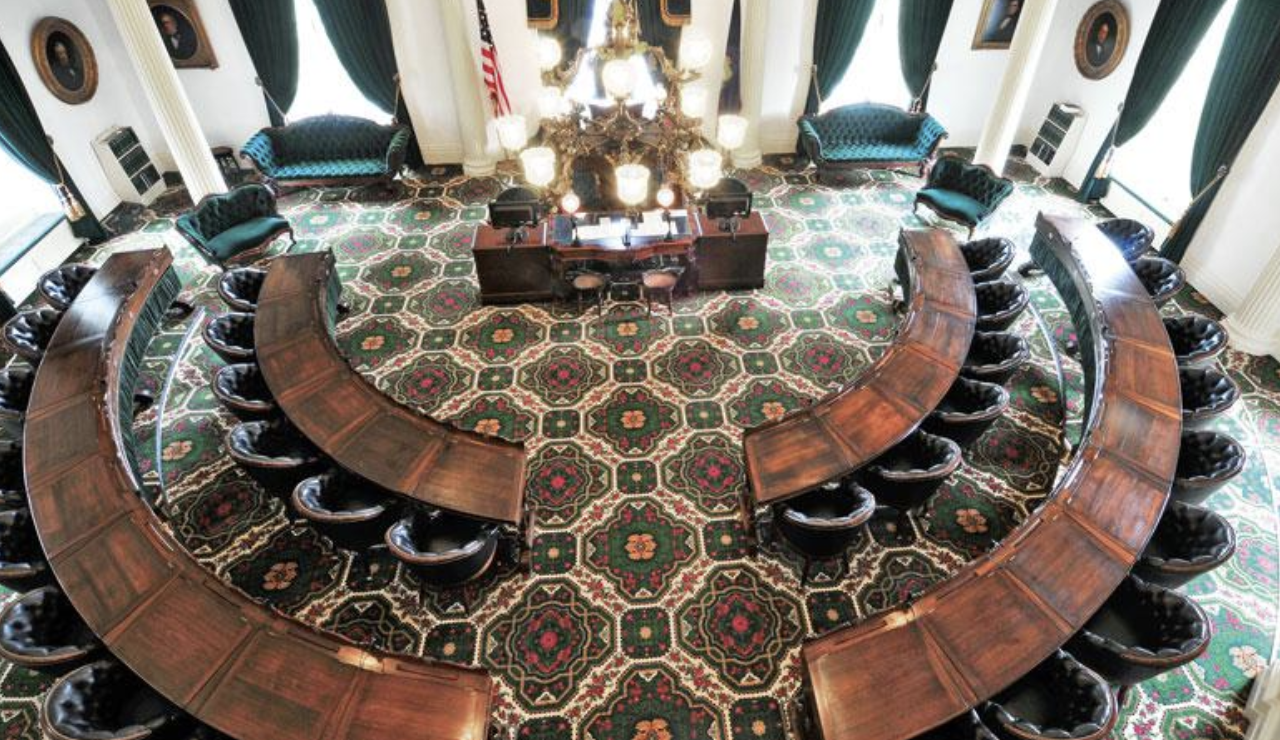
Last May, I wrote a piece entitled “What Will the State Senate Be in 2025?” The idea was that for the second straight election cycle, the stodgy ol’ Senate was going to see an unusual quantity of churn:

This, in a body that values age and seniority above all else, and normally consigns junior members to purely decorative status. It’s gonna be interesting.

Well, the results of this month’s election will bring even more change to the Senate. It’s kind of staggering when you put it all together. By my count, 18 of the 30 senators will be freshmen or sophomores come January. That’s an amazing number. There were 10 newbies in 2023, and nine more will be new senators in 2025. (One 2023 newcomer, Irene Wrenner, lost her bid for a second term.)

The class of 2025: Democrats Seth Bongartz, Joe Major, and Robert Plunkett; and Republicans Scott Beck, Patrick Brennan, Samuel Douglass, Larry Hart Sr., Steven Heffernan, and Chris Mattos. Class of 2023: Martine Gulick, Wendy Harrison, Nader Hashim, Robert Norris, Tanya Vyhovsky, Anne Watson, David Weeks, Becca White, and Terry Williams.

What’s more, in a body known for very long tenures, only four senators will have served continuously since 2015 (Phil Baruth, Ann Cummings, Ginny Lyons, Richard Westman). Historically, you’d need to serve at least that long before the John Bloomers of the world* would consider you to be a Real Senator.

*Kidding. There is only one John Bloomer per planet.

Continue reading

Going Down All the Rabbit Holes With a Republican Candidate for State Senate

Joe Gervais has returned to the political stage. The extremely unsuccessful 2022 Republican candidate for a House seat in and around Manchester is now running for state Senate in Bennington County. Two years ago in this space, I covered the extreme views ineptly concealed behind a façade of common sense conservatism, such as election denialism, Covid conspiratorialism, and belief in the thoroughly debunked canard that vaccines cause autism.

But that was a mere appetizer for the main course we have on today’s menu. Gervais is once again running as a fiscally conservative Republican of the kind that would make Phil Scott proud… but he made the cardinal mistake of revealing his true self in a blog on Substack called “Vermont Musings.”

And boy, are his views ever extreme. Among the most extreme I’ve seen in Vermont politics, and that includes the likes of Art Peterson, Gregory Thayer, and John Klar.

Fasten your seat belts. It’s going to be a bumpy ride.

Continue reading

What Will the State Senate Be In 2025?

Time for some way-too-early speculation about what kind of state Senate we will have in the new biennium. To date, Sens. Jane Kitchel, Bobby Starr, Dick McCormack and Brian Campion have announced they are not seeking re-election. Sen. Dick Mazza resigned last month for health reasons, which brings us to five senior solons — in terms of lifespan and/or tenure — who won’t be there next January.

Disclaimer: The following post is based entirely on my own observations. There is not a lick of insider information at play. I do NOT have sources in Senate leadership.

By my math, the five retirees have lived a combined 372 years (average “only” 74.4 years, thanks to that 53-year-old whipper-snapper Campion, PULL UP YER PANTS young man) and legislative service totaling 158 years. That’s right, one hundred and fifty-eight, more than 31 years apiece under the Golden Dome. Also, three of the five are committee chairs.

This round of departures follows the seismic 2022 election season, when 10 senators — fully one-third of the chamber — did not return. That means fully half of the 2025 Senate will have, at most, two years of experience. In 2020, four senators stepped away (three by choice; John Rodgers came a cropper thanks to his own inattentiveness to the niceties of candidate filing law), which means that 19 members of the new Senate will have no more than four years of experience.

This, in a body that values age and seniority above all else, and normally consigns junior members to purely decorative status. It’s gonna be interesting.

Continue reading

Well, At Least It Wasn’t the Most Violent Thing to Ever Happen in a Senate Chamber

Wow. Not only did the state Senate reject Zoie Saunders’ nomination as education secretary, it did so on a lopsided 19-9 vote. That’s a damning indictment of how out of touch Gov. Phil Scott was in choosing her. I mean, it’s still unclear whether a Vermont Senate has ever rejected a cabinet appointee, much less by a better than two-to-one margin.

And of course the governor immediately appointed Saunders as interim secretary, effectively flipping the bird at the Senate. This won’t do anything to improve his turbulent relationship with the Legislature, but I doubt he really cares about that. If anything, this might presage a flurry of vengeful vetoes that would vault Scott’s all-time record into permanently unbreakable Cy Young territory. Hooray for Governor Nice Guy!

And, well, if condolences are ever in order for someone who just “won,” it’s for Zoie Saunders. She takes on a daunting challenge with an understaffed Education Agency and with the entire educational establishment wishing she would just go away and with two-thirds of the Senate rejecting her. I am convinced she was not the best choice for the job, but man, she’s sitting at the poker table with a deuce-seven off suit. Brutal.

Continue reading

Why Is This Guy Chair of the Senate Education Committee? (With Correction)

By all appearances, the Senate’s confirmation vote on Zoie Saunders (scheduled for Tuesday) is going down to the wire. The Scott administration sure seems to think so, if chief of staff Jason Gibbs’ obsession with Krista Huling is any indication. I’ve also been told that Gov. Phil Scott is making calls to key senators on behalf of his — Only in Journalism Word alert — embattled nominee for education secretary. That’s a level of personal attention he seldom gives to any matter before the Legislature.

If the Senate does reject Saunders, it will be a seismic (another Only in Journalism word) event in our politics. It’s extremely rare for the Senate to reject a gubernatorial nominee. Certainly the administration took that step for granted. (As did Vermont Public.) Otherwise they wouldn’t have let Saunders disrupt her life and career to take the job. One has to wonder if she was fully informed about the risk involved.

If the Senate does reject Saunders due to her stunning lack of experience as (1) a public educator and (2) an administrator overseeing a sizable bureaucracy, it will be in spite of, not because of, the Senate Education Committee’s failure to carry out its responsibility to vet Saunders’ nomination.

Which leads me to the man pictured above, committee chair Sen. Brian Campion, and the rather curious composition of his committee.

Continue reading

Senate Committee Conducts Pillowy Soft Job Interview

Yeah, well, that was depressing.

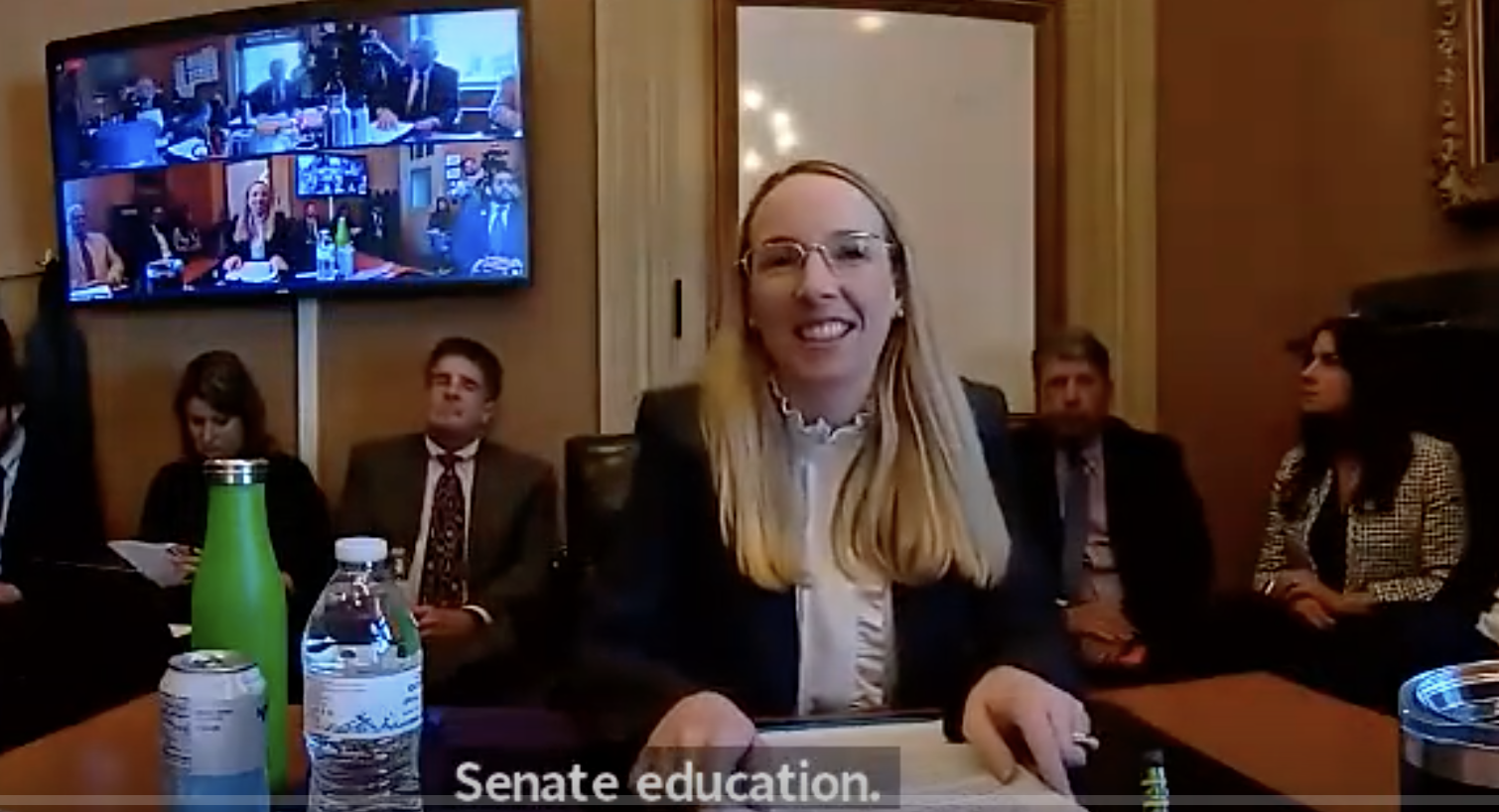
The Senate Education Committee held its confirmation hearing this afternoon for Zoie Saunders, Gov. Phil Scott’s choice for education secretary. She was smiling broadly as the hearing commenced, and she had every reason to smile at the end. The committee failed to raise some very pertinent issues. When they did pose tough questions, they often carefully blunted the sharp edge. (Commitee chair Sen. Brian Campion led the league in “tell me a little bit about” questions, which is an open invitation for the interviewee to wander off in whatever direction they want.) They often asked about what she would do as education secretary or what policies she would pursue, which Saunders easily sidestepped in the familiar manner of Supreme Court nominees batting away hypotheticals.

The bulk of the hearing was a comfortable exchange of educational jargon, the wrapping of empty thought into multisyllabic cloth that obscures the emptiness of the dialogue. It’s familiar ground for Saunders, who’s been a professional educator for the better part of two decades, and it’s equally familiar for members of the Education Committee, who exist in the rarefied air of the profession’s bafflegab. It makes them feel smart, don’t you know.

What the committee failed to do is treat the hearing like a job interview with an applicant with questionable qualifications. The point should have been to explore Saunders’ background and clarify her rightness for the position. The committee accomplished little in that regard. At the end of the affair, there was no hint of any continuing opposition to her nomination. I will be stunned if the committee doesn’t recommend approval by the full Senate. Hell, they’ve set aside an entire… 15 minutes… for committee discussion of her nomination Wednesday afternoon.

Continue reading

Not Quite So Many Scofflaws in High Places As It Seemed

As expected, I’ve gotten some blowback from my post naming all the state lawmakers who didn’t file campaign finance reports by the March 15 deadline, and still hadn’t as of a couple weeks later.

I’ve heard from five lawmakers in all. One, Sen. Brian Campion, said I’d mistakenly put him on the list, and he was right. Four others (Sen. Phil Baruth, Reps. Seth Chase, Martin LaLonde and Emily Long) said they’d been advised by the Secretary of State’s office that they didn’t need to file.

And yes, they were right.

Here’s the deal. If you ended the 2020 campaign cycle with nothing in the bank and reported that fact at the time, and you have yet to raise or spend $500 or more in this cycle, you don’t have to report until you reach that threshold.

That was, indeed, the case for the four lawmakers named above. It may be true for others as well (and I’ll add their names to the list if they let me know). But I believe their number is fairly small.

Continue reading

Wanted: A Few New State Senators. Or a Lot.

Well, I guess there’s at least one group with a worse seniority problem.

The Vermont Senate, as has been noted in this space, is a temple of tenure. It’s almost impossible to defeat a sitting senator; the only time we get a new one is when someone voluntarily retires. That rarely happens and, as a result, the Senate just keeps getting older and older.

How old? Average age of the 30 senators is 63.4 years. There are only five senators under age 50; there are 14 over 70, and 11 who are 75 and older. There are two others in their late 60s, which means we have a Senate majority past retirement age.

And the oldest wield the most power. The average age of the 11 policy committee chairs is 72.1. Brian Campion is the only policy chair under 64. Yep, that chamber loves it some seniority.

This has some unfortunate effects. First, there’s often an airless quality to the Senate’s work. It is an entity apart from the real world — or even those rambunctious young’uns in the House. (Senators often treat the House with open contempt.) Second, senators are often out of touch when discussing issues of concern to young people like digital technology, child care, substance use, rental housing, and workforce development. Third, well, it’s really hard to get the Senate to take a fresh look at anything or contemplate a change in How We’ve Always Done It.

Sure, tenure has its benefits. They know their way around the building, and that’s nothing to sneeze at. Some, including Dick Sears, Bobby Starr, and Jane Kitchel, bring decades of experience and deep knowledge of their policy beats.

But in any organization, you want a mix of young and old, new and tenured. The Senate is terribly skewed toward age and seniority. It’s long past time for some serious turnover. Will 2022 be the year we get it? I sure hope so.

After the jump: Naming some names.

Continue reading

The Legal Clusterf* Around Public Dollars for Religious Schools

You know you’re onto a hot mess when, in the course of a one-hour hearing, a situation is described as “a potential landmine of constitutional issues” and a passage between Scylla and Charybdis, and a leading Constitutional scholar can’t even guess where the courts are going on the issue.

Such was the state of affairs before the Senate Education Committee Wednesday afternoon. The five solons took testimony on how, or whether, the state must pay tuition to religious schools. The short answer is “yes,” under certain circumstances. The long answer is, “yes,” but exactly how we should do it is an impenetrable thicket of non-ambiguous court decisions and costly legal maneuvers.

And if you don’t, under any circumstances, want your tax dollars going to, say, The Lord’s Anti-Semitic Academy Of Creationist Heteronormativity, well, you’re shit out of luck.

The “credit” for this morass can be awarded to the John Roberts Supreme Court. In a 5-4 decision (along ideological lines) in the 2019 case Espinoza v. Montana Department of Revenue, the high court ruled that the state of Montana could not exclude religious schools from a program that doled out tax credit-funded scholarships for schoolkids.

Vermont doesn’t have a program like that, but if a community chooses not to operate public schools, the state pays tuition for the town’s kids to attend one of a handful of approved private schools, like St. Johnsbury Academy and Burr and Burton Academy. If you apply the Espinoza standard to Vermont, the state must throw the program’s doors open to any qualified private school, religious or not. And “approved” can’t be decided on the increasingly frayed principle of church/state separation.

“The Supreme Court has been moving the goalpost in favor of funding religious institutions,” said Vermont Law School Professor Peter Teachout, the Legislature’s go-to guy for thorny constitutional issues.

After the jump: Fasten your seat belts, it’s gonna be a bumpy ride.

Continue reading