Tag Archives: Bobby Starr

How Many More Menards? (SEE ALSO ENSUING POST)

Note: This post is deeply flawed and hurtful in ways I did not intend. In making a case against state policy, I used the Menards as symbols — or props, if you prefer — in ways that dishonor their memory and affect their family and friends. I apologize. I’m keeping this post as is, but I have written a follow-up with an apology and further reflections.

Lucas and Tammy Menard may have been the first to die because the State of Vermont didn’t care, but they will not be the last. There are roughly 1,500 people, all of whom were officially classed as “vulnerable” due to age, disability, or other factors, who have been unsheltered by state policy since mid-September. Our leaders put all of them in the most horribly uncertain of circumstances because we could not muster the political will or managerial smarts to provide for these people.

Instead, we were satisfied with a policy that amounts to “culling the herd,” weeding out those too compromised to survive the onset of winter living in a goddamn tent. The Menards’ deaths could be seen as a policy success in that regard. The long, long list of the unsheltered has just been reduced by two, so hey, congratulations?

It’s a situation that would seem to warrant charges of negligent manslaughter against certain politicians and bureaucrats — except for that pesky immunity standard they enjoy for official acts. And if you think accusing Our Betters of willfully committing two felonies is a bridge too far, well, let us turn to the Merriam-Webster Dictionary definition of “manslaughter” as

…resulting from the failure to perform a legal duty expressly required to safeguard human life, from the commission of an unlawful act not amounting to a felony, or from the commission of a lawful act involving a risk of injury or death that is done in an unlawful, reckless, or grossly negligent manner.


Continue reading

So You’re Saying There’s a Chance

I’ve previously discussed the Republicans’ chances of ending the Dem/Prog supermajority in the House, which are essentially zero. Now it’s time for the Senate, where the Republicans do have an actual chance at ending the supermajority — but the odds are stacked against them.

Scene setting: During the current biennium, the D/P contingent totaled 23 while the R’s had only seven. Twenty votes constitute the narrowest of supermajorities, so the Dems have had a nice little margin for error.

The Republicans need to post a net gain of at least four seats in November to end the supermajority, but every seat they pick up makes it harder to override.

Quick assessment: If absolutely everything broke their way, the Republicans could pick up a maximum of five more seats — which would leave the D/P majority with 18, two short of a supermajority. But the chances of that are slim at best. The Republicans are more likely to win a seat or two, which would preserve the supermajority but make overrides harder to achieve. If you spin the scenario the other way, the Dems could hold serve and pick off one Republican seat.

Continue reading

So the VTGOP’s Big Plan Is… Try to Take Jane Kitchel’s Senate Seat? Is That It?

Previously we looked at the dire financial straits of Esther Charlestin’s candidacy for governor, where she barely cleared $12,000 in a race that calls for, by Howard Dean’s reckoning, at least 164 times that much money. Now it’s time to look at the Republican side of the ledger, where pretty much everybody can rightly cry poverty.

With one notable exception.

That would be state Rep. Scott Beck, running for the Northeast Kingdom Senate seat currently occupied by retiring Democrat Jane Kitchel. Beck has raised a rather stunning $35,565. (His likely Democratic opponent, Amanda Cochrane, has raised a respectable $7,165 and enjoys Kitchel’s active support.) Beck appears to be the only Republican candidate who has raised more than enough money to run a respectable race. Besides, of course, Gov. Phil Scott, The Exception To Every Republican Rule,

More to the point, Beck and the governor are about the only two Republicans who aren’t complete embarrassments when it comes to fundraising. Which shows you just how desperate the party’s situation is.

The VTGOP ought to be in a position for a nice little comeback in the Legislature, threatening to end the Dem/Prog supermajorities that imperil every single one of Scott’s many, many, many vetoes. And they’re not.

Instead, the wistful eyes of the donor class have largely turned to putative Democrat Stewart Ledbetter’s bid to wrest away a Senate seat from liberal Democrat Martine Gulick or Progressive firebrand Tanya Vyhovsky. Ledbetter has amassed the largest campaign kitty of any Statehouse candidate thanks primarily to Burlington-area business leaders. You know, the very people who would historically be bankrolling Republicans.

Continue reading

Whatever Happened to the Great Phil Scott Recruitment Drive of 2024?

When the leader of your party describes your candidate recruitment effort as “disappointing,” it’s a sign that things have gone off the rails. So said VTGOP Chair Paul Dame to Seven Days’ Kevin McCallum, and then added “It’s one of the smallest recruitment classes that we’ve had in the last 10 years.”

Can confirm. I spent a few hours poring over the Secretary of State’s list of candidates who have filed for major party primaries. There may be a few late adds; the deadline was last Thursday, and as of Monday morning the Elections Office was still checking petitions. But what we’ve got so far, by my count, is a total of 69 Republican candidates for House. Which sounds a little bit respectable considering they’ve only got 37 seats right now.

Except for this: At least 30 of those candidates have no shot at winning. There are a few Republican primaries where someone’s gotta lose, a few repeat candidates who have been uncompetitive in the past, and a lot of Republican candidates in deep-blue districts. In other words, the VTGOP has no better than the longest of longshot chances at eliminating the Democratic/Progressive supermajority in the House. They’d have to run the table in competitive districts and hold all their current seats.

On the Senate side the Republicans have 25 candidates, but I count 14 who are not competitive. The R’s do have a shot at ending the Senate supermajority thanks to some key Democratic departures, but that’s all it is: a shot.

So what happened to Gov. Phil Scott’s “pledge” (McCallum’s word) to recruit moderate Republican candidates? Either it was a failure, or it never happened at all.

Continue reading

What Will the State Senate Be In 2025?

Time for some way-too-early speculation about what kind of state Senate we will have in the new biennium. To date, Sens. Jane Kitchel, Bobby Starr, Dick McCormack and Brian Campion have announced they are not seeking re-election. Sen. Dick Mazza resigned last month for health reasons, which brings us to five senior solons — in terms of lifespan and/or tenure — who won’t be there next January.

Disclaimer: The following post is based entirely on my own observations. There is not a lick of insider information at play. I do NOT have sources in Senate leadership.

By my math, the five retirees have lived a combined 372 years (average “only” 74.4 years, thanks to that 53-year-old whipper-snapper Campion, PULL UP YER PANTS young man) and legislative service totaling 158 years. That’s right, one hundred and fifty-eight, more than 31 years apiece under the Golden Dome. Also, three of the five are committee chairs.

This round of departures follows the seismic 2022 election season, when 10 senators — fully one-third of the chamber — did not return. That means fully half of the 2025 Senate will have, at most, two years of experience. In 2020, four senators stepped away (three by choice; John Rodgers came a cropper thanks to his own inattentiveness to the niceties of candidate filing law), which means that 19 members of the new Senate will have no more than four years of experience.

This, in a body that values age and seniority above all else, and normally consigns junior members to purely decorative status. It’s gonna be interesting.

Continue reading

A Stain on the Senate

The Senate Appropriations Committee is a distillation of everything I don’t like about the Senate as a whole. It’s heavily weighted toward seniority. The senior solons get near-total deference from any junior colleague who manages to wedge their way onto the committee. Those veteran members are a knowledgeable lot — but they think they’re smarter, wiser and more knowledgeable than they actually are, and they sometimes reflect antediluvian opinions on current political issues. And they frequently express disdain, if not contempt, for the work of the House.

But the worst of the lot is Sen. Bobby Starr. He’s really been on one this week, as Appropriations considers whether to extend emergency housing programs for the well over 2,000 Vermonters who face unsheltering within the next two months. When it comes to homelessness, he crosses the line from “roguish bumpkin” to “hateful bigot.” Repeatedly.

Starr is allegedly a Democrat, and he does cast some useful votes. But the things that come out of his mouth are a stain on the Senate and on the Vermont Democratic Party, and both institutions would be better off without him. Even if his Northeast Kingdom district were to choose a conservative Republican to replace him, I’d prefer that. At least it’d be honest, and at least we wouldn’t have to deal with a Democrat displaying rank ignorance and prejudice in high office.

So what has he been up to this week? Well, let me tell you.

Continue reading

Dignity: A Modest Proposal

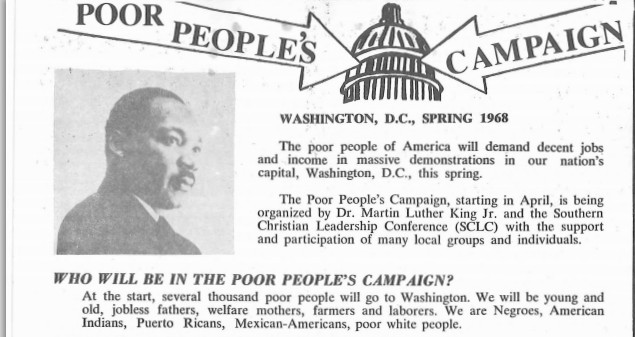
Dr. Martin Luther King Jr. conceived of the Poor People’s Campaign as a way to bring the voices of the poor to Washington. D.C. It was one of those radical ideas conveniently memory-holed by conservatives in their annual one-day co-opting of Dr. King, but it was central to his efforts to bring a measure of economic justice to America. He never got there in person, thanks to an assassin’s bullet.

The debate over extending Vermont’s motel voucher program has made it clear we need a Poor People’s Campaign right here in Vermont, because it’s obvious that the voices of the poor need to be heard as loudly as any other in the halls of the Statehouse.

Well, to be fully accurate, one part of the debate has made that clear. It’s the part provided by Brenda Siegel, who’s been bringing the stories of voucher clients to our attention and, in so doing, forcing The Comfortable to feel a wee bit less comfy.

So, modest proposal: A lobbying organization which, for placeholder purposes, I’m calling “Dignity.” Anyone who does the actual work gets to take as little or as much of this idea as they want.

Continue reading

The Cognitive Dissonance is Getting Thick Around Here

There’s a boatload of infuriating details in a story by VTDigger’s Lola Duffort about the ending of the motel voucher program. One of them stood out for me, not because it’s the most telling or most impactful, but because it’s so painfully ironic.

The story opens with Rebecca Duprey, a voucher client who’s struggled to regain her footing after years of evading a violently abusive ex-husband. Her motel stay has given her half a chance, but now she’s facing a return to living in her car with her two sons.

Duprey’s case strikes at the heart of the lobotomy-style disconnect between state policymaking and, well, basic humanity. As it happens, she’s had years-long relationships with two prominent lawmakers — Rep. Anne Donahue and Sen. Anne Cummings. Each has offered assistance to Duprey, and yet each has voted in favor of an FY2024 budget that will force her back on the streets.

That’s all bad enough, but here’s the topper.

When the two lawmakers learned that Duprey was back in Washington County and spending cold nights in her car, they did not reach out to administration officials or state workers, but instead to Brenda Siegel, an advocate and former gubernatorial candidate, who took over Duprey’s casework and found her the room she currently lives in.

That would be the same Brenda Siegel who’s been treated so shabbily by lawmakers personally inconvenienced by her advocacy. She has, in fact, become the face of the housing advocacy community because, due to her lopsided defeat in last November’s gubernatorial election, she’s an easy political figure to dismiss. Which makes the issue easier to dismiss.

And these two prominent lawmakers turned to Siegel to help when they didn’t think anyone else would. Hmm.

Continue reading

Bobby Starr [Reportedly] Goes Off the Deep End

When last we saw nominally Democratic Sen. Bobby Starr, he was pontificating about all the supposedly “able-bodied” homeless folk livin’ it up in state-funded motel rooms when they oughta be goin’ out and gettin’ a job. Or, as he put it, “The able-bodied, it’s time to go to work and have a place for them to work and earn and provide for their own, as far as I’m concerned.”

That was his argument for ending the motel voucher program on schedule this summer. He didn’t say we’re coddling the ungrateful lazy poors, but that was the umistakable message he was sending. Shades of the Welfare Queen.

But wait, there’s more!

Starr reportedly expanded on his asshattery in a conversation after the hearing with Brenda Siegel, housing advocate and 2022 Democratic candidate for governor. We’ve only got Siegel’s word for this, although she says there were other witnesses. But there are good reasons to believe her; she’s still lobbying for a voucher extension in the FY24 budget, and has no motivation at all to slander a lawmaker, not even Bobby Starr.

Siegel posted her account of the exchange <a href="http://<iframe src="https://www.facebook.com/plugins/post.php?href=https%3A%2F%2Fwww.facebook.com%2Fbrendasiegelvermont%2Fposts%2Fpfbid0rStfwv74gYMA1rKx3UFnDaWsvUzieQtoUrvkzrr164kvwReLXmS63nun9cxGRuLKl&show_text=true&width=500&quot; width="500" height="296" style="border:none;overflow:hidden" scrolling="no" frameborder="0" allowfullscreen="true" allow="autoplay; clipboard-write; encrypted-media; picture-in-picture; web-share">on her Facebook page. Highlights follow.

Continue reading

With Plenty of Misrepresentation and Condescension, Plus Some Astonishingly Retrograde Comments, the Vermont Senate Again Refused to Extend the Motel Voucher Program

In the above photo, Sen. Bobby Starr is expounding on the moral failings of the “able-bodied” poor lazing around in taxpayer-funded motel rooms while his colleagues try to conceal their discomfort. It was just one of many dispiriting passages in Friday afternoon’s meeting of the Senate Appropriations Committee, in which the panel briefly took up and immediately dismissed one last effort to extend the motel voucher program (the one that currently provides shelter to 80% of Vermont’s homeless) beyond the end of June.

Well. Now that I’ve dropped you directly in the middle of the story, let’s go back and set the stage. After the full Senate on Thursday gave preliminary approval to an FY2024 budget that would end the voucher program on schedule, two first-term solons — Nader Hashim and Tanya Vyhovsky — did something very unusual for a pair of rookies in the seniority-heavy upper chamber: They tested the patience of their superiors by submitting a last-minute amendment that would have dedicated another $20 million to the voucher program. (It would have also defunded the detestable remote worker grant program, but that was just a bonus.)

The figure was based on conversations with housing advocates, who believe it’s the minimum amount required to prevent a large-scale unsheltering of voucher recipients. But multiple members of the committee, including chair Jane Kitchel, dismissed the number as inadequate. Kitchel said the $20 million would run out by year’s end, meaning the program would require a midyear injection of funds. She refused to engage in what she called “deficit” budgeting.

Hashim, who presented the amendment to the committee, didn’t have the information needed to counter Kitchel’s assertion, and no one else was given a chance to testify. Committee members also claimed that spending more on vouchers would mean fewer dollars for permanent housing, as if it was impossible to shift money from elsewhere in the budget or even — horrors! — raise revenue to cover the cost. So you see, they said with a metaphorical shrug of the shoulders, they had no choice but to end the voucher program.

I could go on, and I will, but let’s get back to Bobby Starr. You won’t want to miss this.

Continue reading