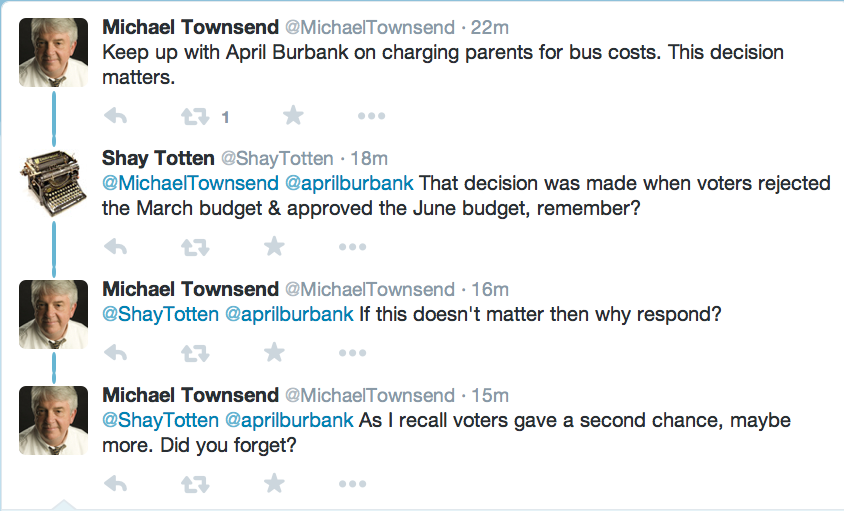
Governor Who?

Welp, the “we don’t need no stinkin’ copy editors” era is off to a whiz-bang start at Vermont’s Largest Newspaper.

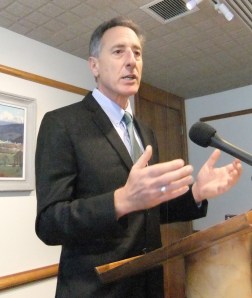
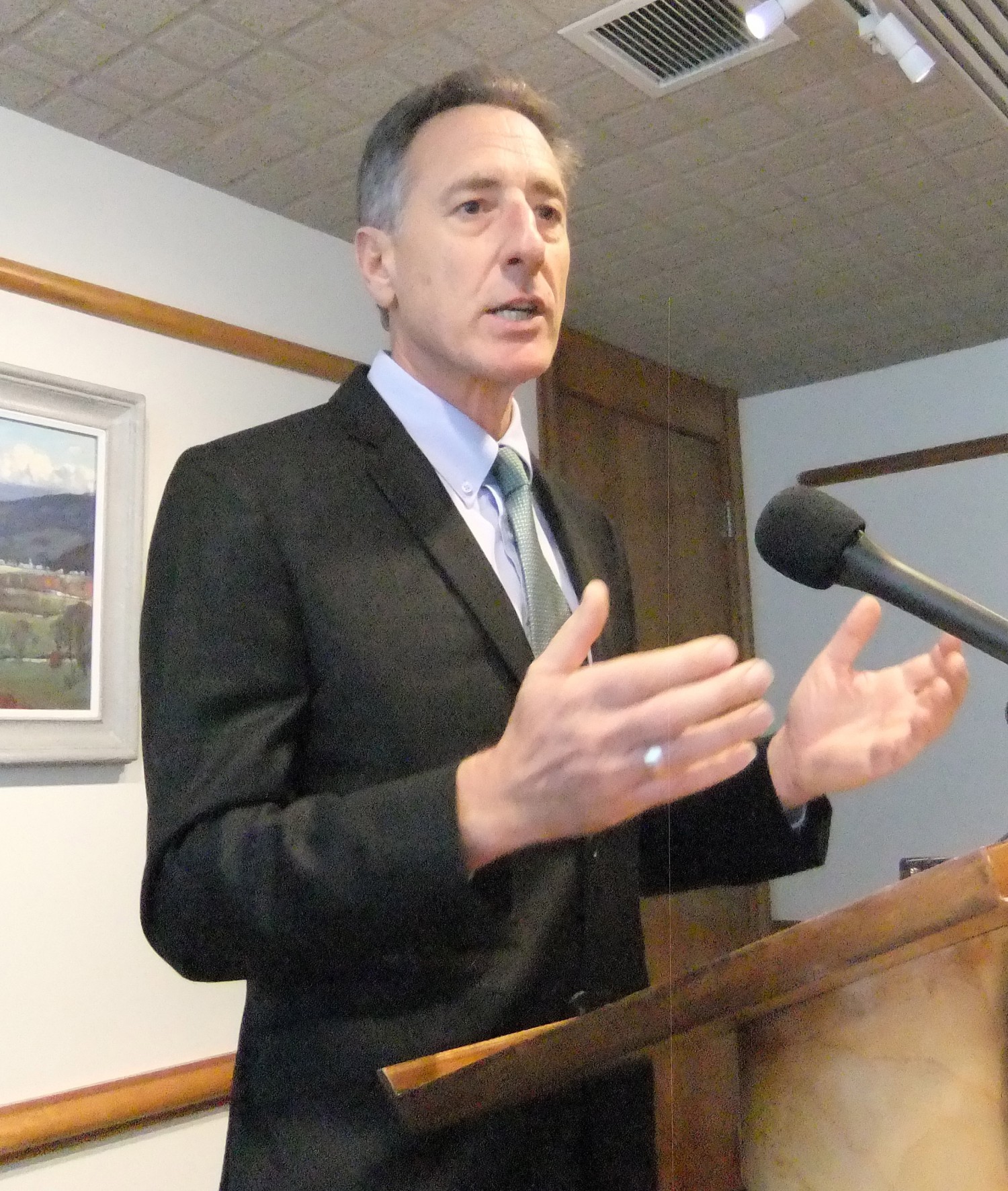
Yeah, that’s the Burlington Free Press’ official Twitter feed misspelling Governor Shumlin’s name. (And four Freeploid staffers, including Gannett Apologist-in-Chief Michael Townsend, retweeting it without noticing.)

Oopsie.

Freeploid Follies, Weekend Catchup Edition

Things are getting a little sketchy at the Burlington Free Press, Vermont’s ever-dwindling Largest Newspaper. I’ve got several items to report; none merited separate posts, but they make a nice collective bundle.

— Things are worse inside 100 Bank Street than I thought. And I thought things were pretty damn bad, what with almost every news staffer being forced to reapply for jobs and a new era of clickbait-oriented, sales-friendly journalism about to begin. Er, sorry, that’s the Newsroom Of The Future.

But as Paul Heintz reported in Wednesday’s Fair Game column, the pursuit of clickbait is already in progress:

Sources say that editors have become increasingly focused on web metrics in recent months. Reporters are expected to monitor the number of clicks their stories receive on a daily basis and rejigger headlines and copy to boost readership.

Oh joy. Not only are they allowing reader metrics to determine which stories they cover, they’re rewriting stories and headlines after the fact in hopes of goosing the pageviews. That’s gotta grind at the soul of any self-respecting journalist.

And things will only get worse in the NOTF, when a “Content Coach” will be monitoring pageviews and “coaching” reporters who don’t measure up. (“Say, Terri, any way you could mention the Kardashians in that school-consolidation snoozer?”)

— Speaking of self-respecting journalists, remember the Columbus Day tag team Tweetwar that erupted between The Freeploid’s Mike Donoghue and Adam Silverman in one corner, and Seven Days’ Mark Davis and Paul Heintz in the other? Donoghue and Silverman were vociferously defending the honor of their employer.

Well, interesting thing about that. As Heintz reported on Wednesday, Donoghue and Silverman are two of only four news staffers who are exempt from the reapplication process. No wonder they’re singing the praises of the Freeploid: they got a pass, and won’t have to go through the demeaning and degrading ordeal of having to re-interview at their current employer.

— Speaking of demeaning and degrading, ace journalism watchdog Jim Romenesko reports that Gannett is offering opportunities for current staffers to, ahem, adjust to the Newsroom Of The Future. Gannett’s holding a virtual re-education camp with seminars on subjects like: How to perform well when interviewing for one of the new jobs, writing “sharper” headlines, achieving better SEO for stories, using social media to “establish your brand and personality,” and “cleaning your copy.” The latter will be crucial because the NOTF will include far fewer copy editors, and reporters will be expected to submit publication-ready stories.

You know, if by some hellish circumstance I was offered a job at Bank Street, I’d turn it down. It’s sounding like a truly awful place to work.

— Speaking of truly awful, my Friday Freeploid arrived with a big fat section on pink newsprint. The front page bore the image of a pink ribbon, the Freeploid’s Circle-B logo, and the title “Making Strides: Breast Cancer Awareness.” Inside were a handful of heartwarming articles about cancer survivors and people involved in fundraising, treatment, and research.

But mostly, the 32 pages (!) were full of advertisements by local businesses proclaiming their support for the fight against breast cancer.

Nowhere, as far as I could see, was there any statement that any of the hefty proceeds from this special section would go to cancer research or treatment. Nope, it was the Freeploid cashing in on an emotionally appealing cause. And their many advertisers doing the same.

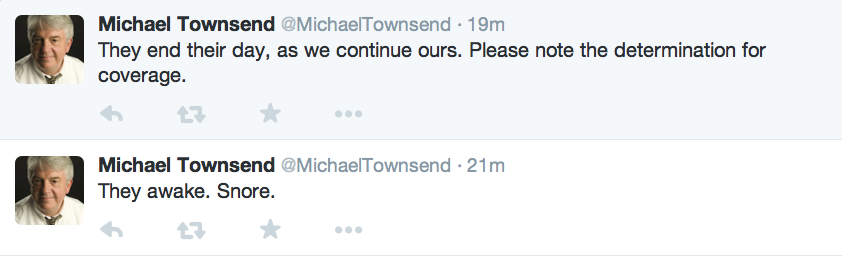
— Finally, an odd note from late Saturday night. Apparently, the Newsroom Of The Future was empty except for the gray countenance of Executive Editor and Chief Corporate Shill Michael Townsend, because Townsend himself was sending out a stream of Tweets about stories on the Freeploid’s webpage. And one of ’em was a real headscratcher.

Screen Shot 2014-10-18 at 11.26.38 PM

That’s odd, I thought. So I clicked on the link, which took me to an article about Entergy’s announcement on Friday that decommissioning Vermont Yankee will cost $1.24 billion.

But WTF is with Townsend’s gratuitous shot at single payer health care? The article has nothing to do with health care reform.

Maybe Mike was sitting at his desk on a Saturday night, Tweeting his brains out and drowning his sorrows in a bottle of Kentucky’s finest. Otherwise, how can you explain this out-of-nowhere shot at Governor Shumlin’s top priority? It was certainly unbecoming for the Freeploid’s number one exemplar of the Newsroom Of The Future.

Here’s a protip for “establishing your brand” on social media, Mike: Measure twice, Tweet once.

The purely cosmetic bipartisanship of Vision To Action Vermont

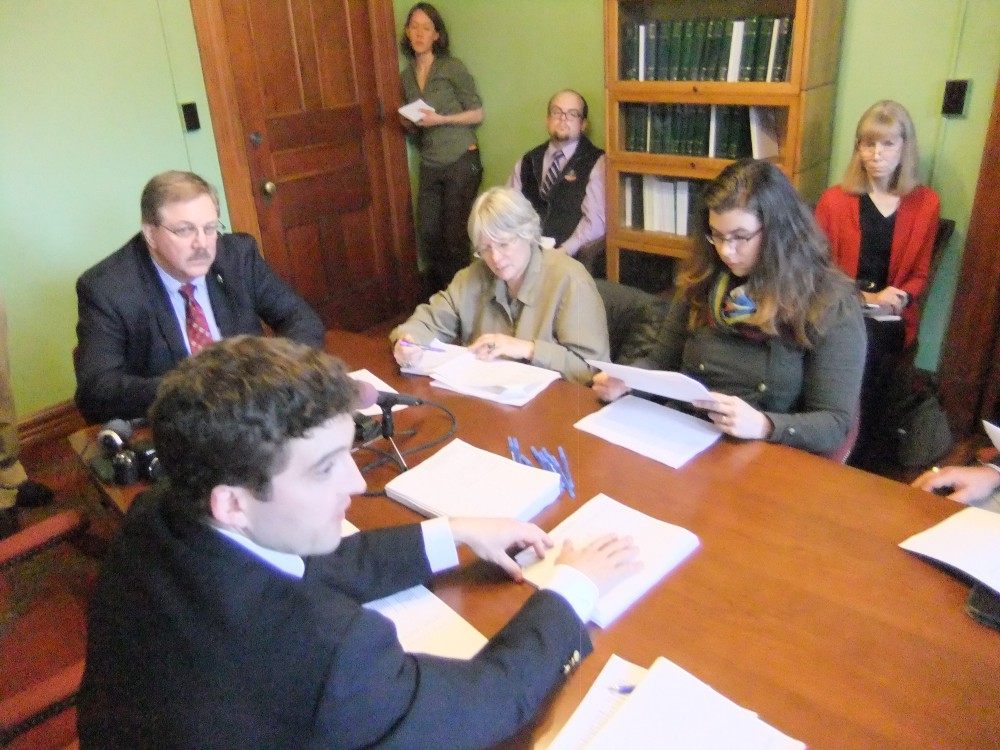
State Reps. Heidi Scheuermann and Paul Ralston. Photo filched w/o permission from VTDigger. I hope they don't mind.

State Reps. Heidi Scheuermann and Paul Ralston. Photo filched w/o permission from VTDigger. I hope they don’t mind.

State Reps. Heidi Scheuermann (R) and Paul Ralston (D), the busy bees behind Vision To Action Vermont, have been busy indeed these days. They’re releasing endorsements almost every day. And, on the surface, it looks to be a fair mix of Republicans and Democrats.

This figures, since V2AVT portrays itself as a nonpartisan, centrist, practical, “rise above party labels and get stuff done” kind of political action committee. If you listen closely, however, you can hear the business-friendly dog whistles a-blowin’. From its launch announcement:

[V2AVT is] a non-partisan organization that will promote, support and elect strong candidates for political office in Vermont who advocate for fiscal responsibility in state spending, and are committed to forming balanced, common-sense public policies that encourage economic prosperity, greater opportunities for Vermont families and businesses, and individual liberties and responsibility.

That’s the entire Dog Whistle Philharmonic in a single sentence: fiscal responsibility, balanced, common-sense, economic prosperity, opportunities, individual liberties and responsibility.

And, despite a thin veneer of bipartisanship, the dog whistles continue to sound throughout V2AVT’s list of endorsements.

As of this writing, V2AVT has endorsed 22 candidates: 11 in the House, 10 in the Senate, plus Lt. Gov. Phil Scott. Overall, they’ve endorsed 13 Republicans, eight Dems, and one Independent.

Okay, leaning rightward, but a respectable number of Democrats, right?

Not so much. There’s a strong trend in V2AVT’s endorsements. The higher the stakes, the more Republicans you get. While the House endorsements are split evenly, 5-5-1, the Senate endorsements include seven Republicans and only three Democrats. And then there’s Phil Scott, the group’s only statewide endorsement.

But beyond the mere numbers, there’s this: most of V2AVT’s Republican candidates are in highly competitive races, while their Democratic candidates are either unopposed or in very safe Democratic territory. 

This is especially true in the Senate, where V2AVT has endorsed all the Republicans’ top challengers except Robert Frenier, who’s challenging incumbent Dem Mark MacDonald in Orange County.

Otherwise, it’s like V2AVT and the VTGOP are using the same playbook. Dustin Degree and Norm McAllister in Franklin County, all three Republicans in Rutland County, Pat McDonald in Washington County. Degree, McDonald, and Rutland’s Brian Collamore are the VTGOP’s top three hopes for Senate gains, but they face uphill battles against formidable candidates: ex-Senator Sara Kittell in Franklin, incumbent P/D Anthony Pollina and incumbent D Ann Cummings in Washington (nobody’s beating Bill Doyle), and Rutland’s WIlliam Tracy Carris, son of longtime Senator Bill Carris.

And who are the Democrats supported by V2AVT? The very safe Jane Kitchel and Dick Sears, plus Sears’ Bennington County running mate Brian Campion. There is only one token Republican candidate on the Benn ballot, and Campion is considered a shoo-in.

Oh, and V2AVT also endorsed safe Republican incumbent Joe Benning.

Now let’s look at the House endorsements.

In Chittenden County, V2AVT is backing incumbent Republican Kurt Wright and Repub newcomer Michael Ly in a two-seat district. Wright is safe; the Repubs have hopes for Ly. And in another two-seat district, Chittenden 9-1, V2AVT is supporting the very safe (and centrist) incumbent Democrat Jim Condon and Republican candidate Joey Purvis, who’s hoping to replace retiring Republican Bob Bouchard.

Chittenden 9-1 is a closely contested district. Condon was the top vote-getter by a mile in 2012; Bouchard barely beat Democrat Curt Taylor; Purvis finished a respectable fourth. This is a seat that the Democrats could take.

Up in the perennial battleground of Franklin County, V2AVT is endorsing 26-year incumbent Dem Kathie Keenan and Republican challenger Corey Parent in a two-seat district. Parent is hoping to snag the seat currently held by Dem Mike McCarthy, who won by a mere 20 votes in 2012.

V2AVT’s favorite Independent is Laura Sibilia, a business-friendly type who’s challenging established Democrat John Moran in Windham-Bennington 1. There’s no Republican on the ballot, but Sibilia’s platform is clearly Republican-leaning.

The group has also endorsed safe Republican incumbent Patti Komline.

As for its Democratic endorsements, Jim Condon and Kathie Keenan are well-established incumbents; Clem Bissonnette is running unopposed has no Republican opponent — his challenge is from the Progressive Party; Cynthia Browning is a famously independent-minded Democrat in a safe Democratic district; and Matt Trieber is unopposed in Windham-3.

Overall, of V2AVT’s eight Democratic endorsements, none are in races closely contested by Republicans. Of its 13 Republican endorsements, seven are in races where the VTGOP hopes to gain ground.

That’s not my idea of nonpartisanship. That’s my idea of advancing the Republican cause.

Is it just me, or does Scott Milne owe a lot of money?

Kudos to Scott Milne, who voluntarily released two years’ worth of tax returns and other personal financial information. That’s more than Governor Shumlin released, and it’s the level of disclosure required of members of Congress.

His financials did raise a niggling question in my mind, though.

Milne lists several assets, the largest of which are the $2,000,000 value of Milne Travel and $1,699,750 representing a 50% share in B&M Realty, the firm he co-owns with David Boies III.

Then there are the liabilities: $1.642 million. The largest is a $950,000 “promissory note,” otherwise not described. Who holds the note? What’s it for? What are the terms of repayment?

There are also three mortgages totaling $1.38 million; Milne is responsible for half of those, or $680,000. Since he “owns” 50% of those mortgages, and he owns 50% of B&M Realty, I’m going out on a limb and guessing that the mortgages arise from B&M investments.

Let us pray.

Let us pray.

It boils down to a healthy net worth of $2.641 million, but still. We’re talking about a guy whose primary income is his $118,000 salary from Milne Travel. Now, I don’t play in these financial leagues, but it seems to me that Milne is carrying a lot of debt.

And his positive net worth depends almost entirely on the valuation of his two corporate interests — Milne Travel and B&M Realty. Is the family business really worth $2,000,000? Is B&M really worth $3.4 million? I don’t know, but I’d have to guess that corporate valuations are somewhat fluid.

Which brings me to my underlying question. How much of Milne’s finances — the black ink and the red — are tied up in the proposed Quechee Highlands mixed-use development planned for a 168-acre parcel just off I-89 at Exit 1 in Hartford?

I assume that Milne’s 50% mortgage obligations, totaling $680,000, are for Highlands-related land purchases. This is currently undeveloped land; if the B&M project is built, it could lead to a West Lebanon, New Hampshire style building boom in that area — making Milne’s stake a whole lot more valuable.

On the other hand, if it doesn’t get built, Boies and Milne will be stuck with the debt load on those 168 acres.

And the project is in serious trouble, having been denied an Act 250 permit by the regional environmental commission, and being noncompliant with the town of Hartford’s current development plan for the area. B&M has appealed the environmental commission’s ruling, and Milne has spoken loudly about what he sees as the anti-business bias and excessive regulatory power of the regional commissions.

Which makes me wonder how he’d handle Act 250 if elected Governor, but that’s another issue. The question raised by Milne’s financials is, how much risk has he taken on here?

In the past, he has semi-jokingly said that B&M is basically Boies’ money and Milne’s shoe leather. Well, to judge by his personal assets and liabilities, Scott Milne has a lot more riding on Quechee Highlands than his footwear. If he takes office and B&M’s appeal is still in process — which it almost certainly will be — then how would he separate policy from personal interest? Especially with the level of financial exposure he seems to have?

In releasing his financials, Milne criticized Governor Shumlin for offering too little information. And clearly, we have more numbers from Milne. But do we know what those numbers mean?

It may be perfectly obvious to someone who operates on that level, and it may be completely innocuous. But to a humble blogger, this looks like high stakes. And it’s all riding on a regulatory decision from the state of Vermont.

More of the same in the money game

So yesterday marked another campaign finance reporting deadline. I don’t know if it was intentional or not, but Scott Milne tried to bracket the news by making a bunch of his own.

And no, I don’t mean his 12 Seconds of Daily Show Fame. I mean yesterday’s unveiling of the Milne Education Plan, and this morning’s release of his personal finances.

Which perhaps drew some attention away from Milne’s return to the fundraising doldrums. After a very successful (by his modest standards) September, he failed to carry the Money Momentum into October. He raised a mere $12,000 in the first half of the month, bringing his total for the entire campaign to $146,000.

The latter total is vastly inflated by $39,000 from himself and his immediate family. Plus roughly another $20K from the Boies Family. (And I think he’s fresh out of Boieses.) He’s also got a $25,000 loan from himself on the books — soon to be forgiven, I’d guess. Add it all up, he’s got maybe $30,000 left at his disposal as he enters the home stretch.

One little note of kismet from the Milne report: he bagged a $150 donation from none other than Tom Salmon, former Auditor General. Salmon will forever be remembered for his famous line, “I need to be an authentic self-utilizing power along the lines of excellence.” I guess The Little Big Fish recognizes a kindred spirit among inarticulate candidates.

The other notable fundraising FAIL was the Dan Feliciano campaign, which seems to be slowly settling into the third-party mire. His fundraising total for the first half of the month, over $13,000, looks healthy; but it includes $10,000 from himself. Even with his own substantial gift, his campaign is in the red, having raised about $30,000 and spent $32,000. Still no sign of #Felicianomentum.

Contrast that with the Shumlin money machine, which raised $65,000 in the past two weeks for a campaign-to-date total of $777,000. And remember, he began 2014 with a lot of money in the bank. And he’s continued his post-Labor Day spending binge, paying out $236,000 in the first half of the month.

Just about the only happy Republican these days is Phil Scott. The People’s Lieutenant Governor kept up his furious pace; he took in $52,000 this time around, bringing his campaign-to-date total to $254,000. He’s spending just about as fast as he’s raising; campaign expenditures total $223,000, including a hefty $73,000 in the first half of October.

I haven’t checked, but this has GOT to be a record-breaker for most expensive statewide race, non-gubernatorial division. It also establishes Scott as a powerful fundraiser, which bodes well for a future campaign for Governor, should he ever decide to climb that mountain.

So, no big news at the top of the ticket. Status quo rules: Shumlin and Phil Scott have big bucks, Dean Corren continues to spend his $200,000 kitty, and Shumlin’s challengers are severely handicapped by a lack of funds.

Scott Milne finally gets the attention he deserves

Well, the punditocracy keeps saying that Scott Milne needs to take advantage of free media to get his message out. And now he has, big time: he earned himself a stout twelve seconds of national airtime on The Daily Show With Jon Stewart. The end of every show is a “Moment of Zen,” a goofy bit of context-free video from somewhere or other. Last night’s MoZ was taken from Vermont PBS’ gubernatorial debate.

Specifically, Milne’s opening statement, in which he managed to screw up the first line of his life story.

Screen Shot 2014-10-16 at 11.18.38 AM For those disinclined to click the video link, here’s a handy transcript.

“My name is Scott Milne. I’ve, uh, uh, third generation, um, ah, born in Vermont, uh, take that back, I was born in Brooklyn.”

Congratulations, Mahatma. You’ve made the big time.

BREAKING: Scott Milne holds a news conference! Also, Hell Freezes Over.

Scott Milne and potted plant. Make your own joke.

Scott Milne and potted plant. Make your own joke.

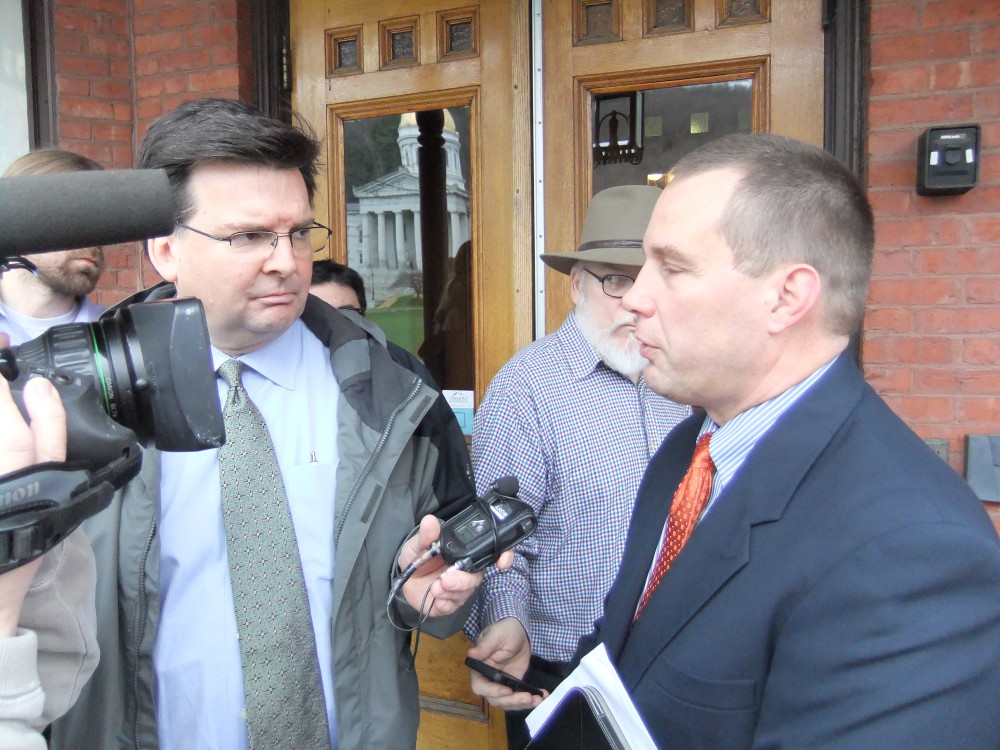
Two rare political events occurred simultaneously today in the library at Spaulding High School: Scott Milne held a news conference, and he unveiled a thoughtful, detailed policy initiative.

Yes, the campaign without a plan has finally come up with one — on education reform. The thesis statement: Vermont spends too much on K-12 education and not enough on higher education. The basic idea: foster efficiency by reorganizing the public school system, and invest the savings into a new program to provide every Vermont student with access to a free college education or vocational program. (The full plan is posted on his campaign website.)

It’s creative. It’s fresh. It’s downright audacious. It’s the kind of thinking that, to me, represents the best of moderate Republicanism: maximizing our investment in the public sector instead of mindlessly cutting. At the very least, it ought to generate some serious conversations about how we spend our education dollars.

There were, of course, spiders in the attic. The Milne plan on paper was seven single-spaced pages with plenty of detail (footnotes, even); but he was less than articulate in the give-and-take of a news conference. He abruptly shifted between explanations of his own plan and recycled attacks on Governor Shumlin. He made plenty of snide comments directed at the media, who were on relatively good behavior. (If he thinks we’re tough on him, he ought to attend a couple of the Governor’s news conferences.) And he didn’t have clear answers to a number of fairly simple questions.

But the biggest problem with today’s announcement was… today. 

It’s October 15th.

The election is three days from yesterday.

And this is the first in a promised series of policy announcements. (A proposal for reinventing state government will come in about two weeks — within days of the election.) After a summer of no ideas, Milne is going to empty the truck in the campaign’s closing days.

If he’d put forward this idea six months ago, or even three, then he might have sparked a serious conversation on the issue and positioned himself as a viable moderate alternative to Shumlin.

That’s conventional thinking, of course, and Milne will tell you he’s running an insurgent campaign. He believes this is the perfect time to start launching his policy ideas.

Well, if he’s right, and every political observer and activist in the state is wrong, then Milne can celebrate his election by holding a good old harvest-time Crow Pie Dinner and invite all of us to dig in. I’ll be at the front of the line.

The broad outline of the Milne plan, entitled “Investing in Vermont’s Future”:

— His previously announced two-year cap on the statewide property tax, designed to force the Legislature to get serious about reform. Any shortfall in school funding caused by the cap would come out of the state’s General Fund. That, in turn, would be made whole through some combination of cuts in other areas and tax increases. Milne favors spending cuts, but he wants to work out the details with the Legislature.

— Universal tuition-free education from pre-K through four-year degree or vocational training for every Vermonter at vocational centers, colleges and universities in the state system.

— The money for free tuition would come from savings in K-12 spending. To realize this, Milne proposes a reorganization of the system into 15 Regional Education Administration Districts (READs). READs would have authority over budgets. There would be no statewide property tax; instead, tax payments go to the READs, which would each set district-wide per-pupil spending.

— READs would foster efficiency because voters would have a stronger connection between school budgets and their taxes. This would lead to lower budgets, leaner spending, and voluntary consolidation of smaller districts.

— The state would ensure compliance with the Brigham decision mandating educational equity, by providing supplemental funding for READs with low per-pupil spending.

— School choice would be gradually broadened. Eventually, every family could send their kids to any school within their READ. School choice would not include private schools.

— For every two years a student attends Vermont schools, s/he would get one year of free post-high school education at any of the state’s public colleges, universities, or technical schools.

— Existing private colleges could join the system, if they’re willing to give a tuition break in exchange for access to more Vermont students.

— The deal would not include any tuition for institutions outside Vermont.

Milne argues that the offer of free tuition would be a powerful draw for people to move into Vermont, thus fueling our economy and putting our finances on sounder footing.

I see some problems with the Milne plan, and I’m sure you do, too. He assumes that a primary cost driver in public schools is the supposed disconnect between voting for school budgets and the resulting tax bill. I’m not at all convinced that this is as big a factor as Republicans think it is.

He also assumes a pretty high degree of public engagement in the READs. I think that’s tremendously optimistic; most of us don’t have the time, or inclination, to get seriously engaged in that process.

Then there’s the problematic Brigham fix. If the state is the funder of last resort, then doesn’t that retain one of the weak points of the current system?

A question about the free tuition. Is the two-year requirement for a year of free tuition retroactive? If so, then you’d potentially have thousands of high school graduates expecting free tuition next fall. If not, and the clock starts with the passage of this plan, then the four-year free tuition offer wouldn’t go into effect until current fourth-graders are graduating from high school. (A current fifth-grader couldn’t qualify for more than three years tuition-free.)

Another quibble (but these kinds of quibbles often doom policy initiatives): If a student attended 12 years of Vermont school, graduated, and is now a freshman at UVM, would s/he retroactively qualify for free tuition? If so, then you’re blowing a fresh hole in state colleges’ budgets. If not, you’ll have a whole passel of pissed-off parents.

And finally, in an effort to avoid any sort of state-mandated cuts, Milne puts an awful lot of faith in voluntary compliance. He criticizes Governor Shumlin for putting the onus on local voters and school boards; but his plan would force the voters and the READs to make some really tough choices, because his goal is to bring per-pupil spending from its current $17,500 to somewhere around the national average of $12,000.

That’s roughly a 30% cut. He sees room for savings in the alleged overstaffing of public schools, and (without saying so directly) in the extra costs of small school districts. Still, that’s a whacking great number, and it’s hard to imagine anything like that number surviving the policymaking process.

Still, it’s an idea. It’s a plan. I give Milne full credit for putting it together, and for finally giving his campaign a raison d’etre beyond “I’m Not Shumlin.”

I look forward to more of his plans. I just wish this had happened a long time ago.

A picture is worse than a thousand words, I guess

Where do you draw the line between journalism and exploitation?

I know where the Burlington Free Press draws it, after reading its downright grisly, torture-porny article on yesterday’s testimony in the Allen Prue murder trial. The article colorfully entitled:

Medical examiner: Jenkins looked ‘beat up’

The Freeploid was happy to report WCAX’s mistaken broadcast of a crime scene photo that showed the murder victim’s body. (Or, as the ever-sensitive Mike Donoghue put it in a Tweet, “naked body of slain teacher.”) Which was wrong, and WCAX News Director Anson Tebbetts fell all over himself apologizing for it.

So, it’s wrong to show a picture. But apparently it’s all right to publish every detail of Medical Examiner Stephen Shapiro’s testimony, including the following phrases:

“Jenkins’ bruised and marked body”

Shapiro “…told the jury about the marks left by different types of strangulation. Shapiro said he determined Jenkins’ official cause of death to be manual strangulation, meaning done by hand.”

Gee, thanks for that clarification. I wouldn’t have guessed.

‘She looked beat up,’ Shapiro said, later adding. ‘She did not do this to herself.’

“Shapiro used a laser pointer to highlight different scrapes and bruises… including six circular marks.”

This was followed by a thorough retelling of the effects of a stun gun on a human body:

Shapiro said the effect of a stun gun is not quite the same as a Taser, since the Taser almost instantaneously incapacitates the person. The stun gun, on the other hand, causes pain but does not incapacitate.

“A stun gun that’s pressed up against your body is more of a compliance weapon,” Shapiro said.

You can almost feel the burn, can’t you?

The first sentence of the story began with “Several loved ones of Melissa Jenkins inhaled sharply and covered their eyes…”

If they happen to read today’s Free Press, I think they’ll be inhaling sharply and covering their eyes all over again.

I know how the Free Press would defend itself. It’s a high-profile murder case, the trial is open, the testimony is fair game, and The People Have A Right To Know.

But do we have to know every detail? Or is this another case of Clickbait Uber Alles?

To me, this story crossed a line. And it makes the Freeploid’s sanctimony over WCAX seem downright hypocritical.


Ride with Uber. Chances are, you’ll get there in one piece

Ah, Uber… the latest high-tech industry disruptor. The “ride-sharing” service that’s just like a cab company without all that pesky regulation. The service that actively, and aggressively, resists any attempt to regulate its business. Now operating in the Burlington market, as the Freeploid reported last week:

Uber will provide rides through the low-cost service called uberX, which uses local drivers in their own cars. Burlington is now the 216th city on the Uber map, and the company will build up to 24/7 on-demand service.

The ‘Loid’s April Burbank went on to detail the city’s response to Uber, which arrived at a time when Burlington was already pondering how to update its taxi regulations, and to dutifully reproduce the complaints of local cab operators and Uber’s reassurances that its services are reliable and safe.

Safe. Hmm. That’s an issue that Burbank failed to explore further. And neither did Seven Days’ Alicia Freese, in a pair of stories that focused on Uber’s successes in other markets and the uncertain reaction from local regulators. All this, even though a quick Google search will reveal a host of problematic experiences and near-brushes with abduction and assault, to which Uber’s standard reaction is “Oops, sorry, here’s your money back, now go away.”

Let’s review some recent trouble spots on Uber’s record, shall we?

A woman in Los Angeles boarded an Uber vehicle for a ride home from a party. Instead, the driver took her 20 miles out of the way

…arriving in a dark, empty parking lot in the middle of the night despite her repeated protests. When she tried to exit the car, her driver locked the doors—only when she caused a commotion and screamed did he finally return her home. What should have been a quick ride took over two hours.

Uber’s initial response: a  partial refund for an “inefficient route.” It later made a full refund. Meanwhile, the woman is staying in a hotel because the driver is still out there somewhere and knows her home address.

A couple weeks ago, an Uber driver in San Francisco got into an argument with his passengers, stopped the car, attacked one of the riders with a hammer blow to the head, and drove away.

Oh, and here’s a thing: a Chicago TV station sent out a bunch of passengers to take rides in Uber cars, “and found not a single driver knew his way around the city.” And worse:

NBC5 then ran background checks on each of the drivers and discovered ticket after ticket — for speeding, illegal stops and running lights. One driver had 26 traffic tickets, yet still passed Uber’s background check.

The station then tested Uber’s driver-screening program by submitting an application from a reformed criminal with “a three-page rap sheet.” She was hired four weeks later, to which she said:

“I was kind of baffled, still am baffled how they let me in,” Locke said. “If I had been offered a job like this, knowing that my life of crime was in burglaries and robberies, …I would pick somebody up, take them to their airport, and my second thought would be: Go back to that house.”

The NBC5 report contains a whole lot of other nasty stuff, including an Uber driver who hit and killed a six-year-old — and who turned out to have a prior conviction for reckless driving; a driver accused of sexual assault by a passenger; and a driver whose car was totaled, and who found that neither Uber’s insurance nor his own would pay for the damages.

Thousands of people have had good experiences with Uber, and any industry has its problems. But Uber’s whole business model is built on avoiding responsibility for those problems. It fights regulation; it doesn’t buy commercial auto insurance for drivers; it classifies its drivers as independent contractors to shift liability away from the company.

It’s the ultimate in caveat emptor: let the buyer beware, let the contractor beware, let bystanders beware. In fact, let everybody beware except Uber itself. And Uber skims the profits.

City officials should think long and hard about the totality of Uber’s track record before allowing it to operate. That consideration should include the above incidents, and Uber’s clearly inadequate driver-screening process, which Seven Days and the Burlington Free Press either overlooked or didn’t think worthy of its readers’ attention.

One man’s cheap shot is another’s cogent criticism. Or, why I bag on the Free Press so much

Those who follow Vermont media accounts on Twitter may have enjoyed a little Columbus Day entertainment by way of a Tweetfight between staffers at the Burlington Free Press and Seven Days, which the Freeploid has long looked down at, but which has become a powerful competitor in the battle for print advertising.

It began with Freeploid vet Mike Donoghue taking a little poke at WCAX:

This was a reference to WCAX mistakenly broadcasting a crime scene photo including the body of a murder victim, which the Freeploid wrote up at great length. Seven Days’ Mark Davis Tweeted a reply about the ‘Loid “firing cheapshots at WCAX.” To which the Freeploid’s Adam Silverman replied “Is someone from Seven Days really one to talk about cheap shots?”

Davis pointed out the “thinly veiled glee” the Free Press was exhibiting over a competitor’s mistake. Donoghue and Silverman accused Seven Days of ignoring the story, to which Paul Heintz replied that he hadn’t gotten a call back from WCAX.

This exchange included two contraditory Tweets from Donoghue. First, he accused Seven Days of ignoring the story because the two entities are media partners; and then he insinuated that WCAX won’t return calls from Seven Days because of some unstated offense.

Which is it, Mike? They’re in bed together, or they can’t stand each other?

Anyway, that’s when I lobbed a couple of spitballs from the back of the class, and Silverman went all Charlie Bronson.

Screen Shot 2014-10-13 at 11.47.41 PM

I can just see him grabbing his crotch as he hit “SEND.”

Which brings me, finally, to the point of this post: an explanation of why I so often criticize the Free Press. Or, in the words of Mr. Silverman, why I deliver so many cheap shots.

Basically, it’s all about the words of Voltaire, best known as delivered by Peter Parker’s Uncle Ben:

With great power comes great responsibility.

The Burlington Free Press is the number-one print publication in Vermont. It ought to be the unquestioned leader in serious journalism. But, because Gannett keeps sucking out its precious bodily fluids to satiate the endless thirst of stockholders, we’re left with a depleted newspaper that can’t serve its readers well but still occupies the largest niche in the Vermont news market.

It doesn’t occupy that niche in any satisfying way, but there it sits, and because of the structure of the news marketplace, nobody can dislodge it.

The Burlington Free Press has great power. To be charitable, it does an inconsistent job of exercising that power. To be less charitable, it’s an almost daily disappointment. So when somebody like Mike Donoghue or Aki Soga positions himself as a guardian of the public trust — and yet expects to be insulated from the kinds of accountability or transparency he expects of everyone else (including WCAX) — well, it makes the rest of us throw up in our mouths a little. Likewise, when Jim Fogler or Michael Townsend serve up a column’s worth of bullshit and expect us to gobble it down like steak.

Too often, the Free Press comes across as arrogant and condescending. And its performance fails to justify its overweening sense of superiority. That’s why the Free Press gets so much criticism. And the occasional cheap shot. Expect both to continue.