Category Archives: Vermont Republican Party

A new nominee for the Most Dangerous Republican award

Last December, around the time of the fabled Chris Christie fundraiser for the Vermont Republican Party (projected take, a quarter mill or so; actual take, less than 50K as far as I can tell from the party’s financial filings), I posited that there was one figure in the downtrodden VTGOP who could pose a threat to the Democrats as a statewide candidate. It wasn’t Phil Scott; it was the closest thing we have to a Chris Christie — a short-tempered, get-things-done, “willing to work with both sides” kind of guy named Thom Lauzon, Republican Mayor of Barre. 

I still think he’s a solid potential statewide candidate, should he ever choose to climb the ladder. But another name has been suggested to me, and it’s an excellent choice. In fact, offhand I’d have to say he’s an even better Most Dangerous Republican than Lauzon.

I’ll give you the name, but first it’s Story Time, kids!

Starting in 2002, Craig Benson spent two disastrous years as Republican Governor of New Hampshire. While he was Governor, he appointed a little-known lawyer named Kelly Ayotte to the post of Attorney General. (In NH, the AG is an appointed position with a five-year term.) By the time her first term had come to an end,  John Lynch was Governor. He was a Democrat but he liked to play the bipartisan game, so he nominated her for a second term.

Before she served out that term, she resigned to run for U.S. Senate. And she won. And she’s now the only Republican member of NH’s four-member Congressional delegation.

The key moment in her ascendancy was her renomination by John Lynch. If he’d appointed a Democrat and sent her packing as a one-term Benson functionary, she would’ve had a much harder time continuing her political career. I firmly believe that there would never have been a Senator Kelly Ayotte if not for John Lynch being too clever for his own good.

Thus endeth the lesson. Back to Vermont, and the new nominee for Most Dangerous Republican.

Neale Lunderville.

At one time, he was the chief hothead on Jim Douglas’ team. He and Jim Barnett, who’s gone on to a very unsuccessful career as a balls-to-the-wall campaign manager, were dubbed “the Nasty Boys” by the late great Peter Freyne for their skilled knifework in Douglas’ campaigns.

Since then, little Neale has grown up — and gotten two great big helping hands from Democratic officeholders. Governor Shumlin chose him to be recovery czar after Tropical Storm Irene, and now Burlington Mayor Miro Weinberger has engineered his hiring as interim head of the Burlington Electric Department.

In the process, the Nasty Boy has acquired a solid nonpartisan reputation as the go-to guy when trouble strikes. He’s been chosen by not one, but two, top Democrats to take on big administrative challenges.

Okay, here’s a hypothetical for you. In the next biennium, the Shumlin administration will unveil its plan for single-payer health care. It’ll be big, expensive, controversial, and a tough sell, even in a lopsided Democratic legislature. Win or lose, Shumlin will expend a lot of his political capital in the fight.

He also faces the whole issue of school funding and organization. Whatever he and the legislature do, more enemies will be made and more people will be alienated.

At best, Shumlin would enter 2016 having fought two extremely tough battles. Even if he wins on single-payer, he’ll be in that very dangerous period between passage and implementation, where everybody will be aware of the cost and the controversy but won’t have experienced any benefit from the new system. And if the implementation process for single payer OR school reform is difficult, contentious, or includes any stumbles, the Governor’s managerial reputation will take more hits.

And now comes, on a shiny white horse, Neale Lunderville.

Well, Lunderville 2.0, New and Improved with a track record for working under Democratic executives and managing the biggest challenges. In short, he’s Vermont’s Mr. Fix-It. The Governor won’t be able to depict Lunderville as a partisan ideologue because, after all, he chose the guy to manage the aftermath of Irene. At the same time, Lunderville will have solid Republican credentials from his tenure in the Douglas Administration. He’ll be more appealing to the conservative base than a Phil Scott will ever be.

The VTGOP won’t be in any shape to challenge the Democrats’ overall  dominance in 2016. But Lunderville could do what Scott Milne can’t do and Randy Brock couldn’t: topple Governor Shumlin.

Farfetched or believable? Just remember, if it happens, you can thank Peter Shumlin and Miro Weinberger for making Governor Lunderville a possibility.
Milne: I will not vilify Shumlin, but he’s a brazen, bullying, radical ultra-progressive

Warm day in downtown Barre. Small crowd, mainly retirement age (Yr. Obdt. Svt. included) gathering on the front lawn of the Aldrich Public Library. The occasion? Scott Milne’s long-awaited launch of his gubernatorial candidacy.

Phil Scott was there. Jim Douglas was there. My frenemy Senator Joe Benning was there.

Who wasn’t there? Well, as far as I could tell, Barre’s Republican Mayor Thom Lauzon wasn’t there. And he usually manages to make himself conspicuous wherever the cameras gather. Interesting. I seem to recall Paul “The Huntsman” Heintz reporting that Lauzon and his wife donated $2,000 to the Governor’s campaign.

Checking… yes, yes he did.

Still, the front section of the library, comfortably air-conned, was full of Milne supporters and the legions of media desperately looking for a sure-fire story during the summer slump.

Milne was introduced by Douglas, who gave Mr. Bunny a hearty endorsement after delivering what sounded very much like a statement for his own candidacy. (Must’ve made a few hearts flutter in the Republican audience and wish for What Might Have Been; Douglas is their Beau Ideal.)

Douglas lauded Milne’s experience in “the real world” of business and commerce, a person “outside the bubble, unaffected by the stale air of the State House.” That’s rich, coming from a guy who spent virtually his entire adult life in that very bubble.

And then the Man of the Hour stepped to the plate, promising “a campaign of ideas” and said that he would “not be vilifying the Governor.”

In the following few minutes, Milne used these words in direct or indirect reference to the incumbent: doubting that Shumlin’s course is “responsible and realistic,” calling the Governor’s agenda “ultra-progressive,” referring to Shumlin as “headstrong about the need for exuberance and rapid, radical change,” characterizing his Administration as one of “unbridled experimentation,” and decried the use of “bullying tactics” and “brazen displays of power.”

But he won’t be “vilifying” the brazen, bullying, headstrong, radical, ultra-progressive Governor. Bwahahaha.

By contrast, Milne depicted himself as moderate, “cautious,” “responsible,” and reluctant to make any wholesale changes. He said “cautious” a bunch of times.

The strategy, thus, becomes clear: in order to capture the center, Milne will go all-out to portray Shumlin as a fire-breathing radical. Without, of course, vilifying him in any way.

It’s hard to see this working. Shumlin has too many centrist positions, spends far too much time courting the center, and caters to the business community far too often to be convincingly marginalized as an “ultra-progressive.” (When he said that, I could almost hear the guffaws exploding from Prog Central: “Shumlin a progressive? You must be joking!”)

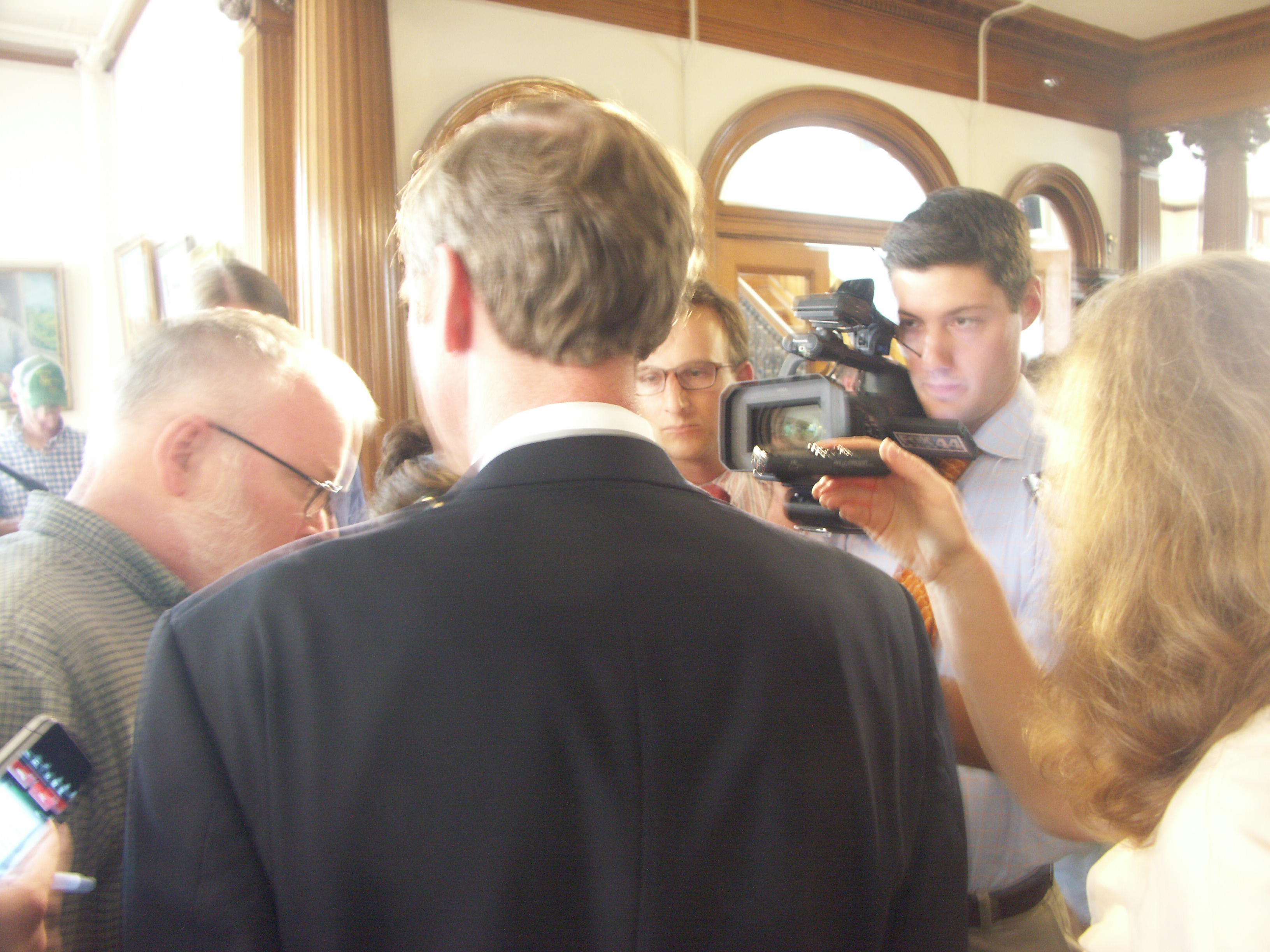
Scrum!

Scrum!

After his speech, his crew made their way to the Elks Club next door for a hamburger lunch. It took Milne a while to get there; he first had to submit himself to his inaugural media scrum. The key point for me was the inevitable exchange about Act 250, given his frustration and anger over the regulatory troubles facing his dream project, the mixed-use Quechee Highlands development. It’s run afoul of the regional Act 250 board and the town of Hartford.

Milne claimed that he is “very supportive of the concept of Act 250,” but then accused Shumlin of “hijacking something into a political ideology rather than a practical program that needs to be applied more pragmatically.”

Not exactly grammatical, but you get his drift. But when asked for specifics on how the Administration had hijacked the process, Milne came up short of the mark:

“I think if you look between the poor management at the Agency of Commerce over the last four years, very poor management at the Agency of Natural Resources, there’s very evidential answers right there.”

Not much meat on those bones, is there? He charges the Administration with “hijacking” the process — an aggressive power grab — and all he can offer as proof is a nonspecific charge of “poor management.”

Hey, a travel agent ought to know that it takes positive, organized action to hijack anything. You don’t do it by accident.

All in all, it was a happy event for the true believers. But if this is the tack Milne plans on taking, he’s gonna get shellacked by the Governor.

Is the ground buckling under Phil Scott’s feet?

Lately, there have been signs aplenty of passengers taking their leave of the Good Ship Moderate Republicanism, helmed since last November by Captain Phil Scott and first mate “Super Dave” Sunderland. Or maybe Scott’s the admiral and Sunderland is captain, whatever works.

Scott and friends came away from last November’s VTGOP meeting with a rather conditional mandate to broaden the party’s base. Make it more attractive to moderate and undecided voters, and the pragmatic business types who’ve made their peace with the Democrats under Governor Shumlin.

It seemed a promising direction. Indeed, the only possible direction, since the Vermont electorate wasn’t suddenly going to turn Texas red. The conservative VTGOP of “Angry Jack” Lindley et al. had hit a glass ceiling at about 35% of the vote.

But it was going to be a tough job for Scott, previously not known for his willingness to tackle tough jobs. He was, by dint of his elective office, the only person who could credibly take it on; but he also, by dint of his personality, seemed unsuited for the task. And even if he rose to the occasion, the odds seemed to be against him. Shumlin and company have done a really good job of co-opting the center, and it’d be a hell of a job for Scott to win back all those voters and supporters without moving so far to the center that he completely alienates the easily alienated conservative base.

It’s only been about nine months, and the Good Ship Moderate Republicanism looks to be taking on water. Recent signs include:

Bruce Lisman’ decision to forego any sort of alignment with the VTGOP, even after he stepped away from leadership of Campaign for Vermont, the self-described nonpartisan policy shop.

Lisman’s brief and pointless flirting with a run for Governor this spring, which lasted just long enough to force State Rep. Heidi Scheuermannf (a Lisman ally) out of the race.

The continued activity of Campaign for Vermont. Its members do include people from across the political spectrum, but the group still tilts substantially toward the right. And many of its key supporters are the kind of people who used to be mainline Republicans.

Roger Allbee’s decision to run for State Senate as a Democrat. The former Douglas Administration cabinet functionary and self-described liberal Republican could have been a powerful ally for Scott. Instead, he’s hoping for a place on the other ticket.

— Former State Rep. Oliver Olsen’s decision to run again for his old seat, but this time as an Independent. In the 2011-12 biennium, Olsen was one of the more vocal and effective members of the House Republican minority; this time, he seems to believe that he’s better off without the “R” next to his name.

— Last week’s VTGOP campaign finance report which, as I reported in this space, was truly horrific. A quarterly fundraising total — during a campaign season, mind you —  of only $7,500. The bulk of that came from a few party insiders. And over the past year, the VTGOP has drawn virtually no small donors, a sign that so far it’s failing to reach the grassroots. In spite of Sunderland’s repeated claims that the people of Vermont are waking up to the failures of the Shumlin Administration. Well, they haven’t awakened enough to write any checks, that’s for sure.

What that dismal report means is that the VTGOP has lost some of its hard-core, ideologically driven donors, but has yet to even begin to attract a new donor base. Nor has it even begun to convince former Republican stalwarts to come back home.

— And finally, this week’s formation of Vision to Action Vermont (V2AVT), a “bipartisan” PAC aimed at supporting candidates who are focused on improving Vermont’s economy. Its co-founder is Scheuermann herself, and her decision to create this independent group is an interesting one. You’d think that Scheuermann would be one of Phil Scott’s most trusted lieutenants, with a bright future in Republican politics. But as with Allbee and Olsen, she has apparently decided that the Republican brand is too toxic to advance her goal of electing lawmakers who are focused on economic issues.

Take all these events together, and it seems like the Republican center-right is fragmenting in all directions rather than coming together behind Scott and Sunderland. That, I think, is a very bad sign for Scott’s effort to broaden his party. The people who might have been part of a new, broader, more vibrant VTGOP are channeling their energy in other directions.

It may seem unfairly early to declare Scott’s project a failure. After all, it’s been less than a year, and it took quite a few years for the VTGOP to get so badly screwed up. But Scott’s party has no resources and few candidates; if he fails to make any headway in Legislative elections, a substantial portion of the party will be ready and eager to unseat Scott’s team and return the party to its former course: down an ideological dead end.

Mark Donka steps very close to the edge

Random thoughts on a Monday afternoon in July, the weather is warm, the sun high in the sky… and some people’s thoughts turn apocalyptic.


Screen Shot 2014-07-21 at 1.17.29 PM

That cheery idea comes from the brain of the likely Republican nominee for Congress in Vermont. Mark Donka faces two equally rabid conservatives in the GOP primary, but he should have a name-recognition edge from his disastrous 2012 bid to unseat Democrat Peter Welch.  I assume he will win the nomination.

To be fair to Mr. Donka, I really don’t take this Tweet as an authentic wish for a catastrophic attack on America — although he clearly opens the door to such an interpretation. But even if you give him the benefit of the doubt, this is so wrong in so many ways. (For starters, let’s run it by the families of 9/11 victims.) I wouldn’t want anyone who thinks like this anywhere near a position of authority. And of course, he knows deep down that he’s never going to be a Congressman, so he’s free to spout whatever hurtful nonsense he likes.

But let’s leave aside the moral dimensions of this offensive remark, and focus for a moment on the practical.

Did 9/11″light the fuse of change”?  Well, I guess you could say it did. It ushered in the Bush Administration’s two disastrous wars, the building of a huge security apparatus and the exercise of broad new government powers, and the explosion of federal deficits (as Bush chose to cut taxes even while prosecuting two wars).

But considering that Mark Donka describes himself as a limited-government conservative who wants to rein in federal authority, cut spending, and pay off the debt, it’s interesting that he should believe that another 9/11 would promote his kind of change, instead of the precise opposite.

Mark Donka: dangerously wrong. And, assuming victory in the primary, one of the top names on the Vermont Republican ticket. Be proud, VTGOP.


The VTGOP: It’s worse than it looks

While poring over the campaign finance filings from this week, I couldn’t help noticing that — in sheer fundraising terms — the Republican Party has slipped into the #3 position. Yep, they’re being out-fundraised, quite handily, by our humble friends in the Progressive Party.

The numbers: VTGOP raised $7,500 for the most recent period (mid-March to mid-July) and $61,000 for the entire election cycle. The Progs, by contrast, raised $16,000 for the period and $89,000 for the cycle. (All numbers rounded off, thanks.)

See, it’s not even close. The Progs are a solid number 2.

This isn’t because the Progressives have enhanced their drawing power; their numbers are roughly on track with the same time frame in the 2012 cycle. It’s just that the Vermont Republicans are simply terrible at fundraising. Really, really, bad.

But wait — it’s worse than that.

In its mid-March filing, the VTGOP reported raising more than $45,000. This, presumably, reflects the take from the big Chris Christie fundraiser in December. That’s a really nice number, but it’s a whole lot lower than what party leaders were projecting before Christie’s visit. And it didn’t set the party on a new, healthier course; it merely provided a temporary jolt, like treating a pneumonia patient with Red Bull. Judging by its latest report, the VTGOP can’t draw flies without a big event. $7,500 is a wretched total for a “major” party entering a statewide election campaign. (It may help explain why short-term party staffer Brent Burns has departed to set up his own campaign shop; I suspect that either he wasn’t getting paid regularly, or it was made clear to him that the party couldn’t continue to pay him. Instead, we have Jeff Bartley as the party’s “Victory Director.” And I’m pretty sure that’s a part-time gig.

But wait — it’s even worse.

That $7,500 for the most recent period included $2,000 from Lt. Gov. Phil Scott’s campaign fund, $1,000 from Phil Scott’s construction company, and another $1,000 from State Rep. Heidi Scheuermann’s campaign fund. Plus $1,000 from Jani-Tech, a janitorial services company. Jani-Tech’s owner, Dawn Terrill, is the VTGOP’s new finance chair. Plus $800 from Greenleaf Metals, owned by party treasurer Mark Snelling.

So the bulk of that pathetic fundraising total came from a handful of insiders. Without Scott, Scheuermann, Terrill, and Snelling, the party would have received a measly $1,700 over a three-month period. A three-month period in which the party ought to have been marshaling resources for intensive campaigning.

What’s worse than pathetic? Abysmal?

One final note of despair. The GOP’s campaign bumpf is generously festooned with references to the state’s political elite, by which they mean the Democrats. But if the Republicans are trying to appeal to the common folk, the working man, Joe Sixpack, they are failing completely. In the past year, the Vermont Republican Party has taken in only 15 individual contributions of less than $100. What little money they’re raising is being given by the usual handful of insiders and well-connected business types.

Of course, a big part of the Republicans’ problem is that they’re getting a lot less from those business types than they used to. Many businesspeople and wealthy donors of centrist orientation, or of a practical bent, have abandoned the Republicans and are either sitting on their money, sending it out of state, or giving it to the Democrats.

But the takeaway here is, the Republicans have no appeal for the general public. At least, not enough appeal for individuals to open up their wallets.

See, it’s even worse than it looks.

When public policy becomes personal

Let’s look at the two guys likely to headline the Republican ticket, such as it is, in Vermont this year: gubernatorial candidate Scott Milne, and incumbent Lieutenant Governor Phil Scott. Both are men of moderate reputation and widely seen as “nice guys.” Both have shown a disinclination to take hard-and-fast political stances.

But for each of them, there’s one exception to the general tone of moderation. Milne and Scott have each spoken loudly and strongly on one issue respectively. For each, it’s an issue that has left the realm of abstract policy and directly impacted their own fortunes. In the case of our Lieutenant Governor, it’s public campaign financing; for Milne, it’s the approval process for new developments, most especially Act 250.

It’s funny how a personal stake can turn a moderate into a firebrand. But it does call into question their ability to govern dispassionately. One of the most important things I want to know about candidates is this: Can they make decisions based on the public good, even if they’re going against their own personal interest? Can they set their interests aside?

Both top Republicans are in danger of failing that test.

As for Scott, after years of building a politiical career on being inoffensive and avoiding the tough call, he has become a late-blooming opponent of public campaign financing. When he was a state Senator, Scott wasn’t particularly against the idea, and he had his chances. And during his tenure as Lieutenant Governor, he’d never spoken out about it.

Until now, when a publicly-financed candidate threatens to give him a real race. Now he’s decided that public financing is an unfair burden on taxpayers, forcing them to effectively support a candidate they may personally oppose. Which ignores the whole social-good function of publicly financing ANYTHING — roads, welfare, education, police, military. Every one of us pays taxes to support something that we personally would not choose to spend money on. Public financing is a drop in that particular bucket.

As for Milne, he’s hot and bothered over the development approval process because of his big personal stake in Quechee Highlands, a proposed housing/retail project slated for a large parcel near Exit 1 of I-89. (This story was broken earlier this week by my colleague BP at Green Mountain Daily.) How hot and bothered? In an essay published last August in the Valley News, his opening salvo was:

All who care about Vermont’s future, fairness in government and how communities settle disputes should pay heed to what is happening a few miles from the Connecticut River at Quechee Highlands.

Wow. That’s putting it pretty strongly. “Vermont’s future” depends on Milne getting his way on this project. Lacking in perspective much?

He goes on to slam the regional planning commission for denying an Act 250 permit for the project. In the process, he reveals substantial ignorance about the mission and workings of those commissions. Most notably, he wrote that the commissions’ purpose “should be to help promote development that creates a foundation for economic health.”

Er, Scott. Hate to break it to you, but those Act 250 bodies are meant to balance development with conservation, not to promote development. And your little project, I have to say, would be built in an area with precious little road infrastructure. The corridor between Exit 1 and Woodstock is already a mess, and the vicinity of Exit 1 is especially bad. The original proposal was for an entirely retail project, which would have been a traffic nightmare. Milne and co. later revised it to mixed-use, residential plus “less than 37 percent retail.” Which is still quite a lot of retail in a 168-acre development. (The retail is clearly aimed at cashing in on the proximity to I-89. The site is less desirable for housing because of freeway noise.)

At the time, one of the pillars of Milne’s argument was that while the regional board had said “no,” the town of Hartford was in favor of the project. And he asserted that the town’s view should have greater weight.

Since then, Hartford has changed its tune. In May, the Hartford Selectboard amended its master plan to bring it into compliance with the regional commission’s plan. Before the Selectboard’s vote, Milne warned that QH would be “dead” if the changes were adopted. He’s already pursuing appeal of the regional commission’s ruling; he’s now threatening to take Hartford to court as well:

“I’m going to try to figure out if I’m going to do anything, and if I do, it’s probably going to involve more lawyers, and it’s just going to continue to brand Vermont as a bad place to do business,” said Milne.

Sheesh. Rejection of Milne’s project will “brand Vermont as a bad place to do business”? Mr. Milne seems to have an awfully… shall we say, expansive… view of himself and the importance of his project.

And it wasn’t long after the Selectboard action that Milne began publicly mulling a run for Governor, having previously given no hint of ever desiring a political career.

Now, I don’t think Scott Milne wants to be Governor so he can save Quechee Highlands. But it’s clear from his own statements that he has very strong pro-development views. And if he were to become Governor, he’d clearly push for substantial changes in the Act 250 process that would shift its focus from conservation to, in his own words, “help promote development.”

That’s a pretty radical take on Act 250, is it not? It’s looking like Milne is not that much of a moderate, at least on this very crucial issue. It calls into question his ability to dispassionately consider issues in which he has a personal interest. It also calls into question the entire foundation of his campaign, which portrays him as a centrist who can build bridges and work with the Democrats.

Republican county committees: part of the solution, or part of the problem?

As we all know, the Vermont Republican Party has been chronically short of funds for quite a while. Right now, they’re either just above water or actually in the red — at a time when major parties ought to be flush with cash to spend on campaigning.

But as I was poring over Tuesday’s campaign finance report filings, I noticed something that struck me as a little odd. Or more than a little.

While the state party is desperately clipping coupons and searching the sofa cushions for spare change, some of the local and county party organizations seem to be going through quite a bit of cash. And what are they spending it on?

Well, a lot of it goes to food, drink, and entertainment for themselves. Very little seems to go toward party-building or candidate support. In fact, virtually no money has been given to candidates with one exception, listed below.

State Republican leaders have openly talked about their grassroots organizations being in terrible shape, and needing to rebuild at the town and county level in order to compete with the very well-organized Democrats. But some of the GOP’s local branches seem to have the resources; they’re just frittering the dollars away on keeping themselves fat and happy.

The term “circle jerk” comes to mind.

Let’s look at some figures. (All donation totals are for the campaign cycle, not just the most recent period.)

The Barre Town Republican Committee reported raising $7,841 and spending $3,443. Virtually all of that — $3143 — was spent on “meals” at the Elks Club.

The Caledonia County Republican Committee raised $3,675 and spent $3,545 — including $2,050 at the Elks Club.

The Washington County Republican Committee has raised $17,800 and spent $10,870. No sign of gifts to candidates; but they did blow about $2,500 at a single restaurant — an old-fashioned meat-and-potato joint called The Steak House.

The Windsor County Republican Committee raised $6,400 and spent $2,500, almost all of it on food and drink. Including $528 for a Super Bowl party at the Coolidge Hotel in White River Junction.

The Orange County Republican Committee raised $3,150. About $800 went to a spaghetti dinner and a golf tournament. However, they did spend a fair bit of their money on a booth at the Tunbridge Fair and materials to hand out there. That’s a tangible party-building activity — but one of only a few.

The Rutland County Republican Committee has raised $3,020 and spent $2,455, including $805 on a “campaign kickoff dinner.” Most of their other expenses seem reasonable: postage, signs and mailers, advertising.

I will admit, right here and now, that I’ve never been involved in a county or town party committee, and I don’t know what goes on there. Maybe at these gatherings, a lot of folks are writing checks directly to their local politicos or the state GOP. (If they were writing checks to the local organization, it’d show up in the finance reports.) But looking at it from the outside, quite a few of the local Republican committees seem to be burning through decent amounts of money for very little in return — aside from their own satiation.

Are these functioning political machines, or are they Old Boys’ Clubs? It seems an especially pertinent question when the state party is going begging for money and is at a profound disadvantage at the grassroots level.

I could find only one local or county Republican organization that’s carrying substantial weight for the VTGOP, and that’s the Rutland GOPAC. It’s raised nearly $18,000 and spent over $15,000, and the bulk of that spending was on direct support to area candidates for House and Senate. So, good on ya, Rutland GOPAC. Considering GOPAC’s spending and the relatively on-point activity of the Rutland Republican Committee, can it be a coincidence that Rutland is one of the few Republican strongholds in the state?

The rest of the guys maybe need a shakeup. I don’t know how you do that with such an entrenched and tradition-bound bunch of folks. (“Give up our Steak House dinners? Never!”) And again, there may be more to this picture than I’m seeing in black and white. But I think this is part of the VTGOP’s problem. It’ll be a challenge to fix.

My second favorite factoid from campaign finance filing day

Most, if not all, of Vermont’s counties have Republican Committees. Some of them raise and spend substantial amounts of money (more on that tomorrow, if I’m lucky). Most of the money is local and stays that way.

But Caledonia County’s Republican Committee raised a rather measly $1200 this reporting period.

All from one single donation.

The benefactor: Philip Morris USA.

Question: Why is a global cigarette giant interested in li’l ol’ Caledonia County?


Scott Milne’s first campaign finance report is in

Drumroll please…

Milne raised a total of $20,420 so far.

(Apparently he needs a little practice with the form; he reported $20,420 in gifts over $100, and another $20,420 in gifts under $100, for a grand total of, yep, $20,420. Oh,well.)

The fundraising total includes $900 from the candidate or immediate family. And $355 in loans forgiven.

The good news is, he’s only spent $600 so far (printing and T-shirts), so he’s still got some money left.

Odd factoid: Pretty much half of his total comes from a single, out-of-state family: the Boieses. David II, David III, Robin, Mary, and Jonathan Boies gave $2,000 apiece to Milne for Governor. Boies II is the famous lawyer of marriage-equality fame; the others are his wife and children. Go figure.

And only $1800 of his campaign kitty came from Vermont donors. $1200 of that is from people named Milne. Let’s say the candidate has yet to establish broad appeal, shall we?

Odd factoid #2: Virtually all of Milne’s donations came in on the same day: last Friday, July 11. Until then, his campaign had raised a mere $5,100.

Milne fever… catch it!

Early afternoon thoughts on campaign finance filing day

First, a couple newsworthy Tweets from VPR’s Peter Hirschfeld. He reports that the Scott Milne campaign will report roughly $20,000 in contributions, and that Phil Scott will report about $50,000. Milne’s total is awfully pitiful; Scott’s still got a ways to go to catch up with Dean Corren, who qualifies for up to $200,000 in public financing.

As of 1 p.m., neither candidate had actually filed. Other notes:

— The aforementioned Corren reported just under $20,000 in donations from 862 donors. No single donation is worth more than $50. That’s an impressive show of organization and appeal.

— If you want a snapshot of the relative financial pull of the Democrats and Republicans, take a look at their respective House campaign operations. The Dems have raised a daunting $108,000 for their House campaign kitty and spent almost all of that. Notable on the expense ledger are salaries for two campaign staffers — just for the House campaign. (The Repubs, at last check, had one paid staffer for the entire state party. Might be two.) The Republicans’ House campaign operation has raised a paltry $12,000 and spent about 5K.

— Most of the House Dems’ money has come from two sources: State Representatives financially supporting a joint campaign, and corporations and their PACs. Big bucks from MVP Health Care, the Association of Vermont Credit Unions, the Vermont Realtor PAC, New England Cable and Telecommunications Association, and the Corrections Corporation of America (yuck), among others.

— You know which PAC has taken in more money than the Republicans’ House campaign? The Common Sense Leadership PAC, the brainchild of House Minority Leader Don Turner. He’s raised $26,000 for this cycle and spent $12,000. None of it on donations to House candidates. He has paid $2700 to consultant Shayne Spence, and $900 to Johnston Consulting. Why he’s wasting money on Darcie Johnston’s “expertise” only he can say. Turner raised $10,000 of his money in $2000 increments from two stalwart Republican families: the Vallees and the Pizzagallis.

— In the closely-watched State Senate race in Windham County, Joan Bowman has reported donations totaling $1500. But about three-quarters of that is from herself or her family. Bowman is one of four Democrats running for two Senate nominations in August: the others are incumbent Jeanette White, former Douglas Administration cabinet member “Artful” Roger Allbee, and newcomer Becca Balint. It’ll be interesting to see how much Balint takes in; from the outside, it looks like she and Bowman are in a face-off for the non-White, non-Allbee votes.

Bill Doyle doesn’t have to lift a finger, and isn’t. He’s sitting on a balance of $6,500 from previous campaigns. He’s raised $100 this year and spent nothing. I think he’s rightly confident.

Pat McDonald, the former Republican State Rep who’s now running for one of Washington County’s three seats, has racked up a noteworthy $10,000 in donations. She’s spent about half of that.

Doug Hoffer has raised a modest $4400 and spent most of it. Well, he is essentially unopposed in his bid for a second term as Auditor. The bulk of his spending was in two contributions to the state Democratic organization: $1500 to the party, and $2250 to the Dems’ “coordinated campaign.” I guess Doug’s taking this “Prog running as a Prog/Dem” thing seriously.

— Former Republican Representative Oliver Olsen, on the comeback trail as an Independent, is raking in the cash (by House standards). He’s raised $5,700, and spent almost nothing.

— Who hasn’t been a candidate in four years, but keeps on filing campaign finance reports? Matt Dunne, that’s who. He filed as “not a candidate” and reported a carry-over surplus of $2,856.54.

— Former Democratic State Senator Bill Carris, who resigned for health reasons in 2012 (Eldred French was appointed to fill out his term), has liquidated his campaign funds. He had $9400 on hand, and distributed it to a variety of candidates and the state Democratic Party. Notable gifts: $2000 to Senate President Pro Tem John Campbell, $1000 to French’s re-election campaign, and $1800 to his son William Tracy Carris, who’s also running for a Democratic nomination in Rutland County, which has a total of three Senate seats.

— Perhaps the most active of Republican groups so far, at least in terms of supporting candidates, is the Green Mountain Republican Senatorial Committee, which has raised over $15,000 and given healthy start-up contributions of $1500 each to Senator Kevin Mullin and Senate candidate Brian Cullamore, both of Rutland county; and $1,000 apiece to Senator Norm McAllister and Senate hopefuls Dustin Degree, Pat McDonald, Joy Limoge, and Bob Frenier.

I’ll be watching the filings all afternoon. (What a life.) More updates later. Stay tuned!