Category Archives: Uncategorized

Seven Days puts on the big-boy pants

I was wondering if someone would swoop in and pick up the pieces after the Burlington Free Press abruptly shuttered its Statehouse Bureau. And now, someone has.

As it expands its coverage of Vermont government and politics, Seven Days has hired veteran Statehouse reporters Terri Hallenbeck and Nancy Remsen.

I couldn’t be happier for Hallenbeck and Remsen personally or for news consumers in Vermont. Seven Days has been steadily upping its game in recent years, but this is a solid, decisive leap into the big time. The little alt-weekly now has a larger politics/Statehouse crew than the once-formidable Free Press. And, even more shocking, a more experienced crew.

The Free Press is supposedly hiring a couple new reporters, but you know what they’re likely to get: bottom-of-the-pay-scale twentysomethings who are proficient with multimedia technology but have little background or experience to inform their reporting. But even if the Freeploid does bring on a couple of seasoned reporters, they won’t be able to replace Hallenbeck and Remsen’s knowledge of the politics and governance of Vermont. They’ll be at the low end of the learning curve, whereas Hallenbeck and Remsen are at the peak.

At a time when newspapers and even many alt-weeklies are in full retreat, Seven Days has taken a bold step forward. Best wishes to the newly enhanced crew, especially to former scurrilous scribe Paul Heintz, now serving as Political Editor.

The most pertinent questions about the Colchester cop

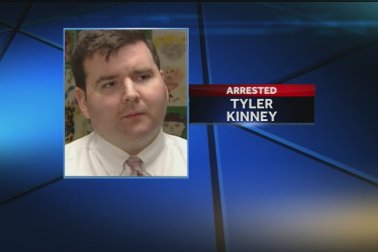
I sense the fine handiwork of the WPTZ graphics department.

I sense the fine handiwork of the WPTZ graphics department.

Every time I read about the case of Tyler Kinney, the Colchester officer who faces federal drug and gun charges, the same thing keeps coming to mind.

How in the blue hell did this go on so long?

Here’s a guy who was on the force for twelve years, and occupied one of its most sensitive positions — keeper of the evidence locker — for two and a half years. He was stealing stuff out of the locker, he had a “heroin addiction for an extended period of time,” and he was sharing his swag with a career criminal with a rap sheet as long as your arm and two felony convictions.

On top of all that, Kinney’s addiction and malfeasance came to light accidentally, after an unrelated search of the career criminal’s home. Absent that coincidence, Kinney might have gone on stealing stuff and destroying God knows how many prosecutions that depended on secure evidence storage.

News coverage of the case, so far, has focused on Kinney himself. But what of the institutional framework around him?

The overarching question breaks down into two parts.

1. What kind of internal oversight does the Colchester police have on its evidence locker and the sole keeper thereof?

2. What is the department’s drug testing policy for its officers? Does it have any? How often does it conduct tests? What drugs does it test for?

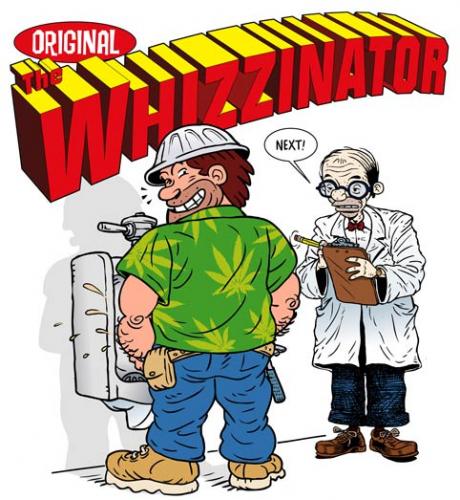
the_whizzinator_83385And how are the tests conducted? Is the officer monitored while, ahem, providing a sample? Or is there opportunity to game the test via the Whizzinator route?

The Colchester Police Department should answer these questions in detail. Necessary reforms must be enacted. If internal policies were not followed, those responsible should answer for their inactions.

Lest we lay all of this at the feet of Colchester Police Chief Jennifer Morrison, allow me to note that she’s only been there for a little over a year. The previous Chief, Charles Kirker, who had been chief for the previous 34 years, needs to give some answers too. Especially in light of this sentence from a softball Burlington Free Press interview on the occasion of his retirement:

My philosophy has always been to delegate to subordinates because you allow them to grow.

Yeah, nothing could possibly go wrong with that.

Beyond Colchester, the same questions should be put to the Department of Public Safety. What are the standards for the State Police? Are there standards that local police agencies must meet?

If not, why not?

If a drug-addicted officer can occupy a critical position of trust for two and a half years, only to be caught by accident, then either there was a complete breakdown in the Colchester police, or there are systemic shortcomings that must be addressed.

That’s all. I’ll hand this over to the watchdogs of the media.

Shumlin: “We have a structural deficit” and other happy tidings

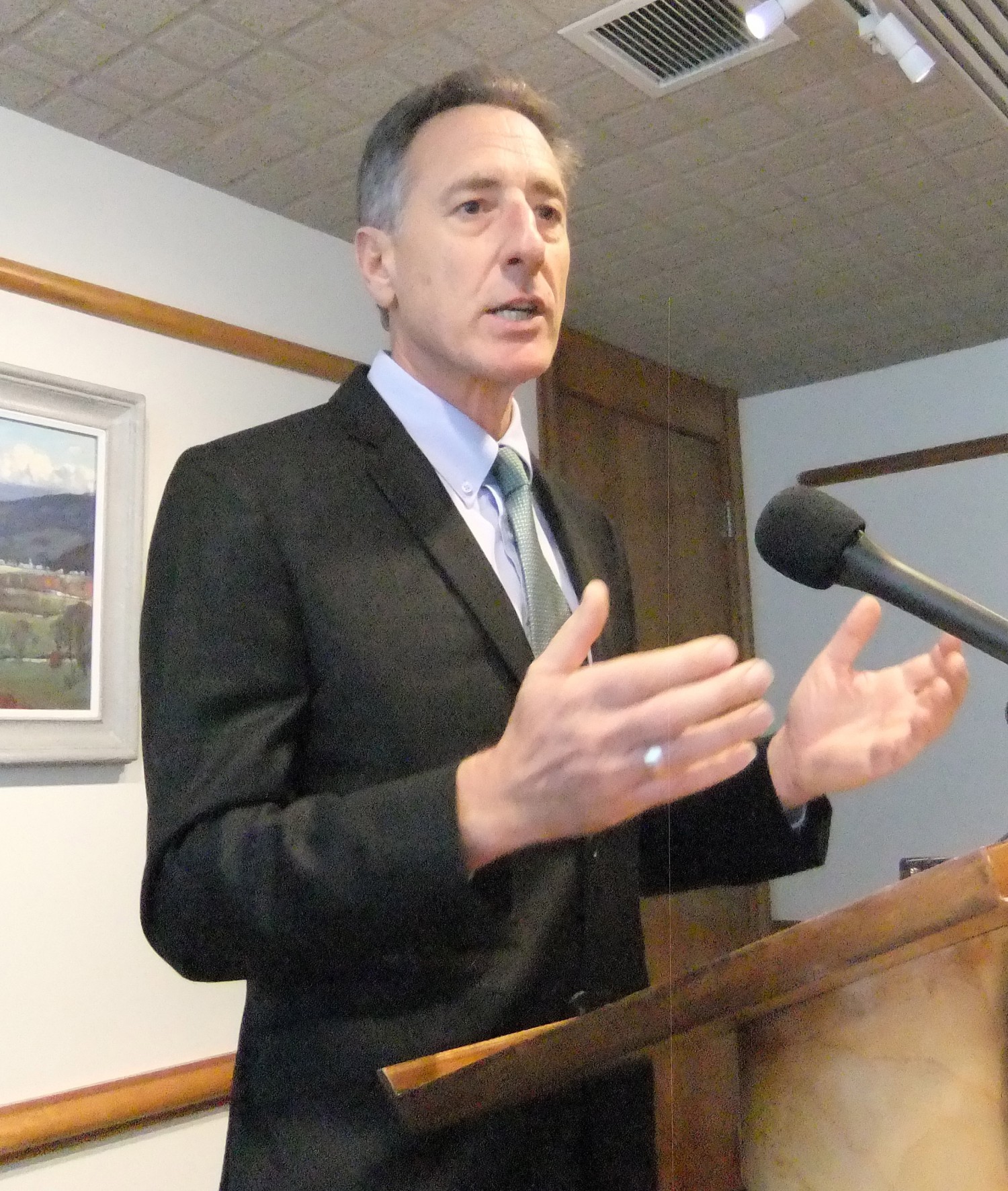
The Governor addresses the multitudes. (The bearded man begging for change is Dave Gram of the Associated Press.)

The Governor addresses the multitudes. (The bearded man begging for change is Dave Gram of the Associated Press.)

An uncharacteristically subdued Governor Shumlin held an agenda-free news conference this morning. I emphasize “agenda-free” because his past practice has been to piggy-back news conferences onto photo opportunities or policy announcements, leaving much less time for general questions.

Today there were a lot of questions and a lot of substance. In no particular order…

The Vermont Health Connect website will go back online this Saturday, which happens to be the first day of open enrollment. So the relaunch will come on the last possible day. Gee, hope things go right; there’s no margin for error.

Shumlin pronounced himself “optimistic,” saying “I’m encouraged by what I’m hearing.” But given how often he, and we, have been burned in the past, he was reluctant to make any predictions. “I’m always hoping it will work.”

— He dismissed Republican calls to shut down VHC and go with the federal exchange, and he had several good arguments. First of all, it’s far too late to make the change this year, so we’d be limping along with VHC for another year in any case. And there are signs it’s finally getting on track. “We’re turning a corner,” he said. “Why not give it a chance?”

There’s also the fact that the federal exchange’s premium subsidies aren’t as generous as Vermont’s. Switching to the federal system would mean higher premiums for thousands of Vermonters who earn between 100-300% of the poverty line.

And, as he pointed out, the US Supreme Court may well strike down federal subsidies, in which case only states with their own exchanges will be able to offer subsidies.

— Get ready for a slam-bang legislative session. Shumlin is still talking about the next step in health care reform (see below), the legislature is hell-bent on property tax and/or school funding reform, Shumlin is talking about significant changes to energy policy, and perhaps worst of all, the quote atop this post: “We have a structural deficit at this point.” Meaning huge challenges in fashioning a budget. That’s a hell of a lot of big, contentious issues to tackle.

Temba, his arms wide.

Temba, his arms wide.

— Speaking of the budget, Shumlin acknowledged that Vermont and many other states “thought the recovery would be more robust,” and its weakness has caused revenue shortfalls. He’s talking about a second round of rescissions in this year’s budget, although he said nothing is final just yet. And he’s talking about major changes in next year’s budget in order to put an end to annual budget crises.

He wants to put the state on a more sustainable path. Which must be making a few Republicans chuckle, since they’ve been preaching this for years. On the other hand, Shumlin has a valid point: the recovery has been weak. If we’d had a normal recovery with decent wage gains, our tax revenue would be stronger and we wouldn’t be facing this dilemma. The big news on this front is that the Governor now believes we’re facing years of sluggishness, and we need to ratchet down the budget to make it sustainable.

When asked whether this might mean tax increases, he didn’t rule them out, but he made it clear that his first choice is to rein in spending.

— On the push for single-payer health care, he repeated his longstanding support for the idea, but acknowledged that in the wake of the election, everything is on the table. He is aiming for a system that combines affordability with universal access to health care. His preference remains single-payer, but it’s looking like we might settle for less than that.

— He made it clear that yes, he won the election, and he has no doubt that he will serve a third term. He pointed to Vermont’s long tradition of electing the top vote-getter when no one wins a majority: ‘The person who gets the most votes, wins.” He cited the 2002 election for Lieutenant Governor, in which he and Progressive Anthony Pollina combined for a liberal majority but Republican Brian Dubie won the most votes; he and Pollina urged lawmakers to elect Dubie, which they did.

— On school funding and organization, he declared “We have a spending problem,” with high per-pupil costs and administrative structures. In some cases, he said, small class sizes can be harmful to achievement rather than helpful. He’s not in favor of mandatory school consolidation, but it’s clear he will push for consolidation by trying to convince local districts that it’s in their best interest.

He did mention the idea of “prioritizing funding to schools that voluntarily consolidate.” That kind of legislative payola may be effective, but it kinda stretches the definition of “voluntary.”

— In a less wide-ranging news conference, his comments on energy policy might have made headlines. They’re likely to get lost in today’s news. He noted the pending sunset of the SPEED program, which has helped spur the renewables industry in Vermont but has also created controversy because it allows the sale of “green” energy credits in other markets. He and the legislature are working on “ideas to replace SPEED.”

He was asked about the prospects for a carbon tax with offsetting cuts in other taxes — a plan likely to be announced tomorrow by a coalition of environmental groups. He was cool to the idea, saying “It’s tough for a small rural state to do it alone,” and pointing particularly to its impact on gas stations near our state borders. He prefers a regional carbon tax instead; but he said he’s had no conversations with other northeastern governors about the idea. Methinks the enviros will have a hard time gaining traction, when you combine Shumlin’s reluctance with an extremely busy legislative session.

— Finally, he was asked about marijuana legalization. He said he wants to wait until the release of a report on the idea in January before proceeding, but noted that “I support legalization. The question is “when.”

Hack’s retreat

The conservatives really thought they’d gotten hold of a hot one.

They’d suddenly “discovered” a Shumlin Administration plan to “take over” Medicare, and began furiously stoking fear among Vermont seniors. Or at least trying their best to do so. As if they really gave a damn about Medicare, considering that their party is actively trying to kill it for future enrollees. And that their favored candidate, Dan Feliciano, is a Libertarian and presumably doesn’t believe in relying on the gubmint for anything.

It took a few days for the Administration to put together a coherent response, perhaps because they were incredulous that anyone would take this seriously. But their response did come, and it was simple and categorical: There is no such thing.

First word actually came from VTDigger’s Anne Galloway, who reported that the pertinent clause in Vermont’s health care reform law had been amended last spring, and that the law no longer mentioned anything like a takeover.

Which, as I predicted, didn’t stop the anti-reform crowd from pushing the idea. Here’s a Twitter exchange between Agitator-in-Chief Darcie “Hack” Johnston and Yours Truly, beginning with a Johnston link to a fear-stoking radio ad produced by the Ethan Allen Institute:

Funny, I didn’t get a response to that last one.

Meanwhile, El Jefe General John McClaughry leaped into the fray with a partial retreat, posted as a Comment under Galloway’s story. In it, he tried to muddy the legal waters before concluding that apparently there would be no Medicare takeover — but instead of admitting the whole hoopla had been pointless, he posited that the Administration was “trying to squirm out” of their alleged intent to take over Medicare. He further congratulated Dan Feliciano, the one who first tried to peddle this bill of goods, for supposedly uncovering the Shumlin plot and forcing the Governor to abandon it.

Like I’ve said before, sometimes I think ol’ Jefe doesn’t really mean the stuff he writes; he’s just trollin’ us.

Later in the day came another VTDigger story, amplifying Galloway’s initial post. This time, Administration officials had joined the chorus.

Robin Lunge, director of Health Care Reform, said unequivocally Monday that it won’t happen.

“Federal law does not permit us to get the cash,” she said.

Reporter Morgan True then explained that the troublesome portion of Act 48, the 2011 health care reform bill, called for the state to pay for all health services “to the extent possible under federal law.” And as Lunge stated, federal law doesn’t permit such a move.

Further, True reported:

That portion of Act 48 is what’s known as session law, or the legislation as passed before it is written into statute.

It provides guidance for writing the statutes, and while it is still law, the portions that don’t make it into statute are often temporary and meant to provide guidance.

“In 2011, we asked the administration to entertain lots of things, but it was in the context of ‘tell us whether you can do this,’” said Rep. Mike Fisher (D-Lincoln), who was on the House Health Care Committee when it drafted Act 48.

And after all that, remember that this year’s Legislature repealed that section of Act 48.

Johnston, of course, was prepared with a fallback position: “if the state is allowed” to set payment rates for medical services “and determine the type of payments, it will be bad for seniors on Medicare.”

Please note the first word: “if”. The whole argument is based on her own assumption.

From there, it’s just a quick hop and a step to the conservatives’ favorite bugaboo: rationing!!!

Scary

It’s a quick, and nearly complete, comedown for Johnston and her ilk. From frightening stories of a Shumlin plot to take control of Medicare and screw around with seniors’ benefits, to a maybe-possibly-perhaps shift in reimbursements. So sad when a good conspiracy theory gets thoroughly blown up by the facts.

The ironic thing about all of this is the notion that hardcore conservatives are suddenly the Protectors of Medicare. Don’t I recall Mr. McClaughry, just a few weeks ago, pining for the good old days before we had all this Social Security and Medicare and Medicaid crap that was draining our independence and sucking the lifeblood out of the private-sector social safety net that somehow, magically, took care of everyone’s needs?

If you’re interested in protecting federal health insurance, I’d advise you that Governor Shumlin is a much better ally than the likes of Darcie Johnston.

How can I miss you when you won’t go away?

Audio accompaniment to this blogpost:

Well, good ol’ “Bitter Bob” Hartwell, outgoing Republicrat Senator from Bennington, has left his fellow Senators a parting gift: the op-ed equivalent of a flaming bag of poo, entitled “What Senate Democrats Must Do.”

Hartwell’s public statements have shifted to the right in recent months, starting with his infamous skepticism about climate change and continuing through his comments to VTDigger last week that the Democrats have gone too far to the left:

“There’s too much spending, there’s too much social engineering, going on. Our party is getting out of line,” he said.

His opinion piece is more of the same. It reads as though it comes, not from the moderate Democrat he claims to be, but from somewhere to the right of Phil Scott. Indeed, it’s a big fat sloppy wet kiss to the Republican Party, delivered one week before Election Day. I’m sure the timing is coincidental, cough, hack, choke.

Bitter Bob, doing research for his opinion piece.

Bitter Bob, doing research for his opinion piece.

He accuses the Democratic Party of becoming “more ideological and, therefore, less effective and more poorly focused on the real issues.” By which he means, the “real issues” that concern Bitter Bob Hartwell.

He then slaps around Democrats and the Shumlin Administration for the “poor rollout of Vermont Health Connect” and says “The Legislature must determine to put an end to the single payer scheme unless it can clearly show significant savings…”

A reminder: There are two goals in advancing single-payer. One is to bend the cost curve, and the other is to provide universal access to health care. If Bob is only interested in the former, well, I’m glad he will no longer represent the Democratic Party in the new biennium.

Then he gets to property taxes and school funding, which “inexcusably, the Legislature has done virtually nothing to control…” Remind me: wasn’t Bob Hartwell in the Legislature himself?

Also, in one badly-written sentence, he appears to endorse Scott Milne’s proposal for a freeze on property taxes.

Then he takes a dump on the Senate Education Committee for “a most unacceptable performance” in failing to address the issue to Hartwell’s satisfaction. He’s talkin’ to you, Dick McCormack, Don Collins, Phil Baruth, Bill Doyle and David Zuckerman.

Somehow I don’t think Bitter Bob was talking to his colleagues this way when the Senate was still in session and his words could have had some impact. Indeed, it’s hard to tell from this essay that Hartwell was a fairly influential member of the Senate majority instead of an innocent bystander.

He then slams “Vermont’s intoxication with large scale renewable energy,” which fits in with his doubts about climate change. It also buttresses his self-congratulatory impulses, as he upbraids the Senate for refusing to pass his bills to create new obstacles in the path of renewable energy.

After that, it’s on to the core Republican talking point: “Vermont continues to spend too much money,” especially on social services programs, and bitches about “throwing money at problems” in a way that’s straight out of the Angry Jack Lindley playbook.

Hmm. Angry Jack and Bitter Bob. The worst Vaudeville act ever.

And then Hartwell rants about something that’s only a major issue in his own mind: the legislature’s failure to repeal the Bottle Bill, which, he says, wastes money, contributes to carbon pollution*, and “shoves businesses… into New Hampshire.” And he takes a gratuitous slap at VPIRG — or, as Hartwell puts it, “one so-called ‘research’ group.”

* Which, according to Bob himself, isn’t really a problem.

The “get off my lawn” ranting continues for several more paragraphs, in which he bemoans the fact that nobody in the Senate is as wise as Bob Hartwell and unleashes a bunch of howlers, including:

— The Senate fails to act “as a team,” and instead pursues “the interests of each committee with little understanding of the effect… on the state as a whole.” Considering his hijacking of the Natural Resources Committee in pursuit of his favored hobbyhorses, that’s pretty rich.

— Vermont should be more like New Hampshire.

— Our economic doldrums have nothing to do with national trends, “but rather by policies internal to Vermont.”

— Dean Corren is a liar.

Yeah, that’s one huge stinking flaming bag of poo. Thanks, Bitter Bob, for giving us a farewell gesture that reminds us all how lucky we are that you’ve decided to get outta Dodge.

Don’t let the door hit you on the way out.

If you can’t grow the grassroots, lay down some astroturf

Campaign for Vermont, now firmly in the post-Lisman era — organizationally, at least; I have a feeling that Bruce is still writing most of the checks — is chugging along, trying to find ways to engage The People in its putatively centrist agenda.

Its latest effort? The Legislator Outreach Tool. It’s a way to take a basic template Letter To Your Lawmaker, make whatever changes you want, click a button, and have it sent by email to the legislator of your choice. Once it’s been vetted by CFV to make sure you haven’t written anything “profain (sic), illegal, threatening or otherwise inappropriate.” A screenshot is below.

The subject of the letter is high property taxes, and the basic letter includes CFV’s talking points on the subject: high per-pupil spending, rising taxes, “a system with little incentive for efficiency.” The letter specifically mentions a Campaign for Vermont report. And I wonder, based on CFV’s past practices, if using the Tool gets you on CFV’s member list. And if the letter arrives in the lawmaker’s inbox with some sort of CFV identifier attached.

Maybe I’m being overly suspicious. But the letter is, at best, a two-edged sword. It facilities contact with your lawmaker (you don’t even have to know your lawmaker’s name to send a letter!) — but on an issue of CFV’s choice, including a reference to CFV and a list of its canned talking points. Look at it one way, it’s an attempt to foster democracy. Look at it another way, it’s an attempt to reinforce CFV’s agenda and strengthen its profile at the State House.

The truth, I think, is somewhere in between.

Screen Shot 2014-10-13 at 3.28.49 PM

I’ve been there

Easy targets of the week: the Hardwick couple who ended a disabled boy’s life by pouring vodka into his IV bag. The overweight, slovenly-looking couple, now charged with second-degree murder. They’re fat, they’re ugly (as all the quick-draw commenters on the WCAX website point out), and they killed a helpless boy.

Sorry, I can’t join the multitude in crying bloody murder.

Because I’ve been there.

I’ve been in a situation where someone I loved was in a severely disabled condition. Not life-threatening, but no chance of meaningful recovery either. I know what it’s like to see complete helplessness and unending suffering, to watch the days and weeks and months and years pass by with no change and no hope. To look into the future and see more of the same, unending.

To be a caretaker, and watch the clock moving in slow motion. To have nothing to say, nothing to do, nothing meaningful to offer except my presence, for whatever the hell that was worth.

And yeah, I’ve asked myself “what’s the point?” I’ve thought that a quick, hopefully painless death would have been the best possible thing for all concerned.

I never did anything about it, but I can tell you the thoughts came to mind.

I don’t know what happened with Isaac Robitille. I don’t know what was really in the minds of Melissa Robitille and Walter Richters: did they mean to kill Isaac, or merely sedate him?

The bare bones of their story don’t reveal enough to pass judgment. They do bring out painful memories of despair, of helplessness, of boredom, of wondering what it was all about and when it would end. And I can tell you, no matter how much assistance you get from the medical and social-services people, it’s not enough to ease the heavy burden you carry 24 hours a day, seven days a week, 365 days a year.

I don’t know how well Robitille and Richters handled the situation. But I know enough to realize that there’s plenty of room for another side to this story. A side that, if true, would make a murder conviction a senseless piling-on to a tragic situation by a system that’s supposed to dispense justice.

It’s possible that they concocted a scheme to rid themselves of the anchor around both their lives; that one of them held Isaac down while the other dumped vodka into the tube, knowing it would kill him, and watching him die before calling the police.

I will say that Isaac’s BAC of .146 doesn’t support that version of events. It seems low to me. If they’d really intended death, I’d think they would have used a higher dose.

But I don’t know. All I know, in fact, is that I don’t know. And although they seem like easy targets, I won’t be passing judgment anytime soon.

Maybe never.


It ain’t over till the Fat Man sings

All'alba vincerò! Vincerò, vincerò!

All’alba vincerò! Vincerò, vincerò!

Interesting. WCAX’s Kyle Midura, last seen as Twitter Guy during the gubernatorial debate, made his way eastward to beautiful Berlin, New Hampshire, where he caught up with New Jersey Governor Chris Christie, stumping the North Country “on behalf of the state’s Republican candidate for Governor, Walt Havenstein.”

And, being a good Vermont reporter, Midura asked Christie if he’d be visiting Vermont to campaign for Mahatma Milne. (Well, I don’t think he said “Mahatma.”)

“We’ve got to focus with 25 days to go on those place where we think we’ve absolutely got the best chance,” Christie said. “That’s where I’m focusing my time.”

Okay, let’s look at that.

The latest polls have shown Scott Milne behind Governor Shumlin by 12 percentage points. And in New Hampshire?

The latest poll places Havenstein 10 points behind incumbent Democrat Maggie Hassan.

Hmm.

Two points.

He won’t cross the river for two points.

Either he knows something about the Vermont race that he’s not telling, or it has less to do with gubernatorial races than with first-in-the-nation presidential primaries.

Either way, congratulations, Governor, on kicking a Republican candidate for Governor when he’s down. I assume that’s one of your duties as head of the Republican Governors Association.

El Jefe brings a chicken to the doctor

Sometimes I wonder if John McClaughry is serious, or if he’s just trolling us all.

I don’t comment on his opinion pieces very often, because he’s so far beyond the pale that it’d be kind of like commenting on an alien civilization. One that considers Ayn Rand a creeping pinko.

Well, this time I’m pretty sure that El Jefe General is under the bridge, snickering. Because his latest effort, dutifully posted by VTDigger, betrays a woeful ignorance of our history. Or at best, a view of our history through coke-bottle-thick rose-colored glasses.

Screen Shot 2013-11-08 at 1.01.59 PMIn it, El Jefe calls for a return to those Good Old Days when health care was a matter of mutual aid instead of government intervention.

We’re not talking the days before Obamacare, or the days before Medicare. We’re talking pre-Franklin Delano Roosevelt. Because as we all know, FDR ushered in the decline and fall of True America. Take it away, El Jefe…

Health care a century ago relied largely on “friendly societies,” that first appeared in the UK as early as 1793. These were self-governing mutual aid societies that promoted ethical behavior, healthy lifestyles, and “the temperate interchange of social feeling” for the afflicted. They also provided medical care, sick pay, and funeral arrangements for members and their families.

… In the U.S. clones of the friendly societies began to appear in the early 1800s under the name “fraternal organizations,” exemplified by the Odd Fellows and the Loyal Order of Moose. These lodges established orphanages, hospitals, banks, schools, retirement homes, newspapers and insurance companies. They sponsored “lodge practice,” where the local lodge members selected and employed a doctor.

Ah yes, the Good Old Days, when all you had to do is join — freely, without a hint of coercion — with your fellows to ensure that all your needs would be met. McClaughry bemoans the repression of these free movements at the hands of the medical establishment, insurance companies, and, of course, the Big Bad Government.

El Jefe paints an attractive picture. Too bad it’s conveniently incomplete. If you were subject to the tender mercies of a “lodge doctor,” before the days of medical regulation and licensing, your life and health were probably in the hands of a quack or a well-meaning tradesman with little or no training.

Let’s just imagine a “lodge doctor,” even a well-intentioned one, trying to cope with the complexities and marvels of modern medicine. (Hey, let’s put him in charge of Ebola containment!)

For more, let us turn to one of my favorite texts: “The Good Old Days — They Were Terrible!” by noted historian/archivist Otto Bettmann, founder of the Bettmann Archives. Published in 1974 and still in print, it’s a breezy, compact deflation of cherished myths about the olden times. Many of which are dearly held by El Jefe.

“The country doctor of old… was actually no more than a venturesome prescriber. Because his diagnosis was based on guesswork his therapy was totally unreliable. Sometimes it cured — often it killed. …general practice in the United States was backward, commercial and often fraudulent.

“The lack of education and proper licensing exposed the sick to hordes of ignoramuses masquerading as doctors. More a trade than a profession, medicine attracted not the sons of the elite — who preferred law or theology — but mediocrities who saw a chance to get rich quickly.” 

Many of America’s “medical schools” were little more than diploma mills, offering a sheepskin after a few months of training.

“Doctors had little professional prestige; indeed many were considered ‘crude, coarse and ignorant, contributing to social butchery by keeping their patients ill.'”

This was American medical care during John McLaughry’s Golden Age of unfettered liberty. Considering all of that, I guess it’s no wonder that John’s little boys’ club, the Ethan Allen Institute, hasn’t hired its own lodge doctor.

Honestly, McClaughry’s essay makes Sue “chicken to the doctor” Lowden look like Anya Rader-Wallack.


Bunched knickers at the Freeploid

The Burlington Free Press’ Mike Donoghue is shocked, shocked, that someone would dare steal his scoop.

Screen Shot 2014-09-11 at 2.18.28 PM

Donoghue is referring to his excellent story on the Louis Freeh accident, in which he broke the news that an eyewitness saw Freeh’s vehicle force three other drivers to swerve out of his way. Which raises the question, why isn’t Freeh facing any charges for reckless driving or endangerment or some such?

And how Mike’s knickers are in a twist because Channel 3 poached his story.

I feel his pain.

As does every non-Gannett journalist in Vermont, who would tell you that the Burlington Free Press is the number-one violator of this ethical principle. The Freeploid likes to pretend, in fact, that it is the only journalistic outlet in the state. It is very quick to grab credit for its own “gets,” and extremely — extremely — reluctant to grant the same credit to others.

Let’s just take one recent example. Terri Hallenbeck, reporting on Governor Shumlin’s campaign launch: 

According to the governor’s office, Shumlin has spent 141½ days in the past two years outside of Vermont, which includes 54 personal days off and 35 days on business for the Democratic Governors Association, of which Shumlin is chairman.

“According to the governor’s office,” my ass. That story came straight out of Paul “The Huntsman” Heintz’ column in Seven Days. Which was entitled “On the Road Again: Shumlin’s 141.5 Days Outside Vermont.”

So, rather than give proper credit to Heintz and Seven Days, Hallenbeck called the governor’s office for confirmation. Which gave her an excuse to avoid giving credit where credit is due. Well, to be fair to Hallenbeck, I suspect that her editors made her do it.

In any case, I say anyone at the Burlington Free Press who whines about story-poaching needs to look in the goddamn mirror.