Category Archives: The media

A picture is worse than a thousand words, I guess

Where do you draw the line between journalism and exploitation?

I know where the Burlington Free Press draws it, after reading its downright grisly, torture-porny article on yesterday’s testimony in the Allen Prue murder trial. The article colorfully entitled:

Medical examiner: Jenkins looked ‘beat up’

The Freeploid was happy to report WCAX’s mistaken broadcast of a crime scene photo that showed the murder victim’s body. (Or, as the ever-sensitive Mike Donoghue put it in a Tweet, “naked body of slain teacher.”) Which was wrong, and WCAX News Director Anson Tebbetts fell all over himself apologizing for it.

So, it’s wrong to show a picture. But apparently it’s all right to publish every detail of Medical Examiner Stephen Shapiro’s testimony, including the following phrases:

“Jenkins’ bruised and marked body”

Shapiro “…told the jury about the marks left by different types of strangulation. Shapiro said he determined Jenkins’ official cause of death to be manual strangulation, meaning done by hand.”

Gee, thanks for that clarification. I wouldn’t have guessed.

‘She looked beat up,’ Shapiro said, later adding. ‘She did not do this to herself.’

“Shapiro used a laser pointer to highlight different scrapes and bruises… including six circular marks.”

This was followed by a thorough retelling of the effects of a stun gun on a human body:

Shapiro said the effect of a stun gun is not quite the same as a Taser, since the Taser almost instantaneously incapacitates the person. The stun gun, on the other hand, causes pain but does not incapacitate.

“A stun gun that’s pressed up against your body is more of a compliance weapon,” Shapiro said.

You can almost feel the burn, can’t you?

The first sentence of the story began with “Several loved ones of Melissa Jenkins inhaled sharply and covered their eyes…”

If they happen to read today’s Free Press, I think they’ll be inhaling sharply and covering their eyes all over again.

I know how the Free Press would defend itself. It’s a high-profile murder case, the trial is open, the testimony is fair game, and The People Have A Right To Know.

But do we have to know every detail? Or is this another case of Clickbait Uber Alles?

To me, this story crossed a line. And it makes the Freeploid’s sanctimony over WCAX seem downright hypocritical.


Ride with Uber. Chances are, you’ll get there in one piece

Ah, Uber… the latest high-tech industry disruptor. The “ride-sharing” service that’s just like a cab company without all that pesky regulation. The service that actively, and aggressively, resists any attempt to regulate its business. Now operating in the Burlington market, as the Freeploid reported last week:

Uber will provide rides through the low-cost service called uberX, which uses local drivers in their own cars. Burlington is now the 216th city on the Uber map, and the company will build up to 24/7 on-demand service.

The ‘Loid’s April Burbank went on to detail the city’s response to Uber, which arrived at a time when Burlington was already pondering how to update its taxi regulations, and to dutifully reproduce the complaints of local cab operators and Uber’s reassurances that its services are reliable and safe.

Safe. Hmm. That’s an issue that Burbank failed to explore further. And neither did Seven Days’ Alicia Freese, in a pair of stories that focused on Uber’s successes in other markets and the uncertain reaction from local regulators. All this, even though a quick Google search will reveal a host of problematic experiences and near-brushes with abduction and assault, to which Uber’s standard reaction is “Oops, sorry, here’s your money back, now go away.”

Let’s review some recent trouble spots on Uber’s record, shall we?

A woman in Los Angeles boarded an Uber vehicle for a ride home from a party. Instead, the driver took her 20 miles out of the way

…arriving in a dark, empty parking lot in the middle of the night despite her repeated protests. When she tried to exit the car, her driver locked the doors—only when she caused a commotion and screamed did he finally return her home. What should have been a quick ride took over two hours.

Uber’s initial response: a  partial refund for an “inefficient route.” It later made a full refund. Meanwhile, the woman is staying in a hotel because the driver is still out there somewhere and knows her home address.

A couple weeks ago, an Uber driver in San Francisco got into an argument with his passengers, stopped the car, attacked one of the riders with a hammer blow to the head, and drove away.

Oh, and here’s a thing: a Chicago TV station sent out a bunch of passengers to take rides in Uber cars, “and found not a single driver knew his way around the city.” And worse:

NBC5 then ran background checks on each of the drivers and discovered ticket after ticket — for speeding, illegal stops and running lights. One driver had 26 traffic tickets, yet still passed Uber’s background check.

The station then tested Uber’s driver-screening program by submitting an application from a reformed criminal with “a three-page rap sheet.” She was hired four weeks later, to which she said:

“I was kind of baffled, still am baffled how they let me in,” Locke said. “If I had been offered a job like this, knowing that my life of crime was in burglaries and robberies, …I would pick somebody up, take them to their airport, and my second thought would be: Go back to that house.”

The NBC5 report contains a whole lot of other nasty stuff, including an Uber driver who hit and killed a six-year-old — and who turned out to have a prior conviction for reckless driving; a driver accused of sexual assault by a passenger; and a driver whose car was totaled, and who found that neither Uber’s insurance nor his own would pay for the damages.

Thousands of people have had good experiences with Uber, and any industry has its problems. But Uber’s whole business model is built on avoiding responsibility for those problems. It fights regulation; it doesn’t buy commercial auto insurance for drivers; it classifies its drivers as independent contractors to shift liability away from the company.

It’s the ultimate in caveat emptor: let the buyer beware, let the contractor beware, let bystanders beware. In fact, let everybody beware except Uber itself. And Uber skims the profits.

City officials should think long and hard about the totality of Uber’s track record before allowing it to operate. That consideration should include the above incidents, and Uber’s clearly inadequate driver-screening process, which Seven Days and the Burlington Free Press either overlooked or didn’t think worthy of its readers’ attention.

One man’s cheap shot is another’s cogent criticism. Or, why I bag on the Free Press so much

Those who follow Vermont media accounts on Twitter may have enjoyed a little Columbus Day entertainment by way of a Tweetfight between staffers at the Burlington Free Press and Seven Days, which the Freeploid has long looked down at, but which has become a powerful competitor in the battle for print advertising.

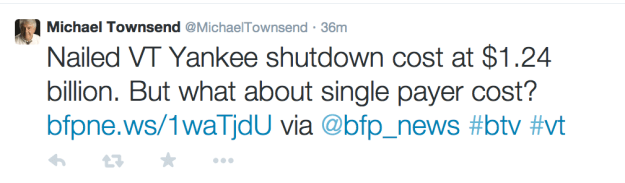
It began with Freeploid vet Mike Donoghue taking a little poke at WCAX:

This was a reference to WCAX mistakenly broadcasting a crime scene photo including the body of a murder victim, which the Freeploid wrote up at great length. Seven Days’ Mark Davis Tweeted a reply about the ‘Loid “firing cheapshots at WCAX.” To which the Freeploid’s Adam Silverman replied “Is someone from Seven Days really one to talk about cheap shots?”

Davis pointed out the “thinly veiled glee” the Free Press was exhibiting over a competitor’s mistake. Donoghue and Silverman accused Seven Days of ignoring the story, to which Paul Heintz replied that he hadn’t gotten a call back from WCAX.

This exchange included two contraditory Tweets from Donoghue. First, he accused Seven Days of ignoring the story because the two entities are media partners; and then he insinuated that WCAX won’t return calls from Seven Days because of some unstated offense.

Which is it, Mike? They’re in bed together, or they can’t stand each other?

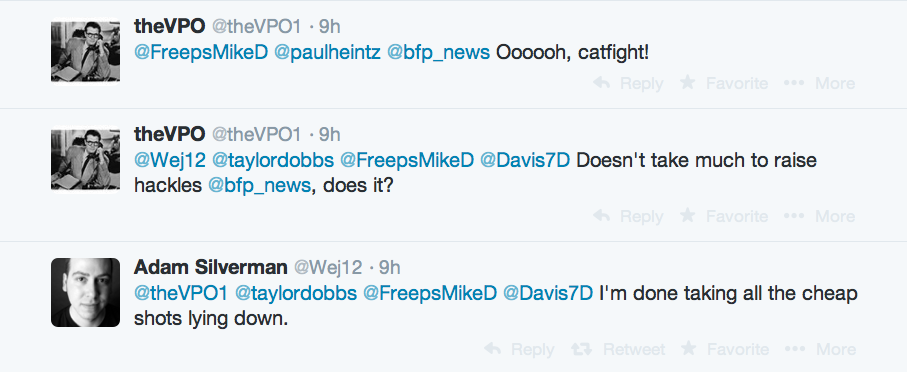
Anyway, that’s when I lobbed a couple of spitballs from the back of the class, and Silverman went all Charlie Bronson.

Screen Shot 2014-10-13 at 11.47.41 PM

I can just see him grabbing his crotch as he hit “SEND.”

Which brings me, finally, to the point of this post: an explanation of why I so often criticize the Free Press. Or, in the words of Mr. Silverman, why I deliver so many cheap shots.

Basically, it’s all about the words of Voltaire, best known as delivered by Peter Parker’s Uncle Ben:

With great power comes great responsibility.

The Burlington Free Press is the number-one print publication in Vermont. It ought to be the unquestioned leader in serious journalism. But, because Gannett keeps sucking out its precious bodily fluids to satiate the endless thirst of stockholders, we’re left with a depleted newspaper that can’t serve its readers well but still occupies the largest niche in the Vermont news market.

It doesn’t occupy that niche in any satisfying way, but there it sits, and because of the structure of the news marketplace, nobody can dislodge it.

The Burlington Free Press has great power. To be charitable, it does an inconsistent job of exercising that power. To be less charitable, it’s an almost daily disappointment. So when somebody like Mike Donoghue or Aki Soga positions himself as a guardian of the public trust — and yet expects to be insulated from the kinds of accountability or transparency he expects of everyone else (including WCAX) — well, it makes the rest of us throw up in our mouths a little. Likewise, when Jim Fogler or Michael Townsend serve up a column’s worth of bullshit and expect us to gobble it down like steak.

Too often, the Free Press comes across as arrogant and condescending. And its performance fails to justify its overweening sense of superiority. That’s why the Free Press gets so much criticism. And the occasional cheap shot. Expect both to continue.

A double standard at the Free Press? I am shocked! Shocked!

Ah, the Burlington Free Press: Champion of transparency everywhere outside its own doors.

The Gannett property steadfastly refuses to explain — or often even confirm — the organizational changes, comings and goings, mostly the latter, that affect the quality of its product and the ability of its readers — or should I say multiplatform consumers? — to depend on the Free Press for reliable, comprehensive journalism.

I’m sure the response from Michael Townsend would be, “Well, we’re a business! We have to protect our trade secrets and business strategy. Besides, we’re not bound to the same accountability standards as the public sector.”

Or, as he more succinctly put it to Paul “The Huntsman” Heintz earlier this week,

“I don’t talk to you guys,” he said. “I’m old-fashioned when it comes to competition.”

Oh, really? Well then, riddle me this, Batman: How come your reporters felt free to question WCAX-TV News Director Anson Tebbetts about the station’s mistaken broadcast of a photo of a murder victim?

And how come Tebbetts answered those questions?

“We’ve spent the last 24 hours apologizing for our terrible mistake,” Tebbetts told the Burlington Free Press. “We apologize to the family, her friends, the community and everyone that surrounded this case. It was a terrible mistake, and we’re deeply, deeply sorry.”

If the two men were in each other’s shoes, would Townsend have told Free Press reporters “I don’t talk to you guys”?

The Freeploid has plastered a thorough exploration of the WCAX incident in the prime spot on its webpage, seizing the opportunity to besmirch its’ competitor’s reputation.  And yet, it refuses to answer Heintz’ perfectly reasonable questions about newsroom cutbacks that will affect the quality of the Free Press’ product.

Anson Tebbetts feels a responsibility to his audience. Michael Townsend, apparently, does not.

The Burlington Free Press, transparency hypocrite.

The Brave New World of Journalismism is Upon Us

Oh boy, here we go… apparently Executive Editor Michael Townsend now occupies the Burlington Free Press Chair in “Good News” Editorials, recently vacated by Jim “Party City” Fogler. Because there it is, the dawning of the thorough Gannettization of Vermont’s Largest Newspaper, under the ominous title “Free Press Resets for the Future.”

The piece begins with a lengthy humblebrag about a recent Dan D’Ambrosio story on IBM that Townsend labeled “epic,” “readable and educational.”

Epic, eh? Guess that puts Homer in his place.

We are Gannett. You will be assimilated.

We are Gannett. You will be assimilated.

Right off the top, I had a strong feeling I was wading through bullshit. There was the title, first of all. But also because it was such a lengthy “soft lede” as they say in the news biz that I figured Townsend was burying the bad stuff; and finally, because I’ve been watching the news about how Gannett newspapers are “resetting for the future.”

By forcing all their newsroom staff to re-apply for their jobs. By cutting total newsroom staff. By getting rid of the formerly rigorous editorial process and relying on reporters to crank out publication-ready copy. By promoting clickbait over serious journalism. And by tearing down the walls between news and sales.

At FreePressMedia, we, as the rest of our colleagues in the Gannett company, are resetting the structure of the newsroom to better enable us to focus on the information and the presentation that you tell us via choice are most important, including accountability journalism and topics that Vermonters are known to be passionate about, such as the environment, local food and the creative economy. These changes are significant for our operations to produce content more tuned to the digital experience.

Part of this resetting is developing a new operational structure to enable us to focus more on the local content that deeply interests readers. With systemic changes in the media business in recent years including changes in approach, format and staff size, we are redefining journalism jobs for the future and our vibrant website, BurlingtonFreePress.com. During the next several weeks, the staff will apply for these jobs with new expectations. We expect time for adaption to the change in structure.

Emphases mine.

“You tell us via choice” means “we’ll abandon journalistic principles and pursue the stories that generate the most pageviews.” See that list: “The environment, local food and the creative economy”? What’s missing?

Oh, how about politics and public policy? Health care, welfare, corrections, infrastructure, taxation, investigative journalism, to name a few. Even transparency, until now a Freeploid bugaboo.

“Redefining journalism jobs” means higher expectations for production, along with lower salaries and worse benefits.

And “staff will apply for these jobs” meaning, well, senior writers, you’re probably S.O.L. We want younger, cheaper staffers more comfortable with multimedia technology.

Yesterday’s retirement announcement by senior writer Sam Hemingway suddenly makes a whole lot of sense. He saw the writing on the digital wall.

I’d expect a bunch more to follow him out the door, voluntarily or otherwise.

A heapin’ helpin’ of credulity at the Bennington Banner

The toughtest task for a daily newspaper — especially a small, cash-strapped one — is to fill the Monday morning news hole. Little or no staff over the weekend; a shortage of easy stories, like public meetings, official releases, and news conferences. So I can sympathize with the folks at the Bennington Banner for seizing on a story with a grabby header: Vermont ranks near the bottom in a national ranking of “parental input” into their children’s education.

Or, as the Banner ineptly put it:

Vermont recently ranked 45th out of the 51 states and Washington D.C. in a report designed to rank states based on how much power parents have over their childrens’ education.

Hey, congratulations to Puerto Rico! I guess they achieved statehood while nobody was looking.

There’s also the small matter of the double-plural form of “children.” But that’s not why I’m writing.

Why I’m writing is that the Banner swallowed, hook line and sinker, a bogus “study” from an ersatz “reform” group, the Center for Education Reform, which is part of the American Legislative Exchange Center (ALEC) web of innocuously-named astroturf organizations. And whose governing board is loaded with high-profile proponents of for-profit and charter schools.

If the Banner had spent two minutes on The Google, it could have uncovered that extremely relevant information, instead of regurgitating CER’s pregurgitated propaganda.

But really, you didn’t even need to go that far to realize that something was rotten in Denmark. Just take a gander at CER’s four — count ’em, four — criteria for evaluating parental input, thoughtfully entitled the Parent Power Index:

School choice, charter schools, online learning, and teacher quality.

Okay, the first two are gimmies. The only form of parental “input” recognized by CER is whether parents can choose their kids’ schools. Which kinda-sorta ignores the most important kinds of parental input available at every public school: teacher conferences, interactions with administrators, school board meetings, and school board elections.

See, public schools are, well, “public.” And members of the public can have just about as much input as they choose to have. Most teachers and administrators welcome parental involvement in their children’s education. And in my years covering school board meetings, I’ve seen countless examples of boards bending over backwards to accommodate the squeaky wheels among their constituencies.

If your idea of “parental input” is limited to one single act of choice, not unlike going to Walmart to buy a new microwave, then I feel sorry for your children. But that’s how CER sees it.

The other two criteria sound more benign, but not when you read the fine print.

“Teacher quality” isn’t a measurement of, oh, the actual quality of a state’s teachers. It amounts to this: Are there state-mandated annual teacher evaluations? Are tenure and retention tied to those evaluations?

In other words, have the teachers’ unions been whipped into subservience?

As for the fourth, “online learning,” CER advocates the availability of “a full-time online caseload.” Which is great, if you want your kid’s education supplied by the University of Phoenix or some other for-profit scam artist.

I’m not saying there’s no place for online learning in K-12 education. But is it really one of the four pillars of “parental input”? No freakin’ way.

In short, this CER report is pure ALEC-style horse hockey. And the Banner should be ashamed of itself for uncritically serving it up to its readers.

In the pursuit of objectivity, the truth is often a casualty

One of the faults of contemporary journalism is its tendency to bend over backwards in the name of “balance.” You have to represent both sides, even if it means including a climate change denier. You have to quote Annette Smith in any coverage of wind turbines, or Darcie Johnston in any piece about health care reform. And you have to pretend that a one-sided campaign is competitive before Election Night because it’d be “unfair” to the obvious loser.

Submitted for your approval, from the Freeploid’s political tag team of Terri Hallenbeck and Nancy Remsen (or, quite possibly, from their timorous editors):

Scott Milne, the Republican gubernatorial challenger who has been accused of getting off to a slow start, showed a surge in his fundraising…

“Accused of getting off to a slow start,” eh?

“Accused”???

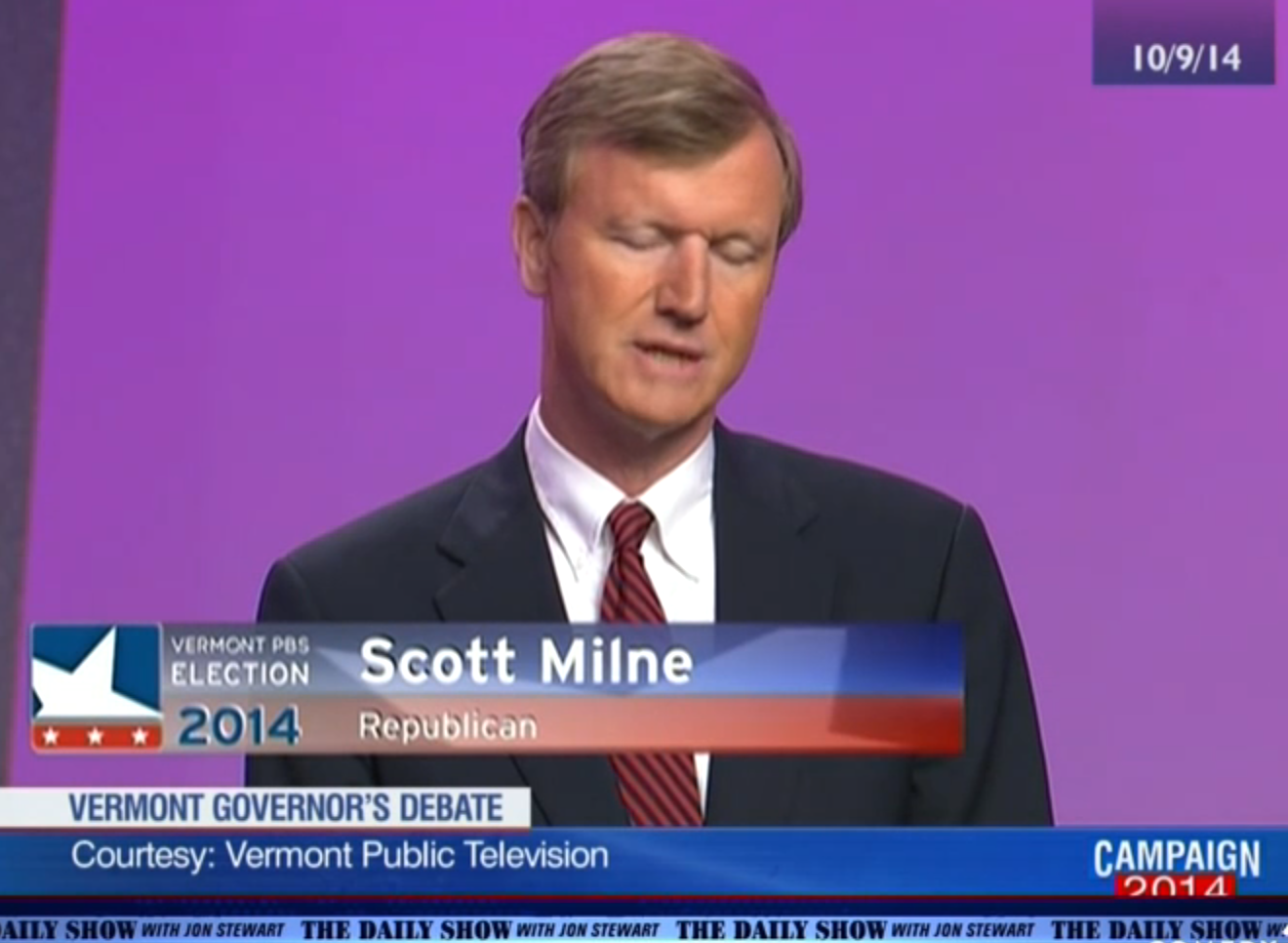
That’s not an accusation, it’s an observation. It’s plain fact. Scott Milne launched his campaign on the last possible day — the filing deadline. He left everybody up in the air until that afternoon. And in his first two months on the trail, he raised virtually zero money outside of his own family and that of his business partner David Boies III.

If I published a Lexicon of Political Terms, I’d use Scott Milne’s mugshot to accompany the definition of “slow start.”

We know that Milne reacts very badly to criticism of his campaign. I’ll bet he’s had some angry calls with Freeploid editors, and this excessive timidity is the result.

Shumlin’s second TV ad: nice, but…

The Governor’s first ad featured a number of Vermonters talking about Shumlin initiatives that had helped their lives. The second spot connects two themes: post-Irene recovery and helping Vermont businesses survive and thrive.

Nice glasses, Gov.

Nice glasses, Gov.

The spot is narrated by John Wall of WallGoldfinger, a furniture maker located in Randolph. Wall tells how his factory was hit hard by Tropical Storm Irene, and how the Administration responded “within a week,” facilitating loans to keep the company afloat.

“It was the difference between life and death,” says Wall. Now, he says, the company is poised for further growth.

It’s a good story, and having it told first-person gives the spot instant impact and credibility.

My only qualm?

I hope we’re not leaning too much on Irene.

It did, after all, happen three years ago, during the first year of Shumlin’s governorship. He deserves full credit for pushing the recovery forward… but I hope he doesn’t lean too heavily on Irene.

In the first ad, one of the four brief testimonies was about Irene; it’s the dominant subject of the second. More are on the way, I’m sure; and if other spots focus on other issues, I’ll be fine with the overall balance. Irene deserves to be part of the story, but let’s have some more recent stuff as well.

Fogler Departs, Crudification of Free Press To Accelerate

Big news in Vermont media: Jim Fogler is stepping down as president and publisher of the Burlington Free Press. And leaving the newspaper business entirely, for a rewarding and soul-enriching gig as a vice president at Party City, the national chain of party supply stores.

Those journalistic ethics should come in handy over there.

I have made my share of sport at Fogler’s expense in the past — if I recall correctly, I wrote that when Jim Fogler writes an optimistic column in the Freeploid, readers (and staff) run for cover. But if I were to guess, I’d say his departure is not good news for Vermont’s Largest Newspaper.

First, there are the circumstances. His resignation is announced on September 25, and his last day at the Freeploid will be October 1. That’s a nanosecond by the standards of executive turnover. I have no inside information whatsoever, but it does make me wonder if his departure was voluntary. Not that he was fired; but rather that they let him know that he’d be replaced, and gave him time to arrange a soft landing. He had spent 26 years with Gannett, after all, so perhaps a little consideration was in order.

The big change comes as Gannett’s newspapers are transitioning into a new era of newsroom organization. A few Gannett papers have already gotten the makeover, which has resulted in the following:

— More reporters, but fewer editors. A smaller newsroom staff overall. Get ready for an explosion in typos, bad writing, and bad grammar.

— Everyone has to reapply for newly redefined jobs. Presumably with lower pay and benefits.

— A dependence on “audience analytics,” i.e. covering stories because of reader interest (pageviews!) rather than importance.

— What appears to be a troubling degree of “synergy” between news and ad sales.

Expect Gannett to parachute in a corporate loyalist (after a, cough, “nationwide search”)  to institute the new regime at the Freeploid.

Copy editors? We don’t need no stinkin’ copy editors!

On Friday, Governor Shumlin released his 2013 income tax form. The Freeploid’s Nancy Remsen  wrote up the story… which included this little gem:

He lists five vehicles, a boat and farm equipment with total value of $128,300. One car, a 1964 Porsche, is valued at $55,000. The other vehicles are older and much less valuable. Since becoming governor, Shumlin gets little chance to drive as he is always chauffeured by his State Police guards.

Huh. Five vehicles. One is a 1964 Porsche. The others “are older.”

Let me guess…

— 1962 Chevy Nova

— 1958 Trabant P50

— 1952 Nash Metropolitan

— 1951 Fuldamobil

— 1948 GAZ-M20

Yeah, that sounds about right.

Funny; I would have guessed that our millionaire Governor would  own at least one car newer than 1964. But hey, the Freeploid reported it, I believe it, and that settles it.