Category Archives: Sue Minter

The first debate

Well, if you wanted fireworks, you didn’t get ‘em. Both candidates at last night’s debate, aired live on Vermont PBS, seemed so focused on getting out their talking points that they barely interacted — even though one-third of the debate was dedicated to candidates asking questions of each other.

So, how’d they do, topline?

Grading on something of a curve here. Phil Scott significantly outperformed my expectations, which had been diminished by his subpar outings in pre-primary debates. There was a lot less word salad, a lot more sticking to his core talking points.

Minter did well. She was forthright in her presentation; she stood her ground on potentially controversial subjects like wind power. But she missed some opportunities. She could have confronted Scott on his bland boilerplate and pressed him to offer specifics. She completely whiffed on Scott’s change in position on climate change. I saw a candidate who was more interested in her own talking points, and in not making a mistake, than in directly confronting her opponent.

And, given the fact that Scott is the presumed front-runner and she didn’t lay a glove on him, he gets the decision on points. If he can rope-a-dope the entire campaign like this, his chances of winning increase.

Continue reading

Phil-Lip-Flop

At the first gubernatorial debate of the campaign last night, Phil Scott pulled a Dunne.

That is, he significantly changed a policy stance while passing it off as no big deal.

The subject was climate change. On many occasions, Scott has acknowledged climate change is real but declined to admit that human activity is responsible. Here he is, at a late-July forum on the Vermont economy in a time of climate change.

Yes, I do believe that climate change is real and it could be for many different reasons. …There are many who think it’s caused by human behavior. There are some who believe it’s due to climate change, uh, changing on a worldwide basis.

Maybe it’s because he’s gotten some pushback for taking a stance to the right of Bruce Lisman and Jim Douglas, who both acknowledge human impact. Maybe he’s repositioning himself for the general election. But he changed his tune substantially at last night’s forum.

Sue Minter asked him why he was out of step with 97 percent of the scientific community in refusing to acknowledge human impact. He began his answer by saying “You’re getting confused.” He then clearly stated that “climate change is real and man-made,” and then added “I was acknowledging that there are many who don’t believe that.”

His approach is to evade areas of controversy and “focus on areas we can agree on.”

So, he believes that climate change is human-caused — but he doesn’t want to challenge those who don’t?

Continue reading

And in the morning, the boulder’s back at the bottom of the hill

You could understand if Phil Scott and Sue Minter find themselves sympathizing with the plight of Sisyphus. Having won their respective primaries, they now face the task of refilling their nearly-empty warchests, and ASAP if you please.

The major-party nominees raised an ungodly (by Vermont standards) amount of money, and spent almost all of it just to get through their primaries.

The grim totals: Minter raised more than a million dollars — and spent all but $54,000 fending off the weaker-than-expected candidacies of Matt Dunne and Peter Galbraith.

Scott enters the general campaign with $158,000 in the bank. But he entered the primary race with $95K left over from his previous walkovers for lieutenant governor. Without that cushion, he’d be dead even with Minter in cash on hand. In terms of money raised during the current campaign, he actually trails both Minter and Dunne.

Continue reading

Oh, and about that other ubiquitous crime wave…

One of the most eye-opening resuls from last month’s VPR Poll concerned substance abuse. When respondents were asked to name “the most important problem facing Vermont,” 17 percent named “drugs.” The only other issue scoring higher than six percent was “economy/jobs/cost of living” at 28 percent. And when asked specifically if opiate addiction is a major problem, a massive 89 percent agreed.

Even more striking were the figures for personal connections to opioid abuse. 53 percent have been affected by opiate addiction or know someone who has. And 94 percent “personally know” someone who has struggled with addiction.

Practically the entire state.

If we needed convincing that opiate addiction is a serious problem, we shouldn’t anymore.

But let’s take another pervasive issue of a similar scope. An issue that’s usually lost in the white noise, that’s never been the subject of a State of the State address.

Continue reading

The Energy Rebellion is a fizzle

In the runup to Tuesday’s primary, I suggested that Peter Galbraith’s candidacy could backfire on his allies in the anti-renewable camp. I thought he was likely to finish a poor third, and that could damage the antis’ claim to represent a sizable and growing force in Vermont politics.

Turns out, they may be loud but they’re not terribly numerous. Galbraith did worse than I thought, finishing with a mere nine percent of the Democratic primary vote.

It remains to be seen if Galbraith’s poor showing diminishes the pull of groups like Vermonters for a Clean Environment and Energize Vermont; but it sure can’t help them.

I can almost hear them arguing that their numbers were split among Galbraith and Republicans Phil Scott and Bruce Lisman. But even if Scott wins the governorship, Democrats will hold the legislative power, and they should be unimpressed by the small number of anti-wind voters in Democratic ranks.

Continue reading

Here comes the money

This one’s for Nick.

Yeah, the Vermont primary campaign blasted through all the old records for money spent. And now the real battle begins.

On the morning after the vote, the Republican Governors Association launched the first TV ad of the general election campaign. Shockingly, it’s pro-Phil Scott.

It may make his railings against outside money look a bit like the protestations of the painted lady under the lamppost, but at least it’s a positive ad. In fact, it’s so sticky-sweet, it ought to come with a warning: “You May Contract Diabetes While Watching This Advertisement.” Scenes of Phil’s appealingly craggy face on a summer day as he greets Real Vermonters, while a piano arpeggiates and an inviting, slightly MILFy voice extols his virtues. He will, Carol Brady assures us, “restore trust in state government, bring new jobs to Vermont, and focus on solving problems, not playing politics.”

I’m sure the next ad will include “heal the sick, raise the dead, cure those with leprosy, and cast out demons.” (Hey, I went to Sunday School*.)

Continue reading

@VTGOP: The King and no court

So the inevitable happened in the Republican gubernatorial primary. Phil Scott won.

The sad thing is, Bruce Lisman actually did pretty darn good. He got all the way from four percent in a February poll to 39 percent in the primary. That’s respectable, really.

But it leaves you wondering, again, what the hell? Why did Lisman challenge the widely-beloved Republican Great White Hope? Why did he pump two million Bruce Bucks into a doomed effort?

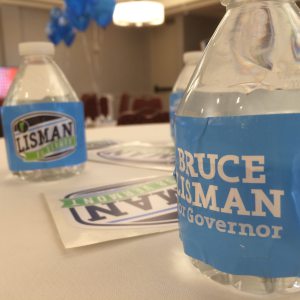
Mmm, smooth. (Photo by Mike Polhamus of VTDigger.)

Mmm, smooth. (Photo by Mike Polhamus of VTDigger.)

He does have some lovely bottled water to show for it. That’ll taste nice, as a visual reminder of the second-worst day of his life. (And a metaphorical reminder of how he flushed a fortune down the drain on a wasteful, futile candidacy.)

I’m assuming his worst day was when Bear Stearns collapsed, although this is a more directly personal ignominy. The Wall Street meltdown was merely a global calamity; this is the people of Vermont telling you to your face, “We don’t want you, now please go away.”

Continue reading

@VTDems: The Odd Couple, and other observations

Mixed bag on the Democratic ticket: Sue Minter for governor, David Zuckerman for Lite-Guv. Not that there’s usually much coordination between the #1 and #2 candidates, but I expect little to none from this pairing.

Indeed, one question worth asking: Now that Zuckerman is the Democratic nominee, will the party share its voter database with him?

But let’s take a step back and ponder tonight’s results and what they mean for Democratic politics. In no particular order:

A good night for the mainstream Democratic Party. I say so despite Zuckerman’s win; he took a plurality of the vote, nowhere near a majority. If he’d been matched up with Shap Smith alone, he would have lost badly. (Yes, I’m assuming that the bulk of Kesha Ram’s votes would have gone to Shap.)

And, of course, Minter had little trouble outpacing Matt Dunne. Some of this was due to Dunne’s Six Days of Hell, but it’s impossible to know how much.

Bernie’s coattails proved surprisingly short. Dunne believed that turning himself into Bernie Lite was the key to victory. We know how that turned out, don’t we?

Truth is, as we can see from the Lite-Guv totals, much of the Democratic electorate is moderate to liberal, not progressive. Bernie’s popularity is partly a matter of policy, but more a matter of persona. Bernie is extremely popular. It’s yet to be proven that his policies alone are a winning formula in Vermont.

Matt Dunne blew it. Last fall, he seemed the clear favorite. Minter was untested and tied directly to the Shumlin administration. Dunne was the more experienced candidate. He raced out to an early fundraising advantage.

He should have won the primary.

Why didn’t he?

Well, part of it was the Six Days of Hell — his position shift on renewable energy siting, his restatement/retraction of said shift, the blatant hypocrisy of his stand against self-funded campaigns even after he self-funded his own, the scorched-earth tactics of blaming the media and “the establishment” for problems of his own making.

But even before that, I’d argue he blew the primary by deciding not to be himself. There’s a Matt Dunne who could have won this race. It’s the plausibly liberal technocrat with high-tech chops who would have brought managerial know-how and broad experience in government and the private sector. That’s a pretty appealing candidate, especially after the administrative misfires of the Shumlin years.

But he simply wasn’t plausible as Bernie II. He had too much of a track record. His policies were part Bernie, part moderate Dem. His personality was a poor fit. And, to the extent that Bernie and the Vermont Democratic Party have a touchy relationship, his embrace of Berniedom did nothing for his own standing with party regulars.

His late-days mistakes only reinforced his reputation in many minds as an overly ambitious pol willing to say anything to become governor. He is now a three-time loser who burned quite a few bridges; a political comeback is possible but seems unlikely. He might have to be satisfied with being a well-paid Google executive. Such a burden.

Sue Minter has a lot of work to do. She’ll have to unify the party, which should be easier since Matt Dunne prioritized party unity in his concession speech. But she will be the underdog against Phil Scott. She spent heavily to fend off Dunne. She’s got some political seasoning in the primary, but now she’s in the spotlight. It’s a big step up for someone who hasn’t run a general election campaign outside of Waterbury.

I’m sure I will have some thoughts on possible strategy for Minter and the Democrats, but all in due time.

The VTGOP will use Zuckerman to attack Democrats. Actually, that’s not a prediction; it’s already begun.

//platform.twitter.com/widgets.js

Zuckerman’s nomination increases the chances that Randy Brock will be our next Lieutenant Governor. Zuckerman’s still the favorite, but he’ll be a weaker general-election candidate than Shap Smith would have been.

And the stakes are high in that race. The lieutenant governor presides over the Senate, sits on the influential Committee on Committees, and casts tie-breaking votes. Brock would be a strong conservative presence; On the other hand…

If Zuckerman does win, we could have a very different Senate. Zuckerman as presiding officer, potentially Tim Ashe as President Pro Tem, and Chris Pearson a very capable lawmaker. Although Zuckerman has been in the Senate for a while, I can’t see him supporting the status quo. He’d have very little patience for the niceties and obscure mores of the Senate.

And whither the omnipresent Dick Mazza? The perennial kingmaker will have to adapt to — or try to conquer — a changed landscape. Will he continue to serve on the influential Committee on Committees? How would he get along with Zuckerman and Ashe as the other two members?

I know one thing. I’m voting for Zuckerman, if only for the entertainment value.

No sign of the Energy Rebellion much touted by the likes of Annette Smith and Mark Whitworth. Peter Galbraith is pulling less than 10 percent of the vote. One might presume that some of Matt Dunne’s 37 percent was due to his last-days revision of his renewables siting policy, but that seems a stretch. Smith and Galbraith loudly denounced Dunne after he re-explained his revision. It’s unlikely that their core supporters would have stuck with Dunne.

Whither Shap? I have no idea, but I’d be shocked if this was the end of his political career. He entered the Lite-Guv race very late, and he was hampered by Kesha Ram’s presence in the race. She’d garnered quite a few endorsements from the House Dem caucus, and many of them stuck with her.

Shap’s young enough to regroup and restart. He remains very popular in Democratic circles. He is highly respected for his shepherding of the House caucus. I doubt he’ll be tagged as a loser; he finished a strong second after a late entry, and he’ll get a lot of credit for that.

If Phil Scott wins the governorship, Shap ’s the early favorite for the Democratic nomination in 2018 — or maybe he’d wait until 2020, a presidential year.

The question will be, what role does he play in the near future? I don’t know, and I doubt that he knows right now. If Minter wins, he could probably have his pick of cabinet posts. Otherwise, he could run silent, run deep: continue to build relationships across the state and prepare for his next political venture.

I think that’s about enough for primary night. I’l turn to the Republicans next.

Everybody hates Matt

Looking forward to Matt Dunne’s memoir of his bid for governor, working title “My House Is On Fire and All I’ve Got Is Gasoline.”

It’s been a remarkable, perhaps unprecedented, four days in Vermont politics: the self-immolation of a well-regarded candidate for governor.

And it just keeps getting worse. Today, prominent environmental groups threw their support behind Sue Minter. And then Dunne compounded the damage by trying to re-explain his new position on renewable energy siting — and in the process, he provoked backlash from the very people he tried to bring on board last Friday, the opponents of ridgeline wind.

Add it all up. Governor Shumlin and most Democratic lawmakers are mad at Dunne because he threw shade on Act 174, the compromise siting bill they carefully shepherded into law this year.

The environmental community is mad at Dunne for shifting ground on renewables in a way clearly intended to empower its opponents.

And now those opponents are mad at Dunne. The Queen Bee of oppositionalism, Annette Smith, sees Dunne as a fake and a poseur. Gubernatorial candidate Peter Galbraith, last seen complimenting Dunne in the latter’s ill-fated Friday press release, now says:

Snap!

Continue reading

Matt Dunne loses his biggest environmental booster

For those who thought I was making a mountain out of a molehill, here’s your Monday morning wakeup: environmental activist Bill McKibben has withdrawn his endorsement of Matt Dunne for governor. He’s shifted his support to Sue Minter. The news was broken today by Seven Days’ Terri Hallenbeck.

This is big in two fundamental ways. First, obviously, McKibben is the planet’s number-one climate change activist. His endorsement of Dunne was effectively an environmental seal of approval.

Second, McKibben was an early and enthusiastic supporter of Dunne — indeed, he encouraged Dunne to run for governor, presumably because he thought that Dunne was the best candidate to continue Vermont’s renewable energy push. As recently as last Wednesday, McKibben co-signed a letter to the Addison Independent endorsing Dunne.

Continue reading