Category Archives: Scott Milne

More of the same in the money game

So yesterday marked another campaign finance reporting deadline. I don’t know if it was intentional or not, but Scott Milne tried to bracket the news by making a bunch of his own.

And no, I don’t mean his 12 Seconds of Daily Show Fame. I mean yesterday’s unveiling of the Milne Education Plan, and this morning’s release of his personal finances.

Which perhaps drew some attention away from Milne’s return to the fundraising doldrums. After a very successful (by his modest standards) September, he failed to carry the Money Momentum into October. He raised a mere $12,000 in the first half of the month, bringing his total for the entire campaign to $146,000.

The latter total is vastly inflated by $39,000 from himself and his immediate family. Plus roughly another $20K from the Boies Family. (And I think he’s fresh out of Boieses.) He’s also got a $25,000 loan from himself on the books — soon to be forgiven, I’d guess. Add it all up, he’s got maybe $30,000 left at his disposal as he enters the home stretch.

One little note of kismet from the Milne report: he bagged a $150 donation from none other than Tom Salmon, former Auditor General. Salmon will forever be remembered for his famous line, “I need to be an authentic self-utilizing power along the lines of excellence.” I guess The Little Big Fish recognizes a kindred spirit among inarticulate candidates.

The other notable fundraising FAIL was the Dan Feliciano campaign, which seems to be slowly settling into the third-party mire. His fundraising total for the first half of the month, over $13,000, looks healthy; but it includes $10,000 from himself. Even with his own substantial gift, his campaign is in the red, having raised about $30,000 and spent $32,000. Still no sign of #Felicianomentum.

Contrast that with the Shumlin money machine, which raised $65,000 in the past two weeks for a campaign-to-date total of $777,000. And remember, he began 2014 with a lot of money in the bank. And he’s continued his post-Labor Day spending binge, paying out $236,000 in the first half of the month.

Just about the only happy Republican these days is Phil Scott. The People’s Lieutenant Governor kept up his furious pace; he took in $52,000 this time around, bringing his campaign-to-date total to $254,000. He’s spending just about as fast as he’s raising; campaign expenditures total $223,000, including a hefty $73,000 in the first half of October.

I haven’t checked, but this has GOT to be a record-breaker for most expensive statewide race, non-gubernatorial division. It also establishes Scott as a powerful fundraiser, which bodes well for a future campaign for Governor, should he ever decide to climb that mountain.

So, no big news at the top of the ticket. Status quo rules: Shumlin and Phil Scott have big bucks, Dean Corren continues to spend his $200,000 kitty, and Shumlin’s challengers are severely handicapped by a lack of funds.

Scott Milne finally gets the attention he deserves

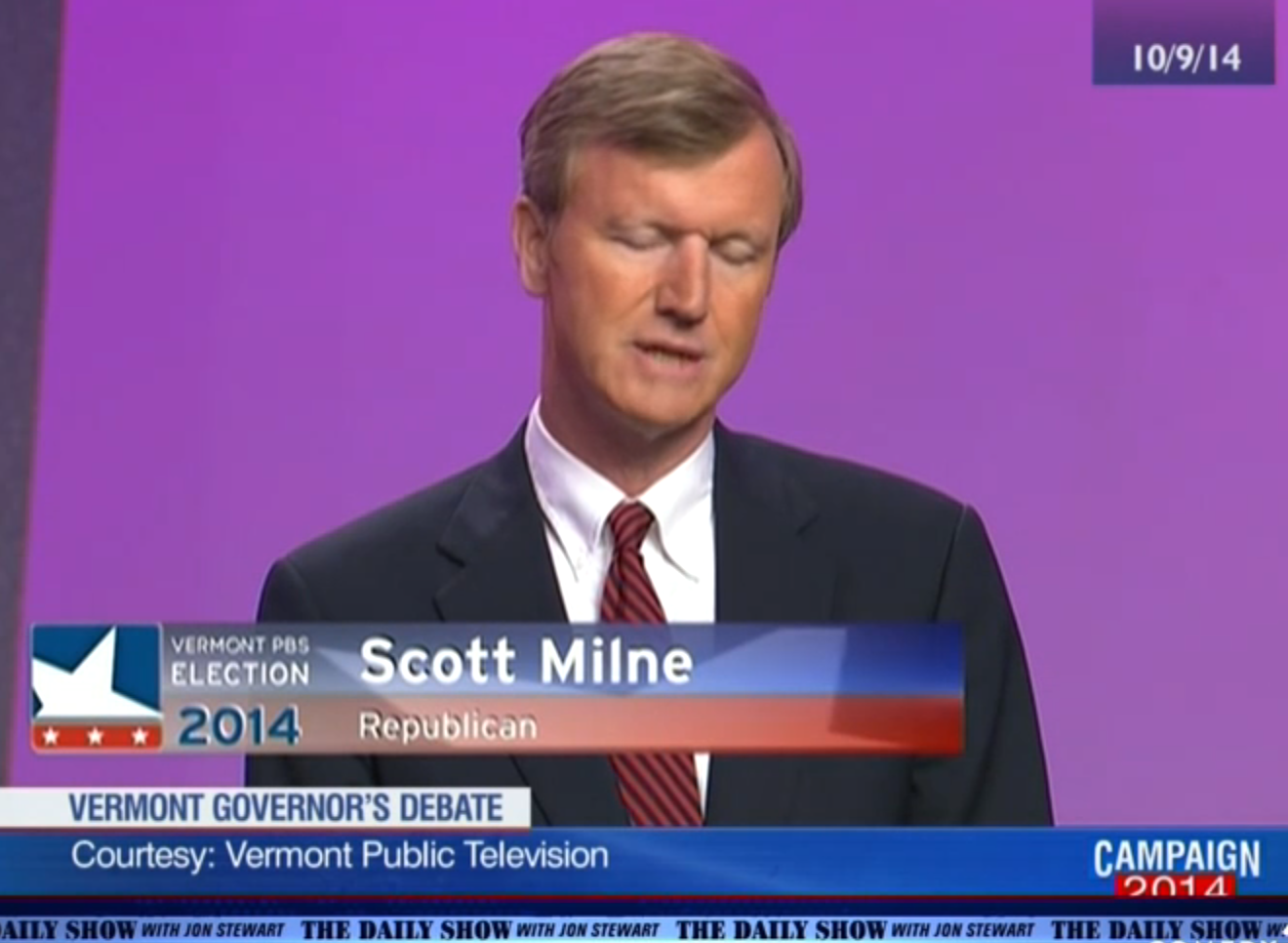
Well, the punditocracy keeps saying that Scott Milne needs to take advantage of free media to get his message out. And now he has, big time: he earned himself a stout twelve seconds of national airtime on The Daily Show With Jon Stewart. The end of every show is a “Moment of Zen,” a goofy bit of context-free video from somewhere or other. Last night’s MoZ was taken from Vermont PBS’ gubernatorial debate.

Specifically, Milne’s opening statement, in which he managed to screw up the first line of his life story.

Screen Shot 2014-10-16 at 11.18.38 AM For those disinclined to click the video link, here’s a handy transcript.

“My name is Scott Milne. I’ve, uh, uh, third generation, um, ah, born in Vermont, uh, take that back, I was born in Brooklyn.”

Congratulations, Mahatma. You’ve made the big time.

BREAKING: Scott Milne holds a news conference! Also, Hell Freezes Over.

Scott Milne and potted plant. Make your own joke.

Scott Milne and potted plant. Make your own joke.

Two rare political events occurred simultaneously today in the library at Spaulding High School: Scott Milne held a news conference, and he unveiled a thoughtful, detailed policy initiative.

Yes, the campaign without a plan has finally come up with one — on education reform. The thesis statement: Vermont spends too much on K-12 education and not enough on higher education. The basic idea: foster efficiency by reorganizing the public school system, and invest the savings into a new program to provide every Vermont student with access to a free college education or vocational program. (The full plan is posted on his campaign website.)

It’s creative. It’s fresh. It’s downright audacious. It’s the kind of thinking that, to me, represents the best of moderate Republicanism: maximizing our investment in the public sector instead of mindlessly cutting. At the very least, it ought to generate some serious conversations about how we spend our education dollars.

There were, of course, spiders in the attic. The Milne plan on paper was seven single-spaced pages with plenty of detail (footnotes, even); but he was less than articulate in the give-and-take of a news conference. He abruptly shifted between explanations of his own plan and recycled attacks on Governor Shumlin. He made plenty of snide comments directed at the media, who were on relatively good behavior. (If he thinks we’re tough on him, he ought to attend a couple of the Governor’s news conferences.) And he didn’t have clear answers to a number of fairly simple questions.

But the biggest problem with today’s announcement was… today. 

It’s October 15th.

The election is three days from yesterday.

And this is the first in a promised series of policy announcements. (A proposal for reinventing state government will come in about two weeks — within days of the election.) After a summer of no ideas, Milne is going to empty the truck in the campaign’s closing days.

If he’d put forward this idea six months ago, or even three, then he might have sparked a serious conversation on the issue and positioned himself as a viable moderate alternative to Shumlin.

That’s conventional thinking, of course, and Milne will tell you he’s running an insurgent campaign. He believes this is the perfect time to start launching his policy ideas.

Well, if he’s right, and every political observer and activist in the state is wrong, then Milne can celebrate his election by holding a good old harvest-time Crow Pie Dinner and invite all of us to dig in. I’ll be at the front of the line.

The broad outline of the Milne plan, entitled “Investing in Vermont’s Future”:

— His previously announced two-year cap on the statewide property tax, designed to force the Legislature to get serious about reform. Any shortfall in school funding caused by the cap would come out of the state’s General Fund. That, in turn, would be made whole through some combination of cuts in other areas and tax increases. Milne favors spending cuts, but he wants to work out the details with the Legislature.

— Universal tuition-free education from pre-K through four-year degree or vocational training for every Vermonter at vocational centers, colleges and universities in the state system.

— The money for free tuition would come from savings in K-12 spending. To realize this, Milne proposes a reorganization of the system into 15 Regional Education Administration Districts (READs). READs would have authority over budgets. There would be no statewide property tax; instead, tax payments go to the READs, which would each set district-wide per-pupil spending.

— READs would foster efficiency because voters would have a stronger connection between school budgets and their taxes. This would lead to lower budgets, leaner spending, and voluntary consolidation of smaller districts.

— The state would ensure compliance with the Brigham decision mandating educational equity, by providing supplemental funding for READs with low per-pupil spending.

— School choice would be gradually broadened. Eventually, every family could send their kids to any school within their READ. School choice would not include private schools.

— For every two years a student attends Vermont schools, s/he would get one year of free post-high school education at any of the state’s public colleges, universities, or technical schools.

— Existing private colleges could join the system, if they’re willing to give a tuition break in exchange for access to more Vermont students.

— The deal would not include any tuition for institutions outside Vermont.

Milne argues that the offer of free tuition would be a powerful draw for people to move into Vermont, thus fueling our economy and putting our finances on sounder footing.

I see some problems with the Milne plan, and I’m sure you do, too. He assumes that a primary cost driver in public schools is the supposed disconnect between voting for school budgets and the resulting tax bill. I’m not at all convinced that this is as big a factor as Republicans think it is.

He also assumes a pretty high degree of public engagement in the READs. I think that’s tremendously optimistic; most of us don’t have the time, or inclination, to get seriously engaged in that process.

Then there’s the problematic Brigham fix. If the state is the funder of last resort, then doesn’t that retain one of the weak points of the current system?

A question about the free tuition. Is the two-year requirement for a year of free tuition retroactive? If so, then you’d potentially have thousands of high school graduates expecting free tuition next fall. If not, and the clock starts with the passage of this plan, then the four-year free tuition offer wouldn’t go into effect until current fourth-graders are graduating from high school. (A current fifth-grader couldn’t qualify for more than three years tuition-free.)

Another quibble (but these kinds of quibbles often doom policy initiatives): If a student attended 12 years of Vermont school, graduated, and is now a freshman at UVM, would s/he retroactively qualify for free tuition? If so, then you’re blowing a fresh hole in state colleges’ budgets. If not, you’ll have a whole passel of pissed-off parents.

And finally, in an effort to avoid any sort of state-mandated cuts, Milne puts an awful lot of faith in voluntary compliance. He criticizes Governor Shumlin for putting the onus on local voters and school boards; but his plan would force the voters and the READs to make some really tough choices, because his goal is to bring per-pupil spending from its current $17,500 to somewhere around the national average of $12,000.

That’s roughly a 30% cut. He sees room for savings in the alleged overstaffing of public schools, and (without saying so directly) in the extra costs of small school districts. Still, that’s a whacking great number, and it’s hard to imagine anything like that number surviving the policymaking process.

Still, it’s an idea. It’s a plan. I give Milne full credit for putting it together, and for finally giving his campaign a raison d’etre beyond “I’m Not Shumlin.”

I look forward to more of his plans. I just wish this had happened a long time ago.

It ain’t over till the Fat Man sings

All'alba vincerò! Vincerò, vincerò!

All’alba vincerò! Vincerò, vincerò!

Interesting. WCAX’s Kyle Midura, last seen as Twitter Guy during the gubernatorial debate, made his way eastward to beautiful Berlin, New Hampshire, where he caught up with New Jersey Governor Chris Christie, stumping the North Country “on behalf of the state’s Republican candidate for Governor, Walt Havenstein.”

And, being a good Vermont reporter, Midura asked Christie if he’d be visiting Vermont to campaign for Mahatma Milne. (Well, I don’t think he said “Mahatma.”)

“We’ve got to focus with 25 days to go on those place where we think we’ve absolutely got the best chance,” Christie said. “That’s where I’m focusing my time.”

Okay, let’s look at that.

The latest polls have shown Scott Milne behind Governor Shumlin by 12 percentage points. And in New Hampshire?

The latest poll places Havenstein 10 points behind incumbent Democrat Maggie Hassan.

Hmm.

Two points.

He won’t cross the river for two points.

Either he knows something about the Vermont race that he’s not telling, or it has less to do with gubernatorial races than with first-in-the-nation presidential primaries.

Either way, congratulations, Governor, on kicking a Republican candidate for Governor when he’s down. I assume that’s one of your duties as head of the Republican Governors Association.

No, I did not watch the freak show.

A study in pink.

A study in pink.

In front of a Susan G. Komen-worthy bright pink backdrop, the recently rebranded Vermont Public Television (now d/b/a Vermont PBS) rolled out the Clown Car O’ Democracy last night.

Yes, the one and only gubernatorial debate featuring all seven candidates for Governor.

Which produced the amusing spectacle of Scott Milne standing uncomfortably next to a Duck Dynasty stunt double, and Dan Feliciano braving sudden death from the razor-sharp brim of a Church Lady hat.

“Amusing spectacle” it was, and amusement was all it was good for. As a way for actual voters to actually make an actual decision, it was a waste of time. And I haven’t seen the overnights, but I wonder if Vermont PBS got as many viewers (74 max) as the ill-fated Burlington Free Press livestreamed debate.

Certainly they could have done better with a rerun of Bob Ross’ “The Joy of Painting.”

In fact, I’d vote for Bob Ross over some of those candidates. And he’s dead.

This notion of an all-inclusive gubernatorial debate seems to bring cheer to some of my friends in the media. It’s so… Vermont, you know?

Well, yeah. But so are rural poverty and frost heaves and agricultural runoff in Lake Champlain.

Vermont law makes it very easy to get a spot on the ballot. Which is fine; I don’t mind having eleventy-bajillion candidates if they get enough petition signatures. But it doesn’t mean they deserve my attention or consideration.

There are, at most, three serious candidates for Governor: Peter Shumlin, Scott Milne, and Dan Feliciano. Ironically, in all the debates so far, we have yet to see the three of them sharing a stage by themselves. More debates are in our future, and maybe we’ll get to see the only matchup that matters. I hope so.

The new polls, part 2: The only thing Shumlin has to fear is Shumlin himself

(See also part 1, which addressed the Phil Scott/Dean Corren results.)

The latest gubernatorial poll from the Castleton Polling Institute (courtesy of WCAX-TV) is a picture of stagnation, with an electorate disappointed in the incumbent, but finding no acceptable alternatives. The results are right in line with other recent surveys, with the helpful addition of Dan Feliciano clarifying the picture somewhat.

The numbers: Shumlin 47, Milne 35, Feliciano 6, and undecided at 8.

A secondary result, underpinning the above: 45% approve of Governor Shumlin’s performance, 41% disapprove. Bad numbers for an established incumbent, especially for one who was in the 60s at his height.

But while the poll is bad for Shumlin, it’s also bad for his challengers. As WCAX’s dueling analysts put it:

“I don’t think Mr. Milne has given the public a reason to vote for him and that is what Mr. Milne’s challenge is going to be in the next six weeks,” said Mike Smith, Republican political analyst.

How about a shot of 5-Hour Energy?

How about a shot of 5-Hour Energy?

“I think these numbers show that there’s one candidate against Peter Shumlin and that is Peter Shumlin,” said Steve Terry, Democratic political analyst.

Milne is stuck in the mid-30s. And Feliciano, for all the insider buzz about his candidacy, is only taking a small chunk of the conservative vote. Six percent is a lot for a Libertarian, but not much for someone who’d positioned himself as the real alternative to Shumlin. As I wrote before, there’s a whole lot of value in the Republican brand, and a deep loyalty among core Republican voters.

As for the independents and undecideds, they’re stuck. Given the 41% Milne/Feliciano total, I infer that Milne has gained a small number of centrists simply by Not Being Shumlin, while he’s lost a few percentage points to Feliciano among the True Believers. Overall it’s a wash, and not nearly enough to win. And the Governor is the only candidate with the resources to get his message out between now and Election Day. Although the big headline was that Shumlin is under the 50% mark, he still stands a solid chance of not only gaining a pure majority, but getting up into the mid-50s. That’d be a decent, if not overwhelming, mandate.

So, in a solidly blue state, why are Shumlin’s numbers so mediocre? The experts point to the obvious: Vermont Health Connect, the human services troubles, and the Jeremy Dodge land deal.

The first two I buy. The last, nope. I don’t think anybody outside the political media remembers that deal. After initial missteps, Shumlin dealt with it wisely and effectively. Remember “it’s not the crime, it’s the coverup”? Well, in the Dodge deal, there was no coverup. There was a fast and fair resolution.

All right, so now I have to offer my own explanation. In two words:

The doldrums.

Which is partly the VHC and human services problems. But more than that, it’s the lack of real, tangible, landmark achievements.

Which is reflected in Shumlin’s third campaign commercial, focusing on the GMO bill. Now, nice as that bill was, it was a sideshow in this year’s legislative session. And, as Paul Heintz pointed out, it’s a stretch to give the Governor much credit:

For years, Shumlin said he backed GMO labeling in concept, but believed that mandating it was legally perilous. He argued that any such attempt would suffer the same fate as Vermont’s 1994 law requiring dairy products produced with recombinant bovine growth hormone to be labeled as such. The Second Circuit Court of Appeals struck it down in 1996 and awarded damages.

But leave that aside for the moment. The bigger question: Is the GMO bill really the Governor’s signature accomplishment for 2014?

I guess it is. Given the size of the Democratic majority and the big issues facing Vermont, that’s a little bit underwhelming. And I think the voters are underwhelmed. One of Scott Milne’s best lines in yesterday’s WCAX debate concerned school funding: “The Governor had huge approval ratings and big majorities, and he didn’t do anything.”

Shumlin’s signature issue, single-payer health care, is still a mystery shrouded in an enigma. He can’t brag about it, because he hasn’t done it yet. Or even offered a plan. That’s not exactly motivational.

There are solid reasons to defend the Governor’s record. He’s dealt with the aftermath of the 2008 recession and Tropical Storm Irene. He’s had to pull rabbits out of his hat to keep the state budget under control as the federal stimulus funds ebbed away. He’s also taken some good, incremental steps in areas like human services and college affordability. The minimum wage hike was nice. He’s done a lot on renewable energy. His opioid initiative holds great promise, but has yet to bear fruit.

Those are not accomplishments to be sneezed at. They are strong indications of substantial administrative competence. That’s important. But it’s not inspirational.

I think that, more than anything else, Vermont voters are uninspired. When Shumlin launched his active campaign in early September, his challenge was to light a fire in his supporters — and perhaps even in himself. So far, he hasn’t really done it.

IF he does it between now and Election Day, he’ll get into the mid-50s. If he doesn’t, he’ll limp across the finish line in the 50-52% range.

Bit by bit, ever so slowly, Scott Milne is turning himself into a candidate

It’s way too late, of course. As I’ve said before, Milne is now doing the kind of stuff he should have done six months to a year ago: traveling the back roads of Vermont, meetin’ folks. Getting his name out there. Learning the ropes of a brand-new trade: running for statewide office. Becoming a halfway competent debater.

Fundraising.

That kind of stuff.

Shumlin/Milne at WCAX debateAnd if you squint a little bit and look closely at last night’s debate performance on WCAX-TV, you can get a glimpse of a real live candidate emerging from the primordial ooze.

It’s way too late, of course. But I’ll give him credit: Milne was a lot less twitchy and erratic than he was a few weeks ago. He was reasonably calm most of the time. When he wasn’t speaking, he held his face practically motionless. Which was a good thing, because WCAX used a split screen much of the time. He scratched his nose a couple times, but he didn’t pick it.

His message remains a mess. He recycles the same handful of tired attacks on Governor Shumlin (how many times did he say “reckless experiment”?). He works in snide little comments at every opportunity. (He responded to a viewer question about his vision for Vermont’s future by saying, ungrammatically, “My vision is a governor that doesn’t make promises that end up broken.” Cute, but not at all visionary.)

He also made a royal botch of his opportunity to ask Shumlin a direct question. His opening was so rambly that co-moderator Kristin Kelly had to interrupt, “Do you have a question for the Governor?” After which he meandered slowly through the firing of Doug Racine as head of Human Services, and Racine’s statement that he hadn’t met with Shumlin in over a year, Shumlin’s out-of-state travel… and at the end, his actual question was a batting-practice fastball down the middle of the plate: “Can you look in the monitor and tell them you’ll be a better Governor in the next two years?” Which gave Shumlin the opening to turn the question immediately back to his agenda.

Stupid.

And most of all, Milne still has nothing like a coherent plan for his hypothetical governorship. He has little or nothing to offer on health care, the state budget, school funding and governance, social services, or the economy. He preaches caution on all fronts; he says he will “listen before I act.” On multiple occasions, he said he would sign specific bills that he disagrees with — apparently signaling that he would frequently defer to the Legislature. As Shumlin pointed out, that’s an odd definition of leadership.

And once in a while, just when you least expect it, he slips out a scrap of a policy idea. Answering a question about improving the economy, he tossed off a passing reference to “tax incentives.” No details, no elaboration. Just a couple of quick words, and then onward.

This is how you roll out a major policy proposal? Really?

I’ll say this. Scott Milne has improved — from an F to maybe a C minus. Give him another 18 months or so, he might turn himself into a credible contender for the governorship.

Wait a minute… checking the calendar here… nope, sorry, he doesn’t have 18 months. He has less than four weeks.

Like I said: it’s way too late, of course.

@bfp_fail: We interrupt this debate to bring you a picture of Peter Diamondstone nodding off

Well, I tried to watch it.

The Burlington Free Press hosted a gubernatorial debate at noon today, and livestreamed it online.

Or tried to.

The first half hour was fine. After that, it kept freezing and crashing. I spent most of the ensuing half hour waiting for isolated bits of audio. Which, as Darcie Johnston pointed out on Twitter, always seemed to happen when Peter Diamondstone was talking. And the frozen image on the screen was usually Diamondstone with his eyes closed. Around 1:00, I gave up.

The Freeploid can’t blame its failure on too many viewers, either. There was a counter onscreen that tracked the number of viewers, and the highest it hit was 74. That’s not enough to crash a livestream.

Well, it shouldn’t be, anyway.

Of course, since the Freeploid only yesterday announced a corporate “reset” that includes forcing newsroom staff to reapply for their jobs, this disaster may have been an inside job. Whatever the cause, it’s a dismal performance.

Speaking of dismal performances, Scott Milne continued to hammer on the shortfalls, real and imagined, of the Shumlin Administration without offering any plans of his own.

Single-payer? Let’s wait six years.

How to cut the budget? Get rid of the governor’s SUV and out-of-state travel.

When asked for specific cuts, he tried to make a joke, talked about bringing in smart people from outside who’d be willing to take pay cuts to work in his administration, made a half-hearted call-out to the long-discredited Challenges for Change, and concluded by saying “I don’t know.”

School funding? He slammed Shumlin for failing to make tough choices, but offered nothing of his own.

And, according to the Freeploid’s Twitter feed (I’d stopped watching the unwatchable livestream by then), MIlne actually said he’d unveil a Lake Champlain cleanup plan by Election Day. 

Sheesh.

At one point, he briefly paused his attacks on Shumlin to day “It’s easy to be a Monday morning quarterback. I’m talking about the future.” And then he resumed the attacks.

Milne has managed to dribble out a few ideas, inadequate and half-assed though they are: a two-year statewide property tax freeze, Challenges for Change, maybe a regional health care exchange. But with less than four weeks until Election Day, he remains the Man Without a Plan, with apologies to Fred Tuttle.

His excuse is that he doesn’t “have a background” in government. Well, sure. But is that a positive asset for filling our top executive position? What if an applicant came to Milne Travel and said “I don’t have a background in the travel business, but you’re doing a terrible job and you should hire me”?

And even if you put a value on bringing in a fresh perspective, why can’t Milne consult with some of his “expert advisers” and come up with a few specifics? He doesn’t need years of government experience to do that.

I’ll say it again: I had some hopes for Scott Milne when his campaign began. And there’s plenty of room for an informed critique of the Shumlin Administration. But he’s just been a disaster.

Postscript. I’d slam the Freeploid for its inexplicable decision to invite Peter Diamondstone and not Dan Feliciano, except that it led to the most entertaining moment of the debate. Diamondstone wasn’t there at noon; he appeared at about 12:10, panting furiously. And continued to pant for a couple of minutes, directly into his microphone, while Milne was trying to answer a question.

Health care reform: the election issue with no teeth?

Interesting thing happened last week. Vermont CURE, an advocacy group for single-payer health care reform, cut ties with Tess Taylor, the former House Assistant Majority Leader who resigned from the Legislature to sign on with CURE only about six months ago. In the middle of the 2014 legislative session.

Taylor had been brought on board in the expectation that there’d be some heavy lifting to do in the 2014 campaign, and her political chops would come in handy. Seemed like a good bet at the time, and an even better one after a spring and summer full of trouble for Vermont Health Connect. Surely, went the conventional thinking, the failures of VHC would mean trouble for Governor Shumlin.

Well, maybe not. Bram Kleppner, chairman of the V-CURE board, speaking with VPR’s Peter Hirschfeld: 

“We were expecting a strong candidate to oppose Gov. Shumlin. We were expecting a wave of strong  candidates coming in to run against supporters of (single-payer). So we brought Tess on, obviously because of her deep expertise in the Vermont political process,” Kleppner says. “But it became clear to us after the primaries that that political and legislative opposition that we were expecting really just hadn’t materialized.”

So, rather than a campaigning challenge, V-CURE will focus on a PR effort to convince the general public that single-payer is the best way forward. Taylor’s experience is less germane to that.

This ties in with an email chat I recently had with fellow blogger (and former Burlington City Councilor) Ed Adrian. He wanted to know how my blogposts about health care reform were doing in terms of readership. He’d noticed that anytime he wrote about health care reform, his numbers were “dismal.”

So I checked my numbers and found that, for whatever it’s worth, the same is true for theVPO. Health care stories just don’t attract many pageviews.

Now, theVPO’s audience is a very select, and self-selected, slice of the general public: those with a strong interest in Vermont politics. You can’t safely generalize from them to the entire electorate.

But you’d think that, if anything, my readers would be more interested in health care than everybody else.

Ed pointed out that a sizable majority of Vermonters have never had to interact with Vermont Health Connect because they get their health insurance elsewhere. For them, VHC’s failings are basically an abstract concern.

I wouldn’t have placed much value in the pageviews of a couple of blogs. But combine it with V-CURE’s move, and i have to wonder: is health care reform a lot more sizzle than steak? Is it mainly of interest to insiders and the political media?

It’s hard to tell from the course of the campaign to date. Scott MIlne hasn’t made a dent in Governor Shumlin’s armor with his attacks on VHC incompetence; but is that because of the issue, or because of his terrible campaign?

Then there’s Dan Feliciano, who’s gotten a lot of insider buzz with his devout opposition to single-payer. But his fundraising has been terrible and his 48-hour fundraising blitz came and went without any news — which has to mean it was a complete failure. Is he getting anywhere with a frontal attack on single-payer? It’s impossible to tell, since he hasn’t been included in recent polls. But his fundraising numbers certainly don’t reveal any groundswell of support.

There’s reason to believe that the failures of VHC may not be that politically harmful to Shumlin. I suspect that property taxes would have been a better issue for the Republicans. They still wouldn’t have beaten the Governor; but only a small portion of Vermonters have interacted with VHC, while pretty much everybody pays property taxes, either directly or indirectly.

It’s worth pondering, anyway.

In the pursuit of objectivity, the truth is often a casualty

One of the faults of contemporary journalism is its tendency to bend over backwards in the name of “balance.” You have to represent both sides, even if it means including a climate change denier. You have to quote Annette Smith in any coverage of wind turbines, or Darcie Johnston in any piece about health care reform. And you have to pretend that a one-sided campaign is competitive before Election Night because it’d be “unfair” to the obvious loser.

Submitted for your approval, from the Freeploid’s political tag team of Terri Hallenbeck and Nancy Remsen (or, quite possibly, from their timorous editors):

Scott Milne, the Republican gubernatorial challenger who has been accused of getting off to a slow start, showed a surge in his fundraising…

“Accused of getting off to a slow start,” eh?

“Accused”???

That’s not an accusation, it’s an observation. It’s plain fact. Scott Milne launched his campaign on the last possible day — the filing deadline. He left everybody up in the air until that afternoon. And in his first two months on the trail, he raised virtually zero money outside of his own family and that of his business partner David Boies III.

If I published a Lexicon of Political Terms, I’d use Scott Milne’s mugshot to accompany the definition of “slow start.”

We know that Milne reacts very badly to criticism of his campaign. I’ll bet he’s had some angry calls with Freeploid editors, and this excessive timidity is the result.