Category Archives: Politics

So what happened with the polls?

Ah, the opinion polls, with their oft-trumpeted 4% margins of error.

Well, they missed the Governor’s race by a lot more than that, didn’t they?

The consensus, such as it was, gave Governor Shumlin a 12-point edge. Right now, the Associated Press has him at 46.4% and Scott Milne at 45.4%. Feel free to check my math, but I think that’s a margin of one percent. 

The polls were off by almost 11 percentage points.

The difference? Virtually every undecided voter went for Scott Milne. Which is unheard-of; usually, the undecideds don’t all go stampeding in one direction.

Plus, the Associated Press is reporting that Vermont had a record low turnout. The Democratic GOTV machine just couldn’t overcome the broad disaffection with the current administration, and the widespread belief that this election wasn’t close, which made it easier to stay home.

So, Milne got a larger chunk of a smaller electorate.

Let’s take the most recent Castleton Polling Inistute survey, reported on Oct.12.

gubernatorial-race

From Oct. 12 to last night, what happened? Governor Shumlin lost a sliver of his support while convincing no undecideds. Scott Milne gained a whopping ten percent by nabbing all the undecideds and poaching nearly two-thirds of Dan Feliciano’s supporters.

What does that say? It says that Governor Shumlin lost the middle, in spite of all his triangulating. And he lost ALL of the middle. And, I suspect, a fair bit of support on the left, who either sat out the Governor’s race or made a protest vote for Milne or a write-in. (Doug Racine, anyone?)

Or just stayed home, not feeling motivated to re-elect Shumlin and feeling (falsely) secure in the knowledge that their absence wouldn’t make much difference in what was thought to be a Democratic cakewalk.

Oh boy, oh boy, it’s last-minute dirty tricks time

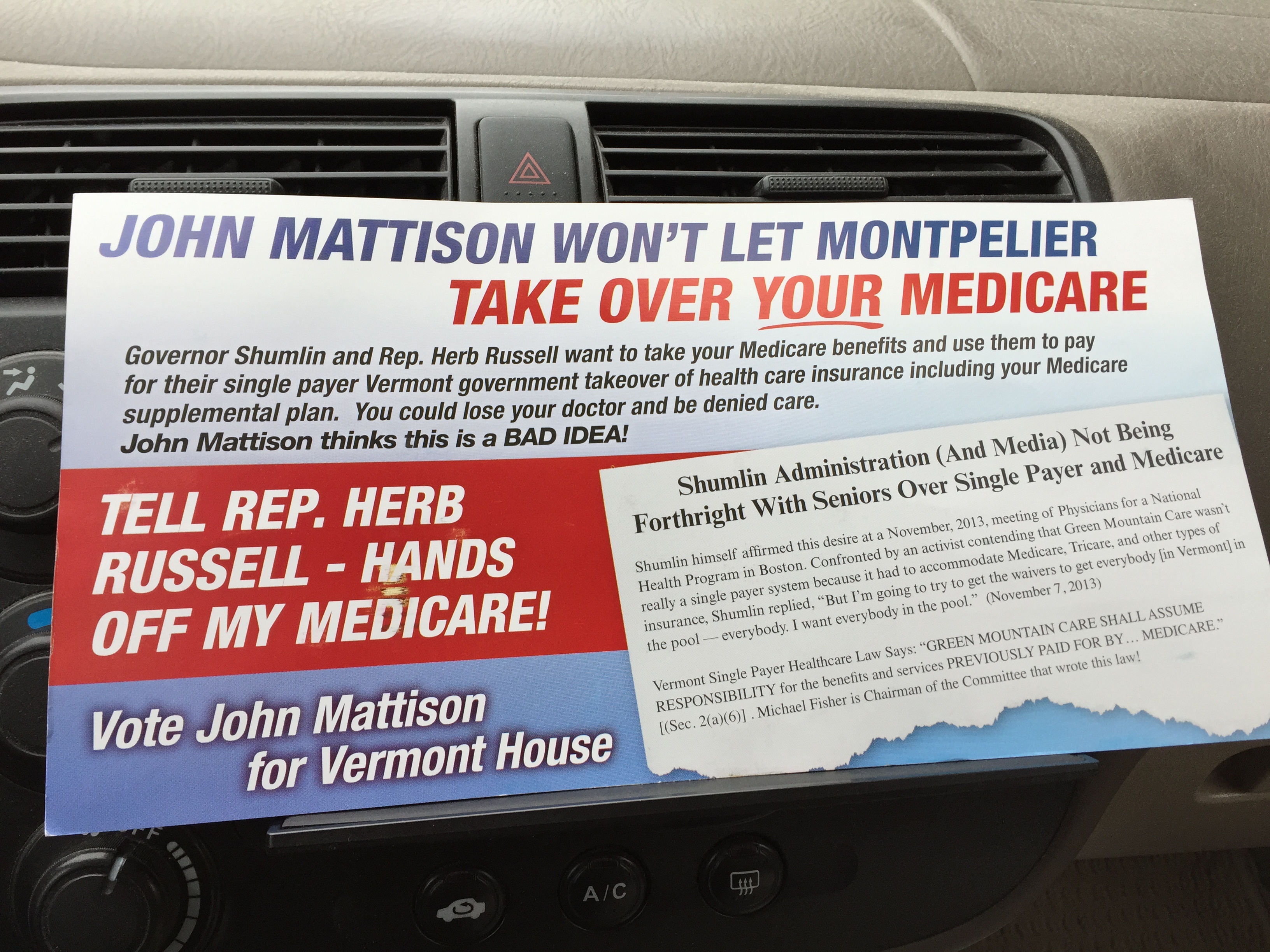
The Republicans are targeting potentially vulnerable Democratic lawmakers with a mailer repeating the conservative lie that the Shumlin Administration wants to “take over” Medicare.

I’ve seen two mailers, identical except for the specific candidates involved. One is for Addison County Republican hopeful Valerie Mullin, and it targets incumbent Dems Mike Fisher and David Sharpe. The other is on behalf of Republican John Mattison, who’s challenging incumbent Herb Russell of Rutland City.

The Mullin flyer bears the return address of “Friends of Valerie Mullin,” her campaign committee, but it clearly was not produced by her campaign because, as I said, it’s identical to the Mattison flyer.

I’ve only seen these two, but it wouldn’t surprise me if identical mailers hadn’t been sent in all districts where a Republican has a chance to knock off a Democratic lawmaker.

So let’s review. In Act 48, the 2011 health care reform bill, there was a provision calling for the state to pursue administration of Medicare as part of single-payer health care. This provision is what’s called “session law,” and was intended as a guideline rather than a mandate.

“In 2011, we asked the administration to entertain lots of things, but it was in the context of ‘tell us whether you can do this,’” said Rep. Mike Fisher (D-Lincoln), who was on the House Health Care Committee when it drafted Act 48.

Administration officials subsequently discovered that the feds wouldn’t allow Vermont to manage Medicare. It was impossible in any case, because Medicare for the entire Northeast is in a single administrative district. Vermont would have had to take over the entire region, which was clearly out of the question. This year, Act 48 was amended and the provision was dropped.

Which hasn’t stopped the desperate Republicans from repeating the lie. And now they’ve produced mailers trumpeting the lie.

Bottom of the barrel, guys. Bottom of the barrel.

Here’s a picture of one flyer, for your edification:

MattisonMedicare


The Mullin flyer is identical except for the names of the candidates.

Randy Brock labors mightily and brings forth a gnat

We have another missive from the desk of Randy Brock, former State Auditor and very unsuccessful candidate for Governor in 2012. This time, he has turned his gimlet eye to the subject of voter fraud, one of the right wing’s favorite chimeras.

(President Bush’s Justice Department spent ungodly amounts of time on this, and came up with a laughably small number of actual cases. That was enough proof for me that voter fraud is not a serious issue.)

Randy Brock's Fraud-O-Tron. Not exactly as illustrated.

Randy Brock’s Fraud-O-Tron. Not exactly as illustrated.

Thankfully, he eschewed the partisan rant. Instead, he went Full Auditor on it, harnessing “big data and inexpensive computer power” to do a vast comparison of voter records. He took “a sample of over 100,000 Vermont voters” from the 2012 election and compared them all to voter records in 48 other states. (Didn’t say which one he omitted. Alaska?) And he found…

… wait for it…

… a whopping 22 cases in which a Vermont voter also cast a vote in another state.

Please check my math, but I believe that’s a rate of 0.02 percent.

Color me unimpressed.

Brock, of course, feels otherwise:

Do we accept a small amount of voter fraud as the “cost of doing business” in a democracy? Or do we say that we must address the rare breaches of voter integrity that strike at the heart of our form of government?

That’s a bit overwrought, don’t you think? Two one-hundredths of a percentage point “strikes at the heart of our form of government”?

Look, I’d love to have a fraud and error rate of zero across the board. But voter fraud is way, way, waaaaaaay down the list of problems with our system of managing elections. Or should I say, our underfunded patchwork clusterfuck NON-system, with different rules and structures in every state, political hacks often in charge, blatant maldistribution of polling places, and vote-counting processes that seem incapable of anything close to precision.

You want “strikes at the heart”? How about Bush v. Gore?

And I’m not even talking about the mischief done by Katherine Harris or the Republican goons who intimidated election officials or the rank partisanship of the U.S. Supreme Court. I’m talking about the simple fact that, given an extremely close election, Florida was incapable of delivering an accurate count. Because of problems with collection and tabulation and incompetence and those God damn hanging chads, there was simply no way to be absolutely certain who won Florida.

That’s what strikes at the heart of our form of government: the fact that we have a system that can’t be relied upon to tell us who actually won the race for President.

Similar events unfolded in Ohio in 2004: A very close election that produced a messy, uncertain result.

(Leaving aside, for the sake of this argument, how many minority voters got discouraged by hours-long lines at their polling places, and how many votes the Democrat lost as a result. I’m just talking about accurately counting the votes that were actually cast.)

Brock actually suggests a reasonable solution for his little tiny problem. Not mandatory voter ID, but “something called the Electronic Registration Information Center (ERIC), a multistate partnership that uses sophisticated software to prevent cross-border voter fraud.”

It’s reasonable, but my response is that there are far worse problems with our system of registering voters, facilitating their right to vote, and accurately counting the votes. A lot of them have to do with fragmented authority. More have to do with a lack of resources.

If you want to get serious about a robust, reliable electoral system, there are much better places to start than with Randy Brock’s 22 votes, or with ERIC, or with mandatory voter ID. We’d be a hell of a lot better off if we created a coherent, consistent, capable, fair, unimpeachable election system.  Then we can address the virtually nonexistent “problem” of voter fraud.

RSLC strikes again; dollar count approaches $300K

The Republican State Leadership Committee, a national PAC devoted to boosting state-level candidates around the country, has dipped into its nearly bottomless wallet once again, dumping another $48,000 into Vermont politics. That brings their campaign-to-date total to more than $291,000.

This time, it’s on behalf of Republican candidates in the Legislature, including the VTGOP’s handful of authentic hopefuls in contested districts. The RSLC’s latest buy is “Postcards” for such worthies as Corey Parent, Scot Shumski, Michael Ly, Valerie Mullin, Joey Purvis, and Janssen Willhoit. The PAC’s official filing lists a total of 25 candidates “mentioned” in the material.

(For those interested in gender equity, that’s five women and 20 men.)

Earlier, I’d compared RSLC’s initial outlay to tossing money on a bonfire. And I still don’t think RSLC’s spending will have much effect on this campaign — especially with a lot of the money going to old-media tactics that don’t seem to work all that well. But RSLC’s continued spending could signal that it’s in Vermont for the long haul. And by RSLC standards, it wouldn’t take much money to tip the scales here. These bastards are definitely worth keeping an eye on.

I’d be more worried if they weren’t spending their money on the aerial-bombardment approach: ad buys and mailers. As Lenore Broughton discovered two years ago, a top-down, traditional-media campaign unconnected from a strong ground effort is a good way to waste money. If RSLC really wanted to have an impact, it’d pump some funds into the financially-starved VTGOP and help develop a political infrastructure.

Of course, if RSLC did that, it’d be subject to tougher restrictions on gifts to political parties. And it’d have less control over the process, which is anathema to the corporate high-rollers who dominate the RSLC donor list.

Postscript. Republicans might well argue that liberals don’t have much room for complaint, considering Gov. Shumlin’s big-dollar campaign, much of which comes from outside Vermont. And they have a point; there is a bit of hypocrisy at play. (Hypocrisy in politics??? I am shocked, shocked!) But there is a distinction between a Vermont candidate raising money wherever s/he can and controlling its use, and a big national organization parachuting into Vermont and making a power play. 

Foto Follies with Corry Bliss

Here’s a dispatch from the heartland, where longtime Republican Senator Pat Roberts is in the fight of his political life against independent Greg Orman, even though Kansas is just about the reddest of red states.

The national Republicans, seeing an unexpected threat, “cleaned out the Roberts campaign and started over with their own people,” and pumping a lotta cash money into the race.

This photo appears in the dictionary next to the definition of "douchenozzle."

This photo appears in the dictionary next to the definition of “douchenozzle.”

Those “people” included Corry Bliss, best known in these parts for driving Brian Dubie’s gubernatorial candidacy over a cliff with streetfight tactics that dented Dubie’s dubious image as a Jim Douglas-style conciliator. It was business as usual for Bliss, who somehow manages to keep getting campaign gigs in spite of the fact that he’s never, ever, not even once, been on the winning side.

Upon parachuting into Kansas, Bliss and Co. immediately turned Roberts to the right:

Roberts… has raised the specter of “national socialism” on the campaign trail and stumped with tea party stalwarts like Sens. Rand Paul (R-KY) and Ted Cruz (R-TX), as well as former Alaska Gov. Sarah Palin.

So far, it’s worked: recent polls indicate that Roberts has shored up support among hard-core conservatives. So maybe Bliss will finally break into the win column.

But not if he does stupid shit like this: 

The national website Buzzfeed has revealed that the Pat Roberts for Senate campaign has been using stock photos of sunflowers from the Ukraine, not Kansas, for its public-relations materials.

The photos, traced back to Ukrainian photographer Mykola Velychko, appear at the top of Roberts’ campaign Web page, his Facebook page and campaign news releases.

Kansas is, ICYMI, the Sunflower State. This is like a Vermont candidate pouring Mrs. Butterworth’s on his pancakes.

Bliss, naturally, “sought to downplay the ‘oops’ factor.”

“Is this a joke?” Bliss told Buzzfeed. “It’s obviously a stock image used by our digital firm to reflect that Kansas is the Sunflower State. But given the many serious issues facing our country right now, I doubt voters care about this silly line of attack by Greg Orman and his liberal allies.”

To be fair, Bliss has a point. The use of stock photos is almost universal, and there’s no evidence that the voters care about it. But… Corry Bliss himself does, when it’s convenient:

Managing Republican Senate hopeful Linda McMahon in Connecticut two years ago, Bliss made political hay of a similar mistake by opponent Chris Murphy, who used pictures of a Norwegian submarine in a campaign ad instead of one from a shipyard in Groton.

In the 2012 flap, Bliss told Hearst media: “Our campaign received several phone calls from both workers at Electric Boat and veterans who served on submarines, both of which were amazed that Congressman Murphy would feature a Norwegian sub in a television ad claiming it was from Groton.”

I’ll bet he wishes the Internet had never been invented. Because thanks to The Google, it’s quite simple to follow the trail of wreckage that Corry Bliss leaves in his wake.

Dear Mr. Feliciano: You are cordially invited to bug the hell out.

Nice little scoop hauled in by Paul Heintz in his “Fair Game” column this week. No, not the lead story about the IBM reverse-sale to GlobalFoundries; but the second item, about a Sooper Secret Meeting (that managed to stay secret for less than a week) at which Dan the Libertarian Man was asked by State Sen. Joe Benning to exit the race and endorse Republican Scott Milne.

According to Heintz, “participants pledged to keep the confab confidential,” which ha ha ha. I think we can assume that Benning didn’t send Paul a press release; the more likely scenario is that somebody else in the meeting, or who knew about the meeting, leaked a few details to Heintz, who then gave Benning a call.

At which point, Benning could have issued a denial. But, in this scenario, he apparently thought to himself “What the heck,” and acknowledged the whole “confidential” thing:

The Fixer. )Image pilfered from VTDigger.)

The Fixer. (Image pilfered from VTDigger.)

“I went through the pros and cons of [Feliciano’s] being in the race,” Benning recalled. “I suggested to him that the poll numbers were not in his favor and that if he stayed in the race, the only thing for sure that would happen is Peter Shumlin would walk back in without any kind of contest.”

… “I said that even if he left the race at this stage, it’s still an uphill battle for Scott Milne,” Benning continued. “But in the event that he had any interest in a future in Republican politics, I would imagine folks on our side of the aisle would be a lot happier if there was no split in the ticket in this race.”

Well, if he had dropped out, he’d have had no choice but to pursue “a future in Republican politics,” because he’d be dead to the Libertarian Party, who would have been justifiably outraged to lose their candidate to a GOP power play.

Ethically speaking (ha ha ha), this was an iffy move. It takes guts, or gall, to call another party’s candidate into a meeting and urge him to bug out.

Politically speaking, however, Benning was right.

Remember when Feliciano looked like he was going to steal the right wing away from Milne? When his write-in bid for the Republican nomination was taken seriously, was endorsed by two of the VTGOP’s four statewide officers, and Milne actually bought TV ads to fend off the “threat”?

When there was open speculation about Milne withdrawing in favor of Feliciano?

Believed to be Dan Feliciano at his campaign headquarters.

Believed to be Dan Feliciano at his campaign headquarters.

Well, that ship sailed long ago. Feliciano has done nothing to show he’s captured anything more than a single-digit sliver of the right wing: he’s way down in the poll that actually included him, and more importantly, his fundraising performance makes Scott Milne look like George W. Bush.

Which leaves us with this. If Milne exited the race and endorsed Feliciano, the latter would get the dead-ender vote but Milne would still be on the ballot, in the Republican slot, and would still garner a whole lot of votes from loyal Republicans. Feliciano’s best case: he’d be this year’s Tony Pollina, managing to outpoll a very weak major party candidate (Gaye Symington) but getting nowhere close to the winner. His worst case: he’d get into the low double digits, pulling Milne down to about 30% and making Governor Shumlin look like a landslide winner.

There’s no way Feliciano could pull very many centrist, “sick of Shumlin” votes; his views are too far from the middle.

Milne, on the other hand, has the inherent — and substantial — advantage of carrying the Republican standard. Even though he’s run an awful campaign, he still gets a solid 35% in the polls. He hasn’t convinced very many undecideds, but he’s retained virtually all of the Republican base.

So here’s how it looks to This Political Observer: Shumlin gets in the low-to-mid 50s either way. If Milne is the active opponent, he gets into the low 40s, with Feliciano retaining most of his meager support even if he stops campaigning. (He’s still on the ballot.)

But if Feliciano is Shumlin’s active challenger, then Milne gets about 30% and Feliciano maybe 15. Or Milne 25 and Feliciano 20. Whatever. And the difference is mainly a matter of style points — of how your party will look in the history books.

Of course, this whole kerfuffle is not really about November 4. It’s about what comes after: a potential relitigation of last fall’s intra-party battle for control of the VTGOP. Last year, Phil Scott’s Moderator faction won a narrow victory. Clearly, there are those within the party who’d like a second bite of that wormy, bruised apple.

In this context, Benning’s acknowledgment makes sense. In the short run, he’s trying to further establish Feliciano as a fringer. But beyond the election, it’s a message to the True Believer faction of the VTGOP: backing Feliciano was a mistake, and we’re still in charge.

As usual, this is all speculation on my part. I certainly haven’t gotten any leaks from Benning or any other Republicans. But it makes sense to me. And this is my damn blog.

@VTGOP plays a sad little game of “gotcha”

I knew the Republicans were desperate for material, but this is ridiculous. From the official @VTGOP Twitter feed:

Ooooooh, BURN!

Okay, here’s the thing. Well, two things.

1. It’s highly doubtful that Sirotkin himself put up those three signs. That’s the work of harried volunteers.

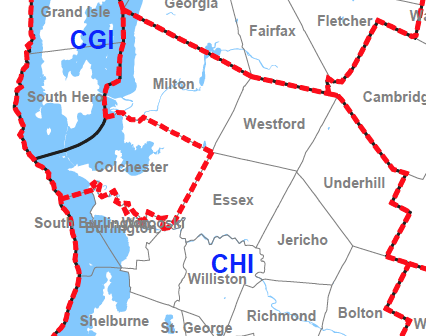
2. Colchester is the only community in Chittenden County* that’s not part of Sirotkin’s district. As you can see from this map, Colchester is an electoral cul-de-sac, surrounded on three sides by Sirotkin territory. (*Correction: Buels Gore and Huntington are also outside the district.)

Screen Shot 2014-10-22 at 10.30.43 AM

Here’s a thought for the bright boys @VTGOP: stop playing little gotcha games and focus on making your party relevant again.

Now that’s a burn. I’m out.

The purely cosmetic bipartisanship of Vision To Action Vermont

State Reps. Heidi Scheuermann and Paul Ralston. Photo filched w/o permission from VTDigger. I hope they don't mind.

State Reps. Heidi Scheuermann and Paul Ralston. Photo filched w/o permission from VTDigger. I hope they don’t mind.

State Reps. Heidi Scheuermann (R) and Paul Ralston (D), the busy bees behind Vision To Action Vermont, have been busy indeed these days. They’re releasing endorsements almost every day. And, on the surface, it looks to be a fair mix of Republicans and Democrats.

This figures, since V2AVT portrays itself as a nonpartisan, centrist, practical, “rise above party labels and get stuff done” kind of political action committee. If you listen closely, however, you can hear the business-friendly dog whistles a-blowin’. From its launch announcement:

[V2AVT is] a non-partisan organization that will promote, support and elect strong candidates for political office in Vermont who advocate for fiscal responsibility in state spending, and are committed to forming balanced, common-sense public policies that encourage economic prosperity, greater opportunities for Vermont families and businesses, and individual liberties and responsibility.

That’s the entire Dog Whistle Philharmonic in a single sentence: fiscal responsibility, balanced, common-sense, economic prosperity, opportunities, individual liberties and responsibility.

And, despite a thin veneer of bipartisanship, the dog whistles continue to sound throughout V2AVT’s list of endorsements.

As of this writing, V2AVT has endorsed 22 candidates: 11 in the House, 10 in the Senate, plus Lt. Gov. Phil Scott. Overall, they’ve endorsed 13 Republicans, eight Dems, and one Independent.

Okay, leaning rightward, but a respectable number of Democrats, right?

Not so much. There’s a strong trend in V2AVT’s endorsements. The higher the stakes, the more Republicans you get. While the House endorsements are split evenly, 5-5-1, the Senate endorsements include seven Republicans and only three Democrats. And then there’s Phil Scott, the group’s only statewide endorsement.

But beyond the mere numbers, there’s this: most of V2AVT’s Republican candidates are in highly competitive races, while their Democratic candidates are either unopposed or in very safe Democratic territory. 

This is especially true in the Senate, where V2AVT has endorsed all the Republicans’ top challengers except Robert Frenier, who’s challenging incumbent Dem Mark MacDonald in Orange County.

Otherwise, it’s like V2AVT and the VTGOP are using the same playbook. Dustin Degree and Norm McAllister in Franklin County, all three Republicans in Rutland County, Pat McDonald in Washington County. Degree, McDonald, and Rutland’s Brian Collamore are the VTGOP’s top three hopes for Senate gains, but they face uphill battles against formidable candidates: ex-Senator Sara Kittell in Franklin, incumbent P/D Anthony Pollina and incumbent D Ann Cummings in Washington (nobody’s beating Bill Doyle), and Rutland’s WIlliam Tracy Carris, son of longtime Senator Bill Carris.

And who are the Democrats supported by V2AVT? The very safe Jane Kitchel and Dick Sears, plus Sears’ Bennington County running mate Brian Campion. There is only one token Republican candidate on the Benn ballot, and Campion is considered a shoo-in.

Oh, and V2AVT also endorsed safe Republican incumbent Joe Benning.

Now let’s look at the House endorsements.

In Chittenden County, V2AVT is backing incumbent Republican Kurt Wright and Repub newcomer Michael Ly in a two-seat district. Wright is safe; the Repubs have hopes for Ly. And in another two-seat district, Chittenden 9-1, V2AVT is supporting the very safe (and centrist) incumbent Democrat Jim Condon and Republican candidate Joey Purvis, who’s hoping to replace retiring Republican Bob Bouchard.

Chittenden 9-1 is a closely contested district. Condon was the top vote-getter by a mile in 2012; Bouchard barely beat Democrat Curt Taylor; Purvis finished a respectable fourth. This is a seat that the Democrats could take.

Up in the perennial battleground of Franklin County, V2AVT is endorsing 26-year incumbent Dem Kathie Keenan and Republican challenger Corey Parent in a two-seat district. Parent is hoping to snag the seat currently held by Dem Mike McCarthy, who won by a mere 20 votes in 2012.

V2AVT’s favorite Independent is Laura Sibilia, a business-friendly type who’s challenging established Democrat John Moran in Windham-Bennington 1. There’s no Republican on the ballot, but Sibilia’s platform is clearly Republican-leaning.

The group has also endorsed safe Republican incumbent Patti Komline.

As for its Democratic endorsements, Jim Condon and Kathie Keenan are well-established incumbents; Clem Bissonnette is running unopposed has no Republican opponent — his challenge is from the Progressive Party; Cynthia Browning is a famously independent-minded Democrat in a safe Democratic district; and Matt Trieber is unopposed in Windham-3.

Overall, of V2AVT’s eight Democratic endorsements, none are in races closely contested by Republicans. Of its 13 Republican endorsements, seven are in races where the VTGOP hopes to gain ground.

That’s not my idea of nonpartisanship. That’s my idea of advancing the Republican cause.

No, I did not watch the freak show.

A study in pink.

A study in pink.

In front of a Susan G. Komen-worthy bright pink backdrop, the recently rebranded Vermont Public Television (now d/b/a Vermont PBS) rolled out the Clown Car O’ Democracy last night.

Yes, the one and only gubernatorial debate featuring all seven candidates for Governor.

Which produced the amusing spectacle of Scott Milne standing uncomfortably next to a Duck Dynasty stunt double, and Dan Feliciano braving sudden death from the razor-sharp brim of a Church Lady hat.

“Amusing spectacle” it was, and amusement was all it was good for. As a way for actual voters to actually make an actual decision, it was a waste of time. And I haven’t seen the overnights, but I wonder if Vermont PBS got as many viewers (74 max) as the ill-fated Burlington Free Press livestreamed debate.

Certainly they could have done better with a rerun of Bob Ross’ “The Joy of Painting.”

In fact, I’d vote for Bob Ross over some of those candidates. And he’s dead.

This notion of an all-inclusive gubernatorial debate seems to bring cheer to some of my friends in the media. It’s so… Vermont, you know?

Well, yeah. But so are rural poverty and frost heaves and agricultural runoff in Lake Champlain.

Vermont law makes it very easy to get a spot on the ballot. Which is fine; I don’t mind having eleventy-bajillion candidates if they get enough petition signatures. But it doesn’t mean they deserve my attention or consideration.

There are, at most, three serious candidates for Governor: Peter Shumlin, Scott Milne, and Dan Feliciano. Ironically, in all the debates so far, we have yet to see the three of them sharing a stage by themselves. More debates are in our future, and maybe we’ll get to see the only matchup that matters. I hope so.

How to waste $142,000

Two suggestions:

1. Get yourself 7,100 $20 bills. Scatter them in a big pile. Douse in gasoline, add one lit match.

2. Spend it on Republican advertising in Vermont.

Image from the RSLC ad. Or maybe from a Cialis spot.

Image from the RSLC ad. Or maybe from a Cialis spot.

As first reported by VTDigger, a national organization called the Republican State Leadership Committee has chosen the second course, pouring $142,000 into a TV/radio ad campaign for Republican legislative candidates.

They might have asked Lenore Broughton how this kind of big-money, old-media, carpet-bombing technique works. She spent at least a million bucks in 2012 on a TV/radio/bulk mail blitz attacking the Dems, and failed to move the electoral needle at all.

But the RSLC didn’t ask her. In fact, they didn’t talk to anyone in Vermont. Just ask one of the first guys they should have talked to.

Rep. Don Turner, R-Milton, the House minority leader, said he welcomed the media campaign, but was unaware of it until VTDigger showed him the ad.

So a D.C.-based Republican organization is running generic ads for nameless candidates, and they didn’t even consult the House’s top Republican. Somehow I don’t think the Democrats are too worried about this. Oh wait, here’s a Democrat now:

It’s just like in 2012, when there was a single Republican donor spending approximately $1 million here in Vermont. The VTGOP is just trying to bankroll their way towards relevance. It’s not going to work. Vermonters have already made it clear that the right-wing agenda has no place in our state, and they will make it clear again on November 4th. The RSLC is spending six figures on behalf of VTGOP candidates and that money comes directly from the Koch brothers and other insidious sources.

That’s from Ben Sarle, the VT Dems’ communications director. Now, naturally you’d expect him to say that. But the facts on the ground support his assertions. No matter what RSLC does, the Dems are extremely unlikely to lose more than a handful of legislative seats; it’s even possible that they’ll add a few to their outsized majorities.

But shed no tears for the RSLC. They’ve got money to burn, with a donor list that’s a Who’s Who of corporate America. In 2012 alone, RSLC spent some $39 million in state campaigns. So a lousy $142,000? That’s pocket change.

Oh, for your further entertainment, here’s the RSLC’s Top 20 donors for the year so far, according to the Center for Responsive Politics.

Screen Shot 2014-10-10 at 12.45.55 AM

Mmmm, delightful. Big Tobacco, Big Oil, Big Banking, Big Pharma. Big Telecom. Wal-Mart. Gambling. The US Chamber of Commerce. They’re all there.

Inclluding at least a couple of Bigs that have been generous to Governor Shumlin: Blue Cross/Blue Shield and Comcast.

Huh.

Say, Ben, perhaps you’d best tone down that talk about “insidious sources.”