Category Archives: Peter Shumlin

The Inaugural Address: A pretty good start

The speech by Governor Shumlin — which he billed as the first of two parts — included some welcome elements. It left a lot unsaid; presumably he will confront property taxes, school governance, health care, and government spending in his budget address next week.

Today’s address focused on two areas: energy, and the environment. In the latter category, his primary focus was on Lake Champlain. It was, if I recall correctly, the first time he’s drawn attention to these issues in a major January speech. To me, it’s a welcome development.

It’s also an opening for him to regain some credibility among liberals. When Peter Shumlin was running for Governor in 2010, his two big issues were single payer health care and the environment (climate change, green energy and Vermont Yankee). But while his administration has made some good incremental gains on the latter issues, they’ve never seemed to get the spotlight. Now they have.

With single payer off the table, perhaps Shumlin is returning to his other signature issue and hoping to put his stamp on Vermont’s future on energy and the environment. If he can’t be the single-payer governor, perhaps he can be the environmental governor. It’s a good strategy.

The caveat, of course: Now he’s gotta deliver.

He also opened the door to raising taxes as part of the effort to close a $100 million budget gap. In a brief preview of next week’s budget address, he said this:

We cannot simply cut our way out of our fiscal challenge year after year – taking away services that are important to so many Vermonters. Nor can we tax our way out of the problem.

Which would seem to indicate that his plan will include a mix of cuts and “revenue enhancements.” I’d urge him to take a long look at the plan that nearly passed the House a couple years ago, which would have raised taxes on the wealthy (by closing loopholes and limiting deductions) and provided some tax relief to the middle and working classes. I say “nearly passed the House” because it was stopped in its tracks by Shumlin’s stubborn opposition.

As for the details on energy and the environment:

The centerpiece on energy is a new renewables strategy, as the current (and, in some circles, controversial) SPEED program is sunsetted in 2017. The Energy Innovation Program is aimed at further boosting our investment in renewables and energy efficiency. Shumlin called the EIP “our single biggest step so far toward reaching our climate and renewable energy goals.”

Sounds good. We await the legislative process with anticipation and a bit of trepidation.

On Lake Champlain, Shumlin came up with a decent-looking package. It doesn’t go far enough, but it’s better than anything he’s offered before. He realizes, as he told the legislature, that if the state fails to meet EPA muster, we’ll face some burdensome federal regulations.

His plan includes:

— New transportation funding to curtail runoff and erosion around our roads and streets.

— New funding and technical assistance for farmers and loggers, to help them meet water-quality standards.

— More thorough efforts to enforce current water quality regulations.

— Making a change in the Current Use program, which would take away that tax break from farmers who fail to reduce pollution.

As for funding, his plan includes two new fees: One on agricultural fertilizers, and one on commercial and industrial parcels in the Champlain watershed.

The revenue would go into a newly created Vermont Clean Water Fund, a repository for state, federal and private funds. The first private money, he announced today, is a $5 million donation (over the next five years) from Keurig Green Mountain, which Shumlin called “a company that depends upon clean water.” He expressed the hope that KGM’s generosity will “inspire others.”

If he can leverage substantial donations from the private sector, his plan could accomplish quite a bit without too much stress on the state’s bottom line. Maybe enough to get the EPA off his back, at least for a while.

From this liberal’s point of view, it’s a good start. But as VPR’s Bob Kinzel said today, the Governor effectively served us dessert before dinner. Next week’s budget address will be a much less appealing dish. Plenty of mushy steamed vegetables scattered around a hunk of gray meat.

Beyond that, well, actions speak louder than words, and we’ve heard plenty of words from this Governor in the past. The political question is: Can he deliver on this agenda in a way that will repair his reputation for effective governance and bring liberals back into the fold? He can; but will he?
Well, that was predictable.

Our long nightmare is over: Gov. Shumlin has been re-elected to a third term*.

*I know, I know… for some, that’s the beginning of the nightmare. 

After all the hyped-up drama… after the late brace of TV ads… after the posturing of many a Republican… after Scott Milne’s uncampaigning for the vote… it was all utterly predictable. Shumlin drew 110 votes, Milne got 69.

According to Ballotpedia, there are 116 Democrats in the legislature, 52 Republicans, seven Progressives and four Independents. So the vast majority of Democrats stuck with their guy.

It was a secret ballot, so we don’t know exactly who voted which way. Milne got 17 votes from non-Republicans. Probably a few Dems, perhaps some Progs upset over Shumlin’s abandonment of single-payer, a couple of Indys.

But we don’t know. And we should know. The secret ballot is one of the serious flaws in our system for choosing a governor when no candidate gets a majority.

The fact that the vote was a strong validation of traditional practice may reduce the momentum for a Constitutional amendment to change the system. Reluctant lawmakers will be able to say, “Our unspoken agreement still works, so why change it?” Which would be unfortunate; it’d be better to change the system before there’s an actual crisis, not after.

Best of luck to Mr. Milne on his return to the travel business.

Big ol’ lead airliner

There’s an absolutely devastating piece on VTDigger this morning. If you haven’t read it, go. Now.

For those who didn’t immediately take my advice, the story outlines the role Governor Shumlin played in holding a pillow over single payer health care’s face until it stopped breathing. Or, as the headline says, “Shumlin built ‘lead airplane’ for single payer.”

If the story is true, here’s basically what happened. At some point, the governor decided that he couldn’t win on single payer. Then, rather than face the music directly, he larded his single payer proposal with assumptions that added to its cost and suppressed its revenues. As the story says, “he cast the program in the most negative light possible.”

And then he walked away.

How did he do it?

Well, first of all, he presented only one plan, when he’d promised a menu of options.

Aside from that, his plan offered top-shelf coverage, paying for 94% of clients’ health care costs — a 94 Actuarial Value. He could have gone with a lower figure; “Act 48, Vermont’s single payer law, directed the administration to shoot for a plan that covered 87 percent of costs.”

So he ignored the law. Not much new there.

The 94 AV added $300 million a year to single payer’s cost.

He also chose to add out-of-state residents who work in Vermont, which added another $200 million. And he called for the elimination of Vermont’s provider tax, which cut $160 million in revenue.

He also chose to assume the new system would yield no administrative savings — which had been one of his big selling points for single payer.

You can see where this is going. Shumlin projected a first-year cost of $2.6 billion, but he could have brought in a perfectly acceptable plan for well under $2 billion.

And he knew it. And he chose not to tell us.

The massive report released by the administration at year’s end included not one, but 15 plans. But Shumlin chose to present only one.

Among the 15 different models in the document dump is Financing Concept 12, which uses an 87 percent actuarial value and would require $1.6 billion in state revenue for the first year.

It excludes out-of-state workers and does not offer supplemental coverage to federal employees or people with employer sponsored coverage, all of which is contained in the plan Shumlin chose.

It’s hard to read that and feel anything other than betrayal.

Maybe there were perfectly sound reasons for Shumlin’s choices, but he didn’t give them and he didn’t provide any options. Instead, he “buried” them in his pre-holiday document dump.

So, Vermont misses a chance at single payer. Even worse, the entire idea of single payer has been significantly set back, perhaps by decades. Because now we have a liberal governor, a strong advocate of single payer, concluding that it’s not practical.

This hurts.

Honest government, if not honest elections

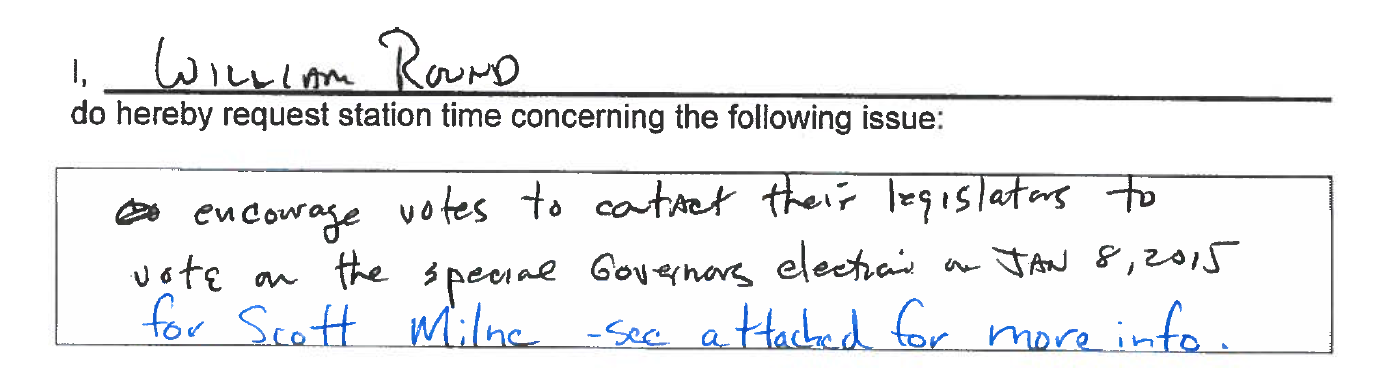
Now comes a brief spurt of outrage from the Kingdom, in the form of a belatedly-organized “group” (mainly one guy, William Round, with some money and a grudge) agitating for the election of Scott Milne as governor by the state legislature.

Newly-minted Seven Days political reporter Terri Hallenbeck says Round told her that “the group started over coffee among friends and includes more than 50 Vermonters he described as ordinary residents.”

Only one of the 50 shows up on the group’s FCC filing, and that would be Mr. Round. His filing asserts that VfHG has no officers, executive committee, or board of directors, so I have to assume that its organization and funding begin and end with William Round.

The lion’s share of the $30,000 ad buy is on WCAX. The ads will run from Dec. 30 through Jan. 7, the day before the legislature will hold its usually ceremonial election. Ad buys are targeted on WCAX and CBS news programming.

The ad says nothing about the close outcome of the November election; it simply recycles Republican complaints about Gov. Shumlin — high taxes, overspending, “broken promises,” etc.

VfHG’s emergence does give Milne the opportunity to deny the validity of the November vote:

“It points out to the people that we’ve got a constitution that essentially says we’ve had no election for governor. That happens on January 8,” Milne said.

Ah, so the votes cast by nearly 200,000 Vermonters? They don’t count. Sorry. We failed to cast them with sufficient clarity of purpose.

Well, it’s just more of Milne’s self-interested pseudo-logic, nothing new there.

As for Mr. Round and his willingness to spend $30,000 in a doomed effort to re-litigate the election? I fully support his Constitutional right to waste his money.

Finally, I suppose it would be churlish of me to reproduce the evidence of ungrammatical haste in filling out an official form? Yes, it probably would.

William Round FCC form


Closing time

Shoutout to my favorite one-hit wonder of all time…

So gather up your jackets, move it to the exits

I hope you have found a friend.

Closing time

Every new beginning comes from some other beginning’s end

And here we are, on The Last Day of Vermont Yankee. Or, as @GovPeterShumlin put it:

Yeah, well, as if.

Problem: today is not “the end of years of controversy.” It is, in the questionably immortal words of Semisonic, “some other beginning’s end.”

What ends today is the productive phase of Vermont Yankee’s history. What begins is the long slow wait for decommissioning. The chances of an accident will diminish, but we’ll still have a whole lot of hyper-toxic stuff SAFSTOR’d on the banks of the Connecticut River.

Look at it this way. The “lifespan” of Vermont Yankee was 42 years. The “deathspan,” if I may coin a word, will be AT LEAST 30 years. That’s the optimistic forecast for decommissioning. And that’s heavily dependent on the always-reliable, ha ha, stock market: Entergy’s decommissioning fund sits at $665 million, a little more than half the estimated cost of decom. Entergy says it won’t start decom until the fund grows to cover the entire (estimated) $1.24 billion price tag.

But hey, the markets always go up, right?

The way Entergy puts it, they’re doing us a big fat favor by planning the decom for the 2040s. By federal standards, they don’t have to do it until 2075.

Sixty years away.

In that scenario, the “deathspan” of the plant will have been 50% longer than the lifespan.

That’s the problem with nuclear energy. I’m not necessarily against nukes; if managed correctly, they do provide reliable carbon-free power. But there’s that long, lingering afterlife — and corporate America has never shown much dedication to long-term responsibilities.

Nor has public America, for that matter; we have yet to devise a long-term storage plan for all that nuclear waste.

Anyway, I suppose @GovPeterShumlin is only doing what a governor has to do: putting the best face on a decidedly mixed reality.

But I’d be very surprised if this was, in fact, “the end of controversy.”

And in the words of Semisonic, wherever they are today:

I know who I want to take me home,

and it ain’t Entergy.

The Emily Post Guide to Gubernatorial Seating Arrangements

There’s one unobserved aspect of Gov. Shumlin’s white-flag presser on single payer health care that I’d like to mention before the event is any farther in our rear-view mirrors.

Because the Governor was announcing his single payer reversal not only to the media, but also to his two big Advisory Councils on health care reform, the event was moved from his ceremonial office to Room 11, one of the larger conference rooms in the Statehouse (which is notorious for small, cramped, unphotogenic rooms). Room 11 is on the first floor, to the left of the Abe Lincoln bust that dominates the central hallway.

It’s a long rectangle; the east and west walls are the long ones. There’s a big wooden conference table along the west wall. Directly in front of this table is a rather narrow open area; along the east wall are three long rows of chairs.

The south wall (closest to the front of the building) is kind of an open area. In front of the north wall are several rows of seats.

The lectern for the news conference was set up on the south end of the room. The seating area on the east wall was filled with members of Shumlin’s Business Advisory Council and miscellaneous others. The conference table opposite was where most of the media sat. (Yeah, we grabbed the comfy chairs.)

In the open area between east and west walls, the TV cameras were set up.

The seating area near the north wall was where Shumlin’s Consumer Advisory Council sat.

Now, it’s well known in government circles (and probably the private sector as well) that proximity equals influence. Presidential staffers clamor for space in the White House instead of the Executive Office Building, for instance.

Well, in this case the Business Advisory Council got the prime seats. The Consumer Advisory Council was in the Siberia of Room 11. Their view of the lectern was blocked by all the TV tripods.

You don’t think that was an accident, do you?

Oh, and also languishing in the cheap seats was a rather forlorn looking Mark Larson, who still holds the title (and draws the salary) of Vermont Health Access Commissioner, even though he was sidelined months ago in a staff shakeup. He may still be a top Shumlin health care executive, but he was nowhere near the front of the room where all his, ahem, colleagues hovered closely behind the governor.

After remarks from Shumlin and others, he opened it up for questions. He sought to go back and forth between the media and members of his two Councils.

Who do you think dominated the Q&A period? Well, the media did, but aside from that it was all Business Advisory Council. Only one voice emerged from the back of the room: CAC chair David Reynolds made a brief and forgettable statement about how much hard work had been done. Not a peep was heard from CAC members like Peter Sterling, James Haslam, and Dr. Deb Richter — three of Vermont’s leading advocates for single payer. Maybe they were in shock, or maybe they couldn’t be seen from the lectern because of all the TV guys.

Several members of the BAC spoke. All were vociferous in their praise for everyone’s hard work, and all credited Shumlin for his hard work and his wisdom in scuppering single payer. Yeah, right: some of these guys were against single payer from day one. A couple of them were harshly critical of the media for being mean to the governor, when in fact we were only doing our jobs, and Shumlin gets worse than that in his regular news conferences.

The business community, up close and with a clear view of the Powers That Be. The consumer representatives, exiled to the back of the room where they’d have to jump and shout to be recognized.

Given the content of Shumlin’s announcement, that all seems about right.

Shumlin waves the white flag

The governor’s number-one public policy goal is no more.

At a news conference today, Governor Shumlin pulled single payer health care off the table, saying the numbers simply don’t add up. Instead, he promised a continued effort to improve access to, and lower the cost of, health care in Vermont.

“This is the greatest disappointment of my political life,” he said, and that nails it. Single payer was one of the foundations of his initial run for governor in 2010. His promise to push for single payer set him apart in a crowded Democratic field and helped overcome doubts about his liberal bona fides.  That promise kept the Progressive Party on the sidelines in 2012 and 2014.

And now, it’s not gonna happen.

Oh, he promised a continued fight for a fairer and more accessible system, starting with the 2015 legislative session. But single payer is out until further notice. When asked, “If not in 2017, when?” he only answered in generalities.

As for the timing of the announcement, only six weeks after the election, Shumlin claimed that his team had just finished working the numbers last Friday and confirmed the bad news on Monday.

The numbers were unacceptably bad. Morgan True of VTDigger had reported that the financing mechanism would be based on an 8% payroll tax and a consumer premium imposed on a sliding scale. But the way the numbers shook out, the actual payroll tax would have to be more like 11.5%, and the premiums would have to be higher than expected. The result could punish the economy and leave many Vermonters with higher health care costs.

He cited several factors that moved single payer out of reach. Federal subsidies were not going to be as generous as hoped. The sluggish economic recovery meant fewer dollars coming into the treasury. That had led to state cuts in Medicaid payments that reduced federal support.

Also, the administration had decided a three-year phase-in for small businesses that don’t currently provide insurance was necessary to cushion the shock of a payroll tax. That phase-in meant substantially lower payroll tax revenue for the first three years.

Shumlin was clearly sensitive to the concerns of the business community. That, and his woodshedding in the November election. He saw single payer as a huge gamble that he was unlikely to win, and now is not the time to stick his neck out.

He also acknowledged that the troubled rollout of Vermont Health Connect cost him credibility on building a new health care system. “We must show we can deliver,” he said. “Vermonters have reason to question us, given the troubles with Vermont Health Connect.”

He emphasized all the hard work that’s been done to create Vermont Health Connect, bend down the cost curve, and lay the groundwork for a better system. And he promised a continued, all-out effort to improve the system. But single payer was his signature deal, and now he’s had to forego it.

Even if the delay is relatively brief — say, two years — single payer is almost certainly unattainable during his tenure in office.  The failure of single payer will be a big part of his legacy, and will significantly hamstring his ability to win back liberal and Progressive voters who’ve been skeptical of him.

Fair or not, today’s announcement confirms that skepticism. Let’s accept that the numbers are honest and the timing was just the way things worked out. Even so, the optics are bad.

There are many liberals who never believed Shumlin was serious about single payer. They will see their cynicism as confirmed.

This retreat will also lend great comfort to the foes of health care reform. A determined Democratic governor, with all the resources he could want, spent three years researching single payer, only to conclude that it wouldn’t work. The revised cost estimate for single payer — $2.6 billion a year — is almost exactly what Wendy Wilton, then-Republican candidate for Treasurer, estimated two years ago.

And the abandonment of single payer strips the governor of his signature issue. Aside from Tropical Storm Irene, his administration has been marked by incremental gains on a number of issues and blocking tax hikes. There haven’t been any high-profile accomplishments — which is why one of Shumlin’s re-election ads focused on GMO labeling, an issue he didn’t support until the last minute. And why a recurring theme in other ads was Irene recovery, something that happened in his first term.

Now we can now look forward to more incremental gains and belt-tightening. His downsized proposals for the 2015 legislature on health care were purely incremental in nature. None will generate headlines or fuel a grassroots movement.

The governor’s gonna have to pull a rabbit out of a hat somewhere to restart his political career. And his biggest hat is now empty.

The Shumlin conundrum

(Say it five times fast.)

Governor Shumlin delivered brief remarks to the House and Senate Democratic caucuses on Saturday. His message, basically: we’ve got big problems to deal with and no money, so let’s dig in and get going!

I can imagine him in a past existence, being a life coach for Roman gladiators.

He appeared in his Airwolf jacket, fresh off a helicopter (or, as he put it, “chopper,” what a man) tour of storm-damaged Vermont. Which caused much speculation on Press Row about who paid for the overflight.

The Shumlin Tour. Not exactly as pictured.

The Shumlin Tour. Not exactly as pictured.

Said speculation didn’t make it to their reports, and the stunt had its desired effect: lots of coverage on the teevee news, with the governor looking both manly and concerned.

Naturally he didn’t have time to change out of his flight gear before the caucuses, hahaha. Really, anybody weighing less than four bills could change clothes in the back of that Yukon SUV he rides around in.

He did use his chopper tour to make a pitch for his renewable energy agenda — “we didn’t use to see storms like this,” but now we got global warming. And then he turned to a series of talking points we can expect to hear again and again in the new year, all designed to diminish expectations and/or dash hopes.

He didn’t use Phil Scott’s phrase “affordability agenda,” but the substance seemed awfully similar. Vermonters are frustrated that their purchasing power is stagnant while costs (and property taxes) are rising.  State spending has to be reined in.

When he took office, he said, economists were forecasting a post-Recession return to 5% annual growth in the Northeast. Turns out, it’s more like 3%, and is likely to stay there for quite some time. But state spending was built on that 5% projection, and that’s led us to our current fiscal mess.

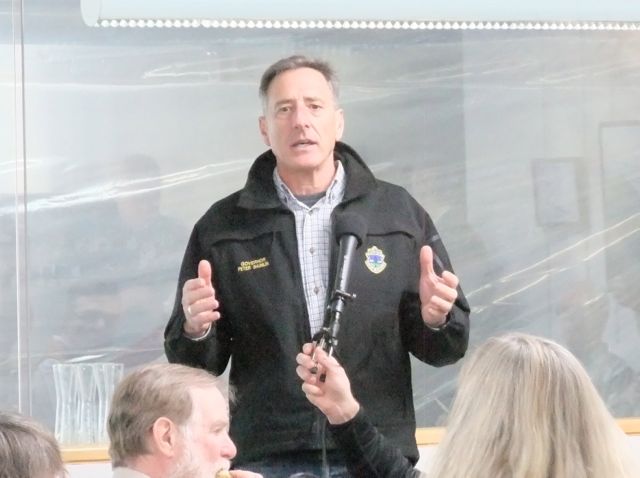
Stringfellow Hawke explains it all. (As the hand of VPR's Peter Hirschfeld gamely tries to keep a microphone within range.)

Stringfellow Hawke explains it all. (As the hand of VPR’s Peter Hirschfeld gamely tries to keep a microphone within range.)

The $100 million shortfall in next year’s budget, he said, is real. We’ve used up the federal recovery money and the one-time funds to balance past budgets. Now, “we’ve got to make tough choices.” We’ve got to bring down growth in state spending to match that seemingly endless 3% growth rate. Thus, he said, “anyone asking for more money had better think twice.”

He made a progressive plaint about the growing income gap between the very rich and the rest of us. He did not, however, connect the dots between that phenomenon and Vermont’s underperforming income tax revenues.

And he certainly did not connect the dots to a quirk in our current tax system that has an official top tax rate of 8.95%, which seems quite high — but the rate that top earners actually pay is not 8.95%, but 5.2%. Furthermore, if you add up all state and local taxes, it turns out that the top 20% pay a lower share of their income than the other 80%, and the top 1% pay the lowest share of them all. (Figures from the Institute for Taxation and Economic Policy.)

When I connect those dots, I think we ought to resurrect a bill that almost passed the House two years ago. It would have shifted more of the tax burden upward, and given modest tax cuts to middle and lower-tier working Vermonters. That bill died a sudden death because of Shumlin’s steadfast opposition.

So when he starts talking about income inequality, he needs to talk about our tax policy as well. Because these days, that’s where the money is. And our top earners are doing extremely well, thank you very much. They can pay their share.

Shumlin also rolled out his school funding argument: Our schools would perform better for less money if there was some kind of consolidation. Because studies show that very small class sizes are just as harmful to achievement as very large class sizes. So we’ve got to embiggen our schools, not to save money (although we would), but for the sake of the children.

Awww.

Surprisingly, there was no mention of single payer health care — or the slightly watered-down “universal health care” — except for a brief mention, in his Cavalcade of Calamities, of unacceptably fast-rising health care costs.

Okay, some realities of my own. I accept the notion that slow growth means an extremely tight state budget, and that we cannot tax our way out of it. We should tweak the tax system to make it more equitable, but that’s not going to bring in much money. We’ll need to make government more efficient if we want to preserve the level of services we’ve come to expect.

I believe that the number-one thing Governor Shumlin needs to do to restore his standing with voters is to re-establish his reputation for good governance. The policies, and I say this as a devout liberal with strong policy positions, are kind of secondary.

Shumlin gained a strong managerial reputation during the Irene recovery. He pretty much blew it in his second term, with the continuing difficulties of Vermont Health Connect, the problems in the Agency of Human Services, and all the budget shortfalls. If he can make state government work effectively, he’ll win back a lot of voters.

And this will be his biggest administrative challenge, not Irene. Authentic crises are difficult, but they get the adrenalin flowing, and everybody puts aside their differences and pitches in. Maintaining the day-to-day operation of a big bureaucracy is harder. It’s an unending slog. It challenges established procedures, and if there’s one thing we Vermonters love, it’s doing things the way we’ve always done them.

As a liberal, I expect to be disappointed repeatedly by Shumlin in the next two years. Clearly, between the realities of the fiscal situation and his own political instincts, there’s going to be a lot of governing from the center. Or even center-right. But if he can govern effectively… if he can actually create new efficiencies, saving money while maintaining services… he will restore his political reputation.

Is he up to that challenge? Two years ago I would have said a resounding “Yes.” Now, I’m not so sure. Flight jacket notwithstanding.

Now that I have their attention

Funny thing happened Thursday, unprecedented in my three-plus years of political blogging.

My sources. Not exactly as illustrated.

My sources. Not exactly as illustrated.

I got calls from not one, not two, but three different top Democrats seeking to gently upbraid me for stuff I’d written this week, and offer some guidance toward alternative views. Their own views, of course.

Which is nice for the ego. They read, and they care.

Also, their messages were valuable. They did offer some good information. But I’m not completely convinced.

The callers offered some pushback on the subject of newsdumps. They insisted that what appear to be newsdumps — the offloading of bad news when people are least likely to see it — were not newsdumps at all, but simply cases of the calendar conspiring against them.

There was a second message: the upcoming round of budget rescissions do not single out Human Services. They don’t deny that AHS is going to feel the pain, but the problem, as they explain it, is that vast areas of the budget are off-limits for rescissions, which makes AHS the only real target of substantial size.

They made some good points. The problem is this: the Shumlin administration has a well-earned reputation for (1) deviousness, (2) political gamesmanship, (3) newsdumps, and (4) targeting Human Services. Their own track record colors my views of recent events. In other words, if I was overly cynical, I put much of the blame on their doorstep.

I’m sure those inside the administration don’t see it that way. For the most part, they honestly believe they’re trying their best to move the state forward through tough times. But the 2014 election should have been a wake-up call: their view of things is often at odds with others’ views. Say, the voters’ views.

Let’s take their points, shall we?

First, on Human Services having to make almost two-thirds of the cuts in the upcoming rescissions. It’s true, but the reason is that AHS takes the lion’s share of general fund money. And only general-fund programs are open to rescission. Schools and transportation don’t get much money from the general fund, for instance.

According to outgoing Administration Secretary Jeb Spaulding, appearing on VPR’s Vermont Edition Friday, AHS accounts for 40% of the total budget — but 75% of General Fund spending.

Which sounds reasonable to me. But…

1. This wouldn’t be the first time the administration targeted AHS. The most notorious case is Shumlin’s ill-fated effort to slash the Earned Income Tax Credit, one of our best bulwarks against the rising tide of income inequality.

2. The rescissions list was released on the Thursday before Thanksgiving. This may or may not have been a newsdump (see below), but it gave little or no opportunity for journalists and bloggers to seek clarification of the raw numbers. When I saw the raw numbers, they looked really, really bad for AHS.

And now, on to newsdumps. I had identified three: the rescissions release, the deadline for submitting rescissions, and the Governor’s release of his single-payer financing plan at the end of this month.

The rescissions release on Thanksgiving Eve wasn’t a newsdump, my callers insist. They had put together the list and informed agency officials earlier that week. Many agencies wanted to tackle the budget-cutting immediately — over the holiday weekend. That meant releasing the list on Wednesday, so the process could begin.

The deadline, Friday Dec. 5, they say, wasn’t a newsdump because they hadn’t planned to release anything on Friday. It was an internal deadline only.

I can accept that. But once again, history informed my cynicism. When I see something bad happening on a Friday or a holiday eve, my Weaselometer begins to howl.

Finally, the long-awaited and catastrophically overdue reveal of the single-payer funding plan (which VTDigger’s Morgan True appears to have uncovered the substance of already) on either Monday December 29 or Tuesday December 30. Many voters will be out of town or otherwise occupied during that time; media outlets will have bare-bones staffing. So of course it looked like a newsdump. 

Not so, insist my callers. They blame the calendar, mostly. You see, the 29th and 30th are on Monday and Tuesday. They couldn’t release it on Friday the 26th, and New Year’s Eve would be universally viewed as a newsdump.

The week before is problematic as well. The 24th, 25th, and 26th are out. Monday the 22nd or Tuesday the 23rd would hardly be any better than the 29th or 30th. And the week before that is too early; the plan may not be completely done by then.

Okay, spin it ahead. New Year’s Day is a Thursday; Jan. 2 is not only the day after a holiday, it’s a Friday, so that’s no good.

Which brings us to Monday the 5th — only two days before the Legislature convenes. That week is likely to be a circus, what with Scott Milne’s Dance of the Seven Veils, various ceremonial activities, and other hard news. (Such as the RAND Corp. report on marijuana legalization.)

The fear, so I’m told, is that a single-payer unveil on Jan. 5 could get lost in a blizzard of news. It would also give lawmakers less time to look it over. And, I’m told, lawmakers wanted to get their hands on it as quickly as possible. Hence, a pre-New Year’s release.

Again, it all makes sense. And again, given the administration’s iffy history, you can understand why an outsider would look at a late-December release and scream “Newsdump!”

This all illustrates how much the administration will have to do, to repair its tattered and battered public image. Much of those batterings were self-inflicted, as the administration acted out of unwarranted hubris and, sometimes, arrogance.

They may not believe they acted badly in the past. But a lot of Vermonters, including a whole lot of liberals, are convinced that they did. That’s why Shumlin’s pre-election approval numbers were so dismal, and why his very expensive campaign hardly moved the numbers at all.

And that’s why I’ve said the Governor should avoid newsdumps or anything that looks like a newsdump, or anything that looks like a political maneuver or a transparently bogus explanation. He’d be better served by standing up in broad daylight and owning the bad news, instead of reinforcing his reputation.

Of course, he’d be far better off by having an administration that didn’t produce so much bad news. But that’s another matter.

Callers, thanks for reading theVPO and taking it seriously. And thanks for calling.

With all due respect to Hal Cohen…

So yesterday Governor Shumlin filled two vacancies in his cabinet. Justin Johnston was announced, in a brief flurry of bad Aussie jokes, as Jeb Spaulding’s replacement in the role of Shumlin’s Rasputin Secretary of Administration.

And Hal Cohen will become Human Services Secretary.

Justin Johnson, Gov. Shumlin, and -- barely visible in back - -Hal Cohen.

Justin Johnson, Gov. Shumlin, and — barely visible in back — Hal Cohen.

Now, I’m sure Hal Cohen is a nice guy and he’s clearly dedicated to the field of social services, having served as head of Capstone Community Action for 18 years. You don’t keep that job for that long unless you’re committed to the mission.

But is he really the best guy for the biggest agency in state government? And even worse, an agency facing an immediate mandate to cut its current-year budget by ten million bucks?

I know virtually nothing about Hal Cohen. But here are a few numbers that portray his challenge in very stark terms.

AHS: 3,500 staff. Annual budget, from general fund: nearly $600,000,000.

Capstone: 180 staff. Annual budget, $16,000,000.

In short, Hal Cohen is making a quantum leap as a manager. At a time when he will face a massive management challenge from Day One.

Cohen does bring some positive qualities to the job. He is deeply involved in delivering services to those in need, which is a very good thing. He has managed a nonprofit social services agency for a long time, and that’s a very good thing.

But he has never managed an organization anywhere near the size and complexity of AHS. When you manage a staff of 180, you do a lot of hands-on, day-to-day management. You have a personal relationship with a sizeable chunk of your employees, and you probably know them all by name.

When you manage a staff of 3,500, you’re delegating almost all of the work. You’re managing the managers — or, more likely, managing the managers’ managers. And if you spend time building personal relationships with your staff, you’re probably not doing your job.

That’s the basic challenge in making this quantum leap.

And then you add the fact that, between this year’s budget and the next, he may well be asked to make spending cuts equivalent to the entire annual budget of Capstone.  

I’m sure that if Shumlin had pulled someone out of the business world, or out of some other state agency, we’d all be howling about hiring a bean-counter who cares more about the bottom line than helping people. (For example: Johnston saying that the primary goal of the budget is “affordability.” Meaning no new taxes.) But I have to wonder if Cohen is the right person for this job at this time. And I also have to wonder, with all due respect to Hal Cohen, how many other people might have said “no” to the idea of becoming the head of an overstretched agency facing major budget cuts. It’s hard to imagine that Cohen was the first name on the list.

I hope, for the sake of Vermont’s poor, that my misgivings are proven to be groundless.