Category Archives: justice and corrections

Some backstory on the militarization of our police

Last week, while I was out of town for a family Thanksgiving, Mark Davis wrote a nice little story in Seven Days about Vermont police agencies picking up a whole lot of military-grade weaponry, thanks to a federal program designed to shore up military contractors’ bottom lines provide local police with “military equipment left over from America’s foreign wars and stockpiles.”

Which brought to mind some of my own past coverage of specific events tied to this story: a small New Hampshire community talked into buying an assault vehicle by a Rush Limbaugh-listenin’, Tea Party-believin’ salesman, and the small-scale invasion of a small Vermont town.

Instrument of peace?

Instrument of peace?

First stop in the Wayback Machine is February 2012, when Keene, NH had received a $300,000 Homeland Security grant to buy an eight-ton armored vehicle called the Lenco Bearcat. This, for a city with a population of 23,000 and virtually no history of violent crime.

But there was all that federal money dangling in front of the city fathers…

During a City Council meeting, the Mayor was heard whispering to a City Councilor “We’re going to have our own tank.”

Better than Viagra. Of course, the grant won’t pay for operating costs like maintenance, training and insurance.

The most fascinating part of the story, to me, was Jim Massery, salesman for vehicle manufacturer Lenco. His pitch was laden with fearmongering about the need for high security everywhere. In fact, one of his quotes was the following:

I don’t think there’s any place in the country where you can say, “That isn’t a likely terrorist target.” How would you know?

There was a whole lot of that, and you can read more in my 2012 post on Green Mountain Daily. Massery, as I discovered, was a true-blue conservative who believed that President Obama was trying to steal our freedoms, and that the government was spending us into oblivion. And yet he had no problem helping the government militarize local police and wastefully spend $300,000 on a Lenco Bearcat that nobody needed. (The notorious Free Staters of Keene probably thought he was an enemy agent tasked with bringing the power of the police state to their own little community.)

One of Massery’s other pitches went like this:

When a Lenco Bearcat shows up at a crime scene where a suicidal killer is holding hostages, it doesn’t show up with a cannon. It shows up with a negotiator.

And, he might have added, that negotiator shows up in grand style, hunkered down in eight tons of steel. Which brings me to story #2. In June of 2012, a man named Alfred Perreault unknowingly touched off a minor invasion of his town of Washington, VT…

A summer scene befitting a Norman Rockwell portrait was spoiled Monday morning when more than a dozen police cruisers, an armored vehicle and the big box truck that houses Vermont’s equivalent of a S.W.A.T. team set up shop in Washington to take what proved to be one unarmed man into custody.

That armored vehicle was, as it happens, a Lenco Bearcat. Purchased by the Vermont State Police with, you guessed it, a Homeland Security grant.

Perreault was known to possess a goodly quantity of firearms, hence the heavy-handed police response. Which must have triggered (sorry) a sizeable panic reaction among townspeople who suddenly saw this caravan o’death roll into town and set up roadblocks.

It all ended peacefully. But as I wrote at the time, there’s an old saying: To the man with a hammer, everything looks like a nail.

Our police agencies have been outfitted with military-grade, up-armored hammers. So naturally, Alfred Perreault looked like a nail.

It’s a lot easier for the authorities to escalate a response when they have the tools of escalation close at hand — indeed, when they may well feel a need to justify the purchase and upkeep of all those hammers. Alfred Perreault clearly needed to be dealt with. But did he warrant such a robust response?

You can bet we’ll be asking these kinds of questions again in the future.

The most pertinent questions about the Colchester cop

I sense the fine handiwork of the WPTZ graphics department.

I sense the fine handiwork of the WPTZ graphics department.

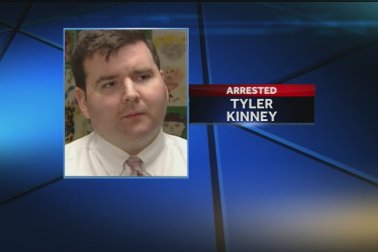
Every time I read about the case of Tyler Kinney, the Colchester officer who faces federal drug and gun charges, the same thing keeps coming to mind.

How in the blue hell did this go on so long?

Here’s a guy who was on the force for twelve years, and occupied one of its most sensitive positions — keeper of the evidence locker — for two and a half years. He was stealing stuff out of the locker, he had a “heroin addiction for an extended period of time,” and he was sharing his swag with a career criminal with a rap sheet as long as your arm and two felony convictions.

On top of all that, Kinney’s addiction and malfeasance came to light accidentally, after an unrelated search of the career criminal’s home. Absent that coincidence, Kinney might have gone on stealing stuff and destroying God knows how many prosecutions that depended on secure evidence storage.

News coverage of the case, so far, has focused on Kinney himself. But what of the institutional framework around him?

The overarching question breaks down into two parts.

1. What kind of internal oversight does the Colchester police have on its evidence locker and the sole keeper thereof?

2. What is the department’s drug testing policy for its officers? Does it have any? How often does it conduct tests? What drugs does it test for?

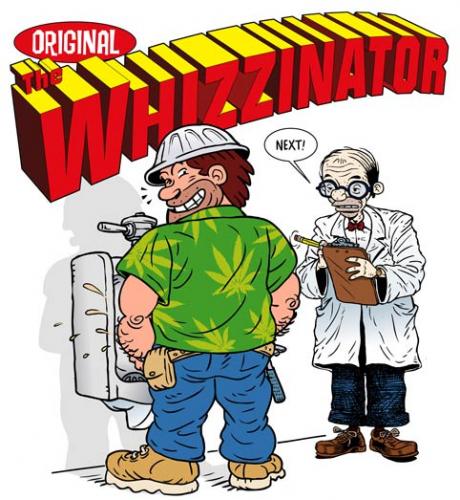
the_whizzinator_83385And how are the tests conducted? Is the officer monitored while, ahem, providing a sample? Or is there opportunity to game the test via the Whizzinator route?

The Colchester Police Department should answer these questions in detail. Necessary reforms must be enacted. If internal policies were not followed, those responsible should answer for their inactions.

Lest we lay all of this at the feet of Colchester Police Chief Jennifer Morrison, allow me to note that she’s only been there for a little over a year. The previous Chief, Charles Kirker, who had been chief for the previous 34 years, needs to give some answers too. Especially in light of this sentence from a softball Burlington Free Press interview on the occasion of his retirement:

My philosophy has always been to delegate to subordinates because you allow them to grow.

Yeah, nothing could possibly go wrong with that.

Beyond Colchester, the same questions should be put to the Department of Public Safety. What are the standards for the State Police? Are there standards that local police agencies must meet?

If not, why not?

If a drug-addicted officer can occupy a critical position of trust for two and a half years, only to be caught by accident, then either there was a complete breakdown in the Colchester police, or there are systemic shortcomings that must be addressed.

That’s all. I’ll hand this over to the watchdogs of the media.

Bunched knickers at the Freeploid

The Burlington Free Press’ Mike Donoghue is shocked, shocked, that someone would dare steal his scoop.

Screen Shot 2014-09-11 at 2.18.28 PM

Donoghue is referring to his excellent story on the Louis Freeh accident, in which he broke the news that an eyewitness saw Freeh’s vehicle force three other drivers to swerve out of his way. Which raises the question, why isn’t Freeh facing any charges for reckless driving or endangerment or some such?

And how Mike’s knickers are in a twist because Channel 3 poached his story.

I feel his pain.

As does every non-Gannett journalist in Vermont, who would tell you that the Burlington Free Press is the number-one violator of this ethical principle. The Freeploid likes to pretend, in fact, that it is the only journalistic outlet in the state. It is very quick to grab credit for its own “gets,” and extremely — extremely — reluctant to grant the same credit to others.

Let’s just take one recent example. Terri Hallenbeck, reporting on Governor Shumlin’s campaign launch: 

According to the governor’s office, Shumlin has spent 141½ days in the past two years outside of Vermont, which includes 54 personal days off and 35 days on business for the Democratic Governors Association, of which Shumlin is chairman.

“According to the governor’s office,” my ass. That story came straight out of Paul “The Huntsman” Heintz’ column in Seven Days. Which was entitled “On the Road Again: Shumlin’s 141.5 Days Outside Vermont.”

So, rather than give proper credit to Heintz and Seven Days, Hallenbeck called the governor’s office for confirmation. Which gave her an excuse to avoid giving credit where credit is due. Well, to be fair to Hallenbeck, I suspect that her editors made her do it.

In any case, I say anyone at the Burlington Free Press who whines about story-poaching needs to look in the goddamn mirror.

Rank hath its privileges

Well, well. Looks llike there was more to the story of Louis Freeh’s car wreck than we were led to believe. 

The former FBI director was driving on state Route 12 in Barnard on August 25 when his vehicle left the road and smashed into a tree and some shrubs. It’s assumed that he fell asleep at the wheel. State police had said they would not seek charges nor even write a ticket. But look what the Burlington Free Press’ Mike Donoghue dug up

An out-of-control SUV driven by former FBI Director Louis Freeh almost struck head-on three motorists, who were forced to take evasive action to avoid crashing in southern Vermont, according to one of the drivers.

The driver, Van Coleman, gave a written statement to a Windsor County deputy sheriff, who was the first police officer on the scene of the Aug. 25 crash of Freeh’s vehicle. Deputy Sheriff Justin Hoyt said he gave the eyewitness report to state police. 

Donoghue reports that a motorcycle and two cars were forced to “swerve into the left lane when Freeh’s vehicle crossed the center line… and headed at the trio at a high rate of speed.” The witness, Coleman estimated that Freeh was doing at least ten MPH over the speed limit. 

Apparently, Coleman’s account failed to make it up the chain of command. VSP spokesperson Stephanie Dasaro, who issued three news releases that didn’t mention the close calls, said “I did not have that level of detail.” And Public Safety Commissioner told Donoghue “This is the first I have heard about that.” 

Flynn added that he “would ask for an explanation.” 

He’d better. This smells as bad as a week-old fish. If Freeh is not charged or ticketed, the State Police needs to provide a solid, thorough, convincing explanation. Otherwise it’ll look like the Good Old Boys’ Network got the better of justice.

Profiles in Courage, Dick Sears Edition… again

It may be the offseason for lawmaking, but there’s still some occasional activity under the Golden Dome. Yes, even aside from the well-chronicled bats in our communal belfry.

Yesterday brought a hearing of the Joint Corrections Oversight Committee. On its agenda: State Auditor Doug Hoffer’s audit of the Sex Offender Registry, which found an 11% rate of “critical errors.” Which triggered a requirement in state law that the Registry must receive a “favorable” audit before the state can start posting home addresses of offenders. Which triggered yesterday’s committee meeting.

Okay, what do you think? Is an 11% “critical error” rate is a “favorable” result?

I thought not.

According to VTDigger’s Laura Krantz, most of the committee also thought not.

Rep. Sandy Haas, P/D-Rochester, said the committee should put in writing that the audit is not favorable. Rep. Bill Lippert, D-Hinesburg, agreed.

Seems simple enough. Ah, but then Senate Judiciary Committee chair Dick Sears runbled into action. Or should I say, inaction.

Sears… said to admit the audit is not positive could create fodder for a lawsuit from a defense attorney. He also worried a judgment would be binding and perhaps require another audit before the addresses can go online.

Dick Sears, who gets a lot of credit in State House circles for being a wise old hand, does this a lot. If any idea comes up that might possibly create some legal bills for the state, he puts his foot down. And so, the Joint Committee “declined to pass judgment” on whether the audit was favorable. Thus ignoring plan old common sense and, if you ask me, the requisites of justice.

Because although the vast majority of the problems uncovered in the audit have been fixed, the system remains flawed and is virtually certain to start pumping out fresh errors.

And what if we start publishing home addresses and a non-offender winds up on the list complete with home address? Or if an offender’s listed home address is wrong? Those are critical errors that could lead to disrupted lives, communities in turmoil, or even vigilante justice.

I don’t know where the Legislature goes from here. There’s clearly an appetite for posting home addresses, but there’s an obvious need to make the Registry as mistake-proof as humanly possible before that step is taken. And there probably isn’t much of an appetite for a better system that’d probably cost more money. So I guess they’ve bravely kicked this can down the road. Thanks to the “leadership” of good old Dick Sears.