Category Archives: justice and corrections

Fill up the dunk tank with Purell, please. I need to feel clean again

Update: Seven Days has just posted a story with more unsavory details. See below.

Things are not looking bright for Good Ol’ Norm. More details came out Friday on the criminal charges against Sen. Norm McAllister; and if you’re not completely skeeved out by them, well, your Skeeve-O-Meter needs a tuneup.

The case against G.O.N. “suggest[s] that McAllister for years used his power over vulnerable women,” reports Seven Days’ Mark Davis:

In December 2012, a woman moved into a trailer home McAllister owned in Franklin and began working at his farm. From the beginning, he asked her for sexual favors in exchange for allowing her to keep her job and home, affidavits say.

Reminder: McAllister’s late wife was still alive when this got started. Extra bonus skeeve points.

There’s a whole parade of horrors in the police documents, with three women alleging nonconsensual sex with McAllister — oral, vaginal, and anal, on dozens and dozens of occasions, sometimes causing pain. And, according to a Sunday evening report on Seven Days, one of his victims may have been below the age of legal consent when the assaults began.

But the low point, IMO, was this:

McAllister also proposed transporting her to area farms so she could perform sex acts on “Mexican” farmhands. He proposed they split the proceeds. She refused.

Eeeeeeeuuuuuuuucccccch. And this is a guy who was an aggressive moralist in his politics.

Continue reading

Good ol’ Norm, maybe not so good

When a prominent figure is charged with a crime, as with Sen. Norm McAllister being accused of sexual assault and trafficking, it might turn out to be a well-concealed aspect of his personality. Everybody has secrets, and some do a really good job of compartmentalizing.

On the other hand, maybe the dam bursts and you start hearing stories. Like this, from former State Rep. Rachel Weston:

Weston/McAllister

Oh boy.

Is this the first of many “Norm the perv” stories to be told? If so, I have to say the Senate did an awful job of policing members’ behavior. Need any more reason to set up an ethics panel, Mr. Campbell?

A Senator behind bars

The mugshot.

The mugshot.

It’s gonna be an uncomfortable day at the Statehouse, what with yesterday’s arrest — at the Statehouse, no less — of Sen. Norm McAllister on charges of sexual assault and human trafficking, blecccch. His friends and colleagues should be prepared for questions about it.

Some free advice, then.

You can always start with a generic “not enough information” approach. That’ll fly at least until his arraignment. After that, you can fall back on the “innocent until proven guilty” mantra, but be very careful about how you frame it.

Avoid anything that shows more sympathy for the (alleged) perpetrator than the (alleged) victims. Avoid coming across like a man who’s never given a thought to the reality of women’s lives. Avoid an overzealous presumption of innocence: “I can’t believe good old Norm would do this.”

Be absolutely sure to avoid casting aspersions on the (alleged) victims. Nothing about skanks or tramps or lowlifes or entrapment.

Continue reading

Our ever-vigilant keepers of the public order

Oh boy, a cop scandal of our very own. And thankfully, it doesn’t involve shooting someone dead on little or no pretext. Just a digital cornucopia of hate speech from one of Vermont’s Finest.

The Vermont State Police is investigating one of its own for material that the trooper posted to social media.

One of the latest Facebook posts from Cpl. Jon Graham’s personal page is an article from Right Wing News. A photo of a smashed Virgin Mary Statue. And a comment from the trooper reading, “and these animals will kill you if you speak badly of Mohammed….tolerance.”

…The posts go back years, seemingly undetected by state police. Some allegedly penning his thoughts like one from 2014, “was just behind a Prius with a Bernie Sanders 2016 sticker…oh how I wanted to spin her vehicle out.”

Others make comments about actual crimes, “Officer involved shooting in Windsor tonight…officer okay…scumbag in hospital…as it should be.”

More specifics in a moment. First, though, a couple of notes that cut to the heart of the problem.

— Graham has been a state trooper for 15 years.

— He’s been posting hateful, racist, sexist stuff on Facebook for years. And his bosses never noticed?
Continue reading

Mary Hooper pulls some fat from the budgetary fire

Previously I brought you bitter tidings of a budget cut that would mean sending more Vermont inmates to for-profit, out-of-state prisons.

Well, my pessimism was premature. Today, Rep. Mary Hooper (D-Breezy Acres) introduced a plan to phase in the closure of the Southeast State Correctional Facility, and devote some of the projected savings to new re-entry programs designed to lower the inmate population. The plan appeared sound and convincing to the House Appropriations Committee. If it all works as planned, Vermont’s inmate census will be low enough when the prison closes, that no out-of-state transfers will be required. (Corrections Commissioner Andy Pallito had estimated that 100 more inmates would have to be exported to the tender mercies of the Corrections Corporation of America.)

And bonus: the released inmates will be better prepared to make a successful re-entry into civilian life. That makes them less likely to re-offend.

Her proposal was accepted by the Appropriations Committee and folded into its budget plan. I don’t know all the details of Hooper’s proposal; I didn’t have a chance to speak with her today. But it’s good news. It turns a negative into a positive, and still allows the state to bank $1.7 million in savings from the prison closure.

More on today’s hot and heavy Appropriations action coming soon. Warning: not a lot of good news.

Rebalancing the inmate portfolio

The House Appropriations Committee is putting in long hours this week, trying to finish work on the budget by Friday afternoon. I don’t envy them their task… but I will point out one little detail regarding one of its proposed cuts.

One of the cuts in committee chair Mitzi Johnson’s list is the closure of the Southeast State Correctional Facility in Windsor. Well, according to Corrections Commissioner Andy Pallito, that would mean sending another 100 inmates to out-of-state, for-profit prisons.

Vermont has been making strides toward bringing its inmates home — possibly inspired by last summer’s court ruling that sending male inmates out-of-state without also sending female inmates is unconstitutional. The state chose not to appeal for fear the decision would be applied to the whole system. As it stood, only the inmate who filed suit was brought back to Vermont.

But the legal Sword of Damocles still hangs by a hair, so dozens of inmates have been repatriated in recent months. The out-of-state count is down to 340.

The fly in the ointment is that our contract with the Corrections Corporation of America calls for a minimum census of 380 inmates. If the count falls below that and stays there long enough, CCA can impose penalties.

That’d be inconvenient.

Our Democratic rulers seem to be taking steps to prevent that from happening. Gov. Shumlin’s budget proposal included the lease of 60 inmate beds to the U.S. Marshal’s office. And now we have a plan to close a state prison. The lease is a revenue source; the prison closure is a budget savings; and on top of that, we get the added bonus of avoiding penalties!

Everybody wins, right?

Well, everybody except the inmates we’ll continue to ship out of state, far away from their families and friends.

Shocker: Gun bill “hits snag”

As VPR’s Peter Hirschfeld reports, the bill that would expand background checks for gun sales “has hit a major snag.”

The snag’s name is Judiciary Committee chair Dick Sears, a.k.a. The Human Snag.

“I don’t believe that the background check portion of the bill has the votes in this committee to pass out of this committee,” Sears said Tuesday.

That’s a nicely passive-aggressive way of putting it. Sears is opposed to the background check portion, and nothing gets through his committee without his consent. I dare say if Sears was the only member of the committee opposed, it still wouldn’t get through.

Hirschfeld notes that it’s still “theoretically” possible that the provision could be passed through some other committee (I’d suggest Agriculture, just for sh*ts and giggles). But the Senate is notoriously deferential to its senior members, and nobody demands more deference than good old Dick.

No surprise anyway. The background check debate was a shadow play from the start. The bill had no chance, given the loud and well-organized opposition of the gun-rights community. Like the Allied soldiers at Gallipoli, it wasn’t a question of whether this bill would die on the beach. The question was, which beach would it die on.

Background check bill, welcome to Sears Beach.

Inmates aren’t people; they’re fungible assets

For those who believe that shipping prison inmates to distant for-profit prisons is immoral (human rights), unconstitutional (judge’s decision, uncontested), or simply counterproductive (isolation may lead to recidivism), this week brought just a little bit of good news courtesy of the soon-to-depart Laura Krantz at VTDigger.

After bringing home a few dozen inmates this week, Vermont has roughly 360 inmates in a Kentucky prison and another 40 in Arizona — the lowest number in a decade.

With the good news came some bad: a provision in Vermont’s contract with the Corrections Corporation of America imposes penalties if the inmate population falls below 380. We are now very close to that figure.

Corrections Commissioner Andy Pallito admits that the provision creates a disincentive for Vermont to bring more prisoners home, even if there’s space in state prisons.

Then came the Governor’s budget address on Thursday. One of the revenue upgrades is $1.7 million from the lease of 60 inmate beds to the U.S. Marshals.

Hmmm. A lower inmate population could trigger higher payments to CCA… but now we’re leasing five dozen beds, putting the squeeze on in-state prison space… Hey presto: Synergy! We save money on CCA and we make money from the U.S. Marshals.

Fiscally, it’s a win-win.

If you don’t mind treating your inmates like commodities instead of human beings.

Some backstory on the militarization of our police

Last week, while I was out of town for a family Thanksgiving, Mark Davis wrote a nice little story in Seven Days about Vermont police agencies picking up a whole lot of military-grade weaponry, thanks to a federal program designed to shore up military contractors’ bottom lines provide local police with “military equipment left over from America’s foreign wars and stockpiles.”

Which brought to mind some of my own past coverage of specific events tied to this story: a small New Hampshire community talked into buying an assault vehicle by a Rush Limbaugh-listenin’, Tea Party-believin’ salesman, and the small-scale invasion of a small Vermont town.

Instrument of peace?

Instrument of peace?

First stop in the Wayback Machine is February 2012, when Keene, NH had received a $300,000 Homeland Security grant to buy an eight-ton armored vehicle called the Lenco Bearcat. This, for a city with a population of 23,000 and virtually no history of violent crime.

But there was all that federal money dangling in front of the city fathers…

During a City Council meeting, the Mayor was heard whispering to a City Councilor “We’re going to have our own tank.”

Better than Viagra. Of course, the grant won’t pay for operating costs like maintenance, training and insurance.

The most fascinating part of the story, to me, was Jim Massery, salesman for vehicle manufacturer Lenco. His pitch was laden with fearmongering about the need for high security everywhere. In fact, one of his quotes was the following:

I don’t think there’s any place in the country where you can say, “That isn’t a likely terrorist target.” How would you know?

There was a whole lot of that, and you can read more in my 2012 post on Green Mountain Daily. Massery, as I discovered, was a true-blue conservative who believed that President Obama was trying to steal our freedoms, and that the government was spending us into oblivion. And yet he had no problem helping the government militarize local police and wastefully spend $300,000 on a Lenco Bearcat that nobody needed. (The notorious Free Staters of Keene probably thought he was an enemy agent tasked with bringing the power of the police state to their own little community.)

One of Massery’s other pitches went like this:

When a Lenco Bearcat shows up at a crime scene where a suicidal killer is holding hostages, it doesn’t show up with a cannon. It shows up with a negotiator.

And, he might have added, that negotiator shows up in grand style, hunkered down in eight tons of steel. Which brings me to story #2. In June of 2012, a man named Alfred Perreault unknowingly touched off a minor invasion of his town of Washington, VT…

A summer scene befitting a Norman Rockwell portrait was spoiled Monday morning when more than a dozen police cruisers, an armored vehicle and the big box truck that houses Vermont’s equivalent of a S.W.A.T. team set up shop in Washington to take what proved to be one unarmed man into custody.

That armored vehicle was, as it happens, a Lenco Bearcat. Purchased by the Vermont State Police with, you guessed it, a Homeland Security grant.

Perreault was known to possess a goodly quantity of firearms, hence the heavy-handed police response. Which must have triggered (sorry) a sizeable panic reaction among townspeople who suddenly saw this caravan o’death roll into town and set up roadblocks.

It all ended peacefully. But as I wrote at the time, there’s an old saying: To the man with a hammer, everything looks like a nail.

Our police agencies have been outfitted with military-grade, up-armored hammers. So naturally, Alfred Perreault looked like a nail.

It’s a lot easier for the authorities to escalate a response when they have the tools of escalation close at hand — indeed, when they may well feel a need to justify the purchase and upkeep of all those hammers. Alfred Perreault clearly needed to be dealt with. But did he warrant such a robust response?

You can bet we’ll be asking these kinds of questions again in the future.

The most pertinent questions about the Colchester cop

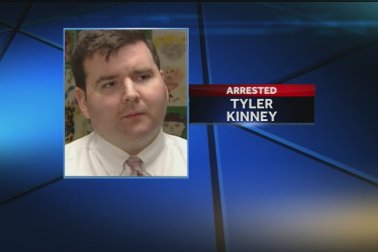
I sense the fine handiwork of the WPTZ graphics department.

I sense the fine handiwork of the WPTZ graphics department.

Every time I read about the case of Tyler Kinney, the Colchester officer who faces federal drug and gun charges, the same thing keeps coming to mind.

How in the blue hell did this go on so long?

Here’s a guy who was on the force for twelve years, and occupied one of its most sensitive positions — keeper of the evidence locker — for two and a half years. He was stealing stuff out of the locker, he had a “heroin addiction for an extended period of time,” and he was sharing his swag with a career criminal with a rap sheet as long as your arm and two felony convictions.

On top of all that, Kinney’s addiction and malfeasance came to light accidentally, after an unrelated search of the career criminal’s home. Absent that coincidence, Kinney might have gone on stealing stuff and destroying God knows how many prosecutions that depended on secure evidence storage.

News coverage of the case, so far, has focused on Kinney himself. But what of the institutional framework around him?

The overarching question breaks down into two parts.

1. What kind of internal oversight does the Colchester police have on its evidence locker and the sole keeper thereof?

2. What is the department’s drug testing policy for its officers? Does it have any? How often does it conduct tests? What drugs does it test for?

the_whizzinator_83385And how are the tests conducted? Is the officer monitored while, ahem, providing a sample? Or is there opportunity to game the test via the Whizzinator route?

The Colchester Police Department should answer these questions in detail. Necessary reforms must be enacted. If internal policies were not followed, those responsible should answer for their inactions.

Lest we lay all of this at the feet of Colchester Police Chief Jennifer Morrison, allow me to note that she’s only been there for a little over a year. The previous Chief, Charles Kirker, who had been chief for the previous 34 years, needs to give some answers too. Especially in light of this sentence from a softball Burlington Free Press interview on the occasion of his retirement:

My philosophy has always been to delegate to subordinates because you allow them to grow.

Yeah, nothing could possibly go wrong with that.

Beyond Colchester, the same questions should be put to the Department of Public Safety. What are the standards for the State Police? Are there standards that local police agencies must meet?

If not, why not?

If a drug-addicted officer can occupy a critical position of trust for two and a half years, only to be caught by accident, then either there was a complete breakdown in the Colchester police, or there are systemic shortcomings that must be addressed.

That’s all. I’ll hand this over to the watchdogs of the media.