Category Archives: JIm Douglas

In which I dip my toe into Jim Douglas’ Well of Lost Dreams

A friend in the media loaned me a review copy of ex-Governor Douglas’ memoir, “The Vermont Way.”  And I’ve started working my way through it.

It’ll definitely be “work,” too. I could tell from the first page that, leaving aside my opinion of Jim Douglas, this book is badly written. It’s flat, wooden, and wordy. This sentence, referring to Springfield, Massachusetts, says it all:

It was the county seat, the city where I was born and a municipality adjacent to the suburb, East Longmeadow, in which my family lived.

Boy howdy. Hemingway couldn’t have said it better.
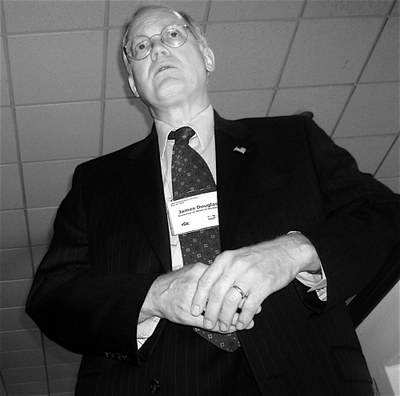
(Photo by the late great Peter Freyne.)

(Photo by the late great Peter Freyne.)

If that was an outlier, Douglas (and his publisher) could be forgiven for a lapse in copy editing. But there’s more. Oh, so much more. Here’s a passage where he might have offered something fresh about Deane Davis, the Republican Governor when Douglas was launching his political career. Instead, he gives us a dry recitation of Davis’ resume:

He was two days away from turning sixty-eight and had completed a successful career as a lawyer, judge, and chief executive officer of the National Life Insurance Company. He had served as president of the American Morgan Horse Association and led Vermont’s Little Hoover Commission, the group that recommended reorganization of state government in the late ’50s.

Morgan Horse Association? What the frack?

If a high school student had written this, he would have gotten dinged for padding the word count. When it comes from Jim Douglas, not only is it lousy writing, but it fails to deliver the kind of insight I’d expect.

Here’s a dinner winner from what should have been a fraught passage — the announcement of the draft lottery during his college years, which would send some of his classmates off to Vietnam. And instead of some hint of emotion or empathy, we get another sentence unworthy of a high school essay:

These days, of course, military service is voluntary, but there have been times in our nation’s history when compulsory induction has been necessary to adequately staff our armed forces.

And by “adequately staff,” he means “replenish our battle-ravaged troops.”

The sentence adds nothing whatsoever to the narrative. Every page has examples of pointless padding, of layer upon layer of verbiage meant to insulate Jim Douglas from betraying actual human feeling or revealing unique insight into his life and career.

Chapter One ends with a passage concerning Douglas’ alleged curiosity about the world outside Vermont. He had studied Russian at Middlebury College; primarily, he says, because it was “the height of the Cold War,” which he defined in a manner, once again, unworthy of a high school essay:

Soviet Premier Nikita Khruschev had proclaimed to the United States and other Western democracies, “We will bury you!” and later, for emphasis, banged his shoe on a desk at the United Nations.

These aren’t the words I’d expect from someone who grew up in the Cold War, with the Cuba missile crisis and air-raid drills and bomb shelters full of rations and bottled water. These are words I’d expect from a youngster who looked up “Cold War” on Wikipedia.

He goes on to talk about this curiosity regarding “other cultures” that “never abated,” and was fulfilled to some degree by his gubernatorial travels. The first “other culture” he mentions is Canada, that strange and distant land and “our largest trading partner.” He then rattles off the other stickers on his gubernatorial steamer trunk: Vietnam (where “the people are very friendly”) and 13 other countries listed in alphabetical order — the most unimaginative rendering possible.

There are no revealing anecdotes, no indication of what he learned or where his alleged curiosity took him. I suspect it mostly took him to official meetings and staged VIP tours. Either way, we get no hint that his journeys gave him any insight. After this perfunctory paragraph, “China,” “Vietnam,” and “Korea” only appear once in the book’s index. All three are mentioned on the same page, in a tossed-off recap of a trip “with business leaders” that “generated a large number of investors and inquiries.”

This is supposedly one area of human experience that really engages Jim Douglas’ intellect, and it’s reduced to a dry, soulless recitation of facts.

I’m only through part of chapter three, but one thing I can tell you:  Whatever you think of Jim Douglas as a politician or leader, this book has to be a disappointment. It is so much less than it could have been.
Jim Douglas: It gets worse

As I reported a couple days ago in this space, Jim Douglas’ new memoir includes a passage that accuses Governor Shumlin of public corruption — of giving a seat on the Vermont Supreme Court to Beth Robinson, a political ally, as a reward to her and to an important constituency. Here it is again:

“The Senate leader, who succeeded me in the governorship, was a strong proponent of gay marriage. Since he was nominated by a scant 200 votes in the Democratic primary, their support may well have provided the margin of victory. He later reciprocated by appointing one of the leading lobbyists of the movement to the Vermont Supreme Court.”

The key word there is “reciprocated.” Douglas is saying that there was a quid pro quo — one of the state’s highest offices was bartered away as a political reward.

Well, on September 11, Douglas was a guest on WDEV’s Mark Johnson Show. When Johnson asked him about the passage, Douglas doubled down — claiming that Robinson is unqualified:

With all due respect to the Justice, I think it’s hard for most Vermonters to believe that she would have risen to the top of the pack but for her leadership on that issue.

“With all due respect,” my ass. Jim Douglas is saying that Beth Robinson had no business being chosen to the high court, and that this is so obviously true that “most Vermonters” would have a hard time believing she was nominated on merit.

Johnson, taken aback by this rather bold assertion, asked if Douglas really believed she was appointed because of her work on the marriage equality court case.

She obviously became well known because of that, and, um… [long pause] who knows?

A wonderful piece of passive-aggressive political attack. Johnson asked “What do you base that on?” Douglas offered no evidence; instead he quickly changed the subject.

His comments about Robinson were baseless and mean-spirited. They’re of a piece with his allegation that Shumlin made a corrupt deal to put her on the high court.

Which, I say again, should have been the top headline news out of Douglas’ memoir. I remain stunned that, with the exception of Mark Johnson, no one in the media has mentioned it at all.


Jim Douglas accuses Governor Shumlin of public corruption

The most dramatic moment of Saturday’s gubernatorial debate had nothing to do with the 2014 campaign or the positions of the four candidates. Instead, it came at about the 36-minute mark, when moderator Mark Johnson asked Governor Shumlin about a passage from former Governor Jim Douglas’ memoir, “The Vermont Way.”

Here is the direct quotation from Douglas’ book, as read by Johnson:

“The Senate leader, who succeeded me in the governorship, was a strong proponent of gay marriage. Since he was nominated by a scant 200 votes in the Democratic primary, their support may well have provided the margin of victory. He later reciprocated by appointing one of the leading lobbyists of the movement to the Vermont Supreme Court.”

Am I the only one who is shocked by that?

Jim Douglas is accusing Peter Shumlin of public corruption at the highest level — of giving away a seat on our state’s highest court as part of a political deal. By doing so, he implies that the recipient of Shumlin’s putative largesse, Beth Robinson, is unqualified to be on the Court.

Jim Douglas has said repeatedly that he isn’t in the business of criticizing his successor. He sure has a funny way of showing it.

Not only did Douglas think this, not only did he say it — he committed it to writing in his own official account of his years in office. (His editor/publisher, Democratic State Senator Chris Bray, allowed it to stand. What was he thinking?)

This is despicable, and Douglas deserves full criticism for it. And it is certainly not, in the words of his self-aggrandizing title, “The Vermont Way.”

Funny thing, though: Every media outlet in the state produced stories about the Douglas memoir. As far as I know, not a single one mentioned this passage, in which Jim Douglas accuses Peter Shumlin of public corruption. A crime.

Mark Johnson was the first, and only, media person to report this.

Most of the media accounts of the Douglas memoir (aside from Paul Heintz’ hard-hitting review in Seven Days) were softball affairs. They sorta mentioned Douglas’ long-held grudges against the media, but otherwise downplayed anything that might be controversial or reflect badly on Douglas. That is a remarkable failure by our watchdogs of the Fourth Estate.

By the way, the other three candidates for Governor recognized a white-hot potato when they saw it. None expressed the tiniest bit of criticism for Shumlin or Robinson. They all, including Republican Scott Milne, backed away from the question as fast as they could. None even mentioned the name “Jim Douglas.” A wise choice.

The limits of messaging

Just finished listening to a Reporter’s Roundtable on VPR*, with three of the better reporters around — VTDigger’s Anne Galloway, VPR’s Peter Hirschfeld, and the Freeploid’s Terri Hallenbeck– examining the entrails of last week’s primary election and the prospects for November. 

*Audio not yet available online, but it should appear here later today. 

Thin gruel, to be sure; the key races are essentially over, with the possible exception of Phil Scott vs. Dean Corren for Lieutenant Governor. But when the race for a mainly ceremonial position is your biggest source of intrigue, well, that tells you all you need to know. 

There was a lot of dancing around the fact that November is in the bag for the Democrats, with the noble exception of Galloway coming right out and saying that Governor Shumlin was going to win. The dancing is understandable, considering that (1) journalists want to appear objective, and (2) as political journalists, they’ve gotta cover this puppy for two more months, and what fun is it when there’s no intrigue? 

Much of the dancing centered on the idea that good “messaging” could carry a Republican candidate into a competitive position. The Dems aren’t invulnerable, the reasoning goes, it’s just that neither Scott Milne nor Dan Feliciano seems capable of delivering a solid, appealing message. 

That’s true, insofar as it goes. But there are three much more powerful factors operating against the Republicans: most voters pay little or no attention to messaging, the electorate is solidly center-left, and today’s Republican Party has little to offer on the key issues in Vermont. 

First, reporters and insiders overestimate the impact of tactics and strategy and messaging. The vast majority of voters have their minds made up before the campaigning starts. The only thing that could change their minds is some sort of shocking revelation or catastrophic event. Some voters do actually watch debates and bring an open mind to campaign coverage, but they only matter when an election is otherwise close. 

Second, it’s obvious from the results of the last decade or so that most voters prefer Democrats. The Legislature has been solidly Democratic for years. Among statewide Republicans, only Jim Douglas and Phil Scott have been able to buck the trend. Both have done so because of their unique personal appeal and by projecting an image of moderation and willingness to compromise. 

And third, Shumlin and the Dems are potentially vulnerable on issues like health care reform, the Department of Children and Families, the economy, taxation (especially school taxes), and the environment (Lake Champlain, the natural gas pipeline). 

On all those issues, the most appealing solutions involve more government, not less. Shumlin is more vulnerable to his left than to his right. 

In spite of Vermont Health Connect’s troubles, health care reform remains popular. Republicans have no answer aside from letting the market do its magic. Fixing DCF would require more resources, or at the very least more effective management. Have the Republicans given anyone reason to believe they care more than the Dems about poor people? Hell, no. Do the Republicans have a track record of good management? Only in the minds of Jim Douglas and Tom Pelham. 

Would the Republicans be better stewards of the environment than Dems? Ha ha. Can they plausibly portray themselves as defenders of public education, which remains extremely popular in Vermont? No; their only solutions are competition and union-busting. Can they convince voters that they’d preserve local control? Not if you could saw money by centralizing. 

On the economy, the Republicans have little to offer aside from the tired, discredited supply-side nonsense. Which took another bullet yesterday with the news (from the Federal Reserve Bank) that our post-Great Recession “recovery” has benefited the wealthy while middle- and working-class wealth has actually declined. One-percenters and corporations have a larger share of our wealth than ever, and all the Republicans can offer is policies that will further enrich the rich. 

And as for taxation, Vermonters may be dissatisfied with rising school taxes and worried about the cost of single-payer health care, but they also favor a robust government that can tackle problems effectively. Most voters don’t want a mindless “cut, cut, cut” approach, and that’s the standard Republican line. 

Here’s what a Republican would have to do, to be competitive on a statewide level: Bring an established reputation for effective governance, or at least an open-minded attitude toward the notion that government can actually solve problems. Express skepticism about political dogma, especially the cherished beliefs of the right. And do that without, somehow, losing too much support among the Republican base. And, finally, regain the support of the business community, which has largely abandoned the VTGOP in favor of a cooperative relationship with the Democrats. 

Now. If a Republican can identify and execute a strategy that accomplishes those things, s/he can win. Otherwise, no amount of good messaging will carry the day. It’s not impossible; there’s at least one potential Republican candidate who could manage it. But he ain’t running this year. 

Everybody loves good ol’ Phil

I think I’ve identified the source of Lake Champlain’s outbreak of blue-green algae: last week’s party in Senator Dick Mazza’s Corvette-laden “garage” on behalf of Lieutenant Governor Phil Scott. Enough horseshit was generated to feed an algae bloom for months.

I’m sorry I missed it. Guess my invitation got lost in the mail. Fortunately, the Freeploid’s Nancy Remsen was there, and made the Mazza Tov the centerpiece of her Phil Scott profile in the Sunday paper. From her account, I extract a few gems…

The Republican lieutenant governor glad-handed Republicans, Democrats, lobbyists and business leaders…

I guess Good Ol’ Phil won’t be a supporter of VPIRG’s campaign finance reform agenda. Just a guess.

“It is great to see such a bipartisan crowd,” [former Governor Jim] Douglas observed. He wasn’t surprised, he said, noting, “Phil Scott is the kind of Vermonter who doesn’t worry about someone’s party label.”

Immediately thereafter, Douglas revealed himself to be the kind of Vermonter who DOES worry about party labels:

Douglas urged the crowd to help re-elect Scott to “make sure we don’t have lopsided government.”

As I have observed before, should we be electing people based on affirmative action? Or should the onus be on Republicans to craft a message that actually resonates with the Vermont electorate?

Oh wait, here comes Senate Penitent Pro Tem John Campbell, who was on hand to offer his almost-not-quite-nudge-nudge-wink-wink non-endorsement.

“I’m here to support a friend,” Senate President Pro Tempore John Campbell, D-Windsor, said as he stood near Scott in the Corvette showroom. Campbell qualified his support, saying, “I’m not raising funds for Phil.”

Isn’t that nice. I guess I shouldn’t think of this as treason.

No, I guess not, because as Campbell says, he’d support a real actual Democrat for Lieutenant Governor, but he won’t support Progressive Dean Corren even if he wins the Democratic nomination. Campbell just can’t overlook Corren’s long-ago “bashing” of Democrats, even though today’s Corren has definitively foresworn any and all Dem-bashing, promises to work hand-in-hand with Democrats, and is much more politically aligned with Governor Shumlin than is Phil Scott. But I guess Campbell, like Jim Douglas, is unfortunately obsessed with party labels.

Also on hand, making excuses for their Phil-anthropy, were State Senator Dick McCormack and Burlington Democrat Ed Adrian. McCormack “acknowledged that his views on many issues are probably closer to Corren’s, ‘but what I’ve done with Phil really counts for a lot.'”

Awwwww, how thweet. As for Adrian, well, he offered his own variation on the VTGOP’s affirmative action theme: keep Phil around as the token Republican.

If Democrats occupy every position of power, they are just going to fight among themselves. What is wrong with having a moderate, token Republican who would frankly be considered a Democrat elsewhere in the country?

Sorry, Ed, color me unconvinced. What’s wrong with having a “token Republican” in the Lieutenant Governor’s office is that, as a member of the Senate Rules Committee and the tiebreaking vote on legislation, he could become a significant roadblock in the push for single-payer health care and campaign finance reform. And I am unmoved by the fact that Scott would be considered a Democrat in West Virginia or Nebraska. It’s like Roger Allbee running for a Democratic Senate seat in Windham County: he may be a liberal Republican and he might make a really good Senator from, oh, Rutland County or the Northeast Kingdom, but he’s too centrist for the Windham electorate. Same with Scott: he’d be a fine Lite-Gov if it were entirely a ceremonial position, and he’d be a breath of fresh air in Montana or Wyoming, but as Lieutenant Governor of Vermont he’s a potential obstacle to Governor Shumlin’s top priority. Which is why Shumlin has all but endorsed Dean Corren.

Maybe it’s because I’ve never had the chance to fall under the up-close-and-personal spell of Phil Scott’s charms*, but I don’t get the Scott fetishism among so many of our Democratic officeholders. It’s reminding me quite a bit of the Vince Illuzzi fetishism of two years ago. Nobody gave Doug Hoffer much of a chance because he was a Progressive, and a rather abrasive one at that, while Everybody Loved Vince.

*Maybe it’s his private-label cologne, a bi-attractant blend of pleasing moderation with rich, manly undertones of racing fuel and asphalt. 

Except when it came Election Day, it turned out that the inside-the-Dome crowd didn’t represent the electorate as a whole. I’m hoping the same thing happens with Corren, for the sake of single-payer’s prospects in the Senate, and in order to drive another stake into the heart of the old-boys’ network, go-along-get-along atmosphere that beclouds our Most Stagnant Deliberative Body.

The boy in the bubble

During Scott Milne’s campaign kickoff this week, former Governor Jim Douglas hailed the travel agent/real estate developer as a person “outside the bubble, unaffected by the stale air of the State House.” At the time, I noted the irony in those words coming from a man who lived practically his entire adult life in that very bubble. Indeed, without a doubt Jim Douglas himself produced a substantial portion of that “stale air.”

(Photo by the late great Peter Freyne.)

(Photo by the late great Peter Freyne.)

But enough subtly-worded fart jokes. I thought it was worthwhile to hammer home the point in more detail… after I make a brief detour to Douglas’ other unintentional laugh line: he invoked that discredited VTGOP talking point about Vermont getting an “F” in a “study” of friendliness toward small business.

Oh no he di’nt.

Oh yes he di’id.

As I’ve said on more than one previous occasion, this was an unscientific, mass-mailing survey conducted by the small-business website Thumbtack.com. It’s been done in each of the past three years. But Vermont was only included in the survey results for the first year, 2012, because in the two following years, not enough Vermont businesspeople responded to the survey.

Vermont’s “F” was from the 2012 study. Which was taken (1) at a much earlier point in our recovery from the Great Bush Recession, when things were lousy for almost everybody, (2) only months after Tropical Storm Irene devastated much of Vermont and derailed Governor Shumlin’s agenda, and (3) only a year and some change into Shumlin’s time as governor.

So that “F” could be credited as much to Jim Douglas as to Peter Shumlin. And it doesn’t take into account any of Shumlin’s subsequent efforts to make Vermont a better place for entrepreneurs.

In short, the grade should not be taken seriously as a measure of Vermont’s business atmosphere. Which didn’t stop Douglas from perpetuating the lie.

Okay, now let’s take a closer look at the Douglas resume, shall we?

He was elected to the House in 1972 at the age of 21, only months after graduating from college. He served in the Legislature until 1979, when he became one of Dick Snelling’s top aides. A year later, he ran for Secretary of State and won; he’d go on to serve six terms.

In 1992, he lost to Pat Leahy for U.S. Senate. For two years after that, as far as I can tell, he was out of government service.

Then in 1994 he ran for Treasurer and won. He served until 2002 when he was elected Governor. He served four terms and retired in 2010. Well, technically, January 2011.

That’s 38 years of his adult life, minus two years, giving us a total of 36 years at the public trough.

No wonder the Wall Street Journal called him a “career politician.” 

The Journal’s 2011 article took Douglas as an example of the difficulties older executives face when embarking on a second career:

Finding a fresh pursuit in midlife is never easy. The challenge looms especially large for top managers with experience in just one industry, however. Mr. Douglas has spent his entire adulthood in politics.

All right, now let’s look at Peter Shumlin, the guy who, I suppose, is Douglas’ exemplar of a person who’s lived too long in the bubble.

Shumlin was appointed to a vacancy in the Legislature in 1990, and served one and a half terms. He then served in the Senate for ten years. He ran for Lieutenant Governor in 2002 and lost.

After that, he spent four years in his family’s business, Putney Student Travel. In 2006 he returned to the State Senate, where he served until being elected Governor in 2010.

From 1990 to the present, that’s 24 years. Minus the four years outside government, that’s 20 years breathing the stale air inside the bubble.

20 for Shumlin. 36 for Douglas.

Now look, Scott Milne’s status as an outsider with a fresh perspective is a respectable enough talking point if you like that sort of thing. But Jim Douglas is the worst possible person to deliver the message. Coming from his mouth, it was completely hypocritical.

A new nominee for the Most Dangerous Republican award

Last December, around the time of the fabled Chris Christie fundraiser for the Vermont Republican Party (projected take, a quarter mill or so; actual take, less than 50K as far as I can tell from the party’s financial filings), I posited that there was one figure in the downtrodden VTGOP who could pose a threat to the Democrats as a statewide candidate. It wasn’t Phil Scott; it was the closest thing we have to a Chris Christie — a short-tempered, get-things-done, “willing to work with both sides” kind of guy named Thom Lauzon, Republican Mayor of Barre. 

I still think he’s a solid potential statewide candidate, should he ever choose to climb the ladder. But another name has been suggested to me, and it’s an excellent choice. In fact, offhand I’d have to say he’s an even better Most Dangerous Republican than Lauzon.

I’ll give you the name, but first it’s Story Time, kids!

Starting in 2002, Craig Benson spent two disastrous years as Republican Governor of New Hampshire. While he was Governor, he appointed a little-known lawyer named Kelly Ayotte to the post of Attorney General. (In NH, the AG is an appointed position with a five-year term.) By the time her first term had come to an end,  John Lynch was Governor. He was a Democrat but he liked to play the bipartisan game, so he nominated her for a second term.

Before she served out that term, she resigned to run for U.S. Senate. And she won. And she’s now the only Republican member of NH’s four-member Congressional delegation.

The key moment in her ascendancy was her renomination by John Lynch. If he’d appointed a Democrat and sent her packing as a one-term Benson functionary, she would’ve had a much harder time continuing her political career. I firmly believe that there would never have been a Senator Kelly Ayotte if not for John Lynch being too clever for his own good.

Thus endeth the lesson. Back to Vermont, and the new nominee for Most Dangerous Republican.

Neale Lunderville.

At one time, he was the chief hothead on Jim Douglas’ team. He and Jim Barnett, who’s gone on to a very unsuccessful career as a balls-to-the-wall campaign manager, were dubbed “the Nasty Boys” by the late great Peter Freyne for their skilled knifework in Douglas’ campaigns.

Since then, little Neale has grown up — and gotten two great big helping hands from Democratic officeholders. Governor Shumlin chose him to be recovery czar after Tropical Storm Irene, and now Burlington Mayor Miro Weinberger has engineered his hiring as interim head of the Burlington Electric Department.

In the process, the Nasty Boy has acquired a solid nonpartisan reputation as the go-to guy when trouble strikes. He’s been chosen by not one, but two, top Democrats to take on big administrative challenges.

Okay, here’s a hypothetical for you. In the next biennium, the Shumlin administration will unveil its plan for single-payer health care. It’ll be big, expensive, controversial, and a tough sell, even in a lopsided Democratic legislature. Win or lose, Shumlin will expend a lot of his political capital in the fight.

He also faces the whole issue of school funding and organization. Whatever he and the legislature do, more enemies will be made and more people will be alienated.

At best, Shumlin would enter 2016 having fought two extremely tough battles. Even if he wins on single-payer, he’ll be in that very dangerous period between passage and implementation, where everybody will be aware of the cost and the controversy but won’t have experienced any benefit from the new system. And if the implementation process for single payer OR school reform is difficult, contentious, or includes any stumbles, the Governor’s managerial reputation will take more hits.

And now comes, on a shiny white horse, Neale Lunderville.

Well, Lunderville 2.0, New and Improved with a track record for working under Democratic executives and managing the biggest challenges. In short, he’s Vermont’s Mr. Fix-It. The Governor won’t be able to depict Lunderville as a partisan ideologue because, after all, he chose the guy to manage the aftermath of Irene. At the same time, Lunderville will have solid Republican credentials from his tenure in the Douglas Administration. He’ll be more appealing to the conservative base than a Phil Scott will ever be.

The VTGOP won’t be in any shape to challenge the Democrats’ overall  dominance in 2016. But Lunderville could do what Scott Milne can’t do and Randy Brock couldn’t: topple Governor Shumlin.

Farfetched or believable? Just remember, if it happens, you can thank Peter Shumlin and Miro Weinberger for making Governor Lunderville a possibility.

Milne: I will not vilify Shumlin, but he’s a brazen, bullying, radical ultra-progressive

Warm day in downtown Barre. Small crowd, mainly retirement age (Yr. Obdt. Svt. included) gathering on the front lawn of the Aldrich Public Library. The occasion? Scott Milne’s long-awaited launch of his gubernatorial candidacy.

Phil Scott was there. Jim Douglas was there. My frenemy Senator Joe Benning was there.

Who wasn’t there? Well, as far as I could tell, Barre’s Republican Mayor Thom Lauzon wasn’t there. And he usually manages to make himself conspicuous wherever the cameras gather. Interesting. I seem to recall Paul “The Huntsman” Heintz reporting that Lauzon and his wife donated $2,000 to the Governor’s campaign.

Checking… yes, yes he did.

Still, the front section of the library, comfortably air-conned, was full of Milne supporters and the legions of media desperately looking for a sure-fire story during the summer slump.

Milne was introduced by Douglas, who gave Mr. Bunny a hearty endorsement after delivering what sounded very much like a statement for his own candidacy. (Must’ve made a few hearts flutter in the Republican audience and wish for What Might Have Been; Douglas is their Beau Ideal.)

Douglas lauded Milne’s experience in “the real world” of business and commerce, a person “outside the bubble, unaffected by the stale air of the State House.” That’s rich, coming from a guy who spent virtually his entire adult life in that very bubble.

And then the Man of the Hour stepped to the plate, promising “a campaign of ideas” and said that he would “not be vilifying the Governor.”

In the following few minutes, Milne used these words in direct or indirect reference to the incumbent: doubting that Shumlin’s course is “responsible and realistic,” calling the Governor’s agenda “ultra-progressive,” referring to Shumlin as “headstrong about the need for exuberance and rapid, radical change,” characterizing his Administration as one of “unbridled experimentation,” and decried the use of “bullying tactics” and “brazen displays of power.”

But he won’t be “vilifying” the brazen, bullying, headstrong, radical, ultra-progressive Governor. Bwahahaha.

By contrast, Milne depicted himself as moderate, “cautious,” “responsible,” and reluctant to make any wholesale changes. He said “cautious” a bunch of times.

The strategy, thus, becomes clear: in order to capture the center, Milne will go all-out to portray Shumlin as a fire-breathing radical. Without, of course, vilifying him in any way.

It’s hard to see this working. Shumlin has too many centrist positions, spends far too much time courting the center, and caters to the business community far too often to be convincingly marginalized as an “ultra-progressive.” (When he said that, I could almost hear the guffaws exploding from Prog Central: “Shumlin a progressive? You must be joking!”)

Scrum!

Scrum!

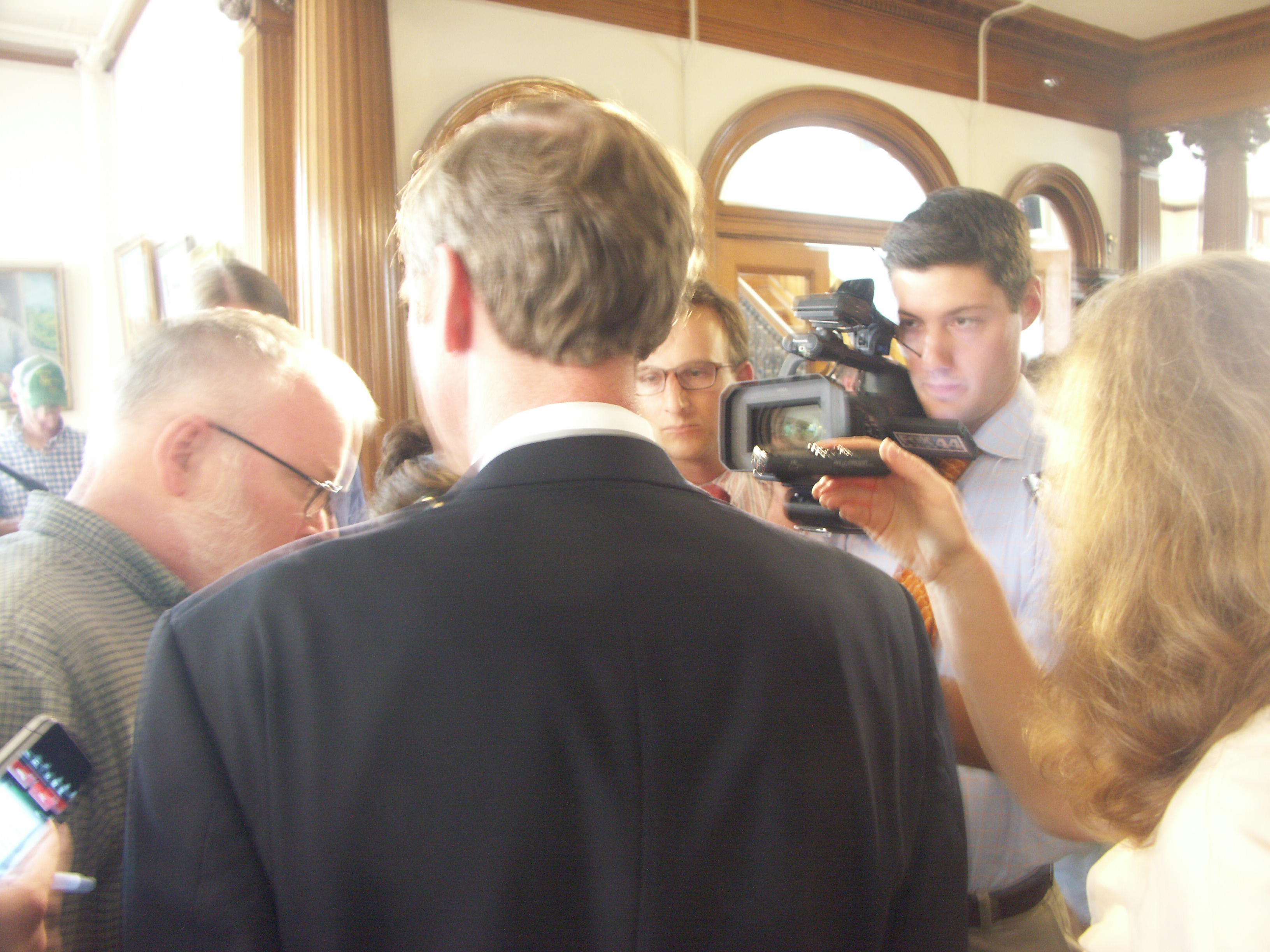
After his speech, his crew made their way to the Elks Club next door for a hamburger lunch. It took Milne a while to get there; he first had to submit himself to his inaugural media scrum. The key point for me was the inevitable exchange about Act 250, given his frustration and anger over the regulatory troubles facing his dream project, the mixed-use Quechee Highlands development. It’s run afoul of the regional Act 250 board and the town of Hartford.

Milne claimed that he is “very supportive of the concept of Act 250,” but then accused Shumlin of “hijacking something into a political ideology rather than a practical program that needs to be applied more pragmatically.”

Not exactly grammatical, but you get his drift. But when asked for specifics on how the Administration had hijacked the process, Milne came up short of the mark:

“I think if you look between the poor management at the Agency of Commerce over the last four years, very poor management at the Agency of Natural Resources, there’s very evidential answers right there.”

Not much meat on those bones, is there? He charges the Administration with “hijacking” the process — an aggressive power grab — and all he can offer as proof is a nonspecific charge of “poor management.”

Hey, a travel agent ought to know that it takes positive, organized action to hijack anything. You don’t do it by accident.

All in all, it was a happy event for the true believers. But if this is the tack Milne plans on taking, he’s gonna get shellacked by the Governor.

Oh, what the hell. Let’s judge a book by its cover

September 3, 2014: Vermont’s bookstores are certain to crack open their doors at the stroke of midnight, in anticipation of an overwhelming response to Jim Douglas’ three-years-in-the-making autobiography. Yeah, it’ll be just like the Harry Potter release crowds.

Well, maybe not. But while we still have almost three months to wait for St. Jim’s tome, we have gotten a gander at the cover.

And boy howdy, is it ever a… er… well… a thing. Jim-Douglas-book-released-Sept--3---img

The picture, title and subtitle, taken together, paint a broad-stroke portrait of arrogance in exile.

The image, Douglas in a suit w/obligatory flag pin, is a reproduction of his official state portrait. Next to him is the title: “THE VERMONT WAY.”

Oh dear.

The unspoken, but clear as day, message: Jim Douglas is the embodiment of the Vermont Way. He is the quintessential Vermonter, the carrier of Vermont values into a new and uncertain century.

And then the subtitle: “A Republican Governor Leads America’s Most Liberal State.” Underscoring what, I fear, will be one of the book’s central messages: Jim Douglas was a uniquely talented politician — the only person who could lead a constituency largely inimical to his party’s policies.

Which omits the fact that Vermont wasn’t nearly as liberal when Douglas took office as it was when he departed. During his eight years as Governor, the Republicans lost ground everywhere else in state government. By the end of his tenure, he could do little beyond castigating the Democrats for overriding his vetoes and ignoring his wise counsel.

Douglas definitely deserves some credit for passing a conservative camel through the eye of a liberal needle. But doesn’t he also deserve blame for the leftward shift of Vermont politics while he occupied our highest office? Doesn’t he deserve blame for leaving his party in shambles, with scant resources, no grass-roots organization, and a nearly complete lack of up-and-coming talent?

And doesn’t he deserve blame for leaving a legacy so pitiful as to be virtually nonexistent? How did he shape Vermont politics during his tenure, and how have his policies influenced post-Douglas political discourse? The answer, it seems to me, is not very much at all.

So he managed to “lead” America’s most liberal state, if only in the sense that he occupied the corner office. But while he was Governor, and even more so since he retired, his state did not follow him. In fact, it moved steadily in the other direction. It’s a severely limited kind of “leadership.”

As for the book cover’s visual equation of Jim Douglas with The Vermont Way… well, if that were true (which it’s not), we’d be well and truly fucked.