Gov. Phil Scott held a momentous press conference today/Wednesday, in which he and a whole bunch of lawmakers unveiled major legislation aimed at tackling Vermont’s housing crisis. (Nobody used the fabled term “omnibus,” but it would have been appropriate.)
It was inspiring, it really was. Scott shared the stage with Democrats and Progressives as well as Republicans, to launch an initiative that’s the end product of what had to be really hard and earnest tripartisan negotiations. It’s the kind of thing that Scott has managed to pull off on occasion when truly engaged. It’s the kind of thing that has earned him his (overblown) reputation for being less interested in politics than in Getting Stuff Done, a reputation that flies in the face of his all-time record for gubernatorial vetoes. Still, this time he rose above partisanship to put this bill together.
And given the truly “all hands on deck” nature of the unveiling, I expect they’re going to pull it off. Which would be remarkable, and a real accomplishment.
(Before I continue, I must explain the illustration at the top of the page. The event featured a whole lot of people sharing the stage with the governor. After the big reveal, Scott asked reporters to stick to the subject at first and hold other questions for later. After the housing questions were exhausted, Scott allowed the assembled guests to depart. Apparently some technician back at the office mistook the ensuing hubbub for the end of the presser, because the feed was cut off at that point. The rest of the Q&A was unavailable on either ORCA Media or WCAX. Oopsie!)
So here’s the place where I point out the turd in the punchbowl.
The event was in stark contrast to the situation with emergency housing for Vermont’s homeless, where the administration is sticking to an inhumane approach that will leave more than a thousand Vermonters, many of them disabled, elderly, or children, without shelter come April 1.
Tuesday was the Housing Policy Dog and Pony Show at the Statehouse. Housing-related officials from the Scott administration made the rounds of three House committees, talking about housing policy with an emphasis on helping the homeless. The big takeaway: Man, are we ever screwed.
The lead witness slash sacrificial lamb was Chris Winters, former deputy Secretary of State and former Democratic candidate for SoS, who now occupies the hottest seat in Montpelier — the commissionership of the Department of Children and Families, home base for the moral and administrative failure that is Gov. Phil Scott’s policy for dealing with homelessness. (Winters is pictured above with one of his deputies, Interim DCF Business Office Director Shawn Benham, speaking to the House Appropriations Committee.)
There were, as my headline indicates, a whole lot of hard questions and precious few clear answers. But the biggest and least-answered question of them all: How in Hell did we get to this place, where Winters and his team are hastily cobbling together a temporary shelter program that will, at best, house a fraction of those about to be unhoused when the state’s motel voucher program expires on April 1?
Well, we suspected that the Scott administration’s plan to create new shelter space would be cheap and bad. But they have outperformed expectations, and that’s not a good thing.
The full plan will be unveiled Tuesday morning before the House Appropriations Committee, but the outlines have now been reported by Vermont Public and VTDigger — oh wait, they each published the same report by the same reporter. Sigh. Our press pool isn’t shallow enough, and now our two leading nonprofit news organizations can’t even produce their own original work? Gaah.
But I digress. The plan, as outlined in the identical stories with identical titles, is just a horrific mess. Inadequate in all respects. It’s of a piece with the administration’s — and the Legislature’s — approach to homelessness: It seems to be aimed at covering official asses than in actually addressing the problem. And covering them with a teeny-tiny fig leaf at that.
It is to be hoped that the Democratic majority in the Legislature rejects this plan outright and devises a robust alternative. Housing advocacy groups are working on their own plan, which may be out by the time you read this.
Two crises. Both involve the concept of “housing,” but they are not the same and we should not confuse the two. Which seems to be the willful intent of the Scott administration heading into a legislative session in which housing will be near the top of everyone’s priority list.
Remember the administration’s big presentation to the Joint Fiscal Committee in November? The one I called “a gloomy overview that has to rank as one of the most depressing events I’ve experienced in my 12-ish years following #vtpoli”? The whole intent of that presentation was to conflate the two crises and, well, subtly shift the focus toward housing and away from homelessness.
Administration officials have continued on that track ever since. The starkest example of this was the opinion piece co-authored by Human Services Secretary Jenney Samuelson and Commerce Secretary Lindsay Kurrle that focused almost entirely on housing policy and virtually ignored the rolling humanitarian crisis of unsheltered homelessness that state policy is creating.
I suspect we’ll get a heavy dose of the same in Gov. Scott’s state of the state address on Thursday. And we shouldn’t fall for it.
Last week, the federal government issued its big annual report on homelessness in America. Not that you’d know it from the Vermont media; the only story I saw about it was a national Associated Press article that the Times Argus ran on page 2.
Which is a damn dirty shame, because the federal report contains a lot of information about Vermont’s situation, which got quite a bit worse from the previous year — and has gotten substantially worse since then.
This news wouldn’t have taken any real effort to uncover. But hey, I guess we’ve had our fill of bad news on homelessness. Such a downer, you know.
The report in question is the U.S. Housing and Urban Development’s Annual Homelessness Assessment Report to Congress. It takes data from a “point in time” (PIT) — a single night in January 2023 — and turns it into a real deep dive on homelessness. It’s an imperfect instrument that almost certainly produces significant undercounts because, well, the unhoused can be hard to find. But it does provide a lot of valuable information.
The depressing topline: Homelessness in America increased by more than 12% from the previous year’s AHAR. Vermont, again, had the second worst rate of homelessness in the country, trailing only New York. (In the 2022 report, Vermont came in second to California.)
Well, you might say, we might still be bad, but at least we didn’t get any worse.
Not so fast, my friend.
The AHAR data shows that homelessness in Vermont increased by 18.5% from the previous year, a jump more than 50% higher than the abysmal national figure.
And we know for a fact that things have gotten even worse in Vermont since the PIT count was taken eleven months ago.
How so? Let’s take a step back. The AHAR count includes all the unhoused — both sheltered and unsheltered.
“Wait,” you might be saying, “how can a sheltered person be homeless?”
Anyone with no fixed address is considered homeless, even if they’ve resorted to couch-surfing or staying with a relative or squatting in an abandoned building or, horrors, returned ot a home they’d fled to escape an abusive or addicted or criminal partner. Those people have shelter, but it isn’t a stable, lasting arrangement. They can’t count on it. It might be a roof over their head but it isn’t, well, home.
Step forward. In the 2023 AHAR, Vermont scores very well in one measure. We have a lot of homelessness, but we have a relatively low rate of unsheltered homeless. Most of our unhoused have places to stay.
Ahem. They did, until the Scott administration and the Legislature decided to ramp down the motel voucher program, which had kept thousands of unhoused Vermonters in liveable shelter. The program was dramatically cut at the end of June, and the administration has been doing its level best to ratchet down eligibility since then. Most of the people who were staying in motels last May are now out of the program. And only a small fraction of the departees are known to have found stable housing arrangements. So it’s a virtual certainty that the ranks of our unsheltered homeless have swollen dramatically since the PIT count was taken in January.
But wait, there’s more!
Since federal pandemic-era rental assistance programs have ended, more and more people have fallen far enough behind on rent to be subject to eviction. As Seven Daysreported last week, sheriff’s departments across Vermont are up to their ears in court-ordered evictions they have to enforce. And it seems certain that more are on the way. It takes months, at least, for a tenant to fall far enough behind to be subject to eviction. Says here we’re only at the beginning of a wave of forced unhousing. Rental supplies are abysmally short, prices are skyrocketing, and many Vermonters — even those with steady employment — can’t keep up.
Homelessness in Vermont has almost surely increased, by quite a lot, since the PIT count in January. There is every reason to expect that it will get even worse. And yet, it doesn’t seem like anyone’s paying attention. Since early November, when administration officials issued a truly dire assessment of our housing shortage to lawmakers — and the media pretty much ignored that hearing — there’s been almost no reporting about the situation.
The decision by administration and Legislature to slow-walk the dissolution of the voucher program averted a singular humanitarian disaster. Instead, it’s been spread out over a period of months and months. A slow drip-drip-drip, not a tsunami. If I were a cynical sort, I’d suspect that Our Leaders wanted to avoid the impression of a catastrophe by enacting it in slow motion. It seems to have worked. That’s a damn shame. And a damn disgrace.
I don’t know what we expected when we ended the motel voucher program and failed to address the opioid crisis with appropriate urgency, but this is what we should have expected.
The above photo of City Hall Park, posted on SeeClickFix, is disturbing to say the least. Some have responded on Twitter with laments about the decline of Paula Routly’s “beautiful burg” and strident calls to Do Something.
By now, I’m sure that Something Has Been Done. But when you have the sheer quantity of human misery now present in Burlington, you’re only playing a grim game of Whac-A-Mole. Unless you hire enough police to have a cop on every corner 24/7, this is going to happen. Or get worse.
You’d think the head of the biggest and most complicated agency in state government would have quite enough on her plate without dipping her toe into housing policy. But somehow, Human Services Secretary Jenney Samuelson found time in her busy schedule to co-write an opinion column — you know, those things nobody reads? — that addresses our housing crisis without ever mentioning our ongoing humanitarian disaster of unsheltered homelessness.
Samuelson co-wrote the piece with Commerce Secretary Lindsay Kurrle, whose job description actually includes housing supply issues. I’ve got no problem with Kurrle promoting the Scott administration’s housing push. But Samuelson? Coming from her, the piece comes across as dishonest and disengenuous.
The biggest howler comes right near the top, where the two secretaries boast that “we’ve been successful in transitioning an unprecedented number of Vermonters out of homelessness” this year.
Great, congratulations. What they don’t mention, of course, is that the unprecedented need for shelter was triggered by THE SCOTT ADMINISTRATION’S INSISTENCE ON ENDING THE MOTEL VOUCHER PROGRAM.
Lately there’s been a big jump in the number of housing units being used as short-term rentals. You know, VRBO, AirBnB, those fine folks. According to a story co-produced by Vermont Public and VTDigger, “the number of homes listed on platforms like Airbnb and VRBO has grown rapidly over the last several years, following a brief pandemic downturn.”
September, in fact, saw an all-time high in units listed on short-term rental sites: 11,747, which is a 16% increase over September 2022.
Short-term rentals are not the sole cause of our dire housing shortage. If we totally eliminated the industry, we’d still have a housing crisis on our hands.
But it sure doesn’t help. And at a time when the Scott administration has committed itself to addressing the issue, why in holy Hell did they use public dollars to help underwrite a short-term rental conference this past weekend?
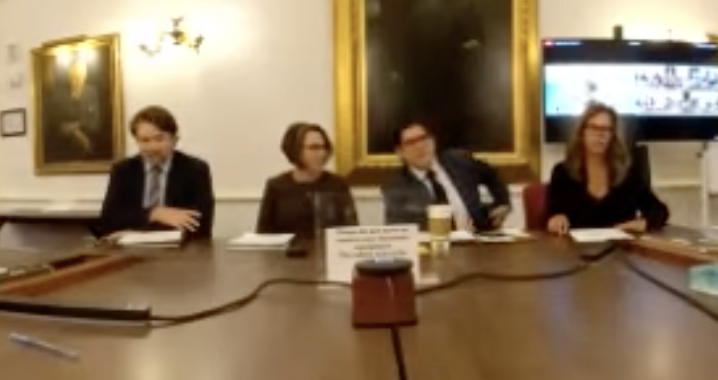
If the above image looks a little fuzzy, thank the limitations of the Legislature’s system for recording and livestreaming its hearings. But it reflects the situation we face on housing: Our public leaders seem small and indistinct when discussing the enormity of Vermont’s housing shortage, and their explication of the crisis was long on broad pronouncements and short on specifics.
The Scott administration’s A-team, pictured above, appeared before the Legislature’s Joint Fiscal Committee and delivered a gloomy overview that has to rank as one of the most depressing events I’ve experienced in my 12-ish years following #vtpoli. Doesn’t quite top Peter Shumlin’s surrender on health care reform or his near defeat at the hands of Scott Milne, but it’s not far behind.
The big takeaway: The housing crisis is even worse than we thought. From top to bottom, end to end, from the most basic of living spaces to the most extravagant, we don’t have nearly enough. Oh, and the epidemic of unsheltered homelessness that Our Leaders assured us was all taken care of last winter? That’s going to get even worse before it has a hope of getting better. And the “getting better” is going to take years.
And the interim solution, if they can manage to pull it off, is a massive increase in emergency shelters, most likely of the congregate variety. That, for a population ill-suited for such arrangements.
The Scott administration has published its monthly report on the GA emergency housing program (as mandated by the Legislature), and it’s nothing but bad news.
The report is downloadable (look for “Pandemic-Era Housing Reporting – October”) from the website of the Legislature’s Joint Fiscal Committee, which will take up the report at its meeting on Tuesday, November 7. I suspect we’ll be in for more earnest expressions of concern, sad head-shaking, and fresh statements of determination to find answers.
The numbers tell a story of stasis. Barely any discernible progress in creating new housing or shelter, only the slightest dent in the number of people staying in state-paid motel rooms, and only a relative handful who managed to find alternative housing in October. This, despite an evident push by administration officials to move people out of the prgram, as reflected in the continuing efforts by former gubernatorial candidate and housing advocate Brenda Siegel, who just received the ACLU of Vermont’s David W. Curtis Civil Liberties Award. Her Twitter feed continues to feature stories of people who are obviously and painfully needy, but who are nonetheless losing their eligibility for motel vouchers.










 The Vermont Political Observer.