Category Archives: Health care reform

Shumlin’s strategy is focused on 2015

The Shumlin Administration’s decision to shut down the Vermont Health Connect website drew the predictable response from his opponents.  “Catastrophic failure,” said Scott Milne. “I still think it’s going to be a disaster,” said Dan Feliciano. And VTGOP chair “Super Dave” Sunderland floated a conspiracy theory: VHC “will be shut down for repairs until after the election” (Italics mine), implying that Shumlin is trying to run out the clock and put off his Day of Reckoning until after he is safely re-elected.

Sorry, not buying it. The timing appears convenient, and Sunderland is well within his rights to make as much hay about it as he can. But the timing makes perfect sense in a non-conspiratorial way: Harry Chen came on board as Human Services Secretary a month ago. His top priorities were (1) trouble in the Department of Children and Families, and (2) review of VHC implementation. He’s had a month, and now he’s got a plan.

But even more importantly, the mid-November relaunch has far less to do with the election than with the open enrollment period. The VHC website has to be back online by November 15.  Repairs have to happen either before then, or after the enrollment period closes in February. It’s a lot easier to do repairs during a shutdown.

Besides, the truth is, Republican (and Libertarian) attacks are irrelevant. The Governor knows he’s going to win the election, and he doesn’t care what they say. His goal is the 2015 legislative session, when he will (finally) roll out his single-payer health care plan.

And in order to do that, he needs to have a functional VHC website. He can’t wait until February to start the repairs because that’s when he’ll be trying to convince lawmakers to vote for single-payer — and he can’t expect them to take that step if VHC is still dysfunctional.

The Governor does, to be sure, have a goal for the campaign: he has to activate the Dem/Prog base. He needs a decent margin of victory and, more crucially, he needs as many Dems and Progs in the Legislature as possible. As Vermont Pundit Emeritus Eric Davis points out, his worst enemy is an enthusiasm gap.

A fully-functional VHC website before Election Day would be the best thing for his base. But failing that, a robust response to its problems and an action plan with a completion date is second best. That’s what Shumlin has delivered. And, Republican snark notwithstanding, I’ll bet you dollars to donuts that the Administration will have very good news to report before Election Day. In fact, I expect to see a VHC relaunch on or about November 1.

That requires solid progress on the IT front, of course. But I’m sure that’s the plan.

Thanks to the organizational decrepitude of the VTGOP, the ineptitude of Scott Milne, and the fundamentally fringey nature of Dan Feliciano’s appeal, Shumlin doesn’t have to worry about re-election. He can’t say so, of course; but his goal is to activate his base and set the stage for the single-payer debate next year.

By that standard, the VHC shutdown is a short-term tactical setback, but it makes all the strategic sense in the world.

Vermont Health Connect Triggers Zombie Apocalypse; Milne Camp Issues Press Release

Earlier today, the Shumlin Administration announced that the Vermont Health Connect website had been taken offline until mid-November to repair its functionality. Fine. A good step, managerially speaking.

It does, of course, create a prime opportunity for the Governor’s Republican challenger to launch an all-out attack on VHC’s failures. Unfortunately for the VTGOP, its “challenger” is Scott Milne. Who, instead of organizing his own news conference and blasting Shumlin with (cough) a “laser-like focus,” what did he do?

He issued a lame, predictable press release. (Which I can’t link to because it’s not posted on his website.)  (Oh wait, there it is. Took him a while.)

No, no, NOOOO.

Don’t crank out a few unmemorable paragraphs of partisan bumpf! Get out in front of the cameras! Get your face and your attack on the teevee news! Gitcher pitcher in the papers!

Well, admittedly, if Milne held a news conference he’d have to answer questions. And as usual, he has no answers.

“I’ve been meeting with some of the top health care leaders in the state throughout my campaign, discussing the right path for Vermont moving forward. I will continue to do what Gov. Shumlin should have been doing: engaging medical professionals, Vermonters looking for affordable care, and insurance providers to develop a solution to healthcare that expands access and provides more options to consumers.”

Mahatma Milne, The Man Without A Plan.

Lasers, lasers everywhere

This morning, the Shumlin Administration did a very good thing. It announced that the Vermont Health Connect website will go offline for several weeks, to try to fix its problems before the start of the next open-enrollment period on November 15. In the meantime, VHC access will be offered through a call center.

If the Administration hadn’t taken this drastic step, the repairs would have had to be postponed until after the open enrollment period —  in February, right at the time when lawmakers will be asked to approve single-payer health care. And how could they do so, if VHC wasn’t yet working properly?

So yes, this is a positive development. I hope we get progress reports in the interim, and I really hope they can pull it off by mid-November. That’d clear the decks for single-payer.

Also today, while the Governor didn’t take my advice (shocking, I know) and “fire some folks,” he did shuffle Health Access Commissioner Mark Larson off to the side:

Shumlin moved oversight for the insurance program from Larson’s department and placed it under the leadership of Miller, the governor’s longtime troubleshooter and former secretary of commerce.

… Larson appeared at the press conference but did not speak.

I’ve been told that the Governor is loyal to those who are loyal to him, and is loath to let people go. (Didn’t apply, obvs., to Doug Racine.) Which is a laudable trait, but can sometimes go too far.

Anyway, give Larson other stuff to do. Fine.

I do have one other suggestion for the Governor: find a new metaphor. Today:

“We have more work to do to make sure Vermonters have a well-functioning website by November 15,” Shumlin said at a press conference in Winooski. “I’m focused on that goal like a laser.”

That “laser focus” thing sounds great, but not when he uses it every time he faces a challenge. December 2012:

“There isn’t a Democratic governor who doesn’t understand climate change is the challenge we must focus on like a laser,” he said.

Also December 2012: 

Shumlin also told House Democrats to “focus like a laser” on health care implementation.

At the September launch of his 2012 re-election bid:

“When I ran two years ago I promised that I would focus like a laser on getting tough things done to create jobs and better economic opportunities for Vermonters.

This past June, signing a bill promoting clean heating technologies:

“For years, through Efficiency Vermont and other organizations, our state has focused like a laser on reducing our electric energy consumption.

Old Habits Die Hard: Back in 2002 when he was running for Lieutenant Governor, Shumlin promised a three-for-one deal:

There are three things I’m going to focus on like a laser beam. The first is bringing about fair prices for prescription drugs. …The second issue is juvenile justice. …The third is job creation.

One of the rules of handling metaphors: they lose their impact with repeated use.

Mr. Empty Suit steps to the mic

“I’ve got plenty of great ideas.”

So said Republican Scott Milne during Saturday’s gubernatorial debate. His comment came after Governor Shumlin repeatedly slammed his failure to give “us one single plan” on a variety of issues.

And then Milne, predictably, failed to name any ideas.

Well, he did have one: a two-year cap on property taxes, which would put public school into a dire budget situation because many of their costs will continue to rise. It’d force spending cuts from the top down, the very opposite of his claim to be in favor of local decision-making. But hey, at least it was an idea.

Otherwise, nothing much. At another point he said “I’ve got two ideas.” The first was that the Governor had spent too much time out of state. Which is not an idea; it’s an attack.. The second was the property tax cap.

Sigh.

As I said in an earlier comment, Milne managed to exceed the minimal standard of competence, e.g. he didn’t poop his pants. Shows you how dismal his campaign has been, that keeping his shorts clean seems like an accomplishment.

As for actually putting forward an inspiring message, nope. Not at all. He hammered repeatedly on the same old attack lines he’s used since launching his campaign: Shumlin is “the most progressive, radical Governor” who insists on pursing single-payer health care. Milne’s idea for health care reform?

“I will be working very hard with people to get something figured out.”

That is, word for word, what Scott Milne actually said.

On trying to keep young people in Vermont, his only contribution was to assert that the Shumlin Administration “has not been business friendly,” and Vermont needs “a new tone” in its dealings with business. F-sharp, perhaps?

When asked about problems at the Agency for Human Services, he pivoted back to his attack on the troubled rollout of Vermont Health Connect, and cited it as an example of poor management. When he actually addressed AHS, he said we need an agency that “puts the family first.” How imaginative.

When asked about cutting state spending, he gave a halfhearted shoutout to the discredited Challenges for Change initiative, then said “I’m not into cutting,” and then said property taxes are too high.

Confused?

In his closing statement, Milne referenced his late mother Marion’s run for State House in 1994 when, as Milne tells it, a local politico gave her no chance to win. But she ran anyway and won. And so can Scott Milne, if people only believe. And he closed with a bombshell: “Vermont needs a different path. I believe it needs a more moderate path.”

Having, once again, failed to give any real hint of his preferred path for Vermont. It’s been defined almost entirely in the negative: He wouldn’t repeat the alleged mistakes of Governor Shumlin.

And, as I reported earlier, he’s postponed a meeting with VTDigger’s editorial board because his platform isn’t ready yet.

Scott MIlne’s campaign is very close to flat broke. Its campaign manager just resigned. The best you can say about Milne’s debate performance is that he didn’t flame out. But he did nothing to advance his campaign, to provide a substantive option to Shumlin. Or to Dan Feliciano, for that matter.

He did okay by his standards, but that’s not nearly good enough.

Dan Feliciano, man of ideas. Well, three ideas.

Saturday’s gubernatorial debate was a big moment for Dan Feliciano, Libertarian candidate for Governor and presumptive usurper of Scott Milne’s mantle as the real conservative challenger to Governor Shumlin.

Dan the Libertarian Man. Photo by VTDigger.

Dan the Libertarian Man. Photo by VTDigger.

So, how’d Dan the Libertarian Man do? About as well as he could have done. Which is, as you might imagine, a two-edged sword.

Feliciano presented himself as the conservative candidate with ideas. And yes, he has ideas. But to judge from his debate performance, he has precisely three of them: Cut taxes and spending, cut regulation, and institute school choice.

That’s it.

He repeated them over and over during the debate because, well, that’s about all he has to say. It was a good performance but, at the same time, it defined his limit as a gubernatorial candidate. His ideas are simply out of the mainstream.

And, worse still, lacking on specifics.

Let’s take, first, his call for lower spending. What’s his big idea on how to cut the cost of state government?

Challenges for Change.

Stop laughing. I’m serious.

Dan Feliciano wants to reintroduce Challenges for Change, the discredited Douglas Administration plan. This… is our Libertarian’s call to arms? A years-old, formerly bipartisan initiative that was abandoned in 2010 because both parties agreed it just wasn’t working?

Until now, I thought that Tom Pelham was the only True Believer left. But no: it’s him and Dan Feliciano. Sheesh.

I suspect that this is one of Feliciano’s attempts to make himself look less scary to mainstream voters. Don’t start with Libertarian ideas for privatizing schools, prisons, police, fire, and snowplowing; start with a mainstream reform plan. A failed plan, but a mainstream one.

On health care reform, he’s dead against single-payer. His “idea,” though, is weak: cut health insurance regulation to foster competition. We’ve already seen how that works: the competition turns into a race to the bottom, with affordable insurance available only to the healthiest, all kinds of exclusions to minimize claims, and a maze of complicated legalese designed to frustrate consumers.

And Feliciano tried to have it both ways when it comes to community rating, Vermont’s rule that prevents price discrimination against the elderly, the sick, and others with high risk factors.  He claimed to support community rating, but he also called for Vermont to scrap its own exchange and adopt the federal one, as New Hampshire has done. Well, Dan, New Hampshire and other states operating in the federal system don’t have community rating. Which is it?

On schools, he wants spending cuts but doesn’t provide any examples. His Big Idea is school choice, which is going to reduce costs in a way he doesn’t explain. I wonder why. Could it be because the savings are based entirely on free-market dogma? Could it be that, in a system already short of students, spreading them around to more institutions will make the situation worse, not better?

When asked about problems in the Agency for Human Services, he said “We need a wholistic approach to families and children.” Without explaining what in the world he means by that. And when asked about supporting agriculture, his one idea was — you guessed it — cutting EPA regulations.

In spite of rampant pollution in Lake Champlain, to which agriculture is the single biggest contributor.

This is Feliciano’s unique position, and his glass ceiling. He is a man of ideas, certainly. But it’s a small handful of endlessly repeated dogmatic ideas that don’t work in the real world. Much as he tries to water it down, he is stuck with Libertarian dogma. It gives him a clear outline, unlike the endlessly foggy Mahatma Milne. But it also consigns him to fringe status in any race with a credible Republican candidate.

If Milne keeps on soiling the sheets, Dan Feliciano might get into the double digits on November 4. But he’ll never be anything more than that. And whenever the Republicans run a viable candidate, he’ll be back down to Emily Peyton territory.

Scott v. Corren, round one: a spirited, informative debate

The two major-party candidates for Lieutenant Governor stood their ground and clearly articulated their positions in their first debate this morning. Incumbent Republican Phil Scott and Prog/Dem Dean Corren debated on WDEVs Mark Johnson Show, broadcasting from a windy, chilly Tunbridge World’s Fair.

(Johnson has posted the audio as a podcast for your listening pleasure. Also, the video is available here, thanks to CCTV.)

Scott and Corren provided the voters with a clear choice… although the Scott option involves his usual bobbing and weaving on the issues. But that’s Phil Scott, and he said as much in his closing statement: if you like the job I’ve been doing, I promise two more years of the same. Corren made a strong, understandable case for his progressive agenda, particularly single-payer health care.

Neither candidate made any notable stumbles. If you went in a Phil Scott fan, you almost certainly left as one. Ditto Dean Corren. Undecideds were given a lot to think about, and a clear choice between two contrasting styles and philosophies.

I also have to say a word on behalf of host/moderator Mark Johnson. He conducted the proceedings without a hard-and-fast format, which often results in a stilted faux-conversation; instead, Johnson was able to maintain a flow and pursue follow-up questions as he saw fit.

The first half of the debate was dominated by health care reform, and especially whether to

Dean & Pete: Best buds

Dean & Pete: Best buds

pursue single-payer. That was to Corren’s advantage; since he has a clear position.

He began with the fiscal case for single-payer. He argued that single-payer would be simpler than the former or current system, and far better for controlling health care costs. It will require new taxes, he acknowledged, but the current system is extremely burdensome; single-payer will reduce the overall burden. As Lieutenant Governor, he would be an advocate for single-payer, communicating its virtues and being a “watchdog” to ensure that the details are done correctly.

Cost control efforts have failed, Corren argued, because no one entity has full control over all the costs. If a reform cuts costs in one area, those costs are actually shifted to an unregulated area. Single-payer would allow for a unified effort to cut costs.

Phil & Pete: Best buds

Phil & Pete: Best buds

Scott remains “skeptical” — his favorite word, as he himself admitted. He wants to see the details before making a decision on single-payer, but he clearly prefers to stick with the current system instead. Which involved a bit of tortured logic: he said that the rollout of Vermont Health Connect has been “disastrous,” but that nonetheless, having a health care exchange “makes sense.”

He also said that reform may be difficult because Vermont is such a small state, and offered the idea of a tri-state insurance “coalition” involving Vermont, New Hampshire, and Maine.  Not sure he articulated the advantage of such an approach, but there you go.

Personality and approach: Scott kinda tried to have it both ways — but hey, that’s the way he is. He played up the advantage of his “collaborative” approach but also claimed that “I stick to my guns.” When asked to cite an example of an issue he feels strongly about, he offered the environment and growing the economy. Not a convincing display of passion or principle; everybody is in favor of both. The devil is in the details.

Corren portrayed himself as a strong progressive voice on the issues. As such, he’d be a valuable part of Governor Shumlin’s team. But at the same time, he’d be independent enough to take stands when he sees fit. As such, he argued, he’d be a better “watchdog” over health care reform than Scott because he truly wants it to be successful: “We need a Lieutenant Governor who will work for reform, not be skeptical.”

Party problems: When asked about past differences between Progs and Dems, including his own criticism of the Dems, he said that was all behind him, and asserted that the Democratic Party and the electorate in general have moved to the left, making a better fit between D and P. “I feel very comfortable working with the Democrats,” he said. “I’m proud of what the Democratic majority has done.”

Scott was asked why the Republican Party struggled so much in Vermont. He blamed perceptions of the national party’s stands, especially on social issues. He said the “core of Vermont Republlicanism” was embodied by leaders like George Aiken, Bob Stafford, and Jim Jeffords, and said “We lost that, and we need to refocus.”

Property taxes and school funding: Scott said he was “disappointed in the Legislature” for failing to tackle the issue this year. He said “we need to do it,” but acknowledged that “it’s difficult.” He said that education costs need to be brought under control and acknowledged that might require some school consolidation. But he said it should be on a “case by case basis” instead of an overall mandate.

Corren said the school funding system has hurt the middle class more than anyone; the wealthy pay a smaller proportion on a per capita basis, and income sensitivity eases the burden on poor and working Vermonters. He advocated expanding income sensitivity to the entire populace — which would presumably shift some of the burden upward. He also pointed out that health care is perhaps the biggest driver of school cost increases, and again stumped for single-payer.

Energy. Corren is a strong proponent of developing renewables, including wind. He referred to the “imagined horrors” of living near wind farms, which won’t make him any friends in the Annette Smith camp. He did say that the state should have a clear plan that includes specific areas where wind should be developed and where it should not.

Scott is, to use his favorite word, a wind power “skeptic.” He declared himself a “big proponent of renewable energy,” but emphasized solar power over wind. He repeated his earlier support for a moratorium on new wind projects.

On the Vermont Gas pipeline, Scott tried to have it both ways, expressing his support for the project as a “bridge to the future,” but also supporting a second look at the project by the Public Service Board. Corren declared himself a “skeptic,” saying the economic and environmental benefits of the pipeline are “not proven.”

Children and DCF: Neither candidate had much to offer. Corren said that “problems persist” but acknowledged that he’s “not sure what to do.” Scott said that the Department of Children and Families is full of “good people doing good work,” and wondered if they needed more resources without committing to it. And he returned to his hobby-horse of economic development, arguing that the “affordability crisis” puts more “stress on families.”

Top priorities: As a closing question, Johnson asked each man what they would pledge to do in the next two years.

Corren: He would “work on the details of health care reform, and make sure we have a sustainable plan.” He also promised to work on jobs and development, particularly in the renewable energy sector. He sees that as a major growth opportunity for Vermont.

Scott promised “the same thing as in the past. A collaborative effort to bring people together as a team to move Vermont forward.”

And then, given the last word, he fired a shot at the Democrats. In the last legislative session, he said, there were hundreds of bills, but only about 20 of them had to do with growing the economy. And most of those, he added, failed to pass.

The truth of that assertion probably depends on your definition of bills that have to do with the economy. But Corren didn’t have the chance to respond.

With that, the debate was over. I have to say that, thanks to Johnson’s stellar work as moderator and two candidates who can articulate their positions well, it was one of the more informative debates I’ve ever heard. Too bad there will only be three more, thanks to Phil Scott’s reluctance.

What the Governor needs to do

Finally, Governor Shumlin has begun campaigning for re-election. For those of us who’ve yearned for the relative brevity of a parliamentary-style campaign, the Governor has delivered the closest thing we’re going to get. 

Given the state of the opposition, this should be more victory lap than competitive contest. But still, there’s a lot he needs to accomplish in order to set the stage for a productive third term. Here’s my short (and probably incomplete) wish list. 

— If he really wants single-payer, this is a crucial election. He’ll need to show skeptical Democrats that he still enjoys broad public support. The bigger his margin of victory, the more agreeable the Legislature will be in 2015. 

— He also needs to stump hard in marginal constituencies and elect as many pro-reform lawmakers as possible. That includes money: he has more than enough, not only to fight this election but for a solid foundation for 2016. He should tell some of his deep-pocketed supporters to give to House and Senate campaigns. Or make some donations himself. 

— He should have a very clear explanation for the failures of Vermont Health Connect and the slowness of his Administration’s response. Honesty is better than defensiveness, even if it hurts. And as I’ve written earlier, he might need to fire some folks to show he’s unhappy with the results so far. 

— He also needs to own up to other Administration failures and explain how things will be different next time around. Again, honesty and engagement are key.Maze_Finish

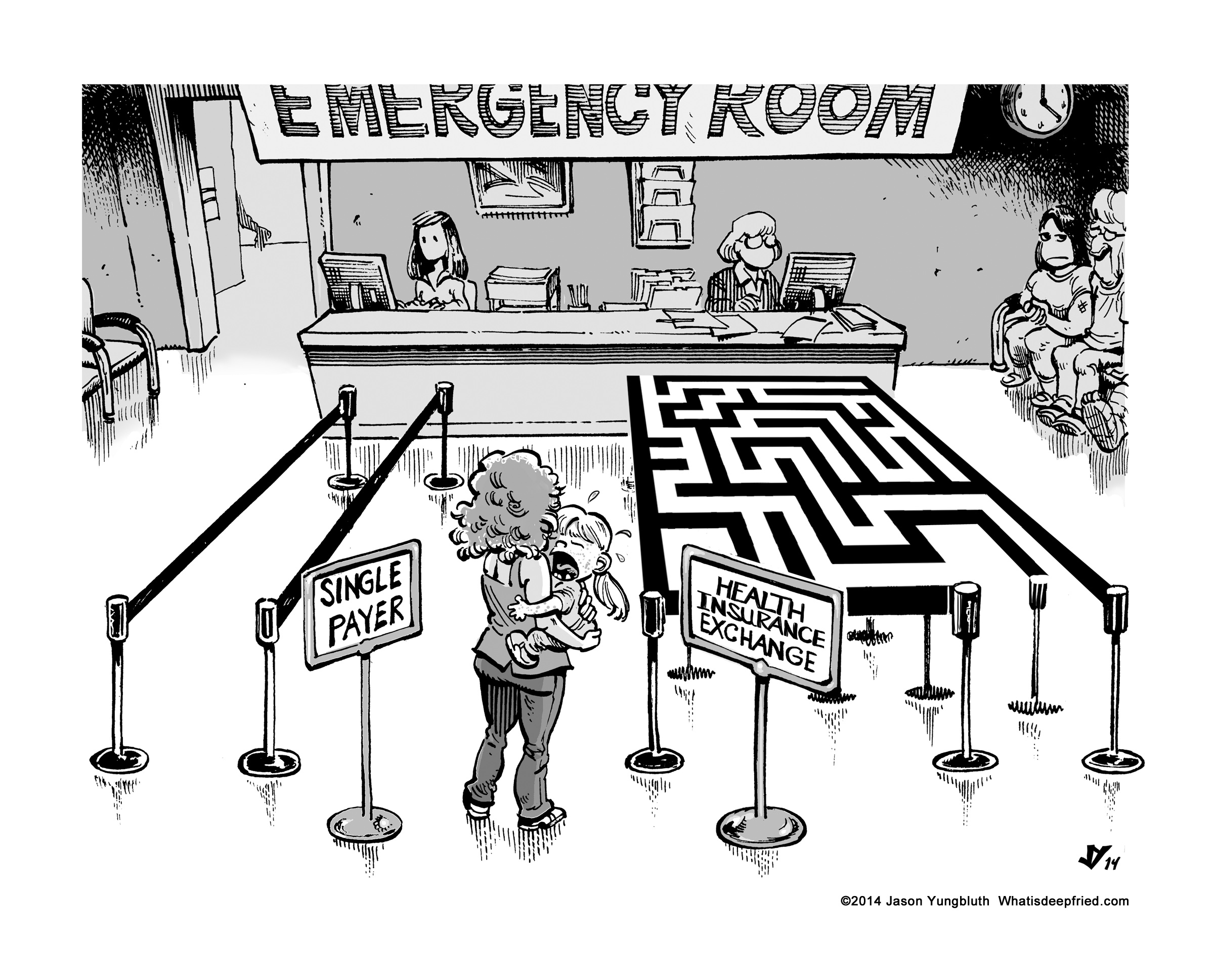
— He should present a convincing case that single-payer would be simpler than Obamacare, which was a cobbled-together compromise package. (Accompanying cartoon by Jason Yungbluth, provided to theVPO by the estimable Dr. Deb Richter.) 

— He should get strongly behind Dean Corren’s bid for Lieutenant Governort, including a lot of joint appearances. And he should urge the Democratic Party to do whatever it can to help Corren. A vote on single-payer in the Senate may well come down to a tiebreaking vote from the presiding officer. If you favor single-payer, do you want that vote cast by Phil Scott or Dean Corren?

— Turning, finally, from health care reform, the Governor needs to present ideas and show he has the energy to tackle other issues that are actually more pressing in the minds of voters: economic growth, school governance and taxation, and the general tax burden. 

— In gubernatorial debates, he needs to press Scott Milne (and Dan Feliciano, when he’s on hand) on the issues. He shouldn’t try to float above the fray, as if his opponents don’t matter. This is not so much for his own benefit, as for the cause of liberalism. He needs to remind people why they should vote for Democrats and Progressives. Too often, he has invoked conservative talking points to justify his moves to the center. He needs to cut that out. 

I think that covers it. I don’t want to see any prevent defense, and I don’t want even a hint of lofty entitlement. No taking the voters for granted. I want a strong, cogent, and relatable message that upholds the principles of modern liberalism and addresses the needs of Vermonters.

The limits of messaging

Just finished listening to a Reporter’s Roundtable on VPR*, with three of the better reporters around — VTDigger’s Anne Galloway, VPR’s Peter Hirschfeld, and the Freeploid’s Terri Hallenbeck– examining the entrails of last week’s primary election and the prospects for November. 

*Audio not yet available online, but it should appear here later today. 

Thin gruel, to be sure; the key races are essentially over, with the possible exception of Phil Scott vs. Dean Corren for Lieutenant Governor. But when the race for a mainly ceremonial position is your biggest source of intrigue, well, that tells you all you need to know. 

There was a lot of dancing around the fact that November is in the bag for the Democrats, with the noble exception of Galloway coming right out and saying that Governor Shumlin was going to win. The dancing is understandable, considering that (1) journalists want to appear objective, and (2) as political journalists, they’ve gotta cover this puppy for two more months, and what fun is it when there’s no intrigue? 

Much of the dancing centered on the idea that good “messaging” could carry a Republican candidate into a competitive position. The Dems aren’t invulnerable, the reasoning goes, it’s just that neither Scott Milne nor Dan Feliciano seems capable of delivering a solid, appealing message. 

That’s true, insofar as it goes. But there are three much more powerful factors operating against the Republicans: most voters pay little or no attention to messaging, the electorate is solidly center-left, and today’s Republican Party has little to offer on the key issues in Vermont. 

First, reporters and insiders overestimate the impact of tactics and strategy and messaging. The vast majority of voters have their minds made up before the campaigning starts. The only thing that could change their minds is some sort of shocking revelation or catastrophic event. Some voters do actually watch debates and bring an open mind to campaign coverage, but they only matter when an election is otherwise close. 

Second, it’s obvious from the results of the last decade or so that most voters prefer Democrats. The Legislature has been solidly Democratic for years. Among statewide Republicans, only Jim Douglas and Phil Scott have been able to buck the trend. Both have done so because of their unique personal appeal and by projecting an image of moderation and willingness to compromise. 

And third, Shumlin and the Dems are potentially vulnerable on issues like health care reform, the Department of Children and Families, the economy, taxation (especially school taxes), and the environment (Lake Champlain, the natural gas pipeline). 

On all those issues, the most appealing solutions involve more government, not less. Shumlin is more vulnerable to his left than to his right. 

In spite of Vermont Health Connect’s troubles, health care reform remains popular. Republicans have no answer aside from letting the market do its magic. Fixing DCF would require more resources, or at the very least more effective management. Have the Republicans given anyone reason to believe they care more than the Dems about poor people? Hell, no. Do the Republicans have a track record of good management? Only in the minds of Jim Douglas and Tom Pelham. 

Would the Republicans be better stewards of the environment than Dems? Ha ha. Can they plausibly portray themselves as defenders of public education, which remains extremely popular in Vermont? No; their only solutions are competition and union-busting. Can they convince voters that they’d preserve local control? Not if you could saw money by centralizing. 

On the economy, the Republicans have little to offer aside from the tired, discredited supply-side nonsense. Which took another bullet yesterday with the news (from the Federal Reserve Bank) that our post-Great Recession “recovery” has benefited the wealthy while middle- and working-class wealth has actually declined. One-percenters and corporations have a larger share of our wealth than ever, and all the Republicans can offer is policies that will further enrich the rich. 

And as for taxation, Vermonters may be dissatisfied with rising school taxes and worried about the cost of single-payer health care, but they also favor a robust government that can tackle problems effectively. Most voters don’t want a mindless “cut, cut, cut” approach, and that’s the standard Republican line. 

Here’s what a Republican would have to do, to be competitive on a statewide level: Bring an established reputation for effective governance, or at least an open-minded attitude toward the notion that government can actually solve problems. Express skepticism about political dogma, especially the cherished beliefs of the right. And do that without, somehow, losing too much support among the Republican base. And, finally, regain the support of the business community, which has largely abandoned the VTGOP in favor of a cooperative relationship with the Democrats. 

Now. If a Republican can identify and execute a strategy that accomplishes those things, s/he can win. Otherwise, no amount of good messaging will carry the day. It’s not impossible; there’s at least one potential Republican candidate who could manage it. But he ain’t running this year. 

Scott Milne’s missed opportunities

Yesterday, over at Green Mountain Daily, I wondered whether the Scott Milne campaign was a real thing or an Andy Kaufman-style work of performance art. 

Still wondering. 

In the last week before Governor Shumlin takes center stage, Milne is spending the vast majority of his time not campaigning. At least not visibly. Yesterday, he sat in on ex-Governor Jim Douglas’ book launch thingy in Burlington, which got him no attention whatsoever; and then, a few hours later, he got five minutes of free airtime on WCAX’s “The :30.” And, as I reported earlier, this was one of his more active days in a week when he should have been taking full advantage of Shumlin’s absence from the fray. 

Meanwhile, the other guy who has no chance of winning, Libertarian Dan Feliciano, was occupying the political spotlight with a clever maneuver straight out of Campaigning 101: Holding a news conference and delivering a simple, headline-friendly message. His reward: what must be the most widespread media coverage ever received by a Libertarian candidate for any office anywhere. 

Libertarian candidate for governor Dan Feliciano says Vermont Health Connect should be scrapped and the state should adopt the federal health care exchange.

Government is standing in the way of health care reform, Feliciano said. He also called Wednesday for the repeal of the state’s health care reform plan (Act 48), the elimination of the Green Mountain Care Board and a return to an open marketplace for health insurance.  

Feliciano said Gov. Peter Shumlin’s goal of creating a single payer health care model in Vermont is “fantasy.” 

He’s wrong, of course. Switching to the federal exchange would result in much higher costs for a lot of Vermonters. He’s also kinda self-contradictory: he wants government out of the way of health care reform, but he wants us to go along with Obamacare. To be fair, it’s a fait accompli, but still: it’s a bit rich for him to call government an obstacle to reform while calling on Governor Shumlin to accept the federal system instead of pursuing a uniquely Vermont approach. 

But my point here isn’t who’s right or wrong — it’s who won the day’s battle for attention. And Feliciano clearly kicked Scott Milne’s ass. 

While Feliciano was delivering a clear message, Milne was rambly and waffly on Channel 3. When asked about single-payer health care and his own idea for reform, he made like an octopus and squirted a cloud of ink: 

I think there’s people on the Governor’s extreme end of radical progressive legislative agenda, which believes uh without facts to back it up, without a plan for how we’re going to pay for it, uh without really a plan for how it’s going to work, believe that single payer’s going to solve all of our problems. I believe on the other extreme are people who don’t even want to consider it because it’s a government takeover of one part of the economy.

The primary plank upon which I’ll be running this campaign, and upon which I’ll be governing Vermont, ah is that we really need to be focused on what’s practical, uh not being driven by what’s a political ideology. So I think the, ah, Vermont Health Connect disaster is a great example of taking a political ideology from the top down, shoving it down the throats of Vermonters without really havin’ a plan in place. So, ah, our team is working hard to get a plan in place, ah, we’ll have very specific ideas for voters to talk about, think about, and hopefully use as one of many criteria for deciding to vote for Scott Milne for Governor in November.  

Got that? Shumlin’s plan is extreme and radical, but not out of the question. Also, Milne doesn’t yet have a plan of his own. 

Yeesh. 

According to his own absurd timetable, August was Phase One of the “unconventional” Milne candidacy, in which he would assail Shumlin’s record. Then, in September, he’d unveil his own agenda. 

Hello? It’s September Fourth. 

All that said, while Feliciano clearly won the battle for September Third, he still ain’t winning in November. However, if Milne keeps up this kind of stuff, Feliciano will be an effective spoiler — earning a double-digit share of the vote, and pushing Milne down into the 20s. The longer Milne goes on looking like a bumbler, or a performance artist, the more Republicans will abandon his cause and vote Feliciano out of disgust or desperation. 

Which would be very damaging to Phil Scott’s party-broadening project. The Milne implosion is emboldening the True Believers to continue resisting Scott’s plan. It could even lead to a blood-on-the-floor battle for control of the party after the election. And, worst case, a permanent split in the already-small VTGOP, with conservatives either joining the Libertarians or deciding to opt out Vermont politics entirely. 

And while the True Believers are a small group that cannot hope to win elections in Vermont, they are the most dedicated and supportive Republicans. Their absence from the VTGOP donor rolls has pushed its already-dire finances into virtual nothingness. 

If the VTGOP had managed to find a credible candidate — say, Heidi Scheuermann, or Phil Scott himself — it would still lose this year, but it might be on the road to self-reinvention as an influential political force. Instead, they’re saddled with Scott Milne. And whatever enthusiasm exists among Republicans is there for Dan Feliciano’s taking. 

The Freeploid’s headline writer is at it again

Same story, two headlines. VTDigger: 

STATE REGULATORS CUT RATE INCREASES FOR VERMONT HEALTH CONNECT

And Vermont’s Largest Newspaper, your Burlington Free Press: 

Vermont health insurance rates to increase 

Both stories concern this week’s action by the Green Mountain Care Board, authorizing increases in health insurance rates for the coming year. Digger chose to emphasize the actual news — that the Board had trimmed the size of requested rate increases — while the Freeploid went with a factual but fundamentally misleading header. 

The requested increases were old news. The Board’s decision to cut them was the real news.

The Burlington Free Press, once again dutifully (if subtly) carrying water for the VTGOP.