Category Archives: Education

The universal Milne

The Scott Milne campaign has a number of albatrosses around its neck.There’s the newbie candidate’s inept performances on the stump and in debates. There’s his apparent allergy to fundraising. There was, of course, his late start. There’s the devastated, improverished infrastructure of the Vermont Republican Party. (Tickets Still Available for the Congressman Peter King fundraiser tonight!) (Please buy a ticket!) (Pretty please?) There’s the fact that he still hasn’t managed to articulate actual positions on the issues.

And on top of all that, there’s his remarkably incoherent political positioning. Because, you see, Scott Milne is trying to be all things to all people. He’s simultaneously opening his big-tent flap to conservatives, moderates, and even liberals.

Scott MilneLiberals?

Yup.

He’s trying to present himself as a thoughful, moderate leader who will consider all points of view, including the most progressive. He’s depicting Governor Shumlin as a bad manager; his pitch to liberals is, “If you replace Shumlin, state government will work better and you’ll see more of your policy dreams come true.”

It’s an impossible balancing act to maintain. And Scott Milne is definitely not the man for the job.

Look at his runaround on the GMO labeling bill during this week’s debate.

First, he said the GMO bill was “a good example of the radical, progressive management of a bill by this Administration.” Then he said he wouldn’t repeal it. Then he couldn’t say whether he would have vetoed it if he’d been Governor. And finally, he returned to the theme of “managing the bill,” saying that if Shumlin hadn’t been so ham-fisted about it, the bill could have been passed “in a much more business-friendly way.”

To sum up: the bill itself isn’t necessarily bad. In fact, it could even be a positive. But Shumlin’s “management of the bill,” whatever the hell that means, was the problem.

If only Scott Milne had been Governor, we would have gotten the same outcome with completely different results. The liberals would have gotten their way, but we would have remained somehow “business-friendly.” Or something like that.

My theory also explains his odd stance on health care reform. Vermont Health Connect was a radical, progressive program — but single-payer health care is NOT necessarily radical. It could turn out to be the best option. Milne ain’t saying.

What he is trying to say to us liberals is, Shumlin’s made a mess of Vermont Health Connect. Elect me, and I’ll make it work so smoothly that it’ll pave the way to single-payer. Maybe.

On issue after issue, Scott Milne is trying to appeal to everybody at the same time. On school funding, he wants to cut costs but he also wants to retain local control. He wants a freeze on the statewide property tax, but he apparently doesn’t want schools to suffer any cuts. And he’s unwilling to even hint at a new school-funding plan. Because he doesn’t want to lose a single vote.

Many issues are simply too “complicated,” and all he promises is to work with the Democratic Legislature on the details. To conservatives, the message is: I’ll hold the line. To liberals, it’s I’ll let you have your way a lot of the time. Somehow he’s not convincing any of us.

Most telling of all is his stance on legalizing marijuana, which sounds like it came from a chronic doper:

“It is a bad idea but if I get a bill, I’ll sign it.”

In the words of the candidate himself, Holy Shamoley.

I realize the man thinks he is “Gandhi-like,” but even the original Mahatma couldn’t have pulled this off.


Vermont schools get a top grade from a surprising source

Those stinkin’ commies at the U.S. Chamber of Commerce have put together a state-by-state “report card” on K-12 educational effectiveness, thoughtfully entitled “Leaders and Laggards.”

And guess who got an “A”?

Vermont. 

Yes, the state with the terrible awful expensive union-dominated monopolized anti-choice public school system got an “A”.

From the U.S. Chamber of Freakin’ Commerce. 

Let’s see you spin that, conservative public school critics.

The Chamber did downgrade Vermont in some areas. We got an “F” in “Parental Options” (no vouchers) and in “Technology” (“limited access to… digital learning options”).  And we got a “D-” in “21st Century Teacher Force,” which basically means we don’t fire teachers often enough for the Chamber’s liking. And there were a couple of middling grades.

But Vermont got a lot of top marks in key areas: Academic Achievement, which is kinda the point of a school system; Postsecondary and Workforce Readiness, which is something our schools are often criticized for; International Competitiveness; and (here’s the real shocker) Fiscal Responsibility.

Wow. If the U.S. Chamber of Commerce thinks Vermont’s schools are excelling in fiscal responsibility and academic achievement, and the Chamber has put Vermont in the top echelon of “Leaders,” I think that’s cause for celebration.

Somehow I doubt it will quiet the critics on the right, although it sure as hell should.

Hey look everybody! Scott Milne has a plan! …oh wait, never mind.

A moment of excitement on my Twitter feed today, courtesy of cigar-smoking VTGOP “Victory Coordinator” Jeff Bartley:

Screen Shot 2014-09-23 at 2.59.30 PM

I could hardly believe my eyes. And I couldn’t wait to click on the link, to a story by WCAX’s Kyle Midura.

After weeks of alluding to his campaign of ideas, Milne provided more details Thursday about his call for a two-year cap on the state property tax.

Well, huzzah. The cap idea has been criticized, by me and many others, as imposing a hard spending cap on local schools. Governor Shumlin said it would erode local control. Midura says that Milne offered a rejoinder to this criticism:

Milne says the cost would shift to other taxes unless schools cut spending. The income tax is most likely — a legislative proposal to move all school costs to that source stalled before lawmakers left Montpelier last May.

It would “shift to other taxes” because the state is legally bound to provide funding to the schools, and if the property tax doesn’t cover it, then it’ll have to come from somewhere. That’s an obvious statement of fact, Mr. Milne. What else you got?

Milne says he would leave how to fill the gap his proposal would create up to legislators.

He is not sharing cost-cutting plans, at least not yet.

“We’ll be talking about our strategies for lowering school costs clearly over the next few weeks,” Milne said.

Awwwww, god DAMN.

A more accurate headline would read, “GOP candidate Milne provides no details of property tax plan.”

The excitement deflates. The Scott Milne Policy Watch continues.

Beware the fast-talking gentlemen bearing snake oil

Must be fall. Traditional time for fairs and festivals around our state. And one of the traditional accompaniments to these events is the patent-medicine man, selling his Secret Natural Herbal Remedies, good for whatever ailments may befall Man, Woman, Child, Horse, and Dog.

And hightailing it to the next town before too many locals get sick from the dubious contents of those thick, opaque bottles.

Well, here come our snake-oil salesmen of politics, hawking their Foolproof Solutions To Our School Funding Ills. Just a tablespoon of my tincture, they cry, and all your problems are solved.

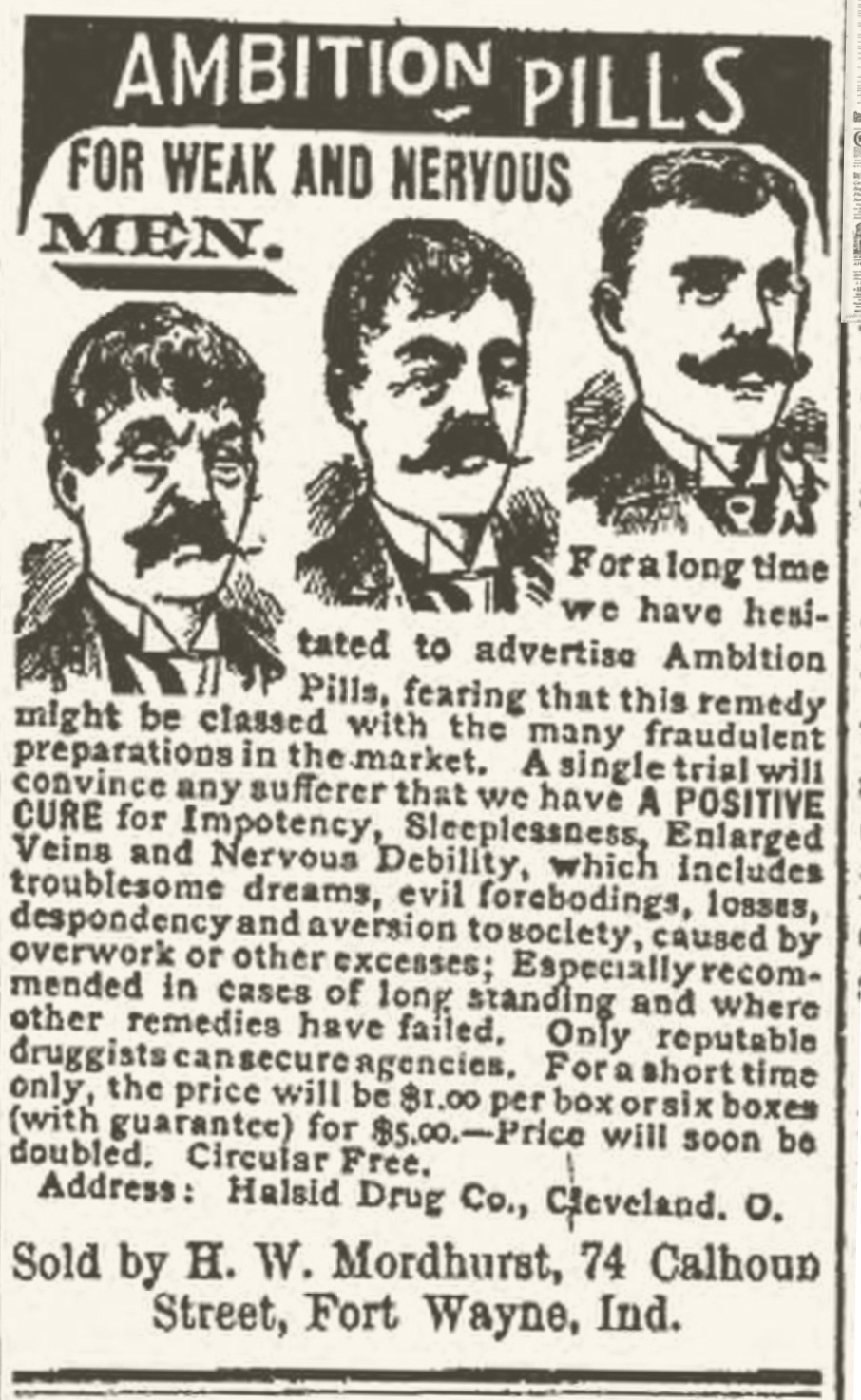
ambition-pillsOn the back of one horse-drawn cart we find a tall slender redhead brandishing a bottle of Olde Mahatma’s Secret Curative, a formula crafted by the Wise Men of the Far East (a.k.a. Pomfret), a stern purgative guaranteed to cleanse the system of blockages, growths, tumors and humors of all sorts, paving the way for a fresh start in a bright new tomorrow.

Behind all the label’s mumbo-jumbo, Olde Mahatma’s Curative is a simple solution with only one active ingredient: a two-year freeze on property taxes. This seemingly harsh treatment pays no heed to complications or practicalities; it just reams out the entire waterworks.

Over here, across the town square, is a dark-haired figure of serious mien offering Doc Feliciano’s Ache-Be-Gone, an elixir which, taken internally or applied externally*, is strong enough to banish every trace of pain from any cause, including lumbago, neuralgia, ague, impetigo, quinsy, and The Screws. Doc F has used all his extensive scientific training to fashion a singular combination of analgesics, potions, and elixirs, including some that have been foolishly prohibited by unimaginative authorities.

*You choose the method and dosage, for each man is the best judge of his own medicinal needs. 

Doc Feliciano promises to banish all pain and discomfort from the unrelenting pressure of property taxes through the indubitable mechanisms of the Free Market. His solution for a public school system with too few students and rising costs? A whole lot more schools! Free Choice For All! Which will, somehow, magically, bring down the cost of the system.

My friends, you would be wise to eschew the easy blandishments of the political snake-oil salesman. Complicated problems require time and care, and nuanced approaches by learned practitioners. You will not find the answers to your educational troubles at the bottom of a murky brown bottle! Keep your hard-earned money in your pocket, and let the peddlers be on their way.

The Scott Milne Policy Watch Continues

It’s beginning to seem like a distant memory, or perhaps just a fever dream.

Remember when Scott Milne promised to roll out his platform in September?

If you do, it’s probably because I keep reminding you.

The Ghost Campaign in the flesh

The Ghost Campaign in the flesh

Well, here it is September 19th, and the only shred of policy we’ve gotten is an ill-thought-out proposal to freeze property taxes for two years while we figure out a new system. No hint of how local schools are supposed to cope with rising costs for salary, benefits, and energy, among others. And no clues about the kind of system Milne would like to implement.

Anyway, on Thursday Milne made an appearance before “30 people” at the Colchester-Milton Rotary. (I wonder hwo many left after the raffle and before the guest speaker.) And perhaps out of sympathy, Seven Days sent reporter Mark Davis to cover it. 

Which produced this nugget:

Milne offered few specifics of his agenda. At various times, he told the 30 people in the crowd that he would release his own plans for health care, education and job creation in the coming weeks.

Cough.

“In the coming weeks”?

Weeks?

WEEKS?

Will somebody please remind Our Man Mahatma that Election Day is only six and a half weeks away?  I’m concerned that his Staff Fabricator may have convinced him the election is actually in November 2015.

Mr. Empty Suit steps to the mic

“I’ve got plenty of great ideas.”

So said Republican Scott Milne during Saturday’s gubernatorial debate. His comment came after Governor Shumlin repeatedly slammed his failure to give “us one single plan” on a variety of issues.

And then Milne, predictably, failed to name any ideas.

Well, he did have one: a two-year cap on property taxes, which would put public school into a dire budget situation because many of their costs will continue to rise. It’d force spending cuts from the top down, the very opposite of his claim to be in favor of local decision-making. But hey, at least it was an idea.

Otherwise, nothing much. At another point he said “I’ve got two ideas.” The first was that the Governor had spent too much time out of state. Which is not an idea; it’s an attack.. The second was the property tax cap.

Sigh.

As I said in an earlier comment, Milne managed to exceed the minimal standard of competence, e.g. he didn’t poop his pants. Shows you how dismal his campaign has been, that keeping his shorts clean seems like an accomplishment.

As for actually putting forward an inspiring message, nope. Not at all. He hammered repeatedly on the same old attack lines he’s used since launching his campaign: Shumlin is “the most progressive, radical Governor” who insists on pursing single-payer health care. Milne’s idea for health care reform?

“I will be working very hard with people to get something figured out.”

That is, word for word, what Scott Milne actually said.

On trying to keep young people in Vermont, his only contribution was to assert that the Shumlin Administration “has not been business friendly,” and Vermont needs “a new tone” in its dealings with business. F-sharp, perhaps?

When asked about problems at the Agency for Human Services, he pivoted back to his attack on the troubled rollout of Vermont Health Connect, and cited it as an example of poor management. When he actually addressed AHS, he said we need an agency that “puts the family first.” How imaginative.

When asked about cutting state spending, he gave a halfhearted shoutout to the discredited Challenges for Change initiative, then said “I’m not into cutting,” and then said property taxes are too high.

Confused?

In his closing statement, Milne referenced his late mother Marion’s run for State House in 1994 when, as Milne tells it, a local politico gave her no chance to win. But she ran anyway and won. And so can Scott Milne, if people only believe. And he closed with a bombshell: “Vermont needs a different path. I believe it needs a more moderate path.”

Having, once again, failed to give any real hint of his preferred path for Vermont. It’s been defined almost entirely in the negative: He wouldn’t repeat the alleged mistakes of Governor Shumlin.

And, as I reported earlier, he’s postponed a meeting with VTDigger’s editorial board because his platform isn’t ready yet.

Scott MIlne’s campaign is very close to flat broke. Its campaign manager just resigned. The best you can say about Milne’s debate performance is that he didn’t flame out. But he did nothing to advance his campaign, to provide a substantive option to Shumlin. Or to Dan Feliciano, for that matter.

He did okay by his standards, but that’s not nearly good enough.

Dan Feliciano, man of ideas. Well, three ideas.

Saturday’s gubernatorial debate was a big moment for Dan Feliciano, Libertarian candidate for Governor and presumptive usurper of Scott Milne’s mantle as the real conservative challenger to Governor Shumlin.

Dan the Libertarian Man. Photo by VTDigger.

Dan the Libertarian Man. Photo by VTDigger.

So, how’d Dan the Libertarian Man do? About as well as he could have done. Which is, as you might imagine, a two-edged sword.

Feliciano presented himself as the conservative candidate with ideas. And yes, he has ideas. But to judge from his debate performance, he has precisely three of them: Cut taxes and spending, cut regulation, and institute school choice.

That’s it.

He repeated them over and over during the debate because, well, that’s about all he has to say. It was a good performance but, at the same time, it defined his limit as a gubernatorial candidate. His ideas are simply out of the mainstream.

And, worse still, lacking on specifics.

Let’s take, first, his call for lower spending. What’s his big idea on how to cut the cost of state government?

Challenges for Change.

Stop laughing. I’m serious.

Dan Feliciano wants to reintroduce Challenges for Change, the discredited Douglas Administration plan. This… is our Libertarian’s call to arms? A years-old, formerly bipartisan initiative that was abandoned in 2010 because both parties agreed it just wasn’t working?

Until now, I thought that Tom Pelham was the only True Believer left. But no: it’s him and Dan Feliciano. Sheesh.

I suspect that this is one of Feliciano’s attempts to make himself look less scary to mainstream voters. Don’t start with Libertarian ideas for privatizing schools, prisons, police, fire, and snowplowing; start with a mainstream reform plan. A failed plan, but a mainstream one.

On health care reform, he’s dead against single-payer. His “idea,” though, is weak: cut health insurance regulation to foster competition. We’ve already seen how that works: the competition turns into a race to the bottom, with affordable insurance available only to the healthiest, all kinds of exclusions to minimize claims, and a maze of complicated legalese designed to frustrate consumers.

And Feliciano tried to have it both ways when it comes to community rating, Vermont’s rule that prevents price discrimination against the elderly, the sick, and others with high risk factors.  He claimed to support community rating, but he also called for Vermont to scrap its own exchange and adopt the federal one, as New Hampshire has done. Well, Dan, New Hampshire and other states operating in the federal system don’t have community rating. Which is it?

On schools, he wants spending cuts but doesn’t provide any examples. His Big Idea is school choice, which is going to reduce costs in a way he doesn’t explain. I wonder why. Could it be because the savings are based entirely on free-market dogma? Could it be that, in a system already short of students, spreading them around to more institutions will make the situation worse, not better?

When asked about problems in the Agency for Human Services, he said “We need a wholistic approach to families and children.” Without explaining what in the world he means by that. And when asked about supporting agriculture, his one idea was — you guessed it — cutting EPA regulations.

In spite of rampant pollution in Lake Champlain, to which agriculture is the single biggest contributor.

This is Feliciano’s unique position, and his glass ceiling. He is a man of ideas, certainly. But it’s a small handful of endlessly repeated dogmatic ideas that don’t work in the real world. Much as he tries to water it down, he is stuck with Libertarian dogma. It gives him a clear outline, unlike the endlessly foggy Mahatma Milne. But it also consigns him to fringe status in any race with a credible Republican candidate.

If Milne keeps on soiling the sheets, Dan Feliciano might get into the double digits on November 4. But he’ll never be anything more than that. And whenever the Republicans run a viable candidate, he’ll be back down to Emily Peyton territory.

Scott v. Corren, round one: a spirited, informative debate

The two major-party candidates for Lieutenant Governor stood their ground and clearly articulated their positions in their first debate this morning. Incumbent Republican Phil Scott and Prog/Dem Dean Corren debated on WDEVs Mark Johnson Show, broadcasting from a windy, chilly Tunbridge World’s Fair.

(Johnson has posted the audio as a podcast for your listening pleasure. Also, the video is available here, thanks to CCTV.)

Scott and Corren provided the voters with a clear choice… although the Scott option involves his usual bobbing and weaving on the issues. But that’s Phil Scott, and he said as much in his closing statement: if you like the job I’ve been doing, I promise two more years of the same. Corren made a strong, understandable case for his progressive agenda, particularly single-payer health care.

Neither candidate made any notable stumbles. If you went in a Phil Scott fan, you almost certainly left as one. Ditto Dean Corren. Undecideds were given a lot to think about, and a clear choice between two contrasting styles and philosophies.

I also have to say a word on behalf of host/moderator Mark Johnson. He conducted the proceedings without a hard-and-fast format, which often results in a stilted faux-conversation; instead, Johnson was able to maintain a flow and pursue follow-up questions as he saw fit.

The first half of the debate was dominated by health care reform, and especially whether to

Dean & Pete: Best buds

Dean & Pete: Best buds

pursue single-payer. That was to Corren’s advantage; since he has a clear position.

He began with the fiscal case for single-payer. He argued that single-payer would be simpler than the former or current system, and far better for controlling health care costs. It will require new taxes, he acknowledged, but the current system is extremely burdensome; single-payer will reduce the overall burden. As Lieutenant Governor, he would be an advocate for single-payer, communicating its virtues and being a “watchdog” to ensure that the details are done correctly.

Cost control efforts have failed, Corren argued, because no one entity has full control over all the costs. If a reform cuts costs in one area, those costs are actually shifted to an unregulated area. Single-payer would allow for a unified effort to cut costs.

Phil & Pete: Best buds

Phil & Pete: Best buds

Scott remains “skeptical” — his favorite word, as he himself admitted. He wants to see the details before making a decision on single-payer, but he clearly prefers to stick with the current system instead. Which involved a bit of tortured logic: he said that the rollout of Vermont Health Connect has been “disastrous,” but that nonetheless, having a health care exchange “makes sense.”

He also said that reform may be difficult because Vermont is such a small state, and offered the idea of a tri-state insurance “coalition” involving Vermont, New Hampshire, and Maine.  Not sure he articulated the advantage of such an approach, but there you go.

Personality and approach: Scott kinda tried to have it both ways — but hey, that’s the way he is. He played up the advantage of his “collaborative” approach but also claimed that “I stick to my guns.” When asked to cite an example of an issue he feels strongly about, he offered the environment and growing the economy. Not a convincing display of passion or principle; everybody is in favor of both. The devil is in the details.

Corren portrayed himself as a strong progressive voice on the issues. As such, he’d be a valuable part of Governor Shumlin’s team. But at the same time, he’d be independent enough to take stands when he sees fit. As such, he argued, he’d be a better “watchdog” over health care reform than Scott because he truly wants it to be successful: “We need a Lieutenant Governor who will work for reform, not be skeptical.”

Party problems: When asked about past differences between Progs and Dems, including his own criticism of the Dems, he said that was all behind him, and asserted that the Democratic Party and the electorate in general have moved to the left, making a better fit between D and P. “I feel very comfortable working with the Democrats,” he said. “I’m proud of what the Democratic majority has done.”

Scott was asked why the Republican Party struggled so much in Vermont. He blamed perceptions of the national party’s stands, especially on social issues. He said the “core of Vermont Republlicanism” was embodied by leaders like George Aiken, Bob Stafford, and Jim Jeffords, and said “We lost that, and we need to refocus.”

Property taxes and school funding: Scott said he was “disappointed in the Legislature” for failing to tackle the issue this year. He said “we need to do it,” but acknowledged that “it’s difficult.” He said that education costs need to be brought under control and acknowledged that might require some school consolidation. But he said it should be on a “case by case basis” instead of an overall mandate.

Corren said the school funding system has hurt the middle class more than anyone; the wealthy pay a smaller proportion on a per capita basis, and income sensitivity eases the burden on poor and working Vermonters. He advocated expanding income sensitivity to the entire populace — which would presumably shift some of the burden upward. He also pointed out that health care is perhaps the biggest driver of school cost increases, and again stumped for single-payer.

Energy. Corren is a strong proponent of developing renewables, including wind. He referred to the “imagined horrors” of living near wind farms, which won’t make him any friends in the Annette Smith camp. He did say that the state should have a clear plan that includes specific areas where wind should be developed and where it should not.

Scott is, to use his favorite word, a wind power “skeptic.” He declared himself a “big proponent of renewable energy,” but emphasized solar power over wind. He repeated his earlier support for a moratorium on new wind projects.

On the Vermont Gas pipeline, Scott tried to have it both ways, expressing his support for the project as a “bridge to the future,” but also supporting a second look at the project by the Public Service Board. Corren declared himself a “skeptic,” saying the economic and environmental benefits of the pipeline are “not proven.”

Children and DCF: Neither candidate had much to offer. Corren said that “problems persist” but acknowledged that he’s “not sure what to do.” Scott said that the Department of Children and Families is full of “good people doing good work,” and wondered if they needed more resources without committing to it. And he returned to his hobby-horse of economic development, arguing that the “affordability crisis” puts more “stress on families.”

Top priorities: As a closing question, Johnson asked each man what they would pledge to do in the next two years.

Corren: He would “work on the details of health care reform, and make sure we have a sustainable plan.” He also promised to work on jobs and development, particularly in the renewable energy sector. He sees that as a major growth opportunity for Vermont.

Scott promised “the same thing as in the past. A collaborative effort to bring people together as a team to move Vermont forward.”

And then, given the last word, he fired a shot at the Democrats. In the last legislative session, he said, there were hundreds of bills, but only about 20 of them had to do with growing the economy. And most of those, he added, failed to pass.

The truth of that assertion probably depends on your definition of bills that have to do with the economy. But Corren didn’t have the chance to respond.

With that, the debate was over. I have to say that, thanks to Johnson’s stellar work as moderator and two candidates who can articulate their positions well, it was one of the more informative debates I’ve ever heard. Too bad there will only be three more, thanks to Phil Scott’s reluctance.

Scott Milne hints at an actual policy position

So, Our Man Mahatma was up in Newport on Wednesday, hangin’ out at the Agway and talkin’ politics with the folks. And there to capture the excitement was a camera from the Newport Dispatch, an online-only news website.

Simple, short video, a few Q&A’s; one of which concerned rising property taxes. And while Milne did not take an actual position, he did hint at the vague outlines of a position. Which, for him, constitutes news. Take it away, Mahatma:

“I think there’s a need to rapidly address a solution for not having taxes increase any more while we figure out how to restructure things. That’s gonna be one of the fundamental principles of our campaign, something we’ll be talking a lot more about over the next two weeks. So I’d ask you to stay tuned. You’ll be happy with what we’re going to be talking about.”

Sounds like he’d call for a freeze on property taxes while he and the Legislature work out a longer-term solution. It sounds unworkable to me; there’d be a pretty rough immediate impact on school budgets and the transfer payments needed to ensure equal funding across the state. But hey, it’s an idea from Scott Milne. And that’s news.

But then he kinda blows it by promising an actual policy in “the next two weeks.”

Oh, c’mon now. When he outlined his two-stage campaign — attack Shumlin in August, unroll his positions in September — it seemed way too late to introduce a Milne Plan to the voters. Now he’s promising a Plan by the end of the month. Only a few weeks before the election.

Meanwhile, Milne continues to cede the conservative spotlight to Libertarian Dan Feliciano, who once again held a news conference yesterday where he once again got more attention than he deserves. The funny thing is, Feliciano pulled a Milne: he criticized Shumlin on state spending, but refused to say how he’d cut the budget.

Scott Milne has allowed Dan Feliciano to become a big problem. Not as a viable contender, but as a third “real” candidate in the race, likely to be included in gubernatorial debates.

If those debates were simply Milne vs. Shumlin, then Milne would have room to attack and establish his own positions. With Feliciano sharing the stage, there’ll be a lot less room to maneuver. Milne will be the Man In The Middle, and he’ll almost certainly look wishy-washy by contrast to the tight-fisted Feliciano and the self-proclaimed “progressive” Shumlin. He’d have to be a very strong, forceful presence to stand out in that situation. And to date, Milne has shown no ability whatsoever to be strong or forceful.

The limits of messaging

Just finished listening to a Reporter’s Roundtable on VPR*, with three of the better reporters around — VTDigger’s Anne Galloway, VPR’s Peter Hirschfeld, and the Freeploid’s Terri Hallenbeck– examining the entrails of last week’s primary election and the prospects for November. 

*Audio not yet available online, but it should appear here later today. 

Thin gruel, to be sure; the key races are essentially over, with the possible exception of Phil Scott vs. Dean Corren for Lieutenant Governor. But when the race for a mainly ceremonial position is your biggest source of intrigue, well, that tells you all you need to know. 

There was a lot of dancing around the fact that November is in the bag for the Democrats, with the noble exception of Galloway coming right out and saying that Governor Shumlin was going to win. The dancing is understandable, considering that (1) journalists want to appear objective, and (2) as political journalists, they’ve gotta cover this puppy for two more months, and what fun is it when there’s no intrigue? 

Much of the dancing centered on the idea that good “messaging” could carry a Republican candidate into a competitive position. The Dems aren’t invulnerable, the reasoning goes, it’s just that neither Scott Milne nor Dan Feliciano seems capable of delivering a solid, appealing message. 

That’s true, insofar as it goes. But there are three much more powerful factors operating against the Republicans: most voters pay little or no attention to messaging, the electorate is solidly center-left, and today’s Republican Party has little to offer on the key issues in Vermont. 

First, reporters and insiders overestimate the impact of tactics and strategy and messaging. The vast majority of voters have their minds made up before the campaigning starts. The only thing that could change their minds is some sort of shocking revelation or catastrophic event. Some voters do actually watch debates and bring an open mind to campaign coverage, but they only matter when an election is otherwise close. 

Second, it’s obvious from the results of the last decade or so that most voters prefer Democrats. The Legislature has been solidly Democratic for years. Among statewide Republicans, only Jim Douglas and Phil Scott have been able to buck the trend. Both have done so because of their unique personal appeal and by projecting an image of moderation and willingness to compromise. 

And third, Shumlin and the Dems are potentially vulnerable on issues like health care reform, the Department of Children and Families, the economy, taxation (especially school taxes), and the environment (Lake Champlain, the natural gas pipeline). 

On all those issues, the most appealing solutions involve more government, not less. Shumlin is more vulnerable to his left than to his right. 

In spite of Vermont Health Connect’s troubles, health care reform remains popular. Republicans have no answer aside from letting the market do its magic. Fixing DCF would require more resources, or at the very least more effective management. Have the Republicans given anyone reason to believe they care more than the Dems about poor people? Hell, no. Do the Republicans have a track record of good management? Only in the minds of Jim Douglas and Tom Pelham. 

Would the Republicans be better stewards of the environment than Dems? Ha ha. Can they plausibly portray themselves as defenders of public education, which remains extremely popular in Vermont? No; their only solutions are competition and union-busting. Can they convince voters that they’d preserve local control? Not if you could saw money by centralizing. 

On the economy, the Republicans have little to offer aside from the tired, discredited supply-side nonsense. Which took another bullet yesterday with the news (from the Federal Reserve Bank) that our post-Great Recession “recovery” has benefited the wealthy while middle- and working-class wealth has actually declined. One-percenters and corporations have a larger share of our wealth than ever, and all the Republicans can offer is policies that will further enrich the rich. 

And as for taxation, Vermonters may be dissatisfied with rising school taxes and worried about the cost of single-payer health care, but they also favor a robust government that can tackle problems effectively. Most voters don’t want a mindless “cut, cut, cut” approach, and that’s the standard Republican line. 

Here’s what a Republican would have to do, to be competitive on a statewide level: Bring an established reputation for effective governance, or at least an open-minded attitude toward the notion that government can actually solve problems. Express skepticism about political dogma, especially the cherished beliefs of the right. And do that without, somehow, losing too much support among the Republican base. And, finally, regain the support of the business community, which has largely abandoned the VTGOP in favor of a cooperative relationship with the Democrats. 

Now. If a Republican can identify and execute a strategy that accomplishes those things, s/he can win. Otherwise, no amount of good messaging will carry the day. It’s not impossible; there’s at least one potential Republican candidate who could manage it. But he ain’t running this year.