Category Archives: Education

Messaging 101: Don’t make mistakes in press releases about education

So this happened. Governor Shumlin’s office issued a press release on Monday about education funding — specifically its projection of a two-cent increase in the state property tax for the coming year.

And there was an oopsie. First to spot it was Dave Gram of the Associated Press (and now, apparently, chief Statehouse correspondent for the Burlington Free Press):

And here is the error in context:

“The bottom line is that education spending in Vermont is supported by a wide variety of state revenue sources, not just the property tax,” Gov. Shumlin said. “That’s why I do not think simply shifting more education spending to other sources will address the burden Vermonters feel. We need to tackle this first as a spending challenge because education costs have continued to rise faster than Vermonter’s ability to pay for it, even though our student count has declined.”

It’s bad enough when a gubernatorial missive goes out with a big fat juicy typo. It’s even worse when the subject of said missive is education. Does newly-minted communications chief Scott Coriell need a little proofreading help?

Shumlin: “We have a structural deficit” and other happy tidings

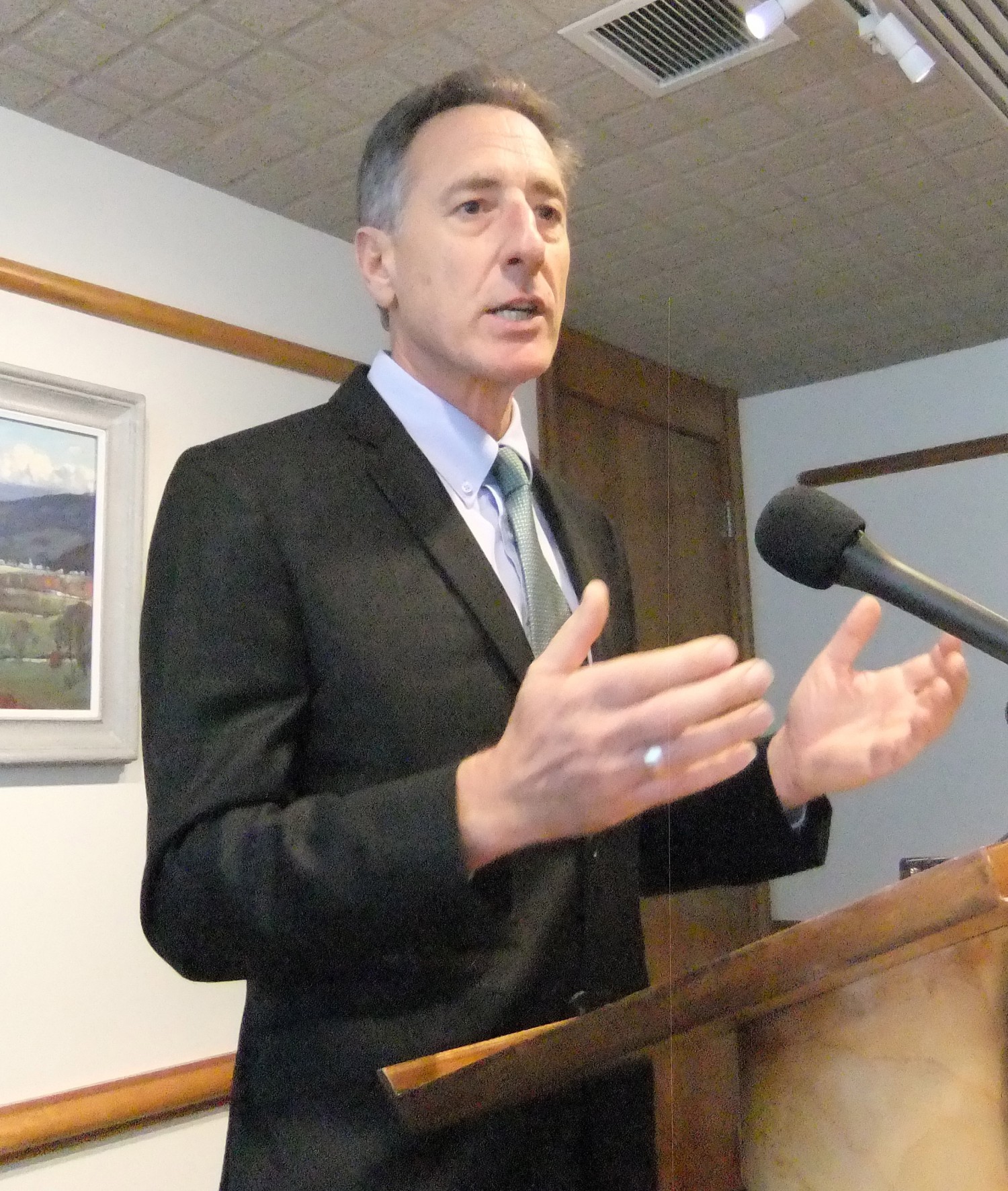
The Governor addresses the multitudes. (The bearded man begging for change is Dave Gram of the Associated Press.)

The Governor addresses the multitudes. (The bearded man begging for change is Dave Gram of the Associated Press.)

An uncharacteristically subdued Governor Shumlin held an agenda-free news conference this morning. I emphasize “agenda-free” because his past practice has been to piggy-back news conferences onto photo opportunities or policy announcements, leaving much less time for general questions.

Today there were a lot of questions and a lot of substance. In no particular order…

The Vermont Health Connect website will go back online this Saturday, which happens to be the first day of open enrollment. So the relaunch will come on the last possible day. Gee, hope things go right; there’s no margin for error.

Shumlin pronounced himself “optimistic,” saying “I’m encouraged by what I’m hearing.” But given how often he, and we, have been burned in the past, he was reluctant to make any predictions. “I’m always hoping it will work.”

— He dismissed Republican calls to shut down VHC and go with the federal exchange, and he had several good arguments. First of all, it’s far too late to make the change this year, so we’d be limping along with VHC for another year in any case. And there are signs it’s finally getting on track. “We’re turning a corner,” he said. “Why not give it a chance?”

There’s also the fact that the federal exchange’s premium subsidies aren’t as generous as Vermont’s. Switching to the federal system would mean higher premiums for thousands of Vermonters who earn between 100-300% of the poverty line.

And, as he pointed out, the US Supreme Court may well strike down federal subsidies, in which case only states with their own exchanges will be able to offer subsidies.

— Get ready for a slam-bang legislative session. Shumlin is still talking about the next step in health care reform (see below), the legislature is hell-bent on property tax and/or school funding reform, Shumlin is talking about significant changes to energy policy, and perhaps worst of all, the quote atop this post: “We have a structural deficit at this point.” Meaning huge challenges in fashioning a budget. That’s a hell of a lot of big, contentious issues to tackle.

Temba, his arms wide.

Temba, his arms wide.

— Speaking of the budget, Shumlin acknowledged that Vermont and many other states “thought the recovery would be more robust,” and its weakness has caused revenue shortfalls. He’s talking about a second round of rescissions in this year’s budget, although he said nothing is final just yet. And he’s talking about major changes in next year’s budget in order to put an end to annual budget crises.

He wants to put the state on a more sustainable path. Which must be making a few Republicans chuckle, since they’ve been preaching this for years. On the other hand, Shumlin has a valid point: the recovery has been weak. If we’d had a normal recovery with decent wage gains, our tax revenue would be stronger and we wouldn’t be facing this dilemma. The big news on this front is that the Governor now believes we’re facing years of sluggishness, and we need to ratchet down the budget to make it sustainable.

When asked whether this might mean tax increases, he didn’t rule them out, but he made it clear that his first choice is to rein in spending.

— On the push for single-payer health care, he repeated his longstanding support for the idea, but acknowledged that in the wake of the election, everything is on the table. He is aiming for a system that combines affordability with universal access to health care. His preference remains single-payer, but it’s looking like we might settle for less than that.

— He made it clear that yes, he won the election, and he has no doubt that he will serve a third term. He pointed to Vermont’s long tradition of electing the top vote-getter when no one wins a majority: ‘The person who gets the most votes, wins.” He cited the 2002 election for Lieutenant Governor, in which he and Progressive Anthony Pollina combined for a liberal majority but Republican Brian Dubie won the most votes; he and Pollina urged lawmakers to elect Dubie, which they did.

— On school funding and organization, he declared “We have a spending problem,” with high per-pupil costs and administrative structures. In some cases, he said, small class sizes can be harmful to achievement rather than helpful. He’s not in favor of mandatory school consolidation, but it’s clear he will push for consolidation by trying to convince local districts that it’s in their best interest.

He did mention the idea of “prioritizing funding to schools that voluntarily consolidate.” That kind of legislative payola may be effective, but it kinda stretches the definition of “voluntary.”

— In a less wide-ranging news conference, his comments on energy policy might have made headlines. They’re likely to get lost in today’s news. He noted the pending sunset of the SPEED program, which has helped spur the renewables industry in Vermont but has also created controversy because it allows the sale of “green” energy credits in other markets. He and the legislature are working on “ideas to replace SPEED.”

He was asked about the prospects for a carbon tax with offsetting cuts in other taxes — a plan likely to be announced tomorrow by a coalition of environmental groups. He was cool to the idea, saying “It’s tough for a small rural state to do it alone,” and pointing particularly to its impact on gas stations near our state borders. He prefers a regional carbon tax instead; but he said he’s had no conversations with other northeastern governors about the idea. Methinks the enviros will have a hard time gaining traction, when you combine Shumlin’s reluctance with an extremely busy legislative session.

— Finally, he was asked about marijuana legalization. He said he wants to wait until the release of a report on the idea in January before proceeding, but noted that “I support legalization. The question is “when.”

Scandal! Panic!! Naked Hippies!!! Taxpayer Dollars!!! AAAAAAHHHHHHHH!!!!!!!!!

About five weeks ago, the Vermont Historical Society announced a bit of good news: it won a $117,521 grant from the Institute of Museum and Library Services to conduct research and create exhibits and programs about Vermont’s countercultural movement of the 1970s. (The total cost of the project is roughly $260,000; VHS is responsible for getting the rest of the money.) VHS curator Jackie Calder explains:

“By collecting objects, papers, and oral histories we will be creating a body of information for this pivotal period in our state history, making it available for generations to come. And our project’s community forums and public programs will engage Vermonters in learning about this important time in our history.”

It’s a worthy project. The countercultural movement had a lasting impact on Vermont — its politics, culture, environmental movement, its very active food scene, even its economy. (Ben and Jerry’s, anyone?)  The idea of collecting oral histories is especially pertinent, since the firebrands of the 70s are now, ahem, getting up there in age and won’t be around forever.

So, all good, yes?

Yes, until the right-wing “news” site Vermont Watchdog got wind of the grant — more than a month after it was announced — and predictably headlined it like this:

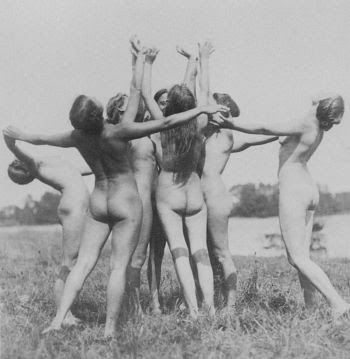
Taxpayers stripped of $117,521 for naked hippie commune research

Damn dirty clickbait!

Damn dirty clickbait!

Ahh, nothing like a little moral panic to clear the sinuses, eh?

VW’s one and only staffer, Bruce Parker, hit all the high notes in his predictable screed: a “taxpayer-funded” project to study “the hippie commune movement that invaded Vermont” with its “oft-nude, drug-addled drifter colonies,” “idealistic youth dropping out of society,” “free-love vagabond communards,” and a former member reminiscing about how “We shared food. We shared sex. We shared clothing…”

Damn dirty HIPPIES!

This story combines two favored tropes of the far right: exaggerating government-funded activities to make them look ridiculous, and slamming the excesses of the left. Especially hippies. Damn dirty hippies!

But seriously, that 70s stuff — which itself had its roots in earlier back-to-the-land movements, as embodied in the works of Helen and Scott Nearing and pioneering New Hampshire-based food writer Beatrice Trum Hunter — did play a significant role in creating the Vermont of today.

The old Vermont, remember, was an extremely red state, ruled for over a century by the Republican Party. Montpelier was a famously stiff community where the sidewalks got rolled up at 5 p.m.

The transition is striking. And the role of the counterculture movement is definitely worth studying and discussing. Libraries and museums are the places that collect and preserve our past. That’s kind of important, no? We need to understand our past in order to understand how we got where we are.

I think Santayana put that a little better. But you get the point. Museums and libraries are the repositories of our history, our culture. They are the institutions that preserve what is important. And it’s inarguable that the 70s counterculture played an important role in Vermont’s history.

Even if you can’t stand damn dirty hippies.

Neale Lunderville, the shiniest bauble on the public policy tree

Oh, those darn Democrats. They just can’t seem to resist the dubious charms of former Douglas Administration functionary (and campaign hatchet-man, lest we forget, and I bet Doug Racine hasn’t) Neale Lunderville.

Mmmm, what should I take over next?

Mmmm, what should I take over next?

Back in 2011-12, Lunderville started his run as the Dems’ unlikely go-to guy when he served as Governor Shumlin’s Irene Recovery Czar. This summer, he added another layer of plausible nonpartisanship as Burlington Mayor Miro Weinberger’s choice to be interim head of the Burlington Electric Department, tasked with undertaking a “strategic review” of the organization.

Well, unbeknownst to almost everyone outside of the State House inner circle, Lunderville had already scored a public-policy bingo with his appointment to a not-quite-secret committee tasked with nothing less than crafting an overhaul of Vermont’s public education system. VPR’s Peter Hirschfeld got the goods:

The group isn’t a legislative committee per se – not too many people even know it exists. But members of Smith’s education reform group have been getting together since after the close of the 2014 legislative session. And by year’s end, Smith says he hopes they’ll deliver the policy recommendations that will serve as the basis for an overhaul of the state’s education system.

… He says the advance work being done by the group will give lawmakers the early start they need to get a meaningful bill across the finish line.

The committee is dominated by current and former state lawmakers, most of them Democrats, but also including a couple of Republicans, one former Republican turned independent (Oliver Olsen), one Progressive, and Our Man Neale.

Which makes me again raise the question, Can’t the Democrats find anybody else to take on tough policy challenges? Why do they have to depend on a guy who cut his teeth running the dark side of Jim Douglas’ political operation?

And, especially, why in the Blue Hell do they insist on burnishing the credentials of a guy who might very well be the Republican candidate for Governor in 2016 or 2018?

Ulp. Pardon me for a moment…

Screen Shot 2014-10-27 at 9.10.59 AM

Whew. That’s better. Now, where was i?

Oh yes. Aside from Lunderville’s presence, the committee’s almost total secrecy has to be a concern.

The group’s meetings aren’t warned or open to the public, and minutes aren’t recorded. Smith says the off-the-books arrangement is needed to help members of the group feel more “free” to brainstorm different approaches.

So I guess the fact that this isn’t an official committee exempts it from open-meetings and public-records laws — kinda like Dick Cheney’s infamous energy policy committee. But if the group manages to complete its task, it might well be the most powerful committee in the legislature (even if it no longer exists when the legislature comes back to work). It’ll effectively set the school-reform agenda for the lawmakers who actually have to do their business, inconveniently enough, under the public eye.

Three other things you should know:

— According to one member, the committee is focusing on student-to-teacher ratio. Which might mean mandatory minimum class sizes, or even forced school consolidation.

— Lunderville seems to favor centralizing budgetary authority, which he advocates under the guise of allowing local officials to “devote attention where it belongs: student learning.” Their ability to do anything about student learning without the power of the purse would be sharply constrained, of course. Lunderville would like to “go to more of a model like the state has, where there’s one agency, one department on a regional or state level handling those.” Which would be kind of a radical move.

— Finally, as Hirschfeld reports at the top of his story, “public education – not single-payer health care – will be top of mind for House lawmakers.” Not good news for Governor Shumlin, who continues to insist that single-payer is Job One in the new biennium.

Shocker: Realtor-commissioned survey finds property taxes too high

In the category of Not At All Motivated By Self-Interest, No Sirree, comes an opinion poll from Vermont Realtors on the subject of property taxes.

Surprise: they’re too high.

According to the survey, 76 percent of respondents say that property taxes are too high. The poll also demonstrates that this is a non-partisan issue, with two-thirds of Democrats, 78 percent of independents and 85 percent of Republicans sharing the belief that property taxes are too high.

The first thought with stuff like this is: Well, of course. It fits the Realtors’ preconceived political narrative. But the methodology — fully explained in the news release, thank you — is reasonably solid. And there’s no doubt that a lot of Vermonters think the property tax system is out of whack.

But let’s look a bit deeper. The key question in the survey was “Do you believe property taxes are too high, too low, or about right for the services you receive?”

When you start out asking taxpayers if their taxes are too high, you’ve invited a positive response. How many people are going to volunteer that their taxes are too low?

And the consensus rapidly dissolves when people were asked what to do about it.

 According to the poll, 49 percent of respondents say there is a great need [to reform the way public schools are funded], while 26 percent believe that there is “some” need. Just nine percent say there is little need and only eight percent see no need.

To which VR President Donna Cusson noted, “The intensity on the need for change is striking.”

Actually, I kinda thought the opposite. 76% say their property taxes are too high, but only 49% say there is a “great need” for change. That’s a lot of people complaining about property taxes but lukewarm on change. Probably because, as everybody knows, the devil is in the details. And, as everybody knows, it we lessen the property tax burden, we either have to cut spending on our high-performing and well-loved public schools OR we have to raise taxes somewhere else.

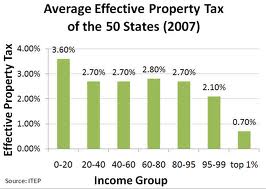
Here's another reason to reform the system. From the Institute on Taxation and Economic Policy.

Here’s another reason to reform the system. From the Institute on Taxation and Economic Policy.

In its press release, VR described the results of two questions. There were other questions, and VR is not releasing those numbers. It says it “has shared the results of the survey directly with candidates for office in an effort to initiate a dialogue about the need for property tax reform…”

So… it wants to tell candidates what the voters think, but it doesn’t want to let the voters know? That’s a bit curious.

I suspect that some of the other survey results were perhaps less forceful. If, say, respondents were asked how best to fix the system, I’m guessing there wouldn’t be any real consensus. Because all the alternatives are unpalatable. And that’s why it’s been so difficult for the Legislature to tackle the issue.

One other oddity: The VR release is dated September 29. At the time, apparently, it got zero attention in the media. This morning, VTDigger posted the release in its ever-popular “Press Releases” section, which is where I noticed it.

BREAKING: Scott Milne holds a news conference! Also, Hell Freezes Over.

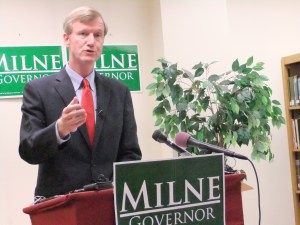
Scott Milne and potted plant. Make your own joke.

Scott Milne and potted plant. Make your own joke.

Two rare political events occurred simultaneously today in the library at Spaulding High School: Scott Milne held a news conference, and he unveiled a thoughtful, detailed policy initiative.

Yes, the campaign without a plan has finally come up with one — on education reform. The thesis statement: Vermont spends too much on K-12 education and not enough on higher education. The basic idea: foster efficiency by reorganizing the public school system, and invest the savings into a new program to provide every Vermont student with access to a free college education or vocational program. (The full plan is posted on his campaign website.)

It’s creative. It’s fresh. It’s downright audacious. It’s the kind of thinking that, to me, represents the best of moderate Republicanism: maximizing our investment in the public sector instead of mindlessly cutting. At the very least, it ought to generate some serious conversations about how we spend our education dollars.

There were, of course, spiders in the attic. The Milne plan on paper was seven single-spaced pages with plenty of detail (footnotes, even); but he was less than articulate in the give-and-take of a news conference. He abruptly shifted between explanations of his own plan and recycled attacks on Governor Shumlin. He made plenty of snide comments directed at the media, who were on relatively good behavior. (If he thinks we’re tough on him, he ought to attend a couple of the Governor’s news conferences.) And he didn’t have clear answers to a number of fairly simple questions.

But the biggest problem with today’s announcement was… today. 

It’s October 15th.

The election is three days from yesterday.

And this is the first in a promised series of policy announcements. (A proposal for reinventing state government will come in about two weeks — within days of the election.) After a summer of no ideas, Milne is going to empty the truck in the campaign’s closing days.

If he’d put forward this idea six months ago, or even three, then he might have sparked a serious conversation on the issue and positioned himself as a viable moderate alternative to Shumlin.

That’s conventional thinking, of course, and Milne will tell you he’s running an insurgent campaign. He believes this is the perfect time to start launching his policy ideas.

Well, if he’s right, and every political observer and activist in the state is wrong, then Milne can celebrate his election by holding a good old harvest-time Crow Pie Dinner and invite all of us to dig in. I’ll be at the front of the line.

The broad outline of the Milne plan, entitled “Investing in Vermont’s Future”:

— His previously announced two-year cap on the statewide property tax, designed to force the Legislature to get serious about reform. Any shortfall in school funding caused by the cap would come out of the state’s General Fund. That, in turn, would be made whole through some combination of cuts in other areas and tax increases. Milne favors spending cuts, but he wants to work out the details with the Legislature.

— Universal tuition-free education from pre-K through four-year degree or vocational training for every Vermonter at vocational centers, colleges and universities in the state system.

— The money for free tuition would come from savings in K-12 spending. To realize this, Milne proposes a reorganization of the system into 15 Regional Education Administration Districts (READs). READs would have authority over budgets. There would be no statewide property tax; instead, tax payments go to the READs, which would each set district-wide per-pupil spending.

— READs would foster efficiency because voters would have a stronger connection between school budgets and their taxes. This would lead to lower budgets, leaner spending, and voluntary consolidation of smaller districts.

— The state would ensure compliance with the Brigham decision mandating educational equity, by providing supplemental funding for READs with low per-pupil spending.

— School choice would be gradually broadened. Eventually, every family could send their kids to any school within their READ. School choice would not include private schools.

— For every two years a student attends Vermont schools, s/he would get one year of free post-high school education at any of the state’s public colleges, universities, or technical schools.

— Existing private colleges could join the system, if they’re willing to give a tuition break in exchange for access to more Vermont students.

— The deal would not include any tuition for institutions outside Vermont.

Milne argues that the offer of free tuition would be a powerful draw for people to move into Vermont, thus fueling our economy and putting our finances on sounder footing.

I see some problems with the Milne plan, and I’m sure you do, too. He assumes that a primary cost driver in public schools is the supposed disconnect between voting for school budgets and the resulting tax bill. I’m not at all convinced that this is as big a factor as Republicans think it is.

He also assumes a pretty high degree of public engagement in the READs. I think that’s tremendously optimistic; most of us don’t have the time, or inclination, to get seriously engaged in that process.

Then there’s the problematic Brigham fix. If the state is the funder of last resort, then doesn’t that retain one of the weak points of the current system?

A question about the free tuition. Is the two-year requirement for a year of free tuition retroactive? If so, then you’d potentially have thousands of high school graduates expecting free tuition next fall. If not, and the clock starts with the passage of this plan, then the four-year free tuition offer wouldn’t go into effect until current fourth-graders are graduating from high school. (A current fifth-grader couldn’t qualify for more than three years tuition-free.)

Another quibble (but these kinds of quibbles often doom policy initiatives): If a student attended 12 years of Vermont school, graduated, and is now a freshman at UVM, would s/he retroactively qualify for free tuition? If so, then you’re blowing a fresh hole in state colleges’ budgets. If not, you’ll have a whole passel of pissed-off parents.

And finally, in an effort to avoid any sort of state-mandated cuts, Milne puts an awful lot of faith in voluntary compliance. He criticizes Governor Shumlin for putting the onus on local voters and school boards; but his plan would force the voters and the READs to make some really tough choices, because his goal is to bring per-pupil spending from its current $17,500 to somewhere around the national average of $12,000.

That’s roughly a 30% cut. He sees room for savings in the alleged overstaffing of public schools, and (without saying so directly) in the extra costs of small school districts. Still, that’s a whacking great number, and it’s hard to imagine anything like that number surviving the policymaking process.

Still, it’s an idea. It’s a plan. I give Milne full credit for putting it together, and for finally giving his campaign a raison d’etre beyond “I’m Not Shumlin.”

I look forward to more of his plans. I just wish this had happened a long time ago.

If you can’t grow the grassroots, lay down some astroturf

Campaign for Vermont, now firmly in the post-Lisman era — organizationally, at least; I have a feeling that Bruce is still writing most of the checks — is chugging along, trying to find ways to engage The People in its putatively centrist agenda.

Its latest effort? The Legislator Outreach Tool. It’s a way to take a basic template Letter To Your Lawmaker, make whatever changes you want, click a button, and have it sent by email to the legislator of your choice. Once it’s been vetted by CFV to make sure you haven’t written anything “profain (sic), illegal, threatening or otherwise inappropriate.” A screenshot is below.

The subject of the letter is high property taxes, and the basic letter includes CFV’s talking points on the subject: high per-pupil spending, rising taxes, “a system with little incentive for efficiency.” The letter specifically mentions a Campaign for Vermont report. And I wonder, based on CFV’s past practices, if using the Tool gets you on CFV’s member list. And if the letter arrives in the lawmaker’s inbox with some sort of CFV identifier attached.

Maybe I’m being overly suspicious. But the letter is, at best, a two-edged sword. It facilities contact with your lawmaker (you don’t even have to know your lawmaker’s name to send a letter!) — but on an issue of CFV’s choice, including a reference to CFV and a list of its canned talking points. Look at it one way, it’s an attempt to foster democracy. Look at it another way, it’s an attempt to reinforce CFV’s agenda and strengthen its profile at the State House.

The truth, I think, is somewhere in between.

Screen Shot 2014-10-13 at 3.28.49 PM

A heapin’ helpin’ of credulity at the Bennington Banner

The toughtest task for a daily newspaper — especially a small, cash-strapped one — is to fill the Monday morning news hole. Little or no staff over the weekend; a shortage of easy stories, like public meetings, official releases, and news conferences. So I can sympathize with the folks at the Bennington Banner for seizing on a story with a grabby header: Vermont ranks near the bottom in a national ranking of “parental input” into their children’s education.

Or, as the Banner ineptly put it:

Vermont recently ranked 45th out of the 51 states and Washington D.C. in a report designed to rank states based on how much power parents have over their childrens’ education.

Hey, congratulations to Puerto Rico! I guess they achieved statehood while nobody was looking.

There’s also the small matter of the double-plural form of “children.” But that’s not why I’m writing.

Why I’m writing is that the Banner swallowed, hook line and sinker, a bogus “study” from an ersatz “reform” group, the Center for Education Reform, which is part of the American Legislative Exchange Center (ALEC) web of innocuously-named astroturf organizations. And whose governing board is loaded with high-profile proponents of for-profit and charter schools.

If the Banner had spent two minutes on The Google, it could have uncovered that extremely relevant information, instead of regurgitating CER’s pregurgitated propaganda.

But really, you didn’t even need to go that far to realize that something was rotten in Denmark. Just take a gander at CER’s four — count ’em, four — criteria for evaluating parental input, thoughtfully entitled the Parent Power Index:

School choice, charter schools, online learning, and teacher quality.

Okay, the first two are gimmies. The only form of parental “input” recognized by CER is whether parents can choose their kids’ schools. Which kinda-sorta ignores the most important kinds of parental input available at every public school: teacher conferences, interactions with administrators, school board meetings, and school board elections.

See, public schools are, well, “public.” And members of the public can have just about as much input as they choose to have. Most teachers and administrators welcome parental involvement in their children’s education. And in my years covering school board meetings, I’ve seen countless examples of boards bending over backwards to accommodate the squeaky wheels among their constituencies.

If your idea of “parental input” is limited to one single act of choice, not unlike going to Walmart to buy a new microwave, then I feel sorry for your children. But that’s how CER sees it.

The other two criteria sound more benign, but not when you read the fine print.

“Teacher quality” isn’t a measurement of, oh, the actual quality of a state’s teachers. It amounts to this: Are there state-mandated annual teacher evaluations? Are tenure and retention tied to those evaluations?

In other words, have the teachers’ unions been whipped into subservience?

As for the fourth, “online learning,” CER advocates the availability of “a full-time online caseload.” Which is great, if you want your kid’s education supplied by the University of Phoenix or some other for-profit scam artist.

I’m not saying there’s no place for online learning in K-12 education. But is it really one of the four pillars of “parental input”? No freakin’ way.

In short, this CER report is pure ALEC-style horse hockey. And the Banner should be ashamed of itself for uncritically serving it up to its readers.

Our finer educational institutions engage in some unproductive ass-covering

Thank goodness for the Clery Act, the federal law that forces educational institutions to track and report sex crimes on campus. It’s blown some fresh air into some very stuffy corridors. And compelled us all to take a hard look at what actually goes on in our supposedly safe, high-toned precincts.

The latest, as reported by VPR, is that reports of sexual assaults “saw dramatic increases” in 2013 at Dartmouth and Middlebury Colleges.

Said institutions reacted, sadly, by blaming the messenger. Middlebury:

“While these numbers are a source of real concern, and we will remain vigilant in enforcing our policies, it is also possible that these numbers reflect a greater willingness among individuals to report violations,” said Shirley M. Collado, dean of the College.

And even worse, from Dartmouth:

We believe that the increase in the number of reports is a result of Dartmouth’s efforts to strengthen a climate of reporting rather than an increase in the actual incidence of sex offenses.

“It is possible.” “We believe.” No evidence offered, just a very convenient belief.

Now, I’m sure they’re right, at least in part. But it’s still a disappointing reaction. Especially from Dartmouth, which has much to atone for in these areas.

A little free PR advice. Here’s what you SHOULD have said.

We view this news with dismay. We believe that the increase may be caused, in part, by an improved climate of reporting; but any incidence of sexual assault on our campus is unacceptable.

We have tried to create an atmosphere in which our students learn that sexual assault is unacceptable, and in which they feel absolutely free to report any assaults. Clearly, we have more work to do.

There. Was that so hard?


Vile overreaction at Goddard College

Well, you knew that inviting Mumia Abu Jamal to speak would prompt a backlash. Especially when the professional ragemongers at Fox News got hold of it. (Seriously, Rupert Murdoch should make a donation to Goddard for giving his minions some raw meat to chew on.)

And, as we might have guessed, the reaction is thoroughly despicable. Goddard staff are getting obscenely violent emails and voice mails. My old colleague John Odum has written it up at his new outpost, POVt.net, and I suggest you check it out. I’ll give you just a sample here, and apologies for the language. This is not the worst one, by the way.

“Hey, if I rape one of your students and slit her throat – can I become a Graduation Day Speaker?”

Yes, there’s worse than that. According to John, the college has contacted the Vermont State Police. For those unfamiliar, this is a small college out in the boonies with a very roomy and impossible-to-secure campus. The commencement ceremonies are small affairs, with each program getting its own; the group that invited Mumia has only 23 students. It’d only take one nutjob to turn commencement into a crime scene.

I hope the VSP takes this seriously and provides appropriate security. I hope the troopers set aside their understandable feelings about Mumia and do their jobs like professionals.

And no, in no way does inviting Mumia Abu Jamal mean that Goddard “deserves” this kind of reaction.