Category Archives: Economy

Greetings From Elysium. How’s the Weather Down There?

Recently I had the opportunity to sit in on an update and short-term forecast of the economy and the markets. It was an exercise in what they call “wealth management” — stewardship on behalf of the well-to-do. I did so as an investor with retirement funds in the markets, who’s been feeling a fair bit queasy about the chances that Donald Trump’s doggedly anarchic policies might cause everything financial to drop straight into the toilet.

Well, I have some very good news wrapped in a bad-news burrito.

The good news, from this analyst’s perch: The economy is doing pretty well, actually. It has weathered Trump’s reign of error because of some very strong fundamentals. Also because deregulation and tax cuts are business-friendly. By every measure, the outlook is positive.

In the aggregate, that is.

But within the aggregate, there are distinct winners and losers. I bet you can guess who falls into which category.

Continue reading

Here’s One Way to Identify the Most Conservative Members of the State Senate

You may have heard that many sectors of the Vermont economy have been thrown into turmoil by Donald Trump’s ridiculous tariff war with Canada. From tourism to energy to craft beer and spirits to maple products to construction materials (when we’re already in a housing crisis due in large part to high building costs), we have begun feeling the pain from Trump’s Quixotic crusade. (Meaning no disrespect to the Man of La Mancha.)

One small response to the situation has come in the form of a state Senate resolution, S.R.11, “supporting warm and cooperative relations on the part of both the United States and the State of Vermont with Canada and urging President Trump to remove all tariffs that he has imposed against Canadian imports and to refrain from subsequently imposing any new tariffs against Canadian imports.”

Seems like something we can all agree with, no? Even Republican senators can see the harm that threatens their constituents from a trade war with Canada. And indeed, the vast majority of Republicans signed on as co-sponsors, joining all the Democrats and Progressive/Democrat Tanya Vyhovsky. A total of 27 names are attached to S.R.11.

Checking my math real quick, that leaves a mere three senators who haven’t signed on.

The envelope, please…

Continue reading

Phil Scott Loses His Binky

For months and months, Gov. Phil Scott has been setting the stage for a Big Austerity Year where he could issue a rousing call to Live Within Our Means Like a Family Around the Kitchen Table, and slam the Democratic Legislature as mouth-foamin’ tax-and-spenders. After all, the federal Covid relief money has been spent, so the state will have to rely more heavily on its own coffers. And as the federal tide recedes, the knock-on effect will be a slowdown in Vermont’s economy. Of course. It all made perfect sense.

And then state economists Jeffrey Carr and Tom Kavet came along yesterday and pissed in the punchbowl. Take it away, VTDigger:

Despite last year’s hand-wringing over an anticipated downturn of Vermont’s economy, one year later, state economists on Thursday were notably optimistic about where the state’s finances stand.

Vermont’s favorite stats ‘n charts duo delivered the surprising good news to the Emergency Board, which consists of the governor and the four legislative “money committee” chairs. The Carr and Kavet economic forecast (downloadable here) will provide the basis for budget deliberations for the fiscal year beginning July 1.

And Scott just lost a fair bit of leverage in those deliberations. I’m sure that as a person, he’s glad to see Vermont doing so well. But c’mon, despite his protestations to the contrary, Phil Scott is a politician. He’s been in politics for more than 20 years. This, speaking purely in political terms, is a setback for his planned austerity offensive.

Continue reading

When the Sun Expires and the Earth Is a Cold, Dead Place, Only Cockroaches and Vermont’s Remote Worker Incentive Program Will Survive

Now comes VTDigger to ask a question with only one reasonable answer: “Amid a housing crisis, will Vermont keep paying people to move here?”

Sadly, the reasonable answer — “No” — is not the real life answer — “Of course we will.”

Yep, our Wise Political Heads may be prepared to kick our homeless where the sun don’t shine, but they seem bound and determined to continue the remote worker incentive program. You know, the one that reimburses people to move to Vermont? Meaning it helps people with enough resources to pay their moving expenses up front and wait for the incentive payment to arrive? The program with absolutely no objective evidence to support its premise?

This thing got started in 2018, before the pandemic and before the related in-migration of the affluent helped create a desperation-level housing shortage. It was the brainchild of our incentive-lovin’ Governor Phil Scott, but legislative Democrats glommed onto it like a lamprey that’s found a nice fat fish. And they’re still firmly attached; the current FY24 budget, going before the full Senate today, would provide $1 million in incentives for people who can afford to buy homes in our overpriced, undersupplied housing market.

These are the same lawmakers who routinely delay and defer and defeat good ideas over a supposed lack of evidence. A lack repeatedly and thoroughly documented by Our Inconvenient Auditor Doug Hoffer, who has looked and looked and found no evidence that the program has any tangible impact.

Continue reading

Housing the Homeless as Economic Development Strategy

We could view homelessness as a moral failure… or a failure of capitalism… or a failure of individuals to live productive lives… or a problem in need of resources we can’t afford to commit…

Or… just spitballin’ here… a waste of potential and precious human capital.

For this discussion, we’re leaving out the moral and ethical dimensions of the issue. We’re not declaring an obligation to protect our most vulnerable. We’re putting on our green eyeshades and considering homelessness from a purely bottom-line point of view.

To hear the Scott administration tell it, extending the emergency motel voucher program is kind of like taking a pile of money and setting it on fire. It produces a bit of transient warmth, but it’s otherwise a waste of resources. Legislative Democrats and even some housing advocates often fall for this: They tacitly accept the premise instead of making the economic case for (a) giving everyone a roof to sleep under in the short term and (b) ending homelessness in the longer term.

When you look at it that way, you find that we can’t afford not to end homelessness. There is abundant evidence that addressing homelessness is an economic winner — not just in the long term, but almost immediately. So let’s stop talking about whether we can afford $72 million for another year of motel vouchers or $31 million for a stripped-down version of the program or a few hundred million to provide enough housing for all. Instead, let’s talk about the economic positives of a humane policy choice.

(I don’t pretend that any of this is my idea, but it ought to be more of a factor in our policy debates.)

Continue reading

Fox Offers Rewrite of Henhouse Bill

There seems to be substantial momentum toward reform of the Vermont Economic Growth Incentive (VEGI) program. Two committee chairs, Democrat Emilie Kornheiser and Republican Michael Marcotte, worked together to craft H.10, which would require much greater transparency in the program among many other things.

That in itself is pretty unusual — leaders of the two major parties cooperating on a big piece of legislation. But what clinches the deal for me is that the Scott administration actually wrote its own version of H.10. It doesn’t usually bother to do that. I take it as a sign that Team Scott thinks some type of reform is inevitable, and they want to influence the process as much as they can. (Both versions of the bill can be accessed via the House Commerce and Economic Development Committee webpage. Archived hearings are on the committee’s YouTube channel.

VEGI is administered by the Vermont Economic Progress Council, a nine-member body including seven gubernatorial appointees. The administration’s version of H.10 was presented by VEPC Executive Director Abbie Sherman, whose interest was clearly in maintaining the current process as much as possible while making pleasant noises about reform. .

Let’s start with the fact that the administration bill would drop the VEGI name and replace it with the decidedly uncatchy Think Vermont Investment Program, or TVIP for short. (Tee-vip? Tuh-vip? Tveep?) When you propose changing the name of an established program, you’re acknowledging that the current name has a bit of stink about it.

Auditor Doug Hoffer, who’s a consistent critic of VEGI because of its lack of transparency and the lack of evidence that it works, is scheduled to testify before House Commerce at 1:00 Wednesday. I’m sure his view will be more comprehensive than mine, but let’s go ahead and take a closer look at VEPC’s version of H.10.

Continue reading

Hoffer Debunks Another Bag of Magic Beans

The city of Burlington is in a spot of bother over “numerous errors’ in its Waterfront Tax Increment Financing (TIF) district. According to Auditor Doug Hoffer, the city owes the TIF district $1.2 million and owes the state Education Fund nearly $200,000, because it couldn’t keep proper accounts for its Waterfront TIF. He also found that the city spent $173,000 on bike path improvements that were, uhh, outside the TIF district. Since the total scope of waterfront improvements was $16 million, those mistakes add up to almost 10% of the whole ball of wax. Not inspiring, that.

But Hoffer doesn’t blame Burlington so much as the complex structure of the program itself. In a way, this shouldn’t be surprising; after all, it’s comically difficult to even explain the TIF concept in lay terms, let alone successfully manage one of the damn things.

But heck, let’s give it a shot. A tax increment financing district allows a municipality to incur debt for infrastructure improvements needed for development in the district and pay the debt out of future higher tax revenue. If it works, everybody wins. But the devil’s in the details, and there are hordes of pesky details in Vermont’s TIF program.

Whew. I think that’s in the ballpark at least, but don’t cite me as gospel. The point is, TIFs are complicated as all getout, and Hoffer’s audit indicates that it’s too much for our cities and towns to handle. In his words, ““Managing the complexities of this TIF district proved challenging for even the largest municipality in Vermont.” Says here if we can’t build a program amenable to proper management, maybe we should ashcan the whole thing.

Continue reading

Here’s One VEGI That’s Bad For You

State Auditor Doug Hoffer has issued a damning indictment of the Vermont Employment Growth Incentive, or VEGI for short. He has, in the past, pointed out the fundamental flaws in the program: the “but for” test at its foundation is impossible to prove and routinely ignored, employers who get these “job creation” grants often fail to actually create jobs, grantees sometimes cut operations or even leave the area despite getting the grants. And while the incentives are big money for the state, they’re peanuts for big employers and they really don’t incentivize anything.

We know that. What we didn’t know — or shall I say, I didn’t know — is that the program is run completely independently by an appointed board. There is no provision in state law for any oversight or review of granting decisions. You can’t take it to court, either. And that board often flouts its own standards. It’s the Wild West.

Funny, this is exactly why Gov. Phil Scott vetoes bill after bill — he decries decision-making by state entities without any legislative or executive review. One would think he’d be leading the charge for VEGI reform. But he’s not, because he’s just fine with giving bags of money to businesses with no strings attached.

Just imagine if a welfare program worked that way: a recipient claims a need but doesn’t have to provide evidence or seek employment. They just get the money.

That wouldn’t fly, would it now?

Continue reading

Nolan Bravely Confronts Mayonnaise Crisis

See? There’s slightly less mayonnaise than there could be!

The Christina Nolan campaign is treading dangerously close to self-parody.

Last Wednesday, Team Nolan posted a brief video on social media showing the candidate in front of literally hundreds of mayonnaise jars talking about a mayo shortage.

It was probably her most viral campaign vid to date, but the attention was all negative. Condiment jokes flew around Twitter. The scorn was well-earned; this was bad, really bad. Downright embarrassing, in fact, for a major-party campaign for a seat in the U.S. Senate. Setting, lighting, text, delivery, sound, were all barely acceptable by community access TV standards. It’s something you might have expected from Nolan’s low-wattage Republican opponents.

This video was only 27 seconds long; to enumerate its offenses against politics will take far longer.

Let’s start at the top. Nolan, dressed to make her seem human and relatable. But they went a little too far with it. Lumpy sweatshirt, oddly bulgy tan shorts and flip flops? It’s possible to dress casually without looking like, well, a slob. Also, the colors make her fade into the background.

She stands, rather awkwardly, in front of a nearly-packed supermarket display to talk about supply chain issues. Whose idea was that? Couldn’t they find a display that was actually empty?

And why mayonnaise? (Team Nolan later posted a much better video of her in front of a nearly-empty display of baby formula, which is the supply chain issue of the day. Not mayo.)

Continue reading

When “Opportunistic Investors” Grab a Chunk of Your Town

Is it just me, or is something slightly… off… about the sale of South Burlington’s University Mall to a global investment firm?

On the surface it seems like good news. Taconic Capital Advisors and Eastern Real Estate will buy the Mall for a tidy $60 million, which happens to be $26.2 million north of its assessed value.

Let’s stop there. A big investment fund buying a declining property in a dying industry for nearly double its assessed value?

Things that make you go hmmmm…

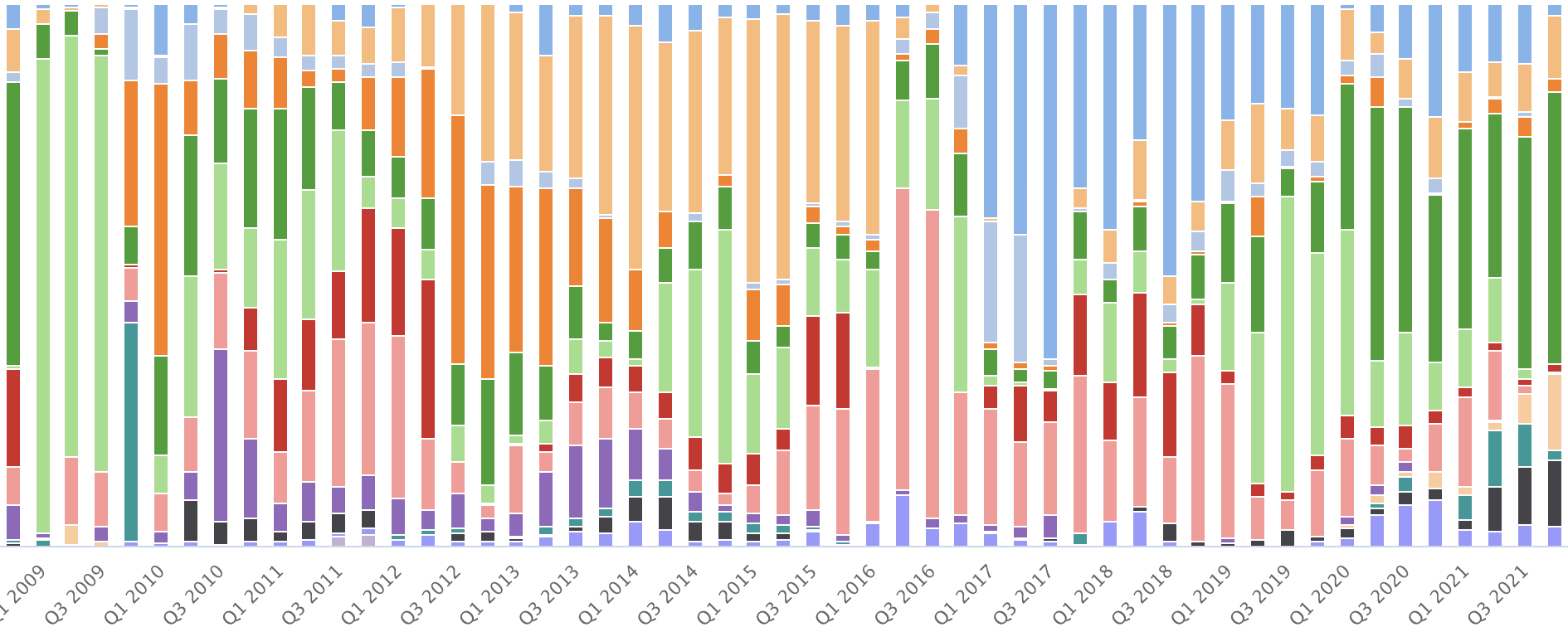
Taconic describes its traders as “opportunistic investors” looking for market inefficiencies. That’s usually Wall Street-speak for “we buy low on assets and squeeze every last dollar out of them.” See: Every time an investment firm buys newspapers.

The above chart, courtesy of the investor-information website “WhaleWisdom,” shows a damn high churn rate for Taconic. The different colors represent different market sectors. As you can see, Taconic specializes on diving into market sectors where they see potential profit and getting out just as quickly.

Given that history, it’s a little hard to credit Taconic’s stated intention to “reenergize” the mall and “build on its success.” First of all, long-term stewardship of an asset doesn’t seem to be Taconic’s game. And second, success?

“That does not compute,” said Mr. Spock when asked for comment.

Continue reading