Category Archives: Budget

If the Governor is worried about the wealth gap, he could maybe do something about it

Gov. Shumlin’s budget address began with a bit of boilerplate that’s been a recurring feature in his recent public remarks: bemoaning the wealth gap in America.

At a time when the wealth gap between the people at the top and everyone else is more extreme than since before the Great Depression, Vermonters hear about the recovery both in Vermont and nationally; they hear about our state’s low unemployment numbers; and they wonder: Why aren’t I seeing it? Why is my family being held back?

The bemoaning is appreciated, but when he does so little about the wealth gap, it comes across as an empty rhetorical gesture — the last ghostly trace of a progressive agenda.

Okay, I don’t expect Peter Shumlin to single-handedly fix our profoundly unbalanced economy. But there’s one big thing staring him in the face that would help the middle class and help close the state’s budget gap.

Raise the effective tax rate on top earners. Not the actual rate, but the effective rate.

Yes, I’ve said this before; and yes, Shumlin blocked a House proposal to do just that a couple years ago. But our tax system has gotten worse since then, and our budget shortfall has grown.

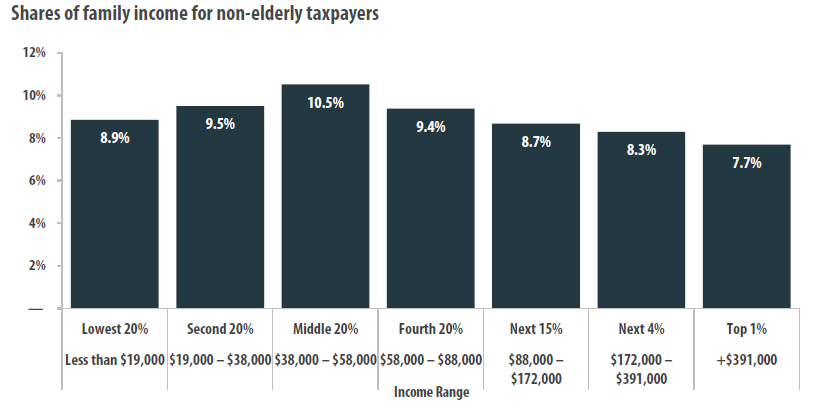
Just look at this chart.
ITEP 2014 tax chart

Sorry, I should have warned you: seeing that chart may result in nausea and vomiting.

According to figures released this week by the Institute on Taxation and Economic Policy (ITEP), Vermont’s tax system hits the working and middle classes the hardest, while top earners pay the least of all (as a percentage of their incomes).

In the past, the Governor has praised the fairness of our tax system. He should never, ever do that again until he fixes it.

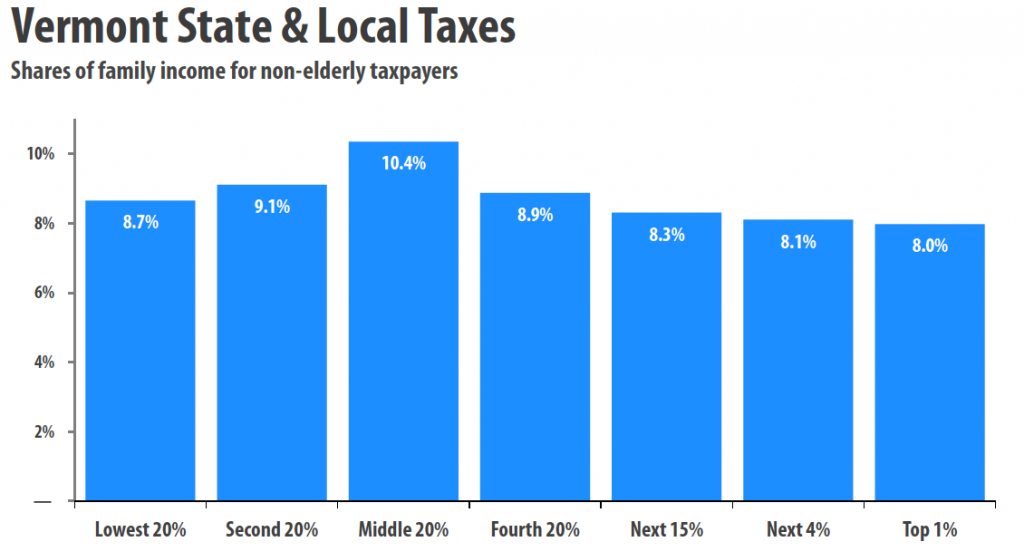
Not only has he failed to do so… not only has he blocked efforts to do so… but during the last two years, Vermont’s tax system has actually gotten worse. Here’s the ITEP chart from two years ago.
ITEP 2012 tax chart

Compare the two charts: Higher shares of family income for the bottom 60%, and lower shares for the very top. No relief for the middle class, despite the Governor’s rhetoric.

In many ways, our state tax system is relatively progressive, but there are problems. The sales tax is extremely regressive; the property tax hits the working and middle classes the hardest. And as Paul Cillo of the Public Assets Institute points out: 

“The regressive property tax is Vermont’s largest single revenue source supporting state and local public services, and the Legislature has been shifting more and more public costs onto the property tax.”

And while income tax rates are very progressive, the actual taxes paid are much less so. Vermont’s tax rate for top earners is 8.95% — but because of generous rules on taxable income and deductions, those top earners pay an effective rate of only 5.1%. 

In addition to the fairness issue, the disparity puts pressure on Vermont’s budget, as PAI points out:

If the nation fails to address its growing income inequality problem, states will have difficulty raising the revenue they need over time. The more income that goes to the wealthy (and the lower a state’s tax rate on the wealthy), the slower a state’s revenue grows over time.

What have we seen throughout the past several months? Income tax receipts coming in lower than expected, forcing cuts in the budget. Hmmm.

There was one modestly progressive tax proposal in the Governor’s speech: he wants to end a tax deduction for state and local taxes paid in the preceding year, a tax break that mostly benefits upper tiers.

Otherwise, he left our unfair, broken, and inadequate tax system untouched.

Just about every time he opens his mouth, he talks about how Vermonters are taxed to the limit of their ability to pay. This is clearly true for most Vermonters, but clearly untrue for the most fortunate among us.

There is a glimmer of hope. Shumlin yesterday took a tiny step away from his past opposition to raising income, sales, or rooms and meals taxes:

You have heard many times over the past four years my opposition to raising income, sales, and rooms & meals tax rates to fund state government.

When he delivered this line, he gave the word “rates” some extra oomph. And making the income tax fairer wouldn’t require a change in rates; it’d just mean closing loopholes and limiting deductions.

Reasonably. I’m not calling for confiscatory taxes on the rich; I’m just calling for them to pay their fair share in an economy that has bestowed most of its benefits on them.

How about it, Shap?
Same song, different verse

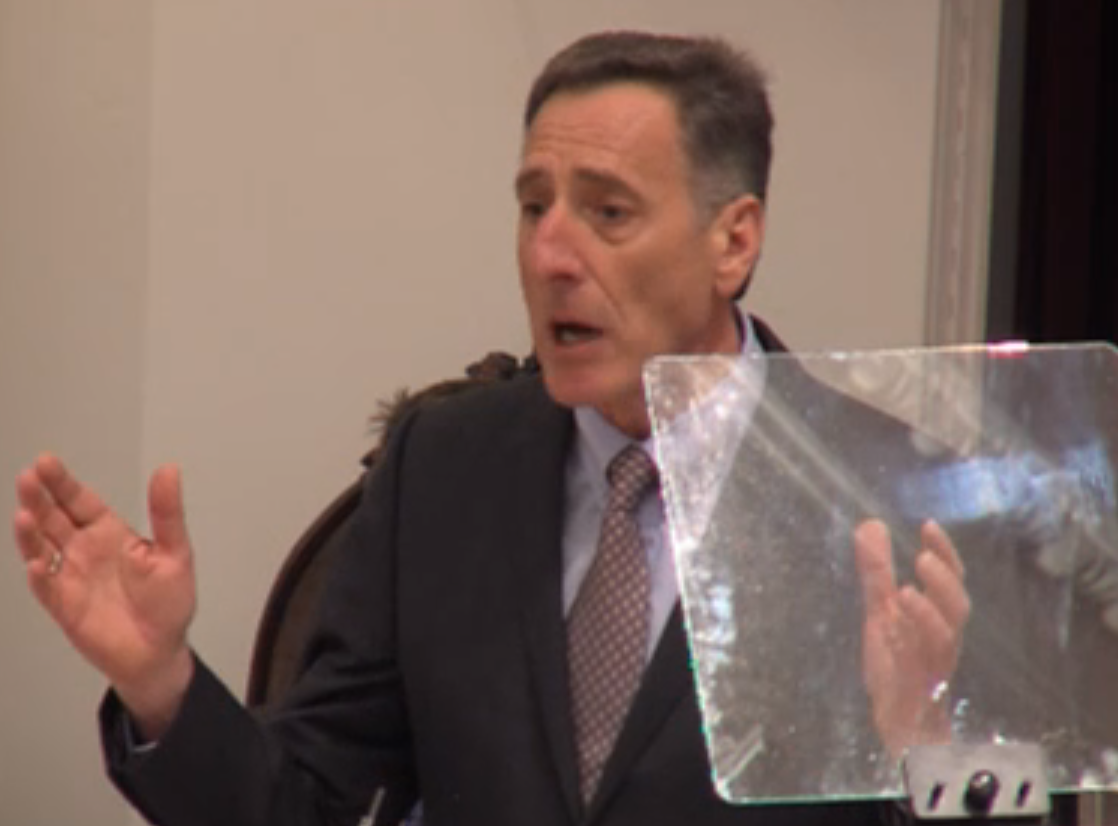
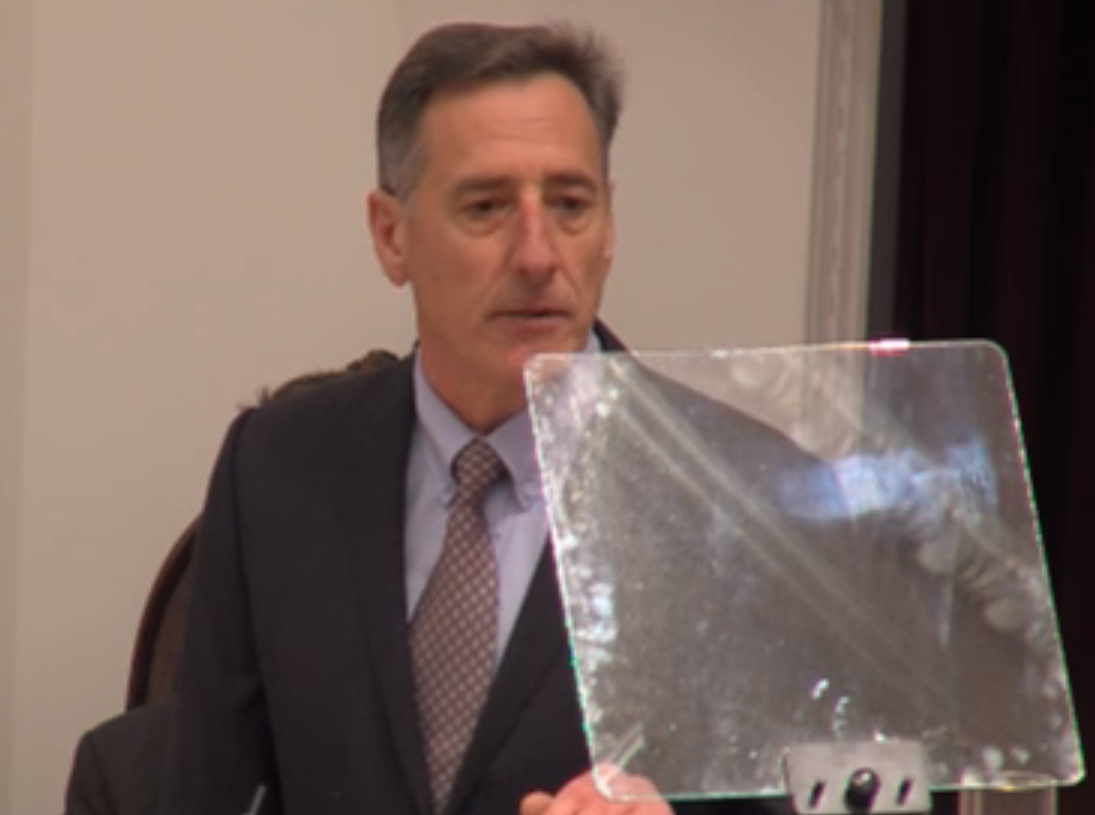
Hey, who switched the teleprompter to Español?

Hey, who switched the teleprompter to Español?

Reactions to the Governor’s budget address…

First, I hope the Republicans are happy. Last week they complained about a lack of attention to some major issues. Today they got a whopping hour and fifteen minutes. Be careful what you wish for.

This speech followed Shumlin’s usual pattern. There’s a whole lot of incrementalism — small, inexpensive approaches to big challenges — and, to spice things up, a handful of bigger proposals almost certain to go nowhere. It strikes many observers as a deliberate tactic: offer an unpalatable solution, and force the legislature to find an alternative. Example from a previous year: his plan for a major cut to the Earned Income Tax Credit.

I’ll give him credit, he’s very good at incrementalism. He finds modest improvements that don’t cost much, if anything. In today’s speech, he was constantly talking of leveraging federal funds, private-sector participation, and partnerships with entities of all sorts. A classic example: his plan to offer “motivated high school seniors” a free two-year Associates’ Degree in engineering technology “with no additional cost to the Education Fund.”

The plan involves the state Agency of Education and participating employers identifying students, and leveraging existing programs plus employer contributions to get them free tuition and a summer internship if they stay and work in Vermont after graduation.

It’s classic Shumlin. It sounds good, it will actually help some people, it’s cheap, and it can be effective as far as it goes.

But it doesn’t touch on the underlying problems: high college costs and stagnant earnings for all but the very wealthy. Even if the incremental stuff works, it seems like small potatoes for those of us who vote Democratic.

How big is the budget gap? It's soooooo big.

How big is the budget gap? It’s soooooo big.

Then there’s the other thing we get: the “big idea” that probably won’t go anywhere. I could mention a few; the double ban on teacher strikes and contract impositions, giving power to the state school board to close schools that fail to meet spending or achievement targets, the payroll tax increase to fund better Medicaid reimbursement.

Indeed, his entire education package seems designed for rejection. For one thing, it seems to do nothing to immediately mitigate rising property taxes. That’ll be lawmakers’ top priority, after last year’s election.

Shumlin’s broader reforms are an odd mix of distant and scary. Neither the teachers’ unions nor the school boards are likely to accede quietly to a plan that will strip them of their ultimate bargaining chips. The idea of eliminating “contradictory incentives” like the small schools grant may be good ideas, but they’ll be tough to support for lawmakers with small school in their districts.

Finally, the idea of Agency of Education “evaluation teams” going into every school to measure achievement and spending performance — with those who fail to meet benchmarks in line for state funding cuts or even closure — is DOA. It’s mandatory consolidation and top-down control via carrot and stick, rather than direct mandate. Kinda the worst of both worlds; no immediate impact, and a whole lot of state interference (as it will be perceived) in local decision-making.

He calls it a “partnership,” but one partner has the ultimate power.

If you think I’m too gloomy on Shumlin’s prospects, just take a look at this reaction statement from House Speaker Shap Smith:

…the Governor acknowledged Vermonters’ concerns about the unsustainable cost of health care, burdensome property tax increases, and the need to clean up our waterways. …I look forward to working with the Administration to make Vermont the best possibly place to work and live, and one that provides opportunity for all Vermonters.

He applauds the Governor for addressing the big issues — but not a peep about the Governor’s proposals. I expect lawmakers to consider Shumlin’s ideas, but he won’t get priority over others’ ideas.

This is all part of the game, as it has been since Shumlin took office. It’ll be even more so after an election that was largely a personal rebuke of the Governor, not the Democrats.

His budget message was a starting point. From here on, it’s a matter of top lawmakers devising proposals of their own that they can convince Shumlin to support.

Multimedia note: if the photos seem a bit blurry, it’s because they’re screengrabs from the Vermont PBS livestream. Workin’ from home today. 

Lock up the wimminfolk — the gunslingers are comin’ to town.

Wild BunchTalk about your Statehouse security risks.

Anytime now, you should expect an invasion by “the most sought-after Guns for Hire,” flooding the Statehouse hallways and your TV screens with an all-out barrage of propaganda issue advocacy.

The approaching marauders hale from a D.C. PR firm with the faintly unbelievable name “Goddard Gunster.” On its home page it proudly boasts of being “the most sought-after Guns for Hire,” as Business Week once called them.

GG will work for anyone who can pay its exorbitant bills, but a frequent customer is the American Beverage Association and its fellow peddlers of sugary drinks. They’ve turned to GG whenever a beverage tax or bottle bill or ban on SuperSizing rears its ugly head — from San Francisco to Telluride to New York City to Massachusetts.

And now, after an unsuccessful effort in 2013, we’re about to see another drive for a sugared-beverage tax* in Vermont. Which means, sure as the sun comes up in the east, Goddard Gunster will be ridin’ into town, guns a-blazin’.

*Popularly called “soda tax,” but would apply to any beverage with added sugar.

In 2013, an SBT bill won approval in the House Health Care Committee, which saw it more as a public health measure than a revenue enhancer; but it failed on a 6-5 vote in the Ways and Means Committee. During the three months between the bill’s introduction and its death, Big Sugar and its retail allies spent more than $600,000 fighting the bill. That’s an astounding figure in Vermont terms.

If you don’t believe me, maybe you’ll believe black-hat lobbyist Andrew McLean, who spearheaded Big Sugar’s anti-tax efforts under the Golden Dome:

MacLean concedes his clients spent “a lot of money” on a “very aggressive campaign” to halt the tax.

“I have not been involved in a campaign that’s that expensive,” he says.

This, from a guy who reps many of the biggest business and industry clients in Vermont.

And it’s sure to be even more expensive this year, because the SBT may have a better chance of passing. The reason? Vermont’s massive budget deficit, most recently estimated at $94 million.

There will be cuts to be sure; but cutting all the way to $94 million would be incredibly painful. It would, of necessity, focus primarily on the Agency of Human Services, which consumes the lion’s share of the General Fund budget. That’d be unpalatable to most lawmakers and to a liberal base already put off by Gov. Shumlin’s abandonment of single-payer health care.

So lawmakers will be looking for relatively painless ways to raise revenue. And that could carry the day for the SBT, which would raise about $35 million per year. That’s more than one-third of the budget gap taken care of right there.

The SBT does face a long uphill battle. Gov. Shumlin opposes it, although his stridency appears to be dwindling a bit. House and Senate leadership are cool to the idea, but advocates are hoping they will warm up as the budget pressure increases.

And sure as shootin’, “the most sought-after Guns for Hire” will be ready to ride into town, tossing money around like bullets in a spaghetti Western. The TV ads will be ubiquitous, touting “consumer choice” and featuring Mom ‘n Pop types worried about the tax’s impact on their little corner store. They’ll also be prominently featured in anti-SBT testimony in the Legislature — even though the big money behind the campaign will come from the beverage industry and big retail chains.

If they spent $600,000 two years ago to kill a longshot SBT bill, how much will they spend this year? Your guesses should start at a million bucks. Two mill would not surprise me.

Just think: more money than any political campaign in Vermont history, spent in a few short months over a soda tax.

This may be our first real taste of the post-Citizens United, Wild West world of unfettered money in politics.

A passel o’ peevishness on Inauguration Day (Part Two)

In Part One, I mused about the overreactions and hurt fee-fees on both sides of yesterday’s Inaugural protest. Now, let’s turn our attention to the Republican reaction to Gov. Shumlin’s inaugural address.

Their main point, according to VTDigger’s Laura Krantz?

Gov. Peter Shumlin ignored the most pressing issues facing Vermont in the first speech of his third term, Republican leaders said Thursday in response to the inaugural address.

… Republicans, gathered in the Senate cloakroom, said they were disappointed Shumlin ignored property taxes and health care — two issues that topped voter concerns during the elections last fall.

The speech focused on energy and the environment, so the complaint is technically accurate. But it deliberately ignores the fact that Shumlin billed this speech as Part One of a two-part 2015 agenda. And the governor specifically said he will address the “missing” issues in next week’s budget address.

“Just because the governor has acknowledged that his plan is a failure doesn’t mean he can ignore health care. We still need to address it,” said Rep. Patti Komline, R-Dorset.

Well, he didn’t “ignore” health care. He said he’d address it next week.

Sen. Joe Benning, R-Lyndonville, said the speech focused not on saving money but on spending more.

Again, the budget address hasn’t happened yet. That’s when Shumlin promises a plan to balance the budget. And, for the fiscal conservatives among us, Shumlin’s energy/environment speech contained very little in the way of new spending. The energy part was mainly about new regulation of renewables, which doesn’t involve any state spending. The Governor did propose two fees to help fund Lake Champlain cleanup, but both are narrowly targeted on sectors that contribute heavily to Champlain’s problems — agriculture and commercial/industrial development.

Republicans said they are open to his ideas about cleaning up Lake Champlain and other waterways but those are not the big problems.

Well, actually it IS a big and urgent problem because, as they well know, the EPA is holding Vermont’s feet to the fire. If we don’t come up with a solid plan, including new funding, then the feds will come down on us hard. That makes Champlain a top priority.

Speaking of new urgency, here’s another Republican missing the point.

“It needs doing but where was he four years ago on this?” said Rep. Brian Savage, R-Swanton.

Well, he was doing the same thing Jim Douglas did before him: postponing the Day of Reckoning as long as possible. As Rep. Savage well knows, the EPA has run out of patience, so Shumlin can’t possibly put it off any longer.

 Argument is an intellectual process. Contradiction is just the automatic gainsaying of anything the other person says.

“Argument is an intellectual process. Contradiction is just the automatic gainsaying of anything the other person says.”

House Minority Leader Don Turner was his usual obstructive self, strongly opposing any new taxes or fees, and even blasting Shumlin’s proposal to use the current use law as an enforcement mechanism for farmers and loggers. And he did so in a stunningly inarticulate fashion:

“I think that we know that current use is a very popular program, and it is a very expensive program. But if we want open land in Vermont its been one of those tools that has worked really well,” he said.

So wait. Current use is “very expensive,” and, in fact, Republicans have called for new limits on the program, but it’s “worked really well” and we can’t possibly do without it. You’d need a couple hours of pounding ’em back at the Capitol Plaza bar before that started to make sense.

The entire Republican response consisted of the automatic gainsaying of anything Shumlin said.

With one exception. Lt. Gov. Phil Scott released a statement that began thusly:

“I was encouraged to hear the Governor talk about economic growth. It was good to hear about the Governor’s support of research and development, especially after this important incentive was reduced last year. I hope that the Governor’s mention in his speech today is a precursor to a proposal included in the budget next week.”

Admittedly Scott sort of bent Shumlin’s message in his own direction, but look at what he did:

— He identified common ground instead of just saying “No.”

— He acknowledged that the inaugural address was Part One of Shumlin’s agenda.

A hint of politics, but overall gracious and inclusive. That’s the way you do it.

The Shumlin conundrum

(Say it five times fast.)

Governor Shumlin delivered brief remarks to the House and Senate Democratic caucuses on Saturday. His message, basically: we’ve got big problems to deal with and no money, so let’s dig in and get going!

I can imagine him in a past existence, being a life coach for Roman gladiators.

He appeared in his Airwolf jacket, fresh off a helicopter (or, as he put it, “chopper,” what a man) tour of storm-damaged Vermont. Which caused much speculation on Press Row about who paid for the overflight.

The Shumlin Tour. Not exactly as pictured.

The Shumlin Tour. Not exactly as pictured.

Said speculation didn’t make it to their reports, and the stunt had its desired effect: lots of coverage on the teevee news, with the governor looking both manly and concerned.

Naturally he didn’t have time to change out of his flight gear before the caucuses, hahaha. Really, anybody weighing less than four bills could change clothes in the back of that Yukon SUV he rides around in.

He did use his chopper tour to make a pitch for his renewable energy agenda — “we didn’t use to see storms like this,” but now we got global warming. And then he turned to a series of talking points we can expect to hear again and again in the new year, all designed to diminish expectations and/or dash hopes.

He didn’t use Phil Scott’s phrase “affordability agenda,” but the substance seemed awfully similar. Vermonters are frustrated that their purchasing power is stagnant while costs (and property taxes) are rising.  State spending has to be reined in.

When he took office, he said, economists were forecasting a post-Recession return to 5% annual growth in the Northeast. Turns out, it’s more like 3%, and is likely to stay there for quite some time. But state spending was built on that 5% projection, and that’s led us to our current fiscal mess.

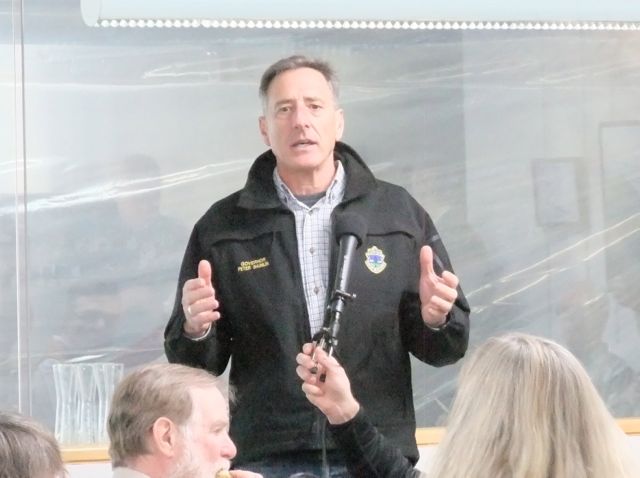
Stringfellow Hawke explains it all. (As the hand of VPR's Peter Hirschfeld gamely tries to keep a microphone within range.)

Stringfellow Hawke explains it all. (As the hand of VPR’s Peter Hirschfeld gamely tries to keep a microphone within range.)

The $100 million shortfall in next year’s budget, he said, is real. We’ve used up the federal recovery money and the one-time funds to balance past budgets. Now, “we’ve got to make tough choices.” We’ve got to bring down growth in state spending to match that seemingly endless 3% growth rate. Thus, he said, “anyone asking for more money had better think twice.”

He made a progressive plaint about the growing income gap between the very rich and the rest of us. He did not, however, connect the dots between that phenomenon and Vermont’s underperforming income tax revenues.

And he certainly did not connect the dots to a quirk in our current tax system that has an official top tax rate of 8.95%, which seems quite high — but the rate that top earners actually pay is not 8.95%, but 5.2%. Furthermore, if you add up all state and local taxes, it turns out that the top 20% pay a lower share of their income than the other 80%, and the top 1% pay the lowest share of them all. (Figures from the Institute for Taxation and Economic Policy.)

When I connect those dots, I think we ought to resurrect a bill that almost passed the House two years ago. It would have shifted more of the tax burden upward, and given modest tax cuts to middle and lower-tier working Vermonters. That bill died a sudden death because of Shumlin’s steadfast opposition.

So when he starts talking about income inequality, he needs to talk about our tax policy as well. Because these days, that’s where the money is. And our top earners are doing extremely well, thank you very much. They can pay their share.

Shumlin also rolled out his school funding argument: Our schools would perform better for less money if there was some kind of consolidation. Because studies show that very small class sizes are just as harmful to achievement as very large class sizes. So we’ve got to embiggen our schools, not to save money (although we would), but for the sake of the children.

Awww.

Surprisingly, there was no mention of single payer health care — or the slightly watered-down “universal health care” — except for a brief mention, in his Cavalcade of Calamities, of unacceptably fast-rising health care costs.

Okay, some realities of my own. I accept the notion that slow growth means an extremely tight state budget, and that we cannot tax our way out of it. We should tweak the tax system to make it more equitable, but that’s not going to bring in much money. We’ll need to make government more efficient if we want to preserve the level of services we’ve come to expect.

I believe that the number-one thing Governor Shumlin needs to do to restore his standing with voters is to re-establish his reputation for good governance. The policies, and I say this as a devout liberal with strong policy positions, are kind of secondary.

Shumlin gained a strong managerial reputation during the Irene recovery. He pretty much blew it in his second term, with the continuing difficulties of Vermont Health Connect, the problems in the Agency of Human Services, and all the budget shortfalls. If he can make state government work effectively, he’ll win back a lot of voters.

And this will be his biggest administrative challenge, not Irene. Authentic crises are difficult, but they get the adrenalin flowing, and everybody puts aside their differences and pitches in. Maintaining the day-to-day operation of a big bureaucracy is harder. It’s an unending slog. It challenges established procedures, and if there’s one thing we Vermonters love, it’s doing things the way we’ve always done them.

As a liberal, I expect to be disappointed repeatedly by Shumlin in the next two years. Clearly, between the realities of the fiscal situation and his own political instincts, there’s going to be a lot of governing from the center. Or even center-right. But if he can govern effectively… if he can actually create new efficiencies, saving money while maintaining services… he will restore his political reputation.

Is he up to that challenge? Two years ago I would have said a resounding “Yes.” Now, I’m not so sure. Flight jacket notwithstanding.

Now that I have their attention

Funny thing happened Thursday, unprecedented in my three-plus years of political blogging.

My sources. Not exactly as illustrated.

My sources. Not exactly as illustrated.

I got calls from not one, not two, but three different top Democrats seeking to gently upbraid me for stuff I’d written this week, and offer some guidance toward alternative views. Their own views, of course.

Which is nice for the ego. They read, and they care.

Also, their messages were valuable. They did offer some good information. But I’m not completely convinced.

The callers offered some pushback on the subject of newsdumps. They insisted that what appear to be newsdumps — the offloading of bad news when people are least likely to see it — were not newsdumps at all, but simply cases of the calendar conspiring against them.

There was a second message: the upcoming round of budget rescissions do not single out Human Services. They don’t deny that AHS is going to feel the pain, but the problem, as they explain it, is that vast areas of the budget are off-limits for rescissions, which makes AHS the only real target of substantial size.

They made some good points. The problem is this: the Shumlin administration has a well-earned reputation for (1) deviousness, (2) political gamesmanship, (3) newsdumps, and (4) targeting Human Services. Their own track record colors my views of recent events. In other words, if I was overly cynical, I put much of the blame on their doorstep.

I’m sure those inside the administration don’t see it that way. For the most part, they honestly believe they’re trying their best to move the state forward through tough times. But the 2014 election should have been a wake-up call: their view of things is often at odds with others’ views. Say, the voters’ views.

Let’s take their points, shall we?

First, on Human Services having to make almost two-thirds of the cuts in the upcoming rescissions. It’s true, but the reason is that AHS takes the lion’s share of general fund money. And only general-fund programs are open to rescission. Schools and transportation don’t get much money from the general fund, for instance.

According to outgoing Administration Secretary Jeb Spaulding, appearing on VPR’s Vermont Edition Friday, AHS accounts for 40% of the total budget — but 75% of General Fund spending.

Which sounds reasonable to me. But…

1. This wouldn’t be the first time the administration targeted AHS. The most notorious case is Shumlin’s ill-fated effort to slash the Earned Income Tax Credit, one of our best bulwarks against the rising tide of income inequality.

2. The rescissions list was released on the Thursday before Thanksgiving. This may or may not have been a newsdump (see below), but it gave little or no opportunity for journalists and bloggers to seek clarification of the raw numbers. When I saw the raw numbers, they looked really, really bad for AHS.

And now, on to newsdumps. I had identified three: the rescissions release, the deadline for submitting rescissions, and the Governor’s release of his single-payer financing plan at the end of this month.

The rescissions release on Thanksgiving Eve wasn’t a newsdump, my callers insist. They had put together the list and informed agency officials earlier that week. Many agencies wanted to tackle the budget-cutting immediately — over the holiday weekend. That meant releasing the list on Wednesday, so the process could begin.

The deadline, Friday Dec. 5, they say, wasn’t a newsdump because they hadn’t planned to release anything on Friday. It was an internal deadline only.

I can accept that. But once again, history informed my cynicism. When I see something bad happening on a Friday or a holiday eve, my Weaselometer begins to howl.

Finally, the long-awaited and catastrophically overdue reveal of the single-payer funding plan (which VTDigger’s Morgan True appears to have uncovered the substance of already) on either Monday December 29 or Tuesday December 30. Many voters will be out of town or otherwise occupied during that time; media outlets will have bare-bones staffing. So of course it looked like a newsdump. 

Not so, insist my callers. They blame the calendar, mostly. You see, the 29th and 30th are on Monday and Tuesday. They couldn’t release it on Friday the 26th, and New Year’s Eve would be universally viewed as a newsdump.

The week before is problematic as well. The 24th, 25th, and 26th are out. Monday the 22nd or Tuesday the 23rd would hardly be any better than the 29th or 30th. And the week before that is too early; the plan may not be completely done by then.

Okay, spin it ahead. New Year’s Day is a Thursday; Jan. 2 is not only the day after a holiday, it’s a Friday, so that’s no good.

Which brings us to Monday the 5th — only two days before the Legislature convenes. That week is likely to be a circus, what with Scott Milne’s Dance of the Seven Veils, various ceremonial activities, and other hard news. (Such as the RAND Corp. report on marijuana legalization.)

The fear, so I’m told, is that a single-payer unveil on Jan. 5 could get lost in a blizzard of news. It would also give lawmakers less time to look it over. And, I’m told, lawmakers wanted to get their hands on it as quickly as possible. Hence, a pre-New Year’s release.

Again, it all makes sense. And again, given the administration’s iffy history, you can understand why an outsider would look at a late-December release and scream “Newsdump!”

This all illustrates how much the administration will have to do, to repair its tattered and battered public image. Much of those batterings were self-inflicted, as the administration acted out of unwarranted hubris and, sometimes, arrogance.

They may not believe they acted badly in the past. But a lot of Vermonters, including a whole lot of liberals, are convinced that they did. That’s why Shumlin’s pre-election approval numbers were so dismal, and why his very expensive campaign hardly moved the numbers at all.

And that’s why I’ve said the Governor should avoid newsdumps or anything that looks like a newsdump, or anything that looks like a political maneuver or a transparently bogus explanation. He’d be better served by standing up in broad daylight and owning the bad news, instead of reinforcing his reputation.

Of course, he’d be far better off by having an administration that didn’t produce so much bad news. But that’s another matter.

Callers, thanks for reading theVPO and taking it seriously. And thanks for calling.

A moment of sanity in the corner office

Apparently the Governor realized it wasn’t a good idea to begin a new biennium with an inter-branch standoff over budget cuts.

The Shumlin administration has decided not to unilaterally cut $6.7 million from the current fiscal year’s budget. The rescissions instead will be included in the executive branch’s budget adjustment proposal to the Legislature in January.

Can we hear a brief rendition of Fanfare For A Single Kazoo?

[Administration Secretary Jeb] Spaulding said the administration agreed to wait on rescissions, but will “slow down” spending in the meantime.

“(G)etting into a fight with the Legislature on this would be counterproductive,” he said in an email.

In the words of some great philosopher somewhere, “Well, DUHHHHH.”

The Administration, for those just joining us, had claimed the authority to cut current-year spending by up to one percent without legislative approval. And, as reported in this space (and, regrettably, nowhere else), the outlined cuts were very heavy on Human Services. Which probably would have caused even more conflict with the Legislature, as it has done on previous occasions when the Administration sought to balance the budget on the backs of the working poor.

Lawmakers weren’t convinced by the Administration’s legal rationale for unilateral action, even though Attorney General Bill Sorrell rubber-stamped it. Legislative Council had a different view:

In a draft memo drafted Nov. 24, Legislative Council attorney Rebecca Wasserman said the rescissions already approved by the Joint Fiscal Committee in August preclude the administration from making unilateral cuts now.

I hate to say it, but I’ll take Wasserman’s word over Sorrell’s. Finance Commissioner Jim Reardon somehow managed to make a big concession sound like a veiled threat:

“We do believe we have the authority based on the consultation with the AG’s office,” Reardon said. “But for the sake of working with the Legislature, we decided we will propose all of the budget adjustments in January.”

“For the sake of working with the Legislature,” meaning, “We let ’em have this one, so they’d better play ball come January.”

Perhaps I read too much into this. And perhaps, in a more cooperative atmosphere, the massive Human Services cuts will be mitigated. We can but hope.

About those rescissions, pt. 2: The poor will always be with you

It seems as though the Shumlin Administration’s cowardly pre-Thanksgiving newsdump was successful: our political media dutifully reported the topline — $17 million in cuts, including $6.7 million to be implemented without legislative approval.

But nobody, at least not yet, has reported any of the details. And there are some noteworthy details. Some entire agencies seem to be getting off scot-free, while others are taking it in the shorts.

Well, one in particular. And if you guessed “Agency of Human Services,” you’d be a cynical observer of Vermont politics.

And you’d be correct.

Human Services is expected to provide almost two-thirds of the total rescissions — more than $10 million.

It must be noted that Human Services is the single biggest agency, so it could be expected to take a hit. But it’s not anywhere near that big. This seems to be a rerun of past Administration efforts to cut human-services spending; I’m reminded in particular of its ill-fated effort to slash the Earned Income Tax Credit. This time, instead of calling for specific (and politically unpopular) cuts, the Administration is dumping the mess into AHS Interim Secretary Harry Chen’s lap.

Gee. Supposedly Shumlin thinks Chen is doing a bang-up job, and would love to have him stay in the post. This is a damn funny way of showing his appreciation.

Most other state agencies come in for some cuts, but nothing close to AHS scale. And there are a couple of agencies that seem to have avoided the budget ax altogether.

Number-one on that list is the Agency of Transportation. It’s one of the bigger state agencies, and it won’t be getting any smaller; it’s being held harmless.

At the same time, the Governor’s hit list gets awfully picayune in spots. The Vermont Humanities Council is being docked $9,000. The Lieutenant Governor’s office is getting nicked by $2,900. And the Vermont Symphony Orchestra is in line to lose $2,000.

I find it hard to believe that Human Services can slash $10 million but Transportation can’t spare a dime. I also find it hard to believe that a process so fine-grained that it could find two grand in savings from classical music couldn’t identify any cuts at all in concrete and asphalt.

My own budgetary chops are pretty limited, so I can’t assess each and every cut. These are a few highlights, obvious even to the untrained eye. It is to be hoped that someone in the media is taking a closer look at the rescission list. There’s definitely some funny stuff going on.

One final note. It’s been widely reported that there’s a potential conflict between Administration and Legislature over the former’s claim that it can cut $6.7 million without lawmakers’ approval. What hasn’t been reported is that the Administration wants the other cuts — the ones requiring legislative approval — to go into effect before the new session begins.

This seems like a pretty devious way to undermine the legislature’s budget-writing authority. It’s yet another potential flashpoint between the two branches of government. And yet another sign that the Governor has already stopped his post-election “listening and learning.” He’s back to taking pre-emptive action and trying to box the legislature into a corner.


About those rescissions, part 1

On Thanksgiving Eve, the Shumlin Administration took out some trash. And before I go on, may I just say that pre-weekend newsdumps — and especially pre-holiday newsdumps — are a cowardly way to govern? If you guys think you’re smart enough to manage this state, have the courage to own the bad news. A newsdump might help minimize the immediate impact, but you’d be better off to face the bad news head-on. Be honest with the people who elected you.

(There was a similar Administration newsdump the Friday before Labor day. That one was a damning review of the management of Vermont Health Connect’s IT infrastructure. I look forward, not at all, to the news we might get on Christmas Eve.)

This newsdump concerns a second round of budget rescissions, made necessary by shortfalls in income tax revenue. Which were caused by an anemic economic recovery that has left the middle and working classes behind. Stagnant wages, stagnant tax revenue. While the top earners continue to depress their tax bills through loopholes and high deductions.

The Shumlin Administration wants to cut $17 million from this year’s spending. I’ll have more to say about the specifics in a later post. For now, I’m focusing on the Administration’s claim that it can cut $6,7 million without the Legislature’s approval. The Administration has an Attorney General’s opinion that approves its legal argument for doing so.

That doesn’t sit well with top lawmakers:

Legislators on the House and Senate’s Joint Fiscal Committee share the administration’s sense of urgency, but do not believe that the Shumlin administration has the legal authority to make most of the planned cuts. The Legislative Council, which advises lawmakers on legal matters, supports that position.

“The statute does not give them the authority to do this,” said Sen. Jane Kitchel, D-Caledonia, co-chair of the Joint Fiscal Committee.

I guess we can conclude that Governor Shumlin’s post-election period of listening and learning has come to an end. One seemingly obvious result of the razor-thin gubernatorial election was that Shumlin would need to repair relations with the legislature and act in a more cooperative manner.

Seems like a lesson unlearned there. And it’s not exactly a good portent for what’s going to be, at best, a contentious and difficult biennium.

Shumlin: “We have a structural deficit” and other happy tidings

The Governor addresses the multitudes. (The bearded man begging for change is Dave Gram of the Associated Press.)

The Governor addresses the multitudes. (The bearded man begging for change is Dave Gram of the Associated Press.)

An uncharacteristically subdued Governor Shumlin held an agenda-free news conference this morning. I emphasize “agenda-free” because his past practice has been to piggy-back news conferences onto photo opportunities or policy announcements, leaving much less time for general questions.

Today there were a lot of questions and a lot of substance. In no particular order…

The Vermont Health Connect website will go back online this Saturday, which happens to be the first day of open enrollment. So the relaunch will come on the last possible day. Gee, hope things go right; there’s no margin for error.

Shumlin pronounced himself “optimistic,” saying “I’m encouraged by what I’m hearing.” But given how often he, and we, have been burned in the past, he was reluctant to make any predictions. “I’m always hoping it will work.”

— He dismissed Republican calls to shut down VHC and go with the federal exchange, and he had several good arguments. First of all, it’s far too late to make the change this year, so we’d be limping along with VHC for another year in any case. And there are signs it’s finally getting on track. “We’re turning a corner,” he said. “Why not give it a chance?”

There’s also the fact that the federal exchange’s premium subsidies aren’t as generous as Vermont’s. Switching to the federal system would mean higher premiums for thousands of Vermonters who earn between 100-300% of the poverty line.

And, as he pointed out, the US Supreme Court may well strike down federal subsidies, in which case only states with their own exchanges will be able to offer subsidies.

— Get ready for a slam-bang legislative session. Shumlin is still talking about the next step in health care reform (see below), the legislature is hell-bent on property tax and/or school funding reform, Shumlin is talking about significant changes to energy policy, and perhaps worst of all, the quote atop this post: “We have a structural deficit at this point.” Meaning huge challenges in fashioning a budget. That’s a hell of a lot of big, contentious issues to tackle.

Temba, his arms wide.

Temba, his arms wide.

— Speaking of the budget, Shumlin acknowledged that Vermont and many other states “thought the recovery would be more robust,” and its weakness has caused revenue shortfalls. He’s talking about a second round of rescissions in this year’s budget, although he said nothing is final just yet. And he’s talking about major changes in next year’s budget in order to put an end to annual budget crises.

He wants to put the state on a more sustainable path. Which must be making a few Republicans chuckle, since they’ve been preaching this for years. On the other hand, Shumlin has a valid point: the recovery has been weak. If we’d had a normal recovery with decent wage gains, our tax revenue would be stronger and we wouldn’t be facing this dilemma. The big news on this front is that the Governor now believes we’re facing years of sluggishness, and we need to ratchet down the budget to make it sustainable.

When asked whether this might mean tax increases, he didn’t rule them out, but he made it clear that his first choice is to rein in spending.

— On the push for single-payer health care, he repeated his longstanding support for the idea, but acknowledged that in the wake of the election, everything is on the table. He is aiming for a system that combines affordability with universal access to health care. His preference remains single-payer, but it’s looking like we might settle for less than that.

— He made it clear that yes, he won the election, and he has no doubt that he will serve a third term. He pointed to Vermont’s long tradition of electing the top vote-getter when no one wins a majority: ‘The person who gets the most votes, wins.” He cited the 2002 election for Lieutenant Governor, in which he and Progressive Anthony Pollina combined for a liberal majority but Republican Brian Dubie won the most votes; he and Pollina urged lawmakers to elect Dubie, which they did.

— On school funding and organization, he declared “We have a spending problem,” with high per-pupil costs and administrative structures. In some cases, he said, small class sizes can be harmful to achievement rather than helpful. He’s not in favor of mandatory school consolidation, but it’s clear he will push for consolidation by trying to convince local districts that it’s in their best interest.

He did mention the idea of “prioritizing funding to schools that voluntarily consolidate.” That kind of legislative payola may be effective, but it kinda stretches the definition of “voluntary.”

— In a less wide-ranging news conference, his comments on energy policy might have made headlines. They’re likely to get lost in today’s news. He noted the pending sunset of the SPEED program, which has helped spur the renewables industry in Vermont but has also created controversy because it allows the sale of “green” energy credits in other markets. He and the legislature are working on “ideas to replace SPEED.”

He was asked about the prospects for a carbon tax with offsetting cuts in other taxes — a plan likely to be announced tomorrow by a coalition of environmental groups. He was cool to the idea, saying “It’s tough for a small rural state to do it alone,” and pointing particularly to its impact on gas stations near our state borders. He prefers a regional carbon tax instead; but he said he’s had no conversations with other northeastern governors about the idea. Methinks the enviros will have a hard time gaining traction, when you combine Shumlin’s reluctance with an extremely busy legislative session.

— Finally, he was asked about marijuana legalization. He said he wants to wait until the release of a report on the idea in January before proceeding, but noted that “I support legalization. The question is “when.”