Category Archives: Budget

The long and winding (and circular) road

It’s been a very long week at the House Appropriations Committee, which has been trying to close the remaining $18 million or so in the budget gap for Fiscal Year 2016. In today’s session, members tried everything they could think of, and then some, to balance the budget while avoiding some of the “big uglies” — the proposed cuts that nobody wanted to make.

Shall I cut to the chase? After advancing through the five stages of grief, they ended up accepting pretty much the entire list, including $6 million from LIHEAP, $2 million from a Department of Children and Families weatherization program, a $1.6 million hit to Reach Up, a million-dollar cut for the Vermont Veterans Home, a reduction in state funds for Vermont PBS, and $817,000 from Vermont Interactive Television.

This list was dubbed a “wish list” by the committee — not because they wanted to cut the items, but precisely the opposite: their wish was to avoid having to cut these items that were put on the chopping block in Gov. Shumlin’s budget proposal.

There were a couple of adjustments. As reported in my previous post, the committee adopted Rep. Maty Hooper’s plan to phase out the state prison at Windsor and devote some of the savings to re-entry programs aimed at reducing the inmate population and avoiding the export of more inmates to out-of-state prisons. And a $500,000 cut to the judiciary system was technically made a one-time cut, with the understanding that the system will reform itself in the coming year to generate equivalent savings in future years.

All the “wish list” cuts adopted by Appropriations added up to a little over $14 million in savings, mainly from the Agency of Human Services. Which is almost inevitable; the committee was looking for cuts only in General Fund programs, which leaves out a significant share of state spending. Most General Fund spending is in Human Services, so that’s where the cuts had to come from.

Mind you, nothing was finally decided today. Some committee members still hope to restore some of the cuts, but in order to do so, they’ll have to find equivalent cuts elsewhere. (Appropriations has no authority to increase revenues; it only oversees the spending of state funds.) As they put it, “buy back” some cuts. That seems unlikely, however; at day’s end, the committee was still $1.93 million short of a balanced budget. So in order to restore any of today’s cuts, they’d have to find more than $2 million in savings elsewhere.

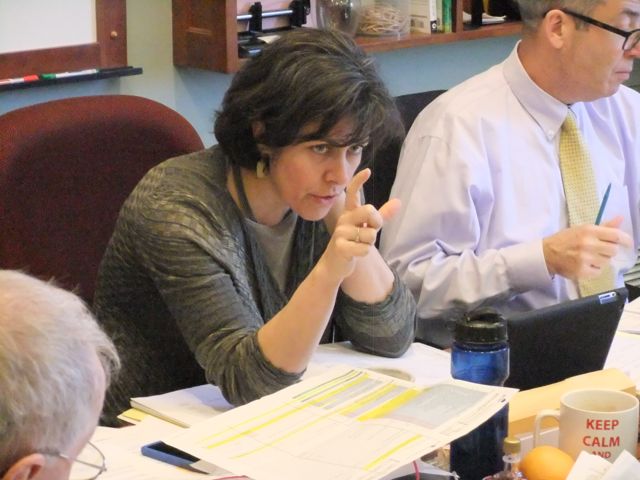
Appropriations Chair Mitzi Johnson looking for cuts of any size, large or small.

Appropriations Chair Mitzi Johnson looking for cuts of any size, large or small.

And they tried really hard today. Most of the committee’s Democratic majority did not want to impose Shumlin’s cuts. Committee Chair Mitzi Johnson repeatedly invited members to come up with their own substitutes. And they all looked high and low, with almost no success.

At one point, Johnson asked members to split up into “unlike pairs” to discuss the “wish list” and other possible cuts. That session lasted almost an hour, and ended with several members making cellphone calls in pursuit of information on possible savings. Items of as little as a few thousand dollars were offered.

In the end, they wound up back at the “wish list.” In the absence of any alternatives, and with guidance from House leadership that only a certain amount of new revenue would be available, the Appropriations Committee bit the bullet and tentatively approved all the cuts on the “wish list.” It also approved a couple million in additional savings that weren’t on the “wish list.”

Watching all this made me appreciate how hard it is to find savings in the budget. For all the conservatives’ cries of waste and abuse and lavish spending, Republican members had no more success than Democrats in finding fat to trim. In the end, committee members of all stripes were reluctantly united behind a budget proposal that will bring painful cuts to many areas of government. There were no easy calls.

This is an early step in the process. The budget has to get through the full House, where trouble may loom in the form of a Republican/liberal coalition that opposes the budget for very different reasons. If it gets through the House, it’ll have to make its way through the Senate’s often weird and unpredictable gauntlet. But the Appropriations Committee tried and tried and tried; and in the end, it couldn’t find more palatable alternatives to Gov. Shumlin’s budget proposal.

Mary Hooper pulls some fat from the budgetary fire

Previously I brought you bitter tidings of a budget cut that would mean sending more Vermont inmates to for-profit, out-of-state prisons.

Well, my pessimism was premature. Today, Rep. Mary Hooper (D-Breezy Acres) introduced a plan to phase in the closure of the Southeast State Correctional Facility, and devote some of the projected savings to new re-entry programs designed to lower the inmate population. The plan appeared sound and convincing to the House Appropriations Committee. If it all works as planned, Vermont’s inmate census will be low enough when the prison closes, that no out-of-state transfers will be required. (Corrections Commissioner Andy Pallito had estimated that 100 more inmates would have to be exported to the tender mercies of the Corrections Corporation of America.)

And bonus: the released inmates will be better prepared to make a successful re-entry into civilian life. That makes them less likely to re-offend.

Her proposal was accepted by the Appropriations Committee and folded into its budget plan. I don’t know all the details of Hooper’s proposal; I didn’t have a chance to speak with her today. But it’s good news. It turns a negative into a positive, and still allows the state to bank $1.7 million in savings from the prison closure.

More on today’s hot and heavy Appropriations action coming soon. Warning: not a lot of good news.

So what kind of game are legislative Republicans up to?

Interesting bit of byplay from last night’s hearing on possible E-911 dispatch closures, as captured by Freeploid newbie Paris Achen, who is one “a” away from being the only Vermont reporter named after two European cities:

Rep. Job Tate, R-Mendon, stood at the entrance of the House chamber and handed out Lifesavers “for life savers.”

Now, I would expect Republicans, being Republicans after all, to oppose revenue increases. But here is Mr. Tate, grandstanding his opposition to a modest budget cut.

This is the party that believes we should take a meataxe to the budget — that Democrats are guilty of out-of-control spending.

Of course, this is also the party that has failed to identify any cuts of its own, aside from its persistent call for dismantling Vermont Health Connect. You know, the proposal with the Incredible Shrinking Savings: originally $20 million, now $8 million.

I’ve heard other rumblings of this behavior by some Republican lawmakers, but this is the first concrete example I’ve seen in the media. It strikes me as highly cynical and deliberately obstructive.

The Republicans like to claim they’re different from their national colleagues — that they adhere to the Vermont Way of civility and cooperation in politics, trying to serve the best interests of the state. Well, actively opposing real budget cuts while issuing vague calls for undefined budget cuts is a piss-poor way of doing so.

Bonus: Tate’s rationale for opposing the E-911 consolidation was tissue-thin.

“For us, the local knowledge of the area is important to directing troopers to the right location,” Tate said.

Consolidation would remove some of the local knowledge about remote areas of the state, he said.

Yuh-huh. You’re telling me that efficient dispatch service depends on local knowledge? It’s not like we’ve got dispatchers in every town and on every hilltop. The current system has four dispatch centers. FOUR. In a state like Vermont, the unique value of “local knowledge” dissipates awfully quickly. It’s hard to see how we’d lose critical “local knowledge” when we’re cutting from four to two.

For health care expansion and SSBT, a long road ahead

Last week brought some relatively cheery news for fans of better access to health care and of the sugar-sweetened beverage tax. The House Health Care Committee passed a fairly wide-ranging bill that would help close the Medicaid gap, provide more assistance to working-class Vermonters seeking health insurance and encourage more primary care providers, among other things. To pay for all that, the Committee opted for a two-pronged approach: the revised 0.3% payroll tax proposed by Gov. Shumlin, plus the two-cents-per-ounce tax on sugar-sweetened beverages.

A good package, a nice bill. But is it a meaningful step, or simply a McGuffin? When you read between the lines of Committee chair Bill Lippert’s statement, and see the slightly shopworn look on his face, well, you start thinking the latter.

I have no illusions that what we propose will be a final product at the end of the session, but it was our responsibility… to identify and articulate priorities that could make a difference now and could be investments for the future, even in a time of tight budgetary constraints.

Glass half full, or glass half empty? I hear a guy resigning himself to the inevitable disembowelment of his bill.

Enough inference. The next stop is the Ways and Means Committee, where opinion is split on the SSBT and there’s widespread opposition to the payroll tax. After that, well, there’s a lot of room for pessimism.

There’s little appetite for raising taxes in Montpelier — or should I say “raising more taxes,” since tax increases will almost certainly be part of a budget-balancing deal. (Front runner: Ways and Means chair Janet Ancel’s plan to cap itemized deductions at 2.5 times the standard deduction.) There’s also the EPA-mandated Lake Champlain cleanup that needs funding. In this climate, it’ll be hard to justify funding the health care package as well.

Regarding the SSBT specifically, Governor Shumlin and House Speaker Shap Smith don’t like it. Really, there aren’t many real fans; some just see it as the least bad option. Most lawmakers seem allergic to the payroll tax, even in reduced form. But let’s say, just for the heck of it, that the Health Care Committee’s bill passes the House. What awaits in the Senate, that notorious den of centrism where liberal House bills go to die?

“I wouldn’t predict what a vote today would be,” says Senate Finance Committee chair Tim Ashe (more D and less P with each passing day). “I’d say they both start in difficult places in terms of a Senate vote. Individual committees may be more or less favorable, but in the whole Senate, both would struggle to pass at this time.”

Gulp. Well, I guess I shouldn’t be surprised. So I guess that leaves us with no money for enhancing our partially-fixed health care system?

“That’s an open question,” says Ashe. “There are the resources to pay for new initiatives or increased support for existing initiatives can come from existing sources or new revenues.”

Oh really? You’ve found a pot of money somewhere?

“I’ll mention just one resource. …This year, Vermonters without insurance are going to ship about six million bucks to the federal government in a penalty. Next year that money goes up to 12 to 14 because the penalty basically doubles.

“So 23,000 Vermonters will be shipping all that money to Washington, and they will get nothing for it. Question is, is there a way to help them NOT send the money to Washington and get nothing for it, but to keep the dollars here and give them something for it? I don’t know what the answer to that is, [but] it makes you scratch your head and say, ‘Well, jeez, wouldn’t it be easier if they just had insurance here?'”

Nice to see the Senator thinking outside the box, BUT… he himself admits he doesn’t know the answer to that. And even if we could somehow funnel the penalty money into health insurance, we’re talking “about six million bucks” this year and 12 mill the year after that. That’s a far cry from the Health Care Committee’s $70 million a year.

Six million, or even 12, isn’t going to buy you a whole lot of improvement. The Medicaid gap would remain painfully wide, and good-quality insurance would remain out of reach for many working Vermonters.

But that’s the kind of year we’ve got. Best to ratchet down expectations.

Of course, we’re now looking at budget gaps in the $50 million range for each of the following two years. Substantial health care reform keeps receding further over the horizon. And universal access? Rapidly approaching pipe dream territory.

Beverage tax pipped at the post?

This should have been a good day for the sugar-sweetened beverage tax. State lawmakers were unconvinced by Governor Shumlin’s proposed payroll tax, and many had turned to the beverage tax as a way to help close the Medicaid cost gap. Today, the House Ways and Means Committee is considering the beverage tax, and advocates on both sides are pointing to this hearing as a key moment.

(Last year, the beverage tax passed the House Health Care Committee but died on a close vote in Ways and Means. Things were looking better for the tax this year.)

But wait, what’s this? Shumlin’s posse has come riding over the hill with a revised payroll tax plan that, according to VPR’s Peter Hirschfeld, “looks to have new life” in the Health Care Committee. Fortuitous timing, neh?

The new plan is friendlier to business, cutting the payroll tax rate in half and eliminating an employer assessment on businesses that don’t offer health insurance to their workers.

Chief of Health Care Reform Lawrence Miller says the smaller tax would generate enough money to pay for Shumlin’s plan to close the Medicaid gap. Which makes me wonder how he can now accomplish this with less than half the revenue of his original plan. What got cut?

We’ll find out soon enough, as the Governor’s new plan gets an airing in legislative committees. But its very introduction may well be enough to throw the beverage tax, once again, into the dumpster.

The Republicans? They got nothin’

On Wednesday, two of Vermont’s top Republicans took to the VPR airwaves to make their case to the people. And one of them said this about global warming, really, actually:

I think there’s science on both sides of the issue that both sides use against each other.

The Mystery Voice belonged to VTGOP Chair David Sunderland, who had just finished “explaining” how the VTGOP was different from the national Republican Party — more inclusive, less extreme. He doesn’t set a very good example, does he?

The occasion was VPR’s “Vermont Edition,” and neither Sunderland nor fellow guest Don Turner made much of an impression. They stuck to the standard Republican bromides: burdensome taxes and regulation; Vermont is a sucky place to live, work, and own a business; government is full of waste, but don’t ask us for specifics.

It was not a very inspiring performance. Next time, maybe they should send Phil Scott and Joe Benning instead.

The two men’s appearance consumed about 34 minutes of radio time, but I’ll focus on two key segments. Believe me, I’m not leaving out anything good — just the boring stuff, like their insistence that the VTGOP was a welcoming, inclusive, and diverse thing. Because, I guess, they’ve got a handful of young white men to go with their endless supply of older white men. Anyway, onward.

First, that great Republican bugaboo, out-of-control state spending. Sunderland and Turner performed a lovely bit of rhetorical contortionism, first saying that we can’t fix the budget right away:

Solving a budget deficit that’s been created over a period of four to six years is a tall task to take on in a single year, and I think it will take longer than a single year to overcome it.

And then immediately saying that we can balance the budget, no problem:

I think we need to look at what government programs are truly working and are truly efficient, weed out the waste and the abuse that’s in the current system, make our government more streamlined, get more effective in serving Vermonters. And I think by doing that, we’ll get a long way towards closing that gap and quite hopefully all the way.

The mic then passed to Turner, who first said this:

We have a committee working with our appropriations people, that started before the session began, and have started to scrub and comb through all areas of state government. We’ve initially focused on the high cost areas.

Wonderful! Surely all this scrubbing and combing produced a bumper crop of the “waste and abuse” that Sunderland believes is endemic in the public sector.

We believe that we need to keep spending level-funded. We go to each agency and say, Okay, you had this much money to spend last year, this is how much you’ve got to spend this year, how are you going to address that?

Oh, great Christ almighty. That old chestnut? You’ve been scrubbing and combing the budget, and all you can come up with is across-the-board cuts?

This is how it always goes with Republicans. They talk smack about wasteful government spending, but when asked for specifics, they offer broad generalities.

In other words, they can’t find the alleged “waste and abuse.”

Oh, I should slightly amend that. Turner did offer one specific budget cut, but it’s not a new item. He still wants us to kill Vermont Health Connect and go with the federal exchange. Funny thing, though: when he first announced the idea, he insisted we could save $20 million this year.

On Wednesday, he put the savings at between eight and ten million. Call it the Incredible Shrinking Budget Cut.

Now, let’s turn to a favorite talking point of our rebranded VTGOP: “We’re different from the national Republicans. Just don’t ask us how.” Mr. Turner?

I don’t know a lot about the national platform and I don’t participate in the national level, I participate very little in the national level. I think that’s the party’s role. What I’ve — I’m Don Turner, I represent Milton, and I am a much more moderate Republican than many maybe in Washington, and some in my caucus.

We in Vermont believe in helpin’ our neighbors, we believe in makin’ sure that the most vulnerable are addressed, we want to protect the environment, but we want to make sure people can afford to live here. Sometimes that means compromising on some of these issues, maybe more than we want to.

Yeah, another politician who starts droppin’ his G’s when he wants to be real folks. I am puzzled, though, by his lack of intellectual curiosity about his own party.

But if you thought that was weak, just wait till you get a load of Sunderland’s response:

Vermont is a unique place, Vermonters are a unique people within the nation. Likewise, the Vermont Republican Party is different than the national Republican Party.

At this point he was interrupted by host Jane Lindholm, who asked for a specific difference.

I think in, in Vermont we’ve tried very hard over the last 15, 16 months or so to really broaden the base of the party, to be open to different ideas, ah different viewpoints, and to welcome people we may not agree with 100% of the time, but we would agree with 80% of the time. And I think as long as we can agree that the focus of our state right now needs to be on growing our economy and creating jobs, making Vermont more affordable, bringing balance back to the discussion in Montpelier, then there’s a place for you in the Vermont Republican Party.

Okay, so. Sunderland completely punts on specifics. And his idea of an “inclusive” party is one that only insists on 80% loyalty instead of 100%.

At this point, immediately after Sunderland’s previous response, Lindholm took a question from a caller, who wanted to know about the VTGOP’s stand on global warming. Turner was, again, an ostrich with his head in the dirt.

You know, I have not spent a lot of time on global warming. I understand that this is a big issue nationally and so on. Vermont is so far ahead of the rest of the country on measures to help with this issue that I don’t think it should be a tip-top issue for us when we have all these other problems.

Well, those who are actually serious about global warming would say that it’s an existential threat to our species, and deserves to be “tip-top” in any list of issues. But what do I know.

This is where Sunderland weighed in with his Koch Brothers-approved know-nothingism.

I think there’s science on both sides of the issue that both sides use against each other. What I think is most interesting is, regardless of your opinion about it, there certainly is a market that Vermont can and should be exploiting to create jobs and grow our economy to address those very issues. So I think regardless, there’s a variety of different opinions within the party and outside the other parties about global warming, man’s impact on climate change, but I would like to see us focus on how our economy and how our state here in Vemront can grow and reflect the values of Vermonters.

There’s a hot mess if I ever saw one. He won’t acknowledge the reality of climate change, but he wants us to somehow capitalize on it even though it might not exist. He then casts another coating of doubt on the science, and finishes with an appeal to “the values of Vermonters.”

Good grief. I’m not particularly happy with what the Democrats are doing these days — weaksauce incrementalism, failing to squarely face serious challenges, and squandering the political capital they’ve gained over the last six years. But the Republicans? Judging by that performance, they have precious little to offer beyond the usual twaddle.

Happy budget fun times

The two House committees in charge of the state’s purse strings got together for a joint meeting Wednesday afternoon, and heard a solid hour of sobering news. The state has a substantial budget gap that seems to be widening by the day, and there is little appetite for the scale of cutbacks or tax increases necessary to close it. The two panels: Ways and Means, which acts on taxation and revenue; and Appropriations, which makes the spending decisions. In a tough budget year like this one, each of the two panels wanted to gain a better understanding of the challenges facing the other.

The bulk of the session was a walkthrough of proposed expenditures and revenues for the coming fiscal year, led by Joint Fiscal Office budget guru* Sara Teachout.

*Not necessarily her actual title. 

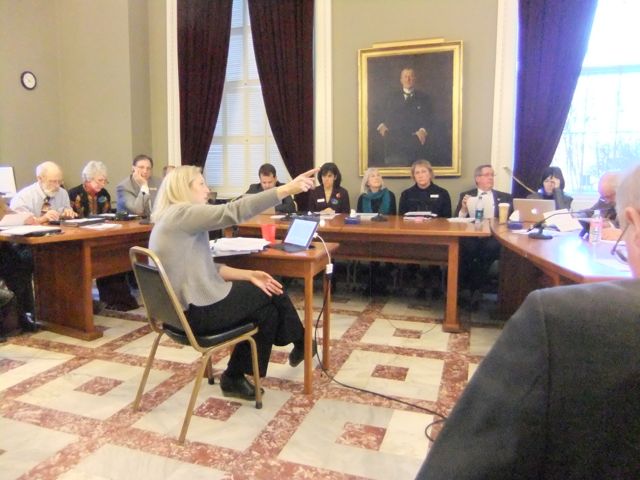
Sara Teachout of the Joint Fiscal Office, pointing to a large flatscreen display full of dispiriting numbers.

Sara Teachout of the Joint Fiscal Office, pointing to a large flatscreen display full of dispiriting numbers.

She began the session by outlining one of the little-known worms in the budgetary apple: cuts in spending would take effect on July 1, the start of FY 2016, but many of the potential revenue enhancements would not. For example: If the state eliminates a tax deduction on personal income, that revenue would not be realized until April 2016, when 2015 tax returns are due. That’s three-quarters of the way through FY 2016.

Much of Teachout’s presentation was a repeat of her tax-budget tutorial I heard at a recent Ways and Means meeting; I wrote three reports on the meeting, which can be found here, here, and here. (If you don’t want to wade through all three, do the last one first.) She did offer more detail at this joint meeting, including a very specific listing of the real costs of various tax expenditures and deductions. (All of her documents are posted on the Ways and Means webpage.)

There was some limited discussion after Teachout’s teach-in. Most significantly, Ways and Means chair Janet Ancel restated her support for a cap on tax deductions: “Speaking for myself, it’s the right thing to do if we’re looking for new revenue.” Rep. Mary Hooper, a member of the Appropriations Committee, noted that a cap on deductions “spreads out the impact, rather than zeroing in on specific exemptions or deductions.”

As I reported previously, Vermont’s tax rules allow the average million-dollar earner to claim hundreds of thousands of dollars in deductions. That’s why top earners pay an effective income tax rate of 5.1% instead of the statutory rate of 8.95%.

Two years ago, the House approved a cap on itemized tax deductions at 2.5 times the standard deduction; the measure died, mostly because of Governor Shumlin’s opposition. This year, he has signaled his openness to changing deductions and expenditures, even as he remains steadfast in opposing increases on his Big Three taxes: income, sales, and rooms & meals.

The cap would, IMO, greatly enhance the fairness of our state tax system. Currently, top earners pay a lower proportion of their earnings in state and local taxes than people in any other income group.

There was also some support in the room for looking at some of the sales-tax exemptions. For example, the state could impose a ceiling on clothing purchases — making them tax-exempt only below a certain dollar amount.

Rep. Mitzi Johnson, Appropriations chair, said her committee will “begin a conversaiton soon to lay out targets [for spending cuts].” She noted the importance of the joint meeting for gaining a clearer picture of “where the revenue could be coming from.”

The meeting was one more small step in what promises to be a long, grinding process leading to decisions that will make at least some constituencies unhappy. As one Statehouse observer told me — only half jokingly — “it might take until July” before they can work everything out.

Peter Shumlin, Tough Guy

One of my least favorite things about our incumbent Governor* is his tendency to adopt Republican talking points, thus giving them a validation they don’t deserve. It’s sometimes called “kicking the hippies” — talking tough about Them Damn Liberals, in an attempt to self-position as a reasonable centrist.

*Same is true of many Democratic politicians, including Barack Obama and the Clintons, which is why Bernie Sanders and Elizabeth Warren can seem so refreshing.

"If one more person says 'G'day, Mate' to me, I swear, they're gonna get such a punch."

“If one more person says ‘G’day, Mate’ to me, I swear I’m gonna ball ’em up.”

So here he comes, by way of Administration Secretary and Hatchet Man WIth An Adorable Accent Justin Johnson, doing a little light sparring with the public-sector union punching bag.

Secretary of Administration Justin Johnson issued an edict to agency and department heads Tuesday that all new hires within the executive branch must be approved by his office.

The move, according to a memo Johnson sent to agency and department heads, is the result of signals from the Vermont State Employees Association that it is not willing to work with the administration on finding $5 million in personnel savings called for in Gov. Peter Shumlin’s budget proposal.

Yeah, really. How dare the VSEA react exactly how you’d expect them to react?

100 times out of 100, a union is going to balk at reopening a signed contract and acceding to personnel cuts. That’s What They Do. It’s the first round in the dance: management takes hard line, union takes hard line, they get together and work things out.

Johnson knows this. But he very publicly reacted to VSEA’s predictable “Fight Back” petition with a summary judgment: “The petition indicated that the union will not deal with the administration on labor savings.”

The petition indicates no such thing. VSEA is simply staking out a strong opening position for the inevitable deal-making. The administration did the very same thing by incorporating cuts in pay and staffing into its budget.

So why is Johnson going straight from the opening salvo to the dreaded Declaration Of Impasse? Because it makes the administration look serious about cutting spending.

Most of the conversation around the Statehouse these days is about tax and fee increases. Shumlin’s budget called for a mix of new revenue and spending cuts. The last thing he wants is for the public debate to center on the former and ignore the latter. So he sent out his H.M.W.A.A.A.* to stomp on the other end of the seesaw.

*pronounced “HIM-wah.”

He could just as easily, and more productively, said something like “We understand the VSEA’s interest in protecting its members. We do not welcome making cuts, but we believe that Vermont’s budget situation requires it. We look forward to working with the union to find ways to save money while preserving a strong, vibrant state workforce.”

But that wouldn’t have accomplished the mission, which was to make the administration look tough.

This would be nothing more than a harmless bit of political theater, except that it provides tacit support for a Republican talking point: that public sector unions are the enemy of the taxpayer. Shumlin does the same thing when he insists that Vermonters are Taxed Enough Already, or when he tries to cut social service programs, or when he frames health care reform not as a social justice issue, but as an economic growth initiative.

In doing so, he cedes the rhetorical ground to the Republicans. It gets him a bit of short-term shine as a Tough Guy and an Unconventional Democrat, but it hurts the liberal cause in the long run.

Plus, it makes me grind my teeth, and my dentist says I should stop that.

Postscript. Just in case there’s any confusion, I made up the quote under Mr. Johnson’s picture.  

Well, here’s another good idea we’ll never hear again

Earlier this week, State Auditor Doug Hoffer issued a report suggesting that the state is getting shorted on leases of public lands to ski areas. The long-term leases were negotiated in the Good Old Days, when ski areas were not much more than trails, lifts, and lodges. And they reflect that; lease payments are based on lift ticket sales.

Simpler times.

Simpler times.

Today, ski areas are ski resorts — with myriad amenities and all-season activities. Lift tickets are a small part of the whole. You could argue that that’s because of investments by private-sector operators; you could also say that none of it would exist without the public lands. The AP’s Wilson Ring put it this way:

The [Auditor’s] report says that inflation-adjusted lease payments to the state declined by 14 percent between 2003 and 2013, but property near the ski areas increased in value by about 150 percent, and meals, alcohol and room taxes have increased by between 40 percent and 61 percent.

Parker Riehle of the Vermont Ski Areas Association scrambled to justify his industry’s bargain-basement leases.

“The better that those sales are and the better that the ski rates are on state land the better that the lease payments are to the state,” Riehle said.

Is he really trying to tell us that rock-bottom leases are more lucrative for the state than reasonably-priced ones? Like the supply-side assertion that lowering taxes will increase revenue? How well does that work, Sam Brownback?

Of course, Riehle was reaching deep into the bottom of his rhetorical barrel; he also claims that the leases have led to the preservation of land and wildlife.

Yes, big expensive resports are nirvana for the ecosystem.

Hoffer doesn’t necessarily recommend trying to reopen the leases; he just wanted to provide information and raise the question.

It’s a very good question, with the state’s budget circumstances so tight that Gov. Shumlin has proposed leasing prison space to the feds (which will keep more state inmates in out-of-state for-profit prisons) and placing a three-year moratorium on the Current Use program, among many other things, to generate new revenue. His administration is effectively searching all the sofa cushions for spare change.

Nonetheless, it’s safe to assume that Hoffer’s report will be quietly shelved. Michael Snyder, Vermont’s Parks and Recreation commissioner, says the state’s hands are tied until the leases expire.

That strikes me as an awfully defeatist attitude. The state does hold the ultimate hammer — it’s our land, after all — and could force the ski resorts to reopen the deals if it wanted to.

Of course, ski resort operators (Bill Stenger, come on down!) are very well-connected people with top-shelf representation at the Statehouse and deep pockets for campaign contributions. I can just hear Our Lawmakers issuing heartfelt paeans to One Of Vermont’s Iconic Industries, a Bedrock of Our Vital Tourism Sector, and pooh-poohing any talk of Reneging On Agreements Made In Good Faith.

Too bad, ’cause if Shumlin’s budget is any indicator, we could really use the money. The resort industry has it to spare. And I’d say we deserve a fair return for the use of public property.

But naah, it ain’t happening. Better luck with your next report, Doug.

If the Governor is worried about the wealth gap, he could maybe do something about it

Gov. Shumlin’s budget address began with a bit of boilerplate that’s been a recurring feature in his recent public remarks: bemoaning the wealth gap in America.

At a time when the wealth gap between the people at the top and everyone else is more extreme than since before the Great Depression, Vermonters hear about the recovery both in Vermont and nationally; they hear about our state’s low unemployment numbers; and they wonder: Why aren’t I seeing it? Why is my family being held back?

The bemoaning is appreciated, but when he does so little about the wealth gap, it comes across as an empty rhetorical gesture — the last ghostly trace of a progressive agenda.

Okay, I don’t expect Peter Shumlin to single-handedly fix our profoundly unbalanced economy. But there’s one big thing staring him in the face that would help the middle class and help close the state’s budget gap.

Raise the effective tax rate on top earners. Not the actual rate, but the effective rate.

Yes, I’ve said this before; and yes, Shumlin blocked a House proposal to do just that a couple years ago. But our tax system has gotten worse since then, and our budget shortfall has grown.

Just look at this chart.

ITEP 2014 tax chart

Sorry, I should have warned you: seeing that chart may result in nausea and vomiting.

According to figures released this week by the Institute on Taxation and Economic Policy (ITEP), Vermont’s tax system hits the working and middle classes the hardest, while top earners pay the least of all (as a percentage of their incomes).

In the past, the Governor has praised the fairness of our tax system. He should never, ever do that again until he fixes it.

Not only has he failed to do so… not only has he blocked efforts to do so… but during the last two years, Vermont’s tax system has actually gotten worse. Here’s the ITEP chart from two years ago.

ITEP 2012 tax chart

Compare the two charts: Higher shares of family income for the bottom 60%, and lower shares for the very top. No relief for the middle class, despite the Governor’s rhetoric.

In many ways, our state tax system is relatively progressive, but there are problems. The sales tax is extremely regressive; the property tax hits the working and middle classes the hardest. And as Paul Cillo of the Public Assets Institute points out: 

“The regressive property tax is Vermont’s largest single revenue source supporting state and local public services, and the Legislature has been shifting more and more public costs onto the property tax.”

And while income tax rates are very progressive, the actual taxes paid are much less so. Vermont’s tax rate for top earners is 8.95% — but because of generous rules on taxable income and deductions, those top earners pay an effective rate of only 5.1%. 

In addition to the fairness issue, the disparity puts pressure on Vermont’s budget, as PAI points out:

If the nation fails to address its growing income inequality problem, states will have difficulty raising the revenue they need over time. The more income that goes to the wealthy (and the lower a state’s tax rate on the wealthy), the slower a state’s revenue grows over time.

What have we seen throughout the past several months? Income tax receipts coming in lower than expected, forcing cuts in the budget. Hmmm.

There was one modestly progressive tax proposal in the Governor’s speech: he wants to end a tax deduction for state and local taxes paid in the preceding year, a tax break that mostly benefits upper tiers.

Otherwise, he left our unfair, broken, and inadequate tax system untouched.

Just about every time he opens his mouth, he talks about how Vermonters are taxed to the limit of their ability to pay. This is clearly true for most Vermonters, but clearly untrue for the most fortunate among us.

There is a glimmer of hope. Shumlin yesterday took a tiny step away from his past opposition to raising income, sales, or rooms and meals taxes:

You have heard many times over the past four years my opposition to raising income, sales, and rooms & meals tax rates to fund state government.

When he delivered this line, he gave the word “rates” some extra oomph. And making the income tax fairer wouldn’t require a change in rates; it’d just mean closing loopholes and limiting deductions.

Reasonably. I’m not calling for confiscatory taxes on the rich; I’m just calling for them to pay their fair share in an economy that has bestowed most of its benefits on them.

How about it, Shap?