Category Archives: 2020 election

The Dems’ Campaign Begins With a (Literal) Bang

Besides that, Mr. Sullivan, how did you like the play?

When outgoing state Rep. Mary Sullivan agreed to emcee this morning’s post-primary Democratic unity rally, I doubt that she realized she was taking her life into her hands. But there, right in the middle of her introductory remarks, came a-tumblin’ the state flag of Vermont, crashing down within inches of her head, rattling the podium on its way to the earth.

Undaunted, Sullivan continued to speak. Although afterward, there might have been some sharp words for whoever set up that flag.

That wasn’t the only cock-up of the morning. The microphone was not correctly tied into the Facebook Live feed of the proceedings, so most of the speakers could barely be heard. A note must also be passed to whoever wrangled that podium, which was too tall for a couple of the speakers — Sen. Debbie Ingram and President Pro Tem In Waiting Becca Balint. They looked like old drivers peeking over the wheel to get a glimpse of the road.

The speakers’ list was comprehensive. The winning and losing candidates for governor and lieutenant governor were there (except for Carcajou), as were the rest of the party’s candidates for statewide office, U.S. Rep. Peter Welch, designated hitters for our two U.S. Senators, and legislative caucus leaders.

All the speakers touted unity. Not all were specific about their calls. In fact, it wasn’t until the sixth speaker that someone actually endorsed the party’s nominee for governor, Progressive/Democratic Lt. Gov. David Zuckerman. It was Attorney General T.J. Donovan who broke the ice, “proudly” endorsing Zuckerman and lite-guv nominee Molly Gray and devoting the bulk of his remarks to praise for the Democratic ticket.

Continue reading
Initial Thoughts on a Robust Primary

So many votes, they barely fit

With the exception of the 462-candidate pile-up that was the Chittenden County Democratic Senate primary, it was an election night bereft of drama. The big races turned out to be uncompetitive, and all were called early in the evening. Which is not to say it wasn’t interesting, at least not to political dead-enders like me. So, thoughts in no particular order:

The Laracey Effect is strong. My own invention, the Laracey Effect is named for Mel Laracey, a deputy city treasurer in Ann Arbor, Michigan many moons ago. He decided to run for State House in an extremely competitive primary. It did not go well; he finished in the back of the pack. Because everyone in and around City Hall knew him, he thought that meant everyone knew him. But in truth, the vast majority of voters had no connection to City Hall.

Tim Ashe is well known in Burlington and Montpelier. He and pretty much everyone else thought that made him well known across the state. Not true. And when the pandemic prevented him from campaigning until the end of June, his fate was sealed.

I thought Molly Gray was going to win, but I was far from certain about it. Turned out she won easily. More easily in a competitive four-way race, in fact, than David Zuckerman did in (effectively) a two-way race. Zuckerman beat Rebecca Holcombe by 10,552 votes. Gray beat Ashe by 11,679, and came within 510 votes of Zuckerman’s total.

Ingram, by the way, was an even bigger victim of the Laracey Effect, believing she had a substantial statewide profile. She finished a distant fourth, and was never a factor in the race. So was former legislative counsel Peter Griffin, who ran for the House seat being vacated by Kitty Toll and finished a poor second.

Expanded mail-in voting was a resounding success. Record turnout when neither of our Senate seats were on the ballot, and with little apparent drama in either race for governor. With universal mail voting available in November, we’re on course to set another turnout record. It’s also a strong argument for mail voting everywhere — that is, if you like maximizing participation in our democracy. At least two of our three political parties do.

There was a lot of unhappiness with the Democratic gubernatorial choices. There were 6,569 write-in votes, more than six percent of the total. (Most of them presumably cast for Gov. Phil Scott.) There were 7,739 blank ballots for governor. Think of that: Seven percent of those who bothered to cast votes couldn’t be bothered to choose a gubernatorial candidate. That’s stunning. And seems to reveal a broad dissatisfaction with the choices on offer. One more sign that Zuckerman has some serious work to do.

Continue reading

Where Are The Ashes Of Yesteryear?

Objects In The Mirror May Be Fuzzier Than They Appear

The following was written in 2003. I’d ask you to guess the author, but I’ve already given away that game.

I should be a Democrat. From Massachusetts, mother a teacher and father a civil servant, family of Kennedy-philes… I’ve got a long life of political activism ahead of me. My loyalties are to ideas and not a party, so if my energies are not going to the Dems, they’ll be going somewhere else.

… Younger people like myself can understand the importance of getting the message to different types of voters. But we also understand the nature of a chameleon, and we don’t want to vote for a leaf and elect a reptile.

That’s a short excerpt from “Letter from a Democratic Party Pooper, and it was indeed penned by Young Tim Ashe, progressive firebrand. The letter was included in Crossroads: The Future of American Politics, written in 2003 by the future governor of New York, Andrew Cuomo. (This tidbit came to my attention courtesy of urban archeologist and Twitter buddy Ed Adrian.)

In the letter, Ashe bemoans the Democratic Party’s habit of tacking to the center. He certainly sounds like a former Bernie Sanders staffer and future Progressive Party officeholder. He doesn’t sound much like Ashe the Senate President Pro Tem, who’s known for cosseting the chamber’s old guard, a cadre of change-averse centrists.

So. Which Tim Ashe is running for lieutenant governor?

Continue reading

On (Whining About) The Media

In my almost-a-decade following #vtpoli, one of the recurring themes is how losing candidates carp about media coverage. If only the press had taken me seriously… if only they’d done an expose of my opponent… if only they’d focused on ideas instead of the horse race… if only.

You mostly hear it from marginal types, including just about any Republican not named “Phil Scott” running for statewide office, ideological extremists, or Vermin Supreme-style perpetual candidates.

The latest entry in this parade is Brenda Siegel, doughty Democratic candidate for lieutenant governor. She’s gone so far as to call a press conference for Wednesday morning “to discuss the frontline communities and forgotten voices that have continually been marginalized in recent elections across the country, including the current Vermont Lt. Governor’s race.”

I’ll bet you a shiny new dime that she’ll point to herself as one of those “forgotten voices that havbe continually been marginalized.” It’s true that campaign coverage has mainly focused on the supposed front-runners, Molly Gray and Tim Ashe. And lately, has focused on attacks, counterattacks and fundraising rather than issues.

As a progressive policy advocate and single mom, Siegel comes from a decidedly unconventional background. And yes, that means she doesn’t get taken as seriously as Ashe, a veteran pol, or Gray, a newcomer who’s wowed the Democratic establishment. This, despite Siegel’s decent showing in the 2018 gubernatorial primary, where she finished third in a weak field.

Does she have a point? Well, kinda. But mostly no.

Continue reading

Aside From the Pandemic, It’s a Great Time to be Phil Scott

The last pre-primary campaign finance reports are in, and the big winner is… yep… Your Governor, Phil Scott.

Not that he raised much money. In fact, he raised so little that it’s clear he feels no urgency whatsoever. (Of course, he’s spending minimal time campaigning as long as the pandemic still hovers, but c’mon, if he had to raise money he’d find ways to do it.)

The latest fundraising reports cover the month of July, basically. During that time, Scott raised a mere $19,000 — bringing his campaign total to $99,000. (Numbers of more than four figures are rounded to the nearest thousand.) Even more telling is how much money he spent: A measly $1,133 for the entire month.

(Interesting entry in Scott’s “Expenses” column: $218.44 in fees to ActBlue. Which means the Democrats’ number-one online fundraising tool is serving as a conduit for Phil Scott?)

Scott is not afraid of John Klar. He’s not afraid of Rebecca Holcombe or David Zuckerman. He’s not afraid, period.

The other gubernatorial reports reinforce Scott’s apparent bulletproofness. Whoever wins the Democratic primary is going to emerge with little or no money in the bank, and the national Democratic donors aren’t coming to the rescue.

After the jump: The Dems’ respective hauls and the race for Lite-Guv.

Continue reading

And the Non-Participation Trophy Goes To… [UPDATED]

Mollee Gray, who has voted in Vermont elections almost as often as Molly Gray

Wow, Seven Days really dropped a turd in the Molly Gray punchbowl, didn’t they?

The story by Colin Flanders, the most can’t-miss piece of political journalism so far this season, provided a ton of insight into how Gray came (seemingly) out of nowhere to dominate the inside game in the race for lieutenant governor. But in terms of the piece’s political impact, Flanders definitely buried the lede.

The part that has Democratic tongues wagging can be found (by dedicated readers) all the way down in paragraph 27. That’s where Flanders reveals that Gray didn’t cast a ballot in a Vermont election between 2008 and 2018.

(Update. Turns out this wasn’t the scoop I thought it was. On July 21, VTDigger’s Grace Elletson posted a profile piece that reported Gray’s voting record. In all their infinite wisdom, she and her editors consigned this tidbit to paragraph 32. But still, she had it first. Also, I didn’t go into it at the time, but the other revelatory aspect of Flanders’ piece was the through exploration of Gray’s family connections. That went a long way to explaining her rapid political rise. Elletson got into some of this, but not nearly as deeply or clearly as Flanders.)

Now, if Gray missed one or two votes, that could be written off as the preoccupation of a busy young professional. But ten years between votes? That’s a dereliction of a citizen’s duty unbecoming in one who would occupy one of Vermont’s highest political perches. Gray expressed regret for missing so many elections, especially the 2016 race between Donald Trump and Hillary Clinton. “It’s something that I’ve learned from,” she said.

Lamely.

One thing I know for sure: None of the other Democratic LG candidates bothered to do any opposition research. I mean, this didn’t require a deep dive — just basic political prudence. And although oppo research has a bad name, it’s a legitimate aspect of politics. If a candidate, especially one so little-known, has any skeletons in the closet, the voters should know. Hell, Gray’s own campaign should have known about this. All those smart people who signed onto her candidacy should have known about it.

And considering that voting records are, well, public records, I’m surprised it took this long for a reporter to look into Gray’s nonparticipation. But it’s been, for journalists, a seriously compressed campaign season. Coronavirus dominated their work from mid-March on, and the Legislature’s extended session took up the rest of the oxygen.

Lucky break for Gray, who may well have dodged this potentially fatal bullet.

Continue reading

Scott Milne, Nonviable Republican

“He squints inquisitively when he speaks and has an easy crooked smile.”

I dunno, I’ve never found crooked smiles all that beguiling.

Time to saddle up. Apparently I have to revisit the undistinguished electoral career of Scott Milne, now that he’s been dubbed “a viable Republican” by the wise heads at VTDigger in a profile that shows him in the best possible light and ignores all his defects and shortcomings.

Starting with the idea that his performance in the 2014 gubernatorial election proves his statewide viability — so much so that his absolute drubbing by Sen. Patrick Leahy in 2016 somehow provides more evidence of his political magnetism.

It’s certainly true that Milne was given no shot at beating then-incumbent governor Peter Shumlin. His loss by a mere two thousand-odd votes was a shock to the #vtpoli world, this blogger included. But 2014 was no ordinary year. Shumlin had squandered all his political goodwill on his doomed venture into health care reform, and an ill-conceived land deal with a neighbor had reinforced a view of Shumlin as a shifty opportunist.

Compare 2014 with 2012. That year, Randy Brock was thoroughly trounced by Shumlin. Brock received 110,970 votes.

Two years later, Milne pulled his magician act, taking Shumlin to the limit. Milne’s vote total: 87,075 votes.

Shumlin, meanwhile, lost almost half his support. He earned 170,767 votes in 2012 — but only 89,509 in 2014. Shumlin had lost his mojo, and Milne was the lucky beneficiary. If the Republicans had nominated a halfway decent candidate, Shumlin would have been shitcanned.

Continue reading

The Lord Chancellor Storms the Castle

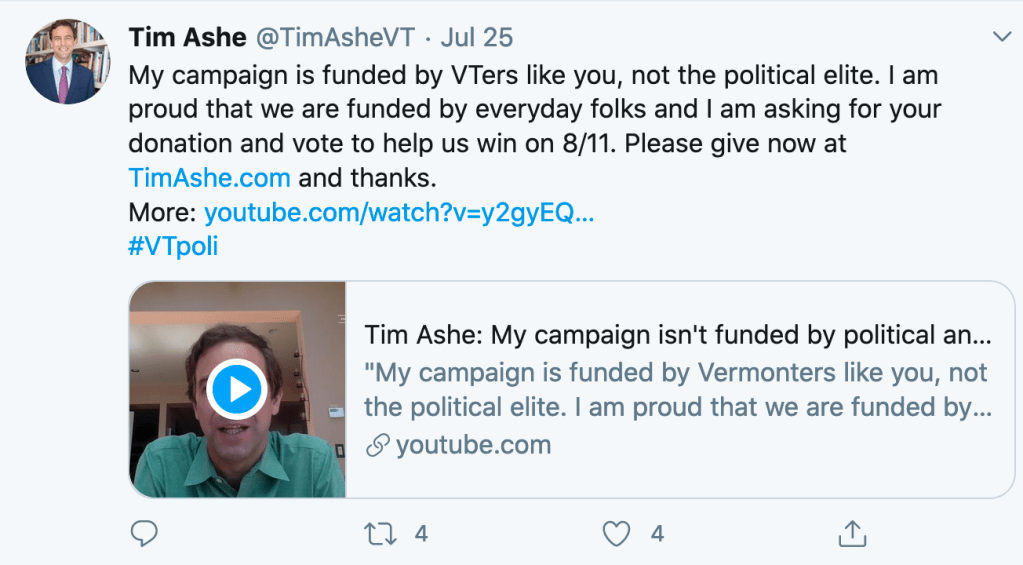
This is, as I tweeted the other day, the most hilarious development of the #vtpoli season. Tim Ashe, who rose to the position of Senate President Pro Tem by making nice with the chamber’s most entrenched senior members, is now presenting himself as the outsider in the race for lieutenant governor, The Man Of The People not beholden to “the political elite.”

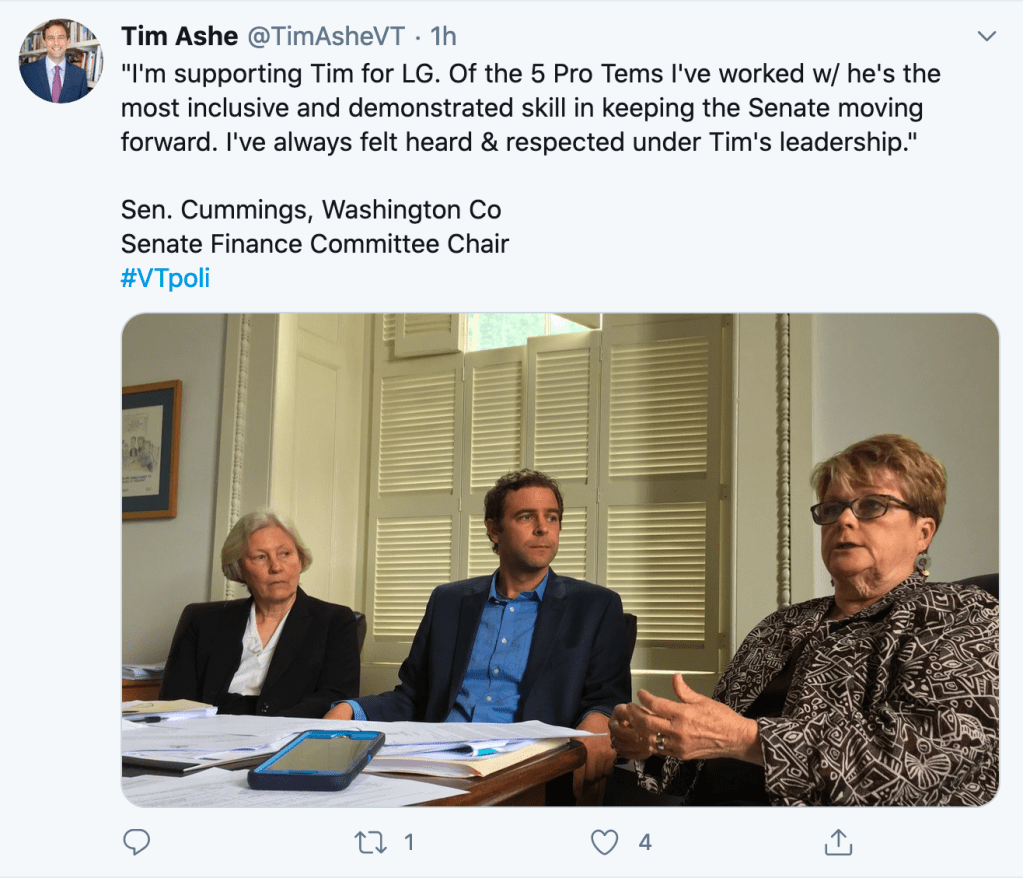
Does he mean elites such as Senate Appropriations chair Jane Kitchel, who serves as the Ashe campaign’s treasurer? Or Senate Finance Chair Ann Cummings, now in her 23rd year in office and so immune from challenge that she hardly bothers to campaign at all?

Look, here they are now.

I sense the distinctive odor of flop sweat.

Ashe, who seemed like the obvious odds-on favorite to succeed David Zuckerman as lieutenant governor, has recast himself as Mr. Outside because he’s in danger of being Wally Pipped by a young woman who had precisely zero profile in Statehouse circles a mere six months ago.

It has to have been quite galling for him to watch Assistant Attorney General Molly Gray rack up endorsement after endorsement from top Vermont Democrats, and follow it up with a truly impressive fundraising performance that has left Ashe in the financial dust.

Continue reading

The Anti-Maskers Emerge

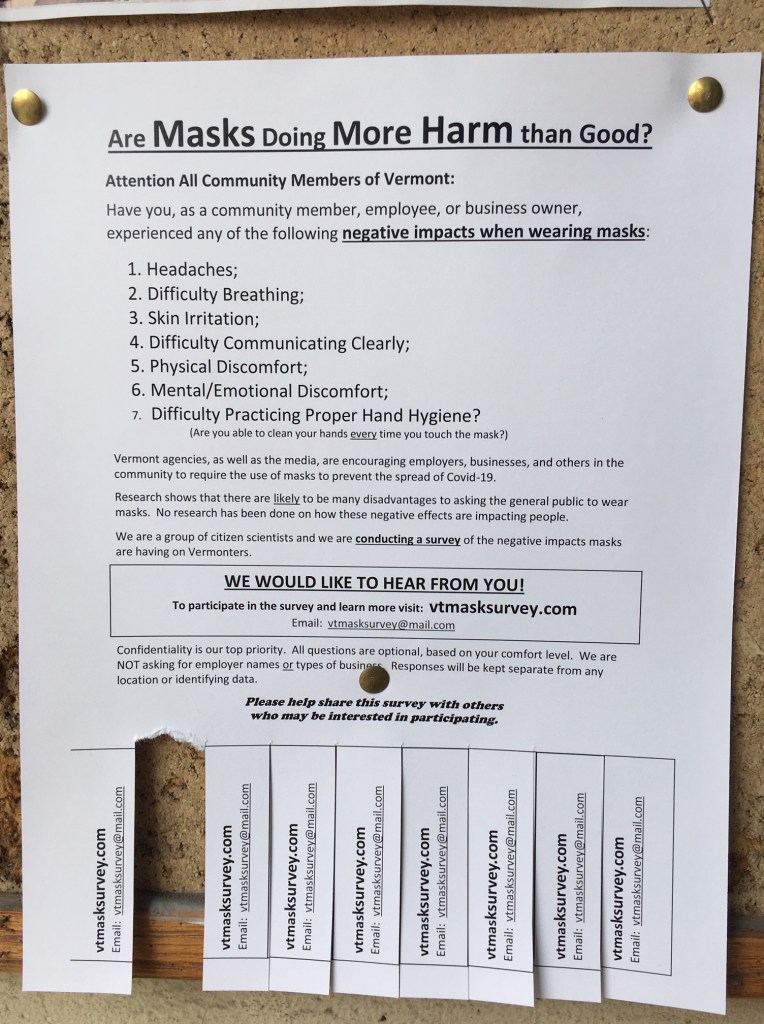
Spotted on a Montpelier bulletin board

It was inevitable, but it’s still disappointing.

“Citizen scientists.” Really.

Impartial seekers of the truth, putting out a one-sided “survey” in a transparent effort to gin up some “evidence” to support their preconceived notion. This is, must I say it, a disgrace.

And to judge from the rhetoric and approach, I’ll bet you a shiny new quarter that the Venn Diagram of “Mask Survey” and “Anti-Vaxxers” is a single circle.

But I have to credit the bravery of the “citizen scientists” behind this flyer. They’re right up front owning their beliefs and accepting the conseq— oh wait, sorry. They actually provide no identifying information or means of two-way contact; only a gmail address and, on its website, a P.O. box in Marshfield.

Nowhere on flyer or website do they cite any of the “research” that “shows there are likely to be disadvantages” to wearing masks. I like the qualifiers: “likely” meaning “fuzzy and unproven,” “disadvantages” in place of “hazards” or “dangers.” In plain English, “undisclosed research that shows a possibility of inconveniences in wearing masks.”

Of course there are “disadvantages.” Masks are a little annoying, they make my glasses fog up, people can’t see your facial expressions, it is a little harder to communicate. The rest of it is bullshit of a particular type — the conspiracy-minded worried-well contingent that makes up most of the anti-vaxxer movement.

And now they’re coming after masks.

Continue reading

The Democratic LG candidates put on a show

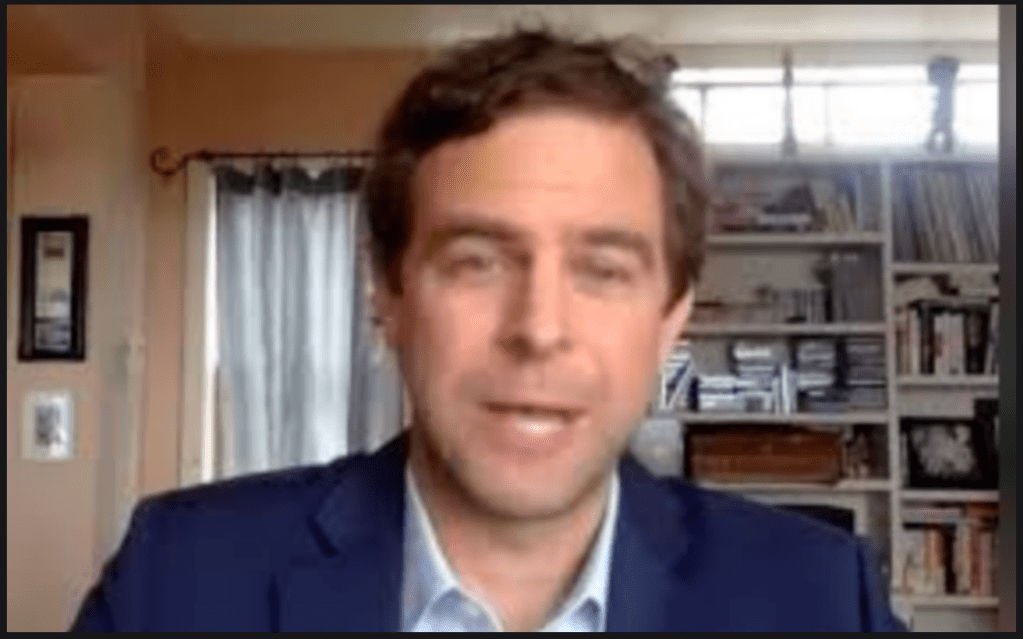
Good lighting and placement, aggressively literate background a bit over the top, prominent placement of Che book lends some much-needed progressive credibility. 8/10

It was, honestly, one of the best debates I’ve ever seen.

The VPR/VPBS debate (viewable online here) moved along quickly. There was quite a bit of substance, and candidates were unafraid to challenge the credentials and positions of others — which is a legitimate part of a good debate. No one interrupted anyone else, and not once did a candidate exceed their time limit or interrupt anyone else. All four candidates performed well. The 45-second limit forced them to stick to their main points, and kept the empty posturing to a minimum.

Which is not to say that it was flawless, but it showcased the quality of the candidates. Voters have four good options in the LG race.

Before I get to specifics, a note about production values. In this year of Zoompaigning, candidates need to have a handle on visual and audio presentation — as do the producers/broadcasters of such events. There’s no excuse for distracting backgrounds, bad lighting or bad sound. All four backdrops were fine; the worst actually belonged to moderator Jane Lindholm. She seemed to be stuck in a featureless closet. Sen. Debbie Ingram was too close to the mic and camera; her voice was sometimes distorted as a result.

Anyway, note to all concerned for future reference: Make sure your shit is tight.

Back to substance. I guess it’s not surprising that all four candidates were well-prepared. They’ve gotten plenty of practice in a series of lower-profile forums hosted by county party committees. They also had to be aware that, in Our Plague Year, the VPR/VPBS debate was likely the most crucial event of the entire primary campaign.

After the jump: Attacks!

Continue reading