Category Archives: 2014 election

A question for Mahatma the All-Knowing

Dear Mr. Milne,

You have floated the notion that the Legislature ought to drop its traditional practice of electing the top vote-getter in gubernatorial elections in which no candidate won a majority. Instead, you say, lawmakers should act like an Electoral College, casting their votes based on which candidate won their district.

Okay, a completely novel idea that flies in the face of precedent. But it does raise a question.

If a lawmaker represents a district where a single candidate won a majority of votes, then it’s clear that you’d want the lawmaker to reflect the constituency.

Now…

What about a district in which no gubernatorial candidate won a majority? Where the top finisher earned a plurality? What should that lawmaker do?

Example: in Washington County, you finished barely ahead of Governor Shumlin. If you only earned a plurality in the county, why should you be entitled to claim the votes of all three state senators?

Your underlying argument is that a plurality does not provide a clear mandate. Stands to reason, then, that a plurality edge in a given county does not constitute a mandate for its senators. Right?

What, then, do those senators do?

If you say “Vote for the plurality winner,” then you are a hypocrite.

The other two options are, (1) those lawmakers should be free to vote their conscience, on whatever grounds they make their decisions, or (2) they should try to cobble together an IRV-style “ideological majority” from their county’s returns and vote for the candidate who earned their imaginary majority.

What we’ve done here is opened a big ol’ can of worms. And I think this is one reason why past lawmakers hewed to the precedent of electing the top vote-getter regardless of party affiliation. (And why, on those rare and ancient occasions they diverged from precedent, there was always something funny about it.)

Now, you being you, I don’t expect a straight answer, just more of your argument-of-convenience, throw-stuff-against-the-wall style of reasoning.

But I thought I’d ask.

Thanks,

John Walters

The limits of introspection

It sounds like Governor Shumlin has reached the end of his post-election navelgazing after ten entire days, and he has found that the reasons for his shocking near-defeat are largely external. Yes, he accepts responsibility for failing to listen to Vermonters and he promises to do better on that score. But as for the widely-held notion that there was a personal message in the election results? Not so much.

You talkin' to me?

You talkin’ to me?

Shumlin appeared on WDEV’s Mark Johnson Show this morning (podcast should be up shortly), and Mark opened the hour with a pretty solid grilling of the Governor about the whys and wherefores of the gubernatorial election.

When asked what messages he took from the returns, Shumlin named two:

— On policy, “there’s a feeling that folks are frustrated” on pocketbook issues, school spending, and continuing wage stagnation for middle- and working-class people. Which is not just a Vermont problem, he was quick to point out, but a national trend, for which he can bear no special responsibility.

— A vaguely-defined brace of regional and local issues. The Vermont Gas pipeline may have cost him votes in Addison County, and his support for ridgeline wind was a problem in the Kingdom. Aside from those two examples, no specifics.

I can accept that Shumlin was confronted by local concerns as he campaigned around the state, but I haven’t seen any evidence for a localized rejection of him. When I looked at four state senate districts, in different parts of the state, I saw a very clear trend: the Governor polled consistently behind Democratic senate candidates, by a similar margin in each of the four counties.

The general message, he said, was “You’ve got to listen more… Don’t get too far out in front of the troops.”

And then Mark tried to explore the personal dimension. Was the election about policies, or about Shumlin personally?

Safe to say he didn’t want to touch that with a ten-foot pole. “I’ll leave that to the pundits,” he said.

Mark followed up with a direct reference to the Jeremy Dodge land deal, which seemed to resonate with a lot of voters. And not in a good way. Shumlin pivoted immediately to generalities: “I’ve got to do my job better going forward.”

Mark: Was this all about policy, then?

Shumlin: I’ll  leave that to the pundits.

Earlier in the interview, Shumlin had said he fully expected a close election because of what he heard on the campaign trail, and his own campaign’s internal research (which he wouldn’t give any details about). At this point, Mark returned to that idea: Didn’t you hear anything from Vermonters about your own style, your personality? Why not talk about it?

Shumlin: “I have talked about it.” Back to generalities: “There were lots of messages in this election.” And then it was eyes forward to the “tough decisions” that lie ahead. “I’ve got to roll up my sleeves and get back to work.”

A bit later, Mark noted that while Vermont Gas might have cost him votes in Addison County, that didn’t explain Shumlin’s troubles in the Burlington suburbs, where he polled poorly and the Dems lost multiple House seats. His only response was another reference to general “economic frustration.”

All in all, he made it pretty clear that he’s closed the book on the past and is ready to “roll up his sleeves and get back to work.” Nothing more to see here folks, move it along.

I can’t say I’m surprised by the lack of personal introspection, but I am disappointed.

If this election was about policy not personality, then I’m left wondering why one individual so badly underperformed the rest of the Democratic ticket. Why the Governor was almost thrown out of office, while his party retained a strong grip on the legislature?

He did admit that he’d gotten a bit distant, that he was listening to the same small group of people too much. And he committed himself to getting around the state more, and holding open public events (of an unspecified kind) that would get him in touch with a broader variety of viewpoints. And that’s a good thing, as far as it goes (and if it really happens).

But clearly, there are dysfunctional elements in his administration and his own conduct, and it sounds like he’s unwilling to go there. Which, in my view, is a huge opportunity missed.

Milne declines recount; Republican trolling to continue

Note: This post supersedes the earlier one entitled “Super Dave Stands Pat.”

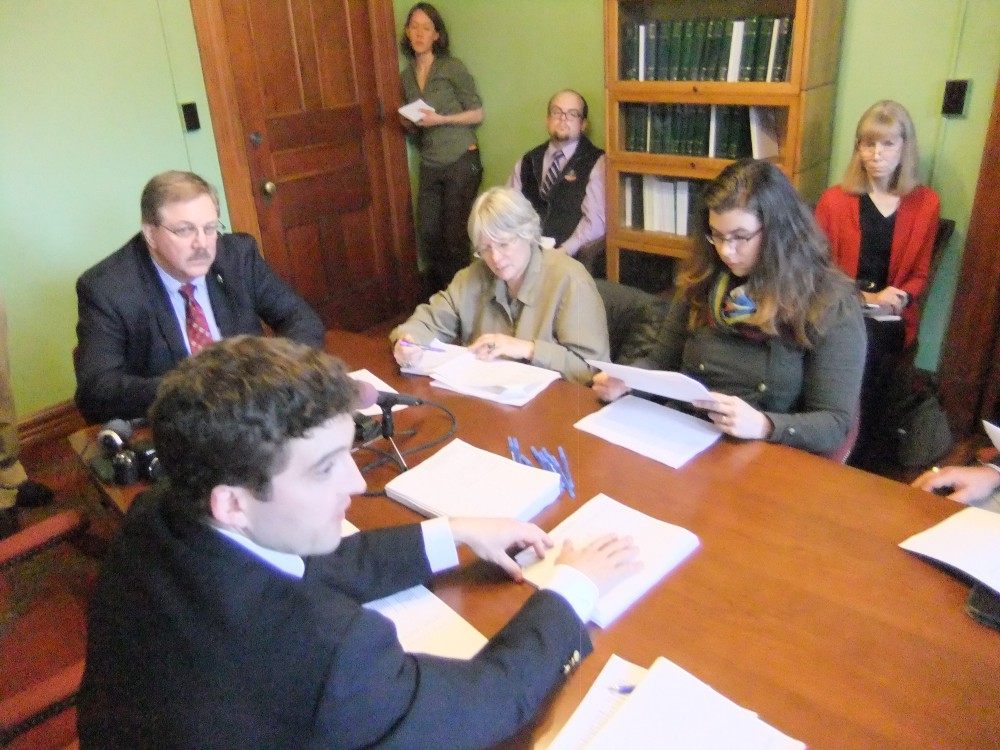
The tedious business of democracy. Clockwise from front: Director of Elections WIll Senning, Secretary of State Jim Condos, Crystal Zevon of the Liberty Union Party, and Kelly Mangan of the Progressive Party. (And at right rear, former Free Press reporter Nancy Remsen.)

The tedious business of democracy. Clockwise from front: Director of Elections WIll Senning, Secretary of State Jim Condos, Crystal Zevon of the Liberty Union Party, and Kelly Mangan of the Progressive Party. (And at right rear, former Free Press reporter Nancy Remsen.)

The state board of canvassers met this morning in a hot, sticky conference room full of media folks awaiting the Big News.

Which, of course, was a complete anticlimax; the election results posted on the Secretary of State’s website were quickly confirmed, with Governor Shumlin holding a 2,434-vote lead over Scott Milne.

A couple hours, later, Milne issued a press release from his secure undisclosed location (seriously, I don’t know how this guy would handle it if he had to meet the media on a regular basis) saying that he would not request a recount. And adding the customary passive-aggressive note: “I trust that Peter Shumlin won the plurality.”

In other words, “I’m pretty sure Jim Condos didn’t steal this puppy.”

Also, he noted that “this race is one of the closest in Vermont history,” and Shumlin’s performance was extremely weak for an incumbent. In other words, “I lost, but I really won.”

And black is white, and war is peace.

Anyway, mighty white of him to forego the recount. But on the larger issue — will he pursue the race into the Legislature? — he was less forthcoming.

Milne plans to address the press and public in an announcement next week regarding the Legislature’s Constitutional duty in January.

“Next week,” by Milne’s standards, might be anytime between tomorrow and Christmas Day.

But I’m not surprised that he’s continuing to troll the entire state with his novel reasoning that the loser should be declared the winner. He’s not alone; VTGOP chair “Super Dave” Sunderland attended the canvassers’ meeting, and did some heavy trolling afterward.

Uh, Dave... I don't think Stewie's buying it.

Uh, Dave… I don’t think Stewie’s buying it.

He told the media that it’s not up to Milne whether to pursue the legislative option because “The Constitution lays out the process that needs to happen. There’s no avoiding a vote in January. It’s required.”

Which is technically true, but in the past, losing candidates have voluntarily withdrawn before the legislature’s vote, to banish uncertainty and allow the winner to get on with the business of governing.

His advice for the candidate?

My advice to Scott is to follow his instincts and do what’s best for Vermont. We certainly have a clear popular vote winner, and you know, how it breaks down in the Legislature district by district tells us maybe a little bit different story, and I think Scott’s weighing those options right now.

Ah, the district-by-district canard. An argument that’s never, ever been raised before in Vermont history. Don’t believe me? Well, Paul Heintz went to an unimpheachable source: former state archivist Gregory Sanford, who said that Milne’s district-by-district idea “simply has no precedent.”

Sanford also outlined all three times when the top vote-getter was not elected governor, and all three had a distinctly fishy smell:

In 1789, legislators ditched incumbent Thomas Chittenden in favor of Moses Robinson after the former was ensnared in a sketchy land deal. In 1835, lawmakers cast 63 inconclusive ballots before giving up and letting lieutenant governor Silas Jennison serve as acting governor. And in 1853, the Democrats and Free Soil Democrats teamed up to steal the state’s top jobs from the Whigs, whose slate of candidates won pluralities.

But Sunderland? This guardian of the Vermont Way is clinging to Milne’s non-precedent. When the former state representative was asked how he would vote if given the chance, he danced around for a while before giving a kinda-sorta answer:

Well, I think every election is different. And I think every legislator is different year to year, session to session, district to district. My district, in this election, voted strongly for Scott Milne, and I would definitely take that into consideration, unless there were some other um strong um… uh… some strong push from a personal conscience standpoint, um, I think I’d be inclined to vote the way my constituents voted in my district. But that’s not to say there might be exceptions.

Yup, the Republican trolling continues apace. They know that the legislature is not going to ignore precedent and choose the loser over the winner. But they want to keep the question open as long as they can, to distract our attention and pester the Democrats.

Super Dave stands pat

The state board of canvassers met this morning. Also, the sun rose.

Nothing unexpected; Gov. Shumlin’s margin over Scott MIlne is 2,434 votes.

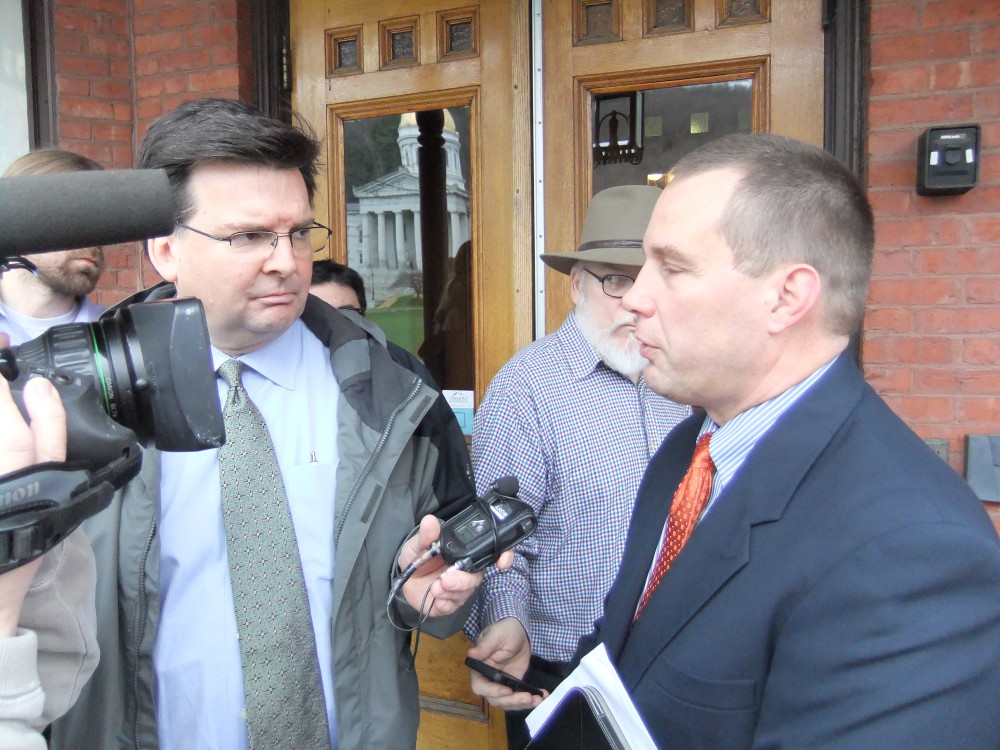
Afterward, VTGOP chair “Super Dave” Sunderland spoke to the media. He couldn’t say whether Milne would ask for a recount; he’d have to do so by the end of the day today. Milne, as expected, wasn’t there.

On the larger question, Sunderland kept alive the Repbulican narrative that the Legislture might well choose to elect Milne instead of Shumlin. Indeed, he went so far as to say that if he were still in the legislature, he’d vote for Milne.

More details later.

That online petition: color me unimpressed

One of the lesser products of our gubernatorial overtime period is an online petition seeking the election of Scott Milne by the Vermont Legislature. The petition was organized by persons unknown of the conservative persuasion (see below) and posted — ironically — through the petition posting service on MoveOn.org, an organization seeking to promote “progressive political change.”

Anyone can use its service, and that’s where our persons unknown have put up their petition. In spite of the distinctly liberal company they’re keeping.

I say “persons unknown” because the petitioner is identified only as C.A.C.M. I don’t recognize the acronym, and MoveOn doesn’t provide any further information. (Any relation to t.A.T.u.?) MoveOn does offer the opportunity to send an email to C.A.C.M., and I did so on Monday, asking them to identify themselves.

Haven’t gotten an answer. Somehow, I don’t think I will. Need I comment on the irony in a movement claiming to represent the voice of the people hiding behind an obscure acronym?

(If I hear from someone at C.A.C.M., I’ll be happy to strike the above comment and report on its identity.)

The petition has drawn a bit of attention in the media, first from VPR and today from VTDigger. Both stories refer to the petition having been signed by “thousands.”

That’s technically true; as of 7 p.m. on November 11, there were 3,152 electronic signatures. When VPR posted its story last Friday, the total was about 2,500. But while “thousands” is correct on the bare fact, I’d argue that it’s misleading. When I see “thousands,” I think a lot more than two or three thousand. To say “thousands” in the headline gives the petition drive a bit too much credit.

Even by the diminutive standards of the Vermont electorate, 3,000 isn’t really an overwhelming response. And to judge by the comments appended by signers, the petition’s appeal is obviously to the dead-ender, hard-core anti-Shumlin part of the electorate. There’s no reason that this petition should have any effect whatsoever on the process going forward.

One more thing. In order to sign the petition, you have to provide your name, email address, and physical address. The small print below the petition box says:

By signing, you agree to receive email messages from MoveOn.org Civic Action and MoveOn.org Political Action. You may unsubscribe at any time.

So all these disgruntled conservatives are handing over their contact information to one of our country’s leading progressive groups. I hope they’re ready for the progressive email messages they’re about to start receiving.

Signs of hubris in the VTGOP

Vermont Republicans gained significant ground in last week’s election. But when you get right down to it, they’ve still got a long, long way to go. They didn’t field serious candidates for most of the statewide offices; they made nice gains in the legislature, but remain on the short end of big Dem/Prog majorities. They made progress on the back-office stuff, but they remain heavily out-organized and out-fundraised by the Dems.

And whatever made Scott Milne a serious contender in spite of a deeply flawed campaign with virtually no resources, well, can you bottle it and spray it on the next guy? Nope. I don’t think anyone really knows why Milne made such a strong showing, and I doubt it’s replicable.

My point is, the Republicans still have serious work to do. The VTGOP is not yet a serious contender — not statewide, not in the legislature. And already, there are signs that this whiff of success is going to their heads.

The most obvious sign is their eager acceptance of Milne’s reasoning for continuing the campaign into the legislature. Or should I say “Milne’s reasonings,” since he has a number of them on offer.

There’s the “ideological majority” notion, that lumps all of Dan Feliciano’s votes in with Milne’s, plus (I guess) most of Emily Peyton’s and Cris Ericson’s and Peter Diamondstone’s to, somehow, get Milne to 50% plus 1.

There’s the “incumbent rejection” idea: since most voters rejected the incumbent, that means the second-place finisher really won. In spite of the fact that more voters rejected Milne than rejected Governor Shumlin.

Then there’s the “legislative district” argument, which says that Milne won more districts than Shumlin and therefore demonstrated broader support. Which is obvious nonsense because many of Milne’s wins came in districts heavy on real estate and light on population.

And finally, we have the “there really isn’t a precedent” argument, in which Milne cites the handful of counter-precedents he can find — all of them emitting a fishy odor. The problem is, there really is a precedent, a very solid one; and when it hasn’t been honored, things have gone haywire.

In football, they say if you have two quarterbacks, you really have none. Well, Scott Milne has four arguments, but really has none. He’s throwing a whole bunch of stuff against the wall and hoping something sticks.

Among the people seeing through this are the two most popular Republicans in Vermont: Lt. Gov. Phil Scott and former Gov. Jim Douglas. Both have said that if it comes to the legislature, the top vote-getter should be elected. Here’s Douglas on VPR:

“It would seem to me unlikely that that would be a useful strategy and perhaps he should consider what Doug Racine and others have done historically which is to acknowledge the result and come back and fight another day,” said Douglas.

In 2002, Racine lost to Douglas by about 5,800 votes but since neither candidate won a majority, the vote went to the Legislature. Racine told lawmakers to vote for Douglas because he was the top vote getter.

… “It would seem to me that the good will that he’s accrued during the last several days ought to be preserved,” said Douglas.

I can kinda understand why Milne is sowing seeds of doubt; he came incredibly close to winning, which, in a way, must be harder to accept than losing decisively. (Gollum!) What’s harder to accept is that top Republicans like Don Turner and Joe Benning are grabbing at this logical apparition. Do they not, in Jim Douglas’ words, risk losing “the good will that [has been] accrued”? I think they do.

As they also do with their immediate call for repeal of Vermont Health Connect in favor of the federal exchange. They offer this as a serious proposal, but as VTDigger’s Morgan True reports, they haven’t worked out any of the details. Like how we’d make good all the premium assistance the working poor and middle class receive thanks to Vermont having its own exchange. Turner’s got a kinda-sorta plan for that, but he clearly hasn’t thought it through.

So why pull a half-baked cake out of the oven? The obvious answer is, to try to capitalize on the election results. And because the hubris is strong in the VTGOP right now.

Turner goes so far as to insist that VHC might need repeal even if it’s up and running when the legislature reconvenes.

Hmm, yeah, kill something that’s finally working after all the investment of money, time, and toil? Don’t think so.

The Republicans would do well to consider the letter and the spirit of Jim Douglas’ advice. Don’t get over your skis. Don’t, in the words of Gov. Shumlin, get too far out in front of the troops.

In renewing the war against health care reform, and in promoting the idea that the legislature should elect the second-place candidate, the Republicans show early signs of turning into the balls-to-the-wall ideologues we all love to hate in the national GOP. By now they should know that’s a recipe for disaster in Vermont. And it’s the opposite of Phil Scott’s alleged vision for a broader, more inclusive party.

A little diplomacy, a little statesmanship, might seem like a step backward right now. But it’s the best thing for the longer-term prosperity of the Vermont Republican Party.

A phony “crisis of conscience”

So I stopped at my mailbox this morning and picked up my copy of the Times Argus.

And there, splashed across the front page, was a writeup of the latest twists and turns of the trumped-up “controversy” over a potential Legislative vote for Governor. 

The article is entitled “A Crisis of Conscience?”

Well, at least it was framed as a question, not as a statement of fact.

Because the answer to the question is a clear, unambigious “No.” There is no crisis, and this is not a matter of conscience. Or, shall we say, deciding whether to ratify the election of Peter Shumlin is not a matter of conscience.

What is a matter of conscience is whether Republican lawmakers are going to jump on board this Bandwagon of Convenience devised by second-place finisher Scott Milne and abrogate 150+ years of precedent to cast their votes for Milne.

And here I thought the Republicans considered themselves the true guardians of the Vermont Way.

Atop the Times Argus’ front page spread were photos of Milne and Shumlin. The caption next to the Milne shot says “Republican Scott Milne won the most districts in the state with 62.”

I've got just the idea for you! Low mileage, runs good, new battery & tires. Don't mind the rust.

I’ve got just the idea for you! Low mileage, runs good, new battery & tires. Don’t mind the rust.

This statement is at the core of Milne’s argument. He won more legislative districts, or more counties if you prefer, than Shumlin, and this shows his broader appeal.

Well, fiddlesticks. As is the case every election, the Democrat rolled up big majorities in the more populated areas of the state, while the Republican won in most rural areas. If you look at the Secretary of State’s election map, you’ll see that there is more red than blue. Of course, some of those districts that went for Milne contain more moose than people, but it looks impressive on the map.

And unfortunately for Milne’s argument, we do have this principle of “one person, one vote.” Vermont’s old system of electing one Representative from each community (one for Burlington, one for Glastenbury) was ruled unconstitutional in 1964. Milne’s argument is cut from the same unconstitutional cloth.

The article itself lists the 43 Democratic lawmakers who face this alleged “crisis of conscience.” Their districts cast more votes for Milne than Shumlin, so (the article asks) should they stick with their man, or support the wishes of their constituents without regard to the wider picture?

Based on Vermont history, this is a phony dilemma. Virtually every time this question has arisen, it’s been answered the same way: the person with the most votes wins. And on those few times when the legislature failed to honor this precedent, there was something shady going on, or there were profound repercussions after the fact. Or both.

The 1976 Lieutenant Governor’s race, Milne’s favorite, had some of both. Plurality winner John Alden was known by many to be under criminal investigation when the legislature voted for the second-place finisher, T. Garry Buckley. Also, there was controversy at the time over the fact that Buckley had actively lobbied for lawmakers’ votes. That controversy was one big reason why his own Republican Party turned against him in 1978 and opted for Peter Smith for Lieutenant Governor.

Scott MIlne can go ahead with his little game, because freedom of speech. And opportunistic Republican leaders can go on supporting his quest even though they know they’re in the wrong, and they know that MIlne will lose in the legislature. They’re just trying to sow a little mayhem and create a fake political argument that Governor Shumlin’s next term is somehow illegitimate.

Just as, I suppose, Jim Douglas’ first term was illegitimate because he failed to win even 45% of the popular vote. And, by extension, his entire eight years in office were illegitimate because if he hadn’t won that first election, it’s doubtful that he would ever have been elected Governor.

The only conscience involved here is the conscience of the Republican Party. They know that precedent is on Governor Shumlin’s side. Many of them voted Shumlin’s way in 2010, when he failed to win 50% of the popular vote. But they are grasping at a straw of opportunity instead of hewing to the Vermont Way.

It’s understandable. But it’s also crass, opportunistic, and unconscionable.

There are only two questions in play, neither of which constitute a “crisis” because they are easily answered.

1. Did Peter Shumlin get the most votes?

We are 99% sure the answer is “Yes.” We’ll be 99.9% sure after the results are certified Wednesday morning. We’d be 100% sure if a recount confirms the official result.

2. Does Vermont have a clear and consistent precedent for dealing with this situation?

That answer is an obvious “Yes,” Republican gamesmanship notwithstanding.

Case closed.

Shumlin may have lost the center, but the worst damage was on his left

Much of the post-election analysis has concluded that Governor Shumlin’s extremely narrow apparent victory is a repudiation of his more progressive policies (esp. health care) and that, in response, he’ll have to move toward the center.

There’s some truth in that. On health care, for instance, I really believe he’s got to get Vermont Health Connect up and running before he can expect anybody to support any kind of single-payer plan.

It'll take more than  free food to win back the base.

It’ll take more than free food to win back the base.

However, there’s ample evidence in the unofficial election returns for a very different analysis: the Governor would have sailed to an easy re-election if he hadn’t lost the left wing. There were sizable numbers of liberal voters who (1) stayed home or (2) cast protest votes for Scott Milne, Dan Feliciano, or a write-in. (They felt safe doing so because Milne was such a weak candidate, ha ha, that nobody felt the need to cast a defensive vote for Shumlin.)

As for #1, turnout hit an all-time record low. ‘Nuff said. Conservative voters were motivated, liberal voters were uninspired. The rest of this post will explore #2.

Previously, I cited the vast difference between Shumlin’s vote total and Congressman Peter Welch’s. In the final unofficial results (posted Saturday on the Secretary of State’s website), Welch received a total of 123,349 votes.

Shumlin got 89,509.

That’s a difference of nearly 34,000 votes. To put it another way, more than one-quarter of all Welch voters did not vote for Peter Shumlin.

That’s a stunning figure. But wait, there’s more.

I checked Shumlin’s totals in four Democrat-friendly state Senate districts: Bennington, Windham, Orange, and Washington.

In the Bennington district, Gov. Shumlin got 6,522 votes. He badly trailed Dem incumbent Dick Sears, who got 7,965 votes. That’s over 1400 Sears supporters who did not vote for the Governor.

In the solid blue Windham Senate district, the Governor’s home turf, he was outpolled by Sen. Jeanette White, the top vote-getter for two Senate seats, by a margin of 7777 to 6758.

More than a thousand votes lost, in the county he’s lived almost his entire life.

In Orange County’s Senate district, Shumlin trailed incumbent Democrat Mark MacDonald by 561 votes — MacDonald’s 3797 to Shumlin’s 3236. Which was virtually identical to MacDonald’s margin of victory over his Republican opponent, Bob Frenier.

In fact, if Frenier had equalled Scott Milne’s total and MacDonald had equalled Shumlin’s, the Senate seat would have flipped to the Republicans. So a sizeable number of Orange County voters split their tickets, opting for the Milne/MacDonald combo platter.

In the three-seat Washington County district, Shumlin drew 9,173 votes. That’s almost 2,000 behind top Democrat Ann Cummings (11,167) and 1300 behind Prog/Dem Anthony Pollina (10,474).

Reminder: The Prog/Dem Pollina was, by far, the most liberal of the Senatorial candidates in Washington County. He was believed to be vulnerable to a strong challenge from Republican Pat McDonald. In the end, Pollina was re-elected by a substantial margin.

Governor Shumlin trailed Anthony Pollina, ardent supporter of single-payer health care and higher taxes on the wealthy, by 1300 votes. Those numbers undercut the dominant narrative, that this election’s message was to go slow and move to the center. Pollina ain’t moving to nobody’s center.

Add those four districts, and Governor Shumlin lost more than 5,000 votes compared to the top Democratic Senate candidates.

In short, if the Governor had simply held onto his base, nobody would be talking about a Scott Milne squeaker.

In addition to all these numbers, I can tell you that every liberal I’ve heard from since Tuesday has told me stories about diehard Democratic voters who simply could not bring themselves to vote for Shumlin. That’s anecdotal evidence, but there’s a lot of it around.

I’m sure the Governor lost plenty of votes in the center. But he shouldn’t take this election as a mandate to shy away from progressive policies, and Republicans should be cautious about claiming 2014 as a mandate for them. This election was less about ideology than it was about disappointment in and distrust of Governor Shumlin.

The left wing of the Democratic Party has had its doubts about Shumlin from day one. He was seen as more of an opportunist, a triangulator, than other Democratic contenders in 2010. He placated the left by touting his opposition to Vermont Yankee and promising an all-out push for single-payer health care. During his two terms in office, he has done little to earn the respect of the left, and done much to forfeit their trust. His 2013 push to cut the Earned Income Tax Credit was seen as a betrayal on the left, as was his continual opposition to any sort of tax hikes on top earners. The awful performance of Vermont Health Connect is a mortal threat to single-payer.

If he wants to make a comeback, establish a legacy for his governorship, and perhaps try to run for a Congressional seat one day, he would be well advised to make peace with Vermont liberals instead of turning himself into Phil Scott Lite.

p.s. Yeah, I know, there are lots of liberals who already see him as Phil Scott Lite. Particularly “lite” on the perceived honesty and integrity of our Lieutenant Governor. 

We have our answer: Don Turner is a hypocritical opportunist

Or “opportunistic hypocrite,” take your choice.

To reset the stage, House Minority Leader Don Turner yesterday said he would vote for Scott Milne for Governor if the race goes to the legislature, in spite of a century and a half of precedent that lawmakers ought to opt for the top vote-getter instead of, as the Burlington Free Press charitably put it, being “free to vote their consciences.”

"Let me tell you about my unique personal definition of 'conscience.'"

“Let me tell you about my unique personal definition of ‘conscience.'”

To which I can only say, if their consciences lead them to any other conclusion than Peter Shumlin, then either they’re not listening closely enough to that still small voice, or their consciences are on the fritz.

Anyway, I speculated on how Mr. Turner had voted the last time this very question was before the legislature. Well, the answer comes to us courtesy of Terri Hallenbeck, soon to be late of the Burlington Free Press.

Turner acknowledged that’s a different stance than after the 2010 election, when the Legislature ratified Shumlin’s election over Republican Brian Dubie after Shumlin had a plurality but less than 50 percent of the public vote. That year, lawmakers also ratified the results of Republican Phil Scott, who received the most votes but less than 50 percent of the total for lieutenant governor.

Which means that virtually every lawmaker (including Don Turner) presumably voted against his/her political interests, and in favor of established precedent, at least once. Republicans ratified a Democrat, and Democrats ratified a Republican. It’s worked both ways over time. But now, Turner is pulling a brand-new rationalization out of his butt because it suits him politically.

Gee, I thought Republicans were the guardians of traditional Vermont values.

Or, as somebody who was on the short end of this Vermont tradition put it:

Doug Racine, a Democrat who lost the 2002 governor’s race to Republican Jim Douglas in a campaign that was also decided by the Legislature, said Democratic legislators told him at the time they felt compelled to vote for Douglas, who received the most votes in the election. “For a lot of legislators and for Vermonters it became about fair play,” Racine said.

Perhaps “fair play” is out the window for Republicans who suddenly see an unexpected opportunity to grab the biggest prize. In other words, they’re a whole bunch of Gollums.

p.s. We’re starting to get a glimpse at the future of a clickbait-oriented, post-Remsen-and-Hallenbeck Freeploid. Its coverage of Friday’s important developments consisted of two short articles from the Associated Press. Plus, those stories were pretty much buried on the Freeploid’s website, while more pressing matters — the LL Bean grand opening, a ladybug-infested house, a moose shooting — were given due prominence.

And the crudification of the Burlington Free Press is only just beginning.

Maybe Vermont Republicans have forgotten how to handle success?

Confusing little presser the Republicans held at the Statehouse Friday. Confusing in a couple of fundamental ways. They’re already well on their way to a fatal overdose of hubris; they’re toying with an ill-considered attempt to grab the governorship, or at least undercut Peter Shumlin; and they still don’t know what the hell to do with Scott Milne.

I wasn’t there, but I’ve been told that Milne was actually in attendance, but wasn’t invited to speak.* Indeed, even as they slapped each others’ backs over a relative handful of legislative victories, they “didn’t mention Milne until prompted by reporters,” according to VTDigger’s Laura Krantz.

*Note: Per the Comments below, multiple attendees say that Milne was not present. I’ll accept their word for it.

They “didn’t mention Milne,” the man who might still become their leader, not to mention the state’s.

What… the… hell.

Also, even as they were ignoring the Miracle Man, they were boldly announcing their plans for legislation to dump Vermont Health Connect.

(Let me just pause and note what a Boehnerian idea that is: promising a bill to kill a Democratic reform, a bill they know will never pass, just for the sake of some political posturing.)

Uh, fellows, d’ya think maybe it’d be a good idea if you’d, oh, consult Scott Milne before you make your big plans? Especially since some of you, at least, are going to do what you can to overthrow historical precedent and install him as our next governor?

Presumably, if legislative Republicans get their way, it ought to be Scott Milne setting the agenda, not them. But what do I know.

In fact, according to Seven Days’ Mark Davis, there’s been virtually no communication between Milne and top Republicans since Tuesday. Or before Tuesday, either, since they gave him damn little help during the campaign, believing (like everybody else) that he was a radioactive loser.

As for overthrowing historical precedent, take a bow, top House Republican Don Turner and top Senate Republican Joe Benning. Both of them indicated that they would vote for Milne if the race goes to the legislature, in spite of 161 years of precedent that says the legislature always installs the top vote-getter, whether it’s a Republican (Jim Douglas, 2002) or a Democrat (Peter Shumlin, 2010).

And as I wrote earlier, the last time the #2 vote-getter was installed as governor, it was the result of a dirty backroom political deal between the #2 and #3 parties to take down #1. Kinda like if the Democrats and Progressives united to block a Republican who’d won a plurality. So I don’t think the stolen election of 1853 is the kind of precedent anyone should want to emulate.

While we’re on the subject, Mr. Turner: when the governorship was decided by the legislature in 2010, did you vote for Peter Shumlin? If so, you are a hypocrite and an opportunist.

On the other hand, there was the current top Republican officeholder in the state, Phil Scott, saying that he’d obey precedent and vote for Shumlin if he had to choose. Leadership, boys.

Milne and Turner and Benning have devised a new interpretation of the legislature’s role, by saying that each lawmaker should follow the electoral results in his or her district. Which is a brand-new idea that happens to coincide with their own short-term interests. Statesmanship, boys.

Tuesday was the first taste of victory the Republicans have enjoyed in quite a long time. It’s been more than a decade since they gained seats in the legislature, and six since they won the governorship. This sudden burst of success must be terribly disorienting. It’s obviously gone to their heads, and not in a good way.

Hopefully they can regain their balance and learn to use their hard-won scraps of political power in a positive way.