Author Archives: John S. Walters

Unknown's avatar

About John S. Walters

Writer, editor, sometime radio personality, author of "Roads Less Traveled: Visionary New England Lives."

Draft Phil Scott, We Barely Knew Ye

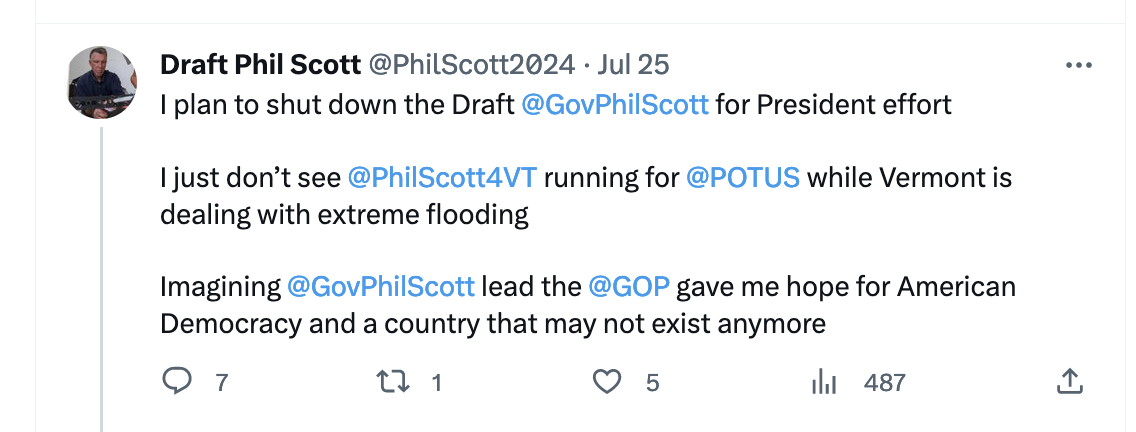
We have apparently seen the last of the invisible-except-on-Twitter “Draft Phil Scott” effort, which put forth a plausibly earnest belief in the potential national appeal of our indisputably popular Republican governor. I never took it seriously because, well, I see no path forward for Scott or any candidate who’s not a creature of the far right.

The arguments in favor of Scott: He’s the most popular governor in the country (true); he’s a real man of the people (that’s his image, certainly); he is particularly popular in the Connecticut River valley (okay); that popularity would give him a shot at success in the historically pivotal New Hampshire primary (nah); and a strong showing in the Granite State could make him the candidate of choice for those seeking an alternative to arch-criminal Donald Trump.

Well, if I hadn’t jumped off the bandwagon before then, that last imaginative leap would definitely lose me. Because the Republican Party of DPS’ imagination hasn’t existed since a lifetime ago. And I’m talking the lifetime of senior-discount-takin’ Yours Truly, not any of you young whippersnappers.

Continue reading

The VTGOP is Finally a Trendsetter — But Not in a Good Way

Is there such a thing as Chronic Wasting Disease among political parties? Because if there is, an epidemic is brewing among state Republican parties. Suddenly, in several key states, GOP coffers are alarmingly empty in a way that calls to mind the Vermont GOP’s underperformance over the last several years.

Last week, the conservative National Review published a piece called “The Quiet Collapse of Four Key State Republican Parties” that chronicled the woes of the GOP in Arizona, Colorado, Michigan and Minnesota — states “that would be tantalizing targets in a good year.” In addition, the Georgia GOP “is spending a small fortune on the legal fees of those ‘alternate’ Republican electors from the 2020 presidential election.”

The problem, according to the National Review’s Jim Geraghty, is “the replacement of competent, boring, regular state-party officials with quite exciting, blustering nutjobs” more concerned with culture war and ideological purity than the tedious work of party-building.

Sample nutjob: in my home state of Michigan, formerly the home of bland conservatives like Fred Upton and Gerald Ford, the state GOP is now helmed by election conspiratorialist Kristina Karamo, who not only believes that the 2020 presidential election was stolen, but so was the 2022 election in which she lost her bid to become secretary of state by a mere 14 percentage points.

The result of such leadership: Parties in battleground states that are racked by infighting and barely have two nickels to rub together.

Continue reading

One “Minor” Consequence of the Flood: A Dramatic Shortage of Legal Representation for Renters

Even in the best of times, the court system is stacked against renters. When landlord/tenant disputes arise, property owners can afford lawyers while renters cannot. The flood will seriously exacerbate this imbalance. As I predicted back on July 14 and VTDigger reported on, ahem, July 31, the flood “disproportionately hit Vermont’s affordable housing stock.”

All those renters occupying flood-ravaged housing will find legal resources very difficult to come by. The scope of this problem has yet to unfurl, and it’s going to be bad for months to come. At minimum. A lot of tenants are going to get screwed.

“There are very few private attorneys who will represent tenants, who are generally low income and unable to pay,” said Sam Abel-Palmer, Executive Director of Legal Services Vermont, a nonprofit focused on civil litigation. His organization and Vermont Legal Aid try to make up for the failure of the free market, but they can offer perhaps 10 full-time attorneys to help all the renters in Vermont. Besides that, there are a few private lawyers who take some cases on a pro bono basis and the state Bar Association pays reduced fees to some members who represent renters.

That’s about all. It falls short of meeting the need, even in the absence of a major disaster. “We sometimes can take cases, sometimes we can offer advice,” said Abel-Palmer.

And now?

“It’s not remotely enough,” Abel-Palmer said.

Continue reading

From the Dept. of Utterly Predictable: Small Towns Dealing with Rise in Homelessness (UPDATED)

This space, April 11, regarding the Legislature’s intent to end the motel voucher program:

Much of the impact will fall on municipalities. You’d think the Vermont League of Cities and Towns might declare an interest in preventing their members from taking it in the shorts. You’d think the mayors would be tramping to the Statehouse to beg the state to bear the responsibility instead of fobbing it off.

Well, the mayors did not, in fact, tramp to the Statehouse, nor did the very influential VLCT bring its considerable muscle to bear. Cue the consequences.

WCAX: “Smaller Vt. Towns Now Coping with Unhoused Population.” Comment from St. Johnsbury Town Manager Chad Whitehead: “This is happening across the entire state. I have talked with numerous town managers, and many population centers have been having this issue.”

The Journal Opinion: “For the second time this month, community members asked the Bradford Selectboard for help in addressing escalating homelessness in town.”

UPDATE. WCAX just ran a piece about downtown Burlington merchants “experiencing some challenges with foot traffic,” according to Colin Hilliard of the Burlington Business Association. One merchant reported “an increased population” of the unhoused on Church Street because of changes in the voucher program.

Yep, those merchants and their organizations should have been in there fighting for shelter, but they weren’t.

Continue reading

Montpelier Is on the Edge of a Doom Loop

Got a haircut this morning.

“Bully for you,” I hear you say. “Want a lollipop?”

Well, no. I bring it up because a classic barbershop conversation brought home a grim reality: Downtown Montpelier is in serious trouble and will never be the same. This, despite the robust community support for many businesses and the prospect of state and federal relief.

My barber plied her wares on Elm Street until July 10. After the flood, she quickly found new quarters on the Barre-Montpelier Road.

And she has no plans to move back, even though her business has “Elm Street” right in its name.

While I was in the chair, a familiar gent came in and sat down. Turned out he was the owner of Capitol Copy, a long-established downtown business we’ve patronized for years. He made it clear he had no plans to reopen, a decision he made easily and without regret. He also said he’d heard that another major downtown business was not going to reopen, in part because the landlord apparently had no plans to restore the property, which also contains two other businesses.

The press accounts of Montpelier’s recovery have tended to emphasize the positive: the robust community response, the doughty merchants rolling up their sleeves and getting down to work. But this encounter made me think that the real picture is much darker — that despite all the happy stories and successful fundraisers, Montpelier’s business district is in serious trouble.

In fact, the heart of downtown is in danger of emptying out unless serious changes are made in construction practices, zoning, planning, and land use — not only in Montpelier itself, but throughout central Vermont. It’s going to take some serious work to save Montpelier, not to mention all the other river-adjacent communities that don’t enjoy the same level of community support as our capital city.

Continue reading

Anything for the Unhoused? Anything at All?

The news is full of stories about the aftermath of the great flood. Our political leaders are fully engaged on the issues of flood relief. We hear about the plight of homeowners, renters, small businesses, and the various public and private efforts to help them in time of need. But there’s one group we hear little to nothing about.

It’s the people who had no home or shelter when the rains came on July 10.

The attitude among our leaders appears to be that after all, the unhoused had nothing before the flood, so did they really lose anything?

That may strike you as an unfair characterization, but it’s kind of baked into the disaster relief system. People and businesses get help based on tangible, reportable property losses. No property, no losses, right?

This includes the 750 or so households we sentenced to homelessness on June 1 when Gov. Phil Scott and Legislature tightened eligibility standards for the motel voucher program. The state made no particular effort to track those people after their forced exit. No one seems to know where they are or what their living conditions are like.

WCAX-TV just ran a story entitled “Where are evicted hotel-motel program recipients staying?” Unfortunately, it made no real effort to answer its own question. There were estimates from Burlington about the increase in the unhoused population since June 1, but nothing beyond the city limits.

And now we’ve added God knows how many more to their number. I’m sure God knows, but I don’t see any effort by our earthly leaders to track the newly unhoused. Have there been any efforts to expand shelters that were at or near capacity before the first drop of rain fell? Has anything been done for them besides handing out tents?

Continue reading

Private Generosity Is a Wonderful Thing. It Has Its Limits.

Scanning through the (literally) hundreds of flood-related GoFundMe campaigns is an exercise that inspires and deeply saddens at the same time. A search for “Vermont” on GoFundMe returns more than 500 matches, and the vast majority are flood-related.

That in itself is an indication of the scope of our disaster. The results of all those campaigns are evidence Vermonters’ generosity — and proof that generosity itself is not enough. Because while GoFundMe is a marvelous platform and every dollar raised will help someone in need, the returns are inconsistent and the need far outstrips the response. The meat and bone of recovery must be an organized public effort.

This has been shown by a study of GoFundMe campaigns launched during the early months of the Covid-19 epidemic. It found that “crowdfunding was most effective in areas with both high levels of education and high incomes.” In short, GoFundMe tends to “exacerbate inequalities and further benefit already privileged groups.”

I looked at several dozen of the flood-related campaigns. There were definite signs of social inequity; as of last night, a campaign intended to help the residents of the Berlin Mobile Home Park (profiled in a brilliant Seven Days cover story by Colin Flanders) had raised only $2,310 toward a goal of $145,000, which would be $5,000 for each household. Kind of explains why one resident told Flanders “”Nobody gives a fuck about a trailer park.”

Continue reading

The VTGOP Is “Helping” Phil Scott Again

Gov. Phil Scott is kinda busy these days with, among other things, talking to the Biden administration and our Democratic Congressional delegation about federal flood relief.

So naturally, Vermont Republican Party chair Paul Dame thought this was an ideal moment to flog the “Biden Crime Family” nonsense. Dame’s weekly commentary, delivered today to the select few on the VTGOP mailing list, is loaded with conditional assertions and misleading phraseology, all in service of the long-discredited narrative that Joe and Hunter Biden are international racketeers of the basest sort.

Good thing for the governor that nobody takes Paul Dame seriously outside his tiny band of true believers (who, unfortunately, occupy most of the leadership positions in the state party). Otherwise, Scott would have some ‘splainin’ to do the next time he picks up the phone to talk to administration officials.

Dame does his level best to whomp up some outrage from the steaming “Biden Crime Family” pile of Santorum. And fails. But his effort is yet another stain on the reputation of a once-respectable political organization — one that ruled Vermont for more than a century and produced remarkable figures like George Aiken, Bob Stafford, Dick Snelling, and Jim Jeffords.

Continue reading

Malloy Deploys Him Some Word Salad

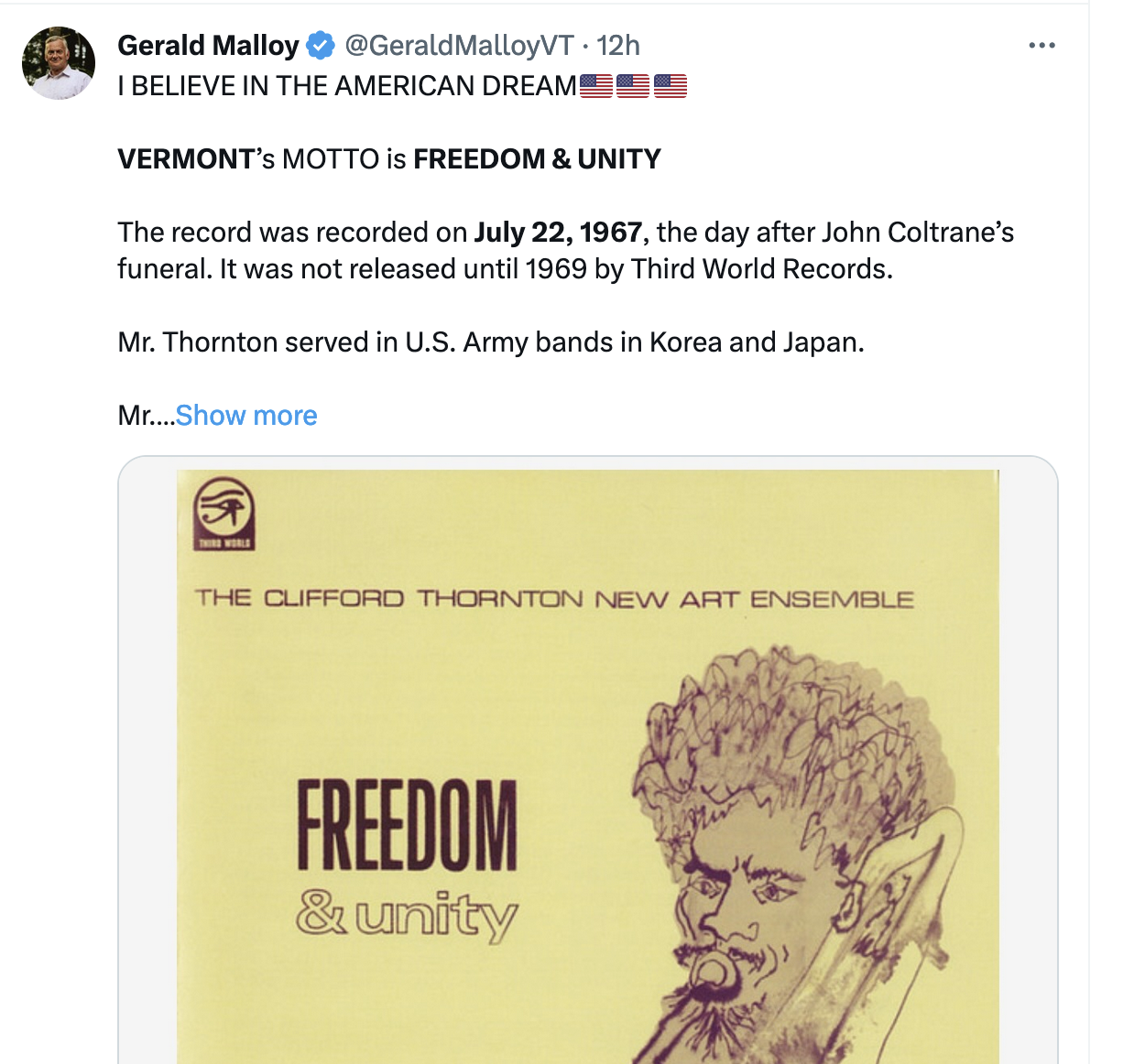
You could be forgiven if you’re confused about whether Gerald Malloy’s Twitter feed is a maladroit attempt to articulate his views or a piece of anarchic performance art. Lately, the unsuccessful 2022 Republican candidate for U.S. Senate has been deploying a mish-mash of anodyne observations and conservative talking points with plenty of ALL CAPS thrown in for good measure.

We’ll run down some of the more entertaining examples, but first I must address the above Tweet, which prompted me to write this post. Malloy posits the late musician/composer/activist Clifford Thornton as an exemplar of THE AMERICAN DREAM, I guess? Based solely, it would seem, on the fact that Thornton titled his first album Freedom & Unity. I seriously doubt that Thornton had Vermont in mind when he made that record, and I suspect that if he knew he was being championed by Gerald Malloy, he’d be spinning in his grave.

The real Clifford Thornton was a practitioner of free jazz, the radical mix of cutting-edge art that cared not for melody or harmony or traditional structure. He was associated with avant-garde greats like Archie Shepp, Ornette Coleman, Albert Ayler, Sun Ra, and Anthony Braxton. A critic wrote that Freedom & Unity was “a natural extension of the music of Ornette Coleman.” There is precisely zero chance that Malloy has actually listened to any of Thornton’s music.

But that’s not the weird slash ironic part.

Continue reading

This Is the Easy Part

Gov. Phil Scott is getting positive reviews for standing tall in the public eye, projecting an aura of confidence and strength, displaying leadership in a time of crisis.

All good things, to be sure. But I remember in 2011 when his predecessor Peter Shumlin got the same kind of plaudits for his handling of Tropical Storm Irene. But it turned out that Shumlin was a much less skillful administrator in the absence of a crisis. From this I learned that crises are not the true test of a leader. You need definite skills in such moments, but they are not the same skills that make someone an effective manager in “normal” times or a visionary who can steer the ship of state in a positive direction.

Phil Scott’s true test will come after the immediate crisis, when he will have to learn the right lessons from the Flood of 2023 and craft policies to minimize the chances of similar disasters in the future. And to do so even if it means re-examining his own beliefs and preconceptions, something that hasn’t been his strong suit in the past.

Continue reading