You know, the settlement that allowed key players to avoid the embarrassment and potential legal liability of testifying under oath? Yeah, that one.
Once in a while, an issue or development just hits me so hard that I find myself lying in bed wide awake, staring at the ceiling and grinding my teeth until I have no choice but to get up and write something. And here we are. Let’s recap the high points, shall we?
Through a combination of incompetence and hubris, state officials allowed themselves to be flim-flammed.
Other state officials then covered up the truth about the affair by claiming they had to keep key documents secret pending court cases.
On the eve of trial, the state settled a lawsuit by EB-5 investors just days before former state officials (up to and including former governor Peter Shumlin) were set to testify under oath.
If all those documents were ever released once the legal peril was removed, it somehow escaped my attention.
The state’s insurance company, AIG, took one look at this mess and denied coverage.
The state rolled over and accepted a token payment from AIG.
The Scott administration and Attorney General Charity Clark then waited as long as possible to reveal the AIG denial — only doing so when they had to go ask the Legislature for the needed funds.
Oh, those smiling happy faces. At left: Everybody’s Favorite Governor. At right: the boy genius formerly known as Phil Scott’s Financial Regulation Commissioner Mike Pieciak, now State Treasurer and presumptive future Democratic candidate for governor.
Yeah, they were chummy back in the day. Funny thing: Even though they now reside on opposite sides of the metaphorical aisle, they still seem to be awfully simpatico. Yesterday, the two of them announced something of a superhero team-up to address climate change and resiliency issues.
Talk about things that make you go hmmm. A top Democratic elected official joining up with the Republican governor to tackle an existential issue on which the Democrats are often at odds with the governor? All I can say is…
Two crises. Both involve the concept of “housing,” but they are not the same and we should not confuse the two. Which seems to be the willful intent of the Scott administration heading into a legislative session in which housing will be near the top of everyone’s priority list.
Remember the administration’s big presentation to the Joint Fiscal Committee in November? The one I called “a gloomy overview that has to rank as one of the most depressing events I’ve experienced in my 12-ish years following #vtpoli”? The whole intent of that presentation was to conflate the two crises and, well, subtly shift the focus toward housing and away from homelessness.
Administration officials have continued on that track ever since. The starkest example of this was the opinion piece co-authored by Human Services Secretary Jenney Samuelson and Commerce Secretary Lindsay Kurrle that focused almost entirely on housing policy and virtually ignored the rolling humanitarian crisis of unsheltered homelessness that state policy is creating.
I suspect we’ll get a heavy dose of the same in Gov. Scott’s state of the state address on Thursday. And we shouldn’t fall for it.
It’s been a loooong time since I last awarded the Veepies — @thevpo’s honors for exceptional stupidity in our politics. But the end of the year seems to have brought out the stupid in folks, so here we go!
First off, the Any Old Excuse In a Storm Award goes to the fearless folk who wear the uniform of the Vermont State Police. This has to do with their continuing failure to bring Daniel Banyai into custody. They allowed the original arrest warrant to expire. Now, they seem to be in no hurry to act, in spite of the fact that Banyai is defying a court order to turn himself in.
That’s bad enough, but there’s one singular item in VTDigger’s account that spurred the Veepies Board of Trustees to action. VSP spokesperson Adam Silverman helpfully told Digger that Banyai is one of roughly 5,200 people in Vermont with some kind of active warrant. I guess that’s supposed to impress me? But c’mon now, most of those warrants are not at all time-sensitive. Banyai has been defying justice and terrorizing the town of West Pawlet for years, as chronicled in a recent New Yorker piece. He ought to be on top of the VSP’s priority list, and they shouldn’t have the temerity to even suggest that he’s merely one among thousands.
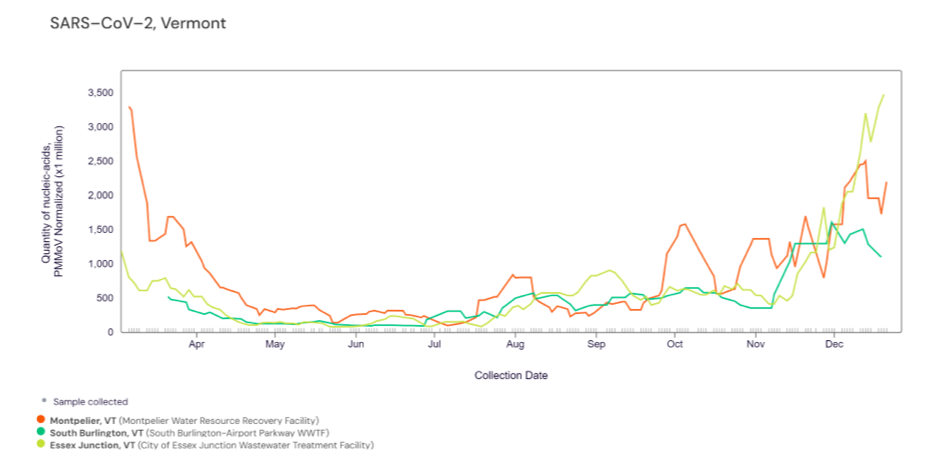
The available evidence points to one dispiriting conclusion: We are about to experience another substantial wave of Covid-19. Both state and federal data (the two are drawn from different testing regimens) show that our wastewater is full of the virus. The Centers for Disease Control says that nationally, wastewater levels are Very High, and the worst levels in the country are in the Northeast. Case counts in Vermont, although still classified as “Low” by the state Health Department, are on the rise. Nationally, according to the CDC, Covid-related emergency room visits, hospitalizations and deaths are all heading upward.
Dr. Michael Hoerger of the Pandemic Mitigation Collaborative is projecting that “Nearly one in three Americans will get infected during the peak two months of this winter surge. That’s 105 million infections & more than five million resulting Long Covid cases.” The PMC says we could be headed into the second highest peak for Covid transmission ever. Including those times when we avoided exposure as much as possible and wore masks whenever we ventured outside.
Yeah, well, I’m sure it’ll be just fine. At least that seems to be the foundation of Gov. Phil Scott’s post-pandemic policy. Because his administration isn’t doing a damn thing about it. Not even to “protect the most vulnerable,” which he says is one of the three pillars of his governorship.
On Friday, December 22, state Auditor Doug Hoffer did something almost routine — but did it in an unusual way.
The routine: Hoffer issued a memo pointing out that there’s no evidence that a state workforce incentive program has any beneficial effect. The unusual: He sent it out at 2:26 p.m. on the Friday afternoon of the Christmas holiday weekend. As you might expect, there was no immediate coverage from any Vermont news outlet, all of whose members had their eyes fixed on the nearest exit when the auditor’s missive hit their inboxes.
It’s almost as though Hoffer realizes that when it comes to state incentive programs, he’s a lonely voice howling into the void. So why not simply launch his note directly into the void?
Perhaps that’s just my inner cynic talking. But really, does it make any difference whether he shoves this thing over the transom on a holiday weekend or calls a press conference in a prime spot? It’s probably going to have the same effect.
My previous post concerning the party reorganization process could have been written a couple weeks earlier. That’s when the information became available. I just plain didn’t get around to it immediately because (1) other stuff got in the way and (2) I was pretty confident that no other media outlet would bother with it.
And I was right. Nobody in Vermont covered it. In fact, nobody in Vermont is covering the nuts-and-bolts of politics anymore. Party reorgs, hirings, departures, leadership changes, party finances: they’re off the agenda. No one routinely (well, really, ever) attends state party committee meetings, conventions, or big fundraising events.
You also see a lot less reporting on individual politicians’ campaign finances. Filing deadlines used to be big occasions. Back when reports were filed in person, political reporters would gather at the Secretary of State’s office to grab the reports and file stories. Everything’s digital now, so all you have to do is open up the SoS campaign finance website and hit “refresh.”
It’s a lot easier. And yet, little to no attention is paid.
Note: This post has been updated with comment from the Progressive Party, see below.
This fall, Vermont’s political parties have undertaken their biennial obligation to reorganize themselves. It’s quite the task. The parties have to encourage members across the state to take part in town caucuses and establish town committees.
The process Is now over and the results are in. The Vermont Democratic Party had the biggest success, organizing town committees in more than 170 communities (they’re still totting up a few stragglers). The same process two years ago resulted in 150 Democratic town committees. That’s a nice bump, considering (a) they had less room to grow than the Republicans or Progressives, and (b) given the flood and all, it wasn’t the best year for encouraging turnout at political meetings.
The Vermont Republican Party lost a bit of ground, falling from 132 town committees in the 2021 reorg to 120 this time around. The Progs saw a modest increase from 44 towns in 2021 to 48 this year.
Last week, the federal government issued its big annual report on homelessness in America. Not that you’d know it from the Vermont media; the only story I saw about it was a national Associated Press article that the Times Argus ran on page 2.
Which is a damn dirty shame, because the federal report contains a lot of information about Vermont’s situation, which got quite a bit worse from the previous year — and has gotten substantially worse since then.
This news wouldn’t have taken any real effort to uncover. But hey, I guess we’ve had our fill of bad news on homelessness. Such a downer, you know.
The report in question is the U.S. Housing and Urban Development’s Annual Homelessness Assessment Report to Congress. It takes data from a “point in time” (PIT) — a single night in January 2023 — and turns it into a real deep dive on homelessness. It’s an imperfect instrument that almost certainly produces significant undercounts because, well, the unhoused can be hard to find. But it does provide a lot of valuable information.
The depressing topline: Homelessness in America increased by more than 12% from the previous year’s AHAR. Vermont, again, had the second worst rate of homelessness in the country, trailing only New York. (In the 2022 report, Vermont came in second to California.)
Well, you might say, we might still be bad, but at least we didn’t get any worse.
Not so fast, my friend.
The AHAR data shows that homelessness in Vermont increased by 18.5% from the previous year, a jump more than 50% higher than the abysmal national figure.
And we know for a fact that things have gotten even worse in Vermont since the PIT count was taken eleven months ago.
How so? Let’s take a step back. The AHAR count includes all the unhoused — both sheltered and unsheltered.
“Wait,” you might be saying, “how can a sheltered person be homeless?”
Anyone with no fixed address is considered homeless, even if they’ve resorted to couch-surfing or staying with a relative or squatting in an abandoned building or, horrors, returned ot a home they’d fled to escape an abusive or addicted or criminal partner. Those people have shelter, but it isn’t a stable, lasting arrangement. They can’t count on it. It might be a roof over their head but it isn’t, well, home.
Step forward. In the 2023 AHAR, Vermont scores very well in one measure. We have a lot of homelessness, but we have a relatively low rate of unsheltered homeless. Most of our unhoused have places to stay.
Ahem. They did, until the Scott administration and the Legislature decided to ramp down the motel voucher program, which had kept thousands of unhoused Vermonters in liveable shelter. The program was dramatically cut at the end of June, and the administration has been doing its level best to ratchet down eligibility since then. Most of the people who were staying in motels last May are now out of the program. And only a small fraction of the departees are known to have found stable housing arrangements. So it’s a virtual certainty that the ranks of our unsheltered homeless have swollen dramatically since the PIT count was taken in January.
But wait, there’s more!
Since federal pandemic-era rental assistance programs have ended, more and more people have fallen far enough behind on rent to be subject to eviction. As Seven Daysreported last week, sheriff’s departments across Vermont are up to their ears in court-ordered evictions they have to enforce. And it seems certain that more are on the way. It takes months, at least, for a tenant to fall far enough behind to be subject to eviction. Says here we’re only at the beginning of a wave of forced unhousing. Rental supplies are abysmally short, prices are skyrocketing, and many Vermonters — even those with steady employment — can’t keep up.
Homelessness in Vermont has almost surely increased, by quite a lot, since the PIT count in January. There is every reason to expect that it will get even worse. And yet, it doesn’t seem like anyone’s paying attention. Since early November, when administration officials issued a truly dire assessment of our housing shortage to lawmakers — and the media pretty much ignored that hearing — there’s been almost no reporting about the situation.
The decision by administration and Legislature to slow-walk the dissolution of the voucher program averted a singular humanitarian disaster. Instead, it’s been spread out over a period of months and months. A slow drip-drip-drip, not a tsunami. If I were a cynical sort, I’d suspect that Our Leaders wanted to avoid the impression of a catastrophe by enacting it in slow motion. It seems to have worked. That’s a damn shame. And a damn disgrace.
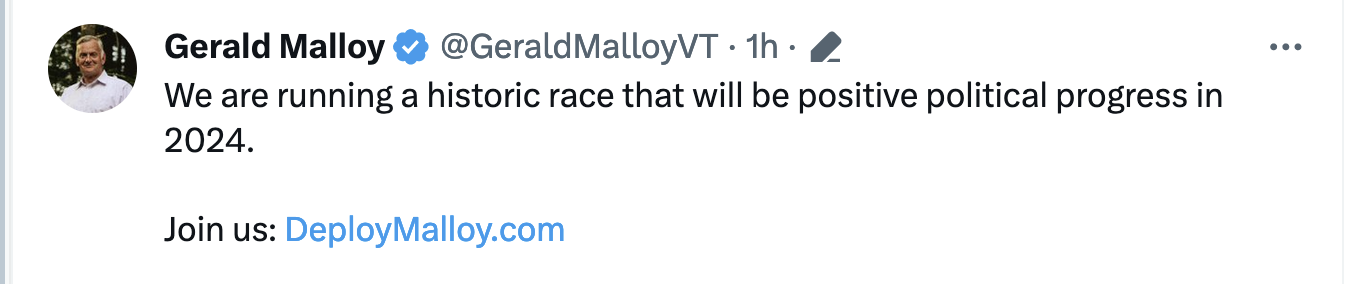
Gerald Malloy, fresh off his razor-thin defeat at the hands of Peter Welch in 2022, is ready for another go. Having lost to Welch by a mere [checks notes] FORTY PERCENTAGE POINTS, Malloy thinks he can do far better against [checks notes again] the most popular Vermont politician of our century, Bernie Sanders.
Yep, Scary Bird Man is running for Senate. Again. Optimistic or deluded? You make the call.
I hope you’re ready for a return of the most bizarre yard signs in Vermont history: an eagle staring you directly in the eye, accompanied by the cryptic legend “Deploy Malloy.” You know, the signs described by VTDigger as “simple yet arguably menacing”? Now available in a wide variety of merch, including some high-test nightmare fuel for the kiddies.













 The Vermont Political Observer.