
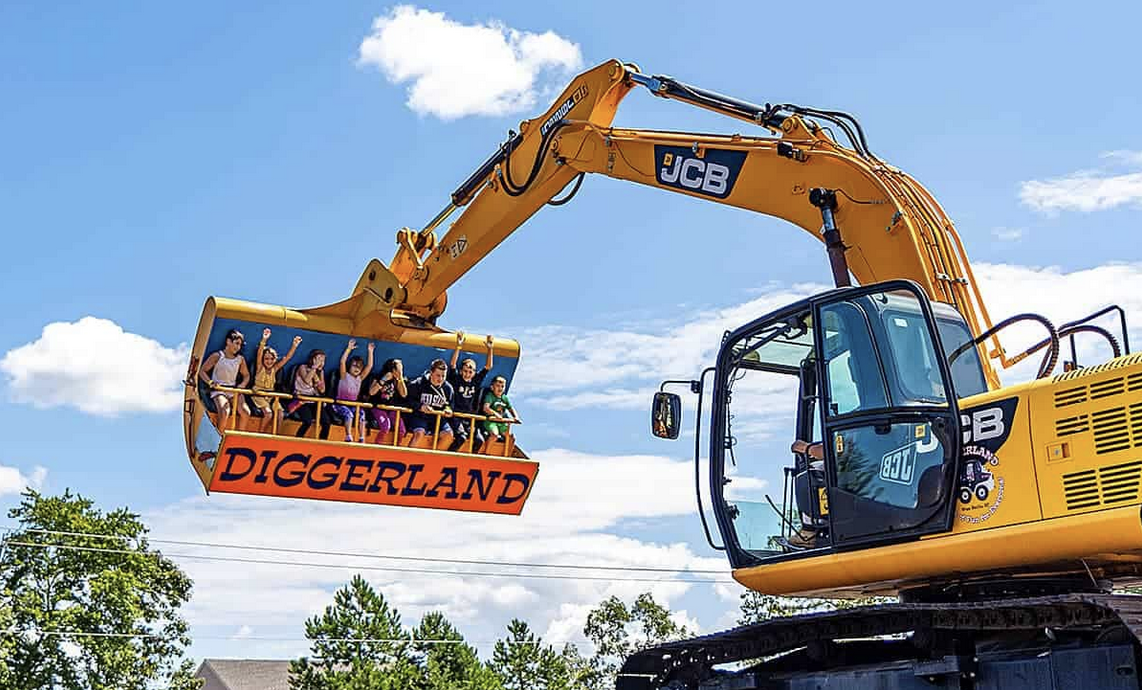
Well, when I went looking for a cheeky illustration for this post about the fortunes of VTDigger, I didn’t plan on discovering Diggerland, “the one and only construction theme and water park in the U.S.!” (Exclamation mark theirs.) But that’s the internet for ya. The real Diggerland, complete with opportunities to “Drive, Ride & Operate specially engineered, real construction machinery,” is located in a New jersey exurb of Philadelphia, which sounds about right.
So no, our favorite nonprofit “print” news organization hasn’t opened a theme park. Not yet. But the idea doesn’t seem completely farfetched given the sweaty, sweaty nature of Digger’s current fundraising campaign.
If you haven’t visited VTDigger in the last several weeks, you’ve missed a huge number of fundraising messages competing for space with a shrinking number of actual news stories. You’ve missed messages directly from staff reporters, which rings ethical alarm bells among ink-stained wretches. You’ve missed pitches that tie support for Digger to the provision of heat and sustenance, which strikes me as a tad aggressive. The implicit message is if you don’t support VTDigger, you don’t care about the poor among us. Which is nonsense.
To me, if you can’t attract enough support for solid journalism as a worthy investment, then little tricks like “give today or someone will be left in the cold” or “give now or someone’s gonna go hungry” aren’t going to make up the difference. Also they just feel uncomfortably tacky.
But if the folks at Digger are a little desperate, a perusal of their latest IRS filing will tell you why.
Backdrop: Every year, nonprofit organizations are required to file a Form 990 with the feds. The filing deadline is very forgiving, which means that Digger’s 990 for tax year 2024 is only now available for review at ProPublica’s excellent Nonprofit Explorer tool. (Hat tip to former Seven Days data reporter Andrea Suozzo, who now runs Nonprofit Explorer.)
So it’s a little out of date as a snapshot of Digger’s current fortunes. But it does reveal how Digger is trying to, ahem, dig itself out of a very deep financial hole. And the 990s for the last five years show a pattern of post-pandemic shrinkage followed by a push to right the ship before it starts to sink.
And it’s a big freakin’ ship. Digger’s expenses in 2024 came in just north of $3 million. Total revenue was short by $75,715, which sounds bad until you see that in 2023, expenses exceeded revenue by a shocking $726,512. Now, that’s a bad year.
How did Digger cut its operating losses by almost 90%? The 990 is short on detail, but a couple things are readily apparent. The vast majority of Digger’s expenses are in staff salaries, benefits, and compensation. If they needed to cut costs, that’s the only real place to go. In 2023, staff expenses totaled $2.73 million. In 2024, that figure fell to $2.4 million. So it’s not just your imagination; Digger is producing less content than it used to because the staff is smaller.
On the revenue side, “contributions and grants” rose from $2.3 million in 2023 to $2.4 million last year, which is barely enough to keep pace with inflation. A larger percentage increase came in the curious category of “program service revenue,” which grew from $417,000 to $516,000, a nearly 25% hike. Program service revenue is a catchall term for allowable sales of goods or services. Nonprofits can’t just sell anything; the sales have to be related to the organization’s mission. In Digger’s case, I suspect that this income is for paid content which can be broadly said to advance the mission of informing the public.
Point being, contributions and grants aren’t growing. Not quickly enough, anyway. Hence the frequent and unapologetic fundraising. Digger’s in a tenuous position. The cuts in coverage make for a less appealing product, which could lead a decline in reader engagement, which could trigger a drop in donations, lather, rinse, repeat.
Back in 2020, Digger received a three-year, $900,000 grant from the American Journalism Project touted as a “transformational investment” in the organization’s business operations. The idea was that a stronger financial arm would bring in more than enough revenue to sustain a bigger Digger after the grant expired.
That didn’t happen. The money was spent, but the projected revenue increases never materialized. I think the main barriers were out of Digger’s control: The Covid pandemic and the loss of sponsorships and other private-sector support, and the general contraction of the news business. There was also a messy leadership transition which saw founder Anne Galloway exiting with a lavish contract for broadly-defined “consulting” services that seem to exist largely in the sphere of imagination. (She was paid $110,000 in 2024; her consultancy contract with Digger expires in February 2026.) In the wake of her departure the entire organization had to be reinvented, not just the business side. And it’s a significant line item at a time when Digger is pinching pennies.
One other item in the Form 990: Digger’s statement of purpose, a necessary thing for a nonprofit organization. Here’s what it says:
VTDigger is an online news daily dedicated to public service journalism. We cover Vermont politics, business, healthcare, education, energy, criminal justice and the environment. Our mission is to produce rigorous journalism that explains complex issues, holds the government accountable to the public, and engages Vermonters in the democratic process.
This statement seems to have been written when Galloway was in charge and Digger’s journalism was focused on state politics, government, and the legislative process. In more recent times, Digger has spread itself farther and wider — and I would say it’s spread too thin. Digger has fewer reporters in Montpelier and more scattered around the state. There is precious little accountability journalism to be seen. Investigative reporting is almost nonexistent.
This may be a reasonable response to the general decline in news coverage everywhere, and in particular the near-disappearance of the Associated Press’ Vermont bureau. There’s a lot less coverage everywhere than there used to be, and perhaps Digger is trying to fill some of the void. But an argument can be made that Digger is no longer abiding by its stated purpose, which centers on statewide issues and politics.
If I were in charge, I’d return to a Statehouse/state government focus. That’s what earned Digger its stripes. It’s a journalistic “market” that’s grossly underserved. That kind of Digger would be a more appealing product to a core readership interested in state issues as well as major benefactors and foundations. If Digger reversed its dilution of focus, I’d predict an uptick in reader support. That’s easy for me to say, of course.
But the situation is this. Digger was, and is, a shining example for the developing world of nonprofit journalism. It is widely hailed as a pioneer and a success story. And yet, its future is far from assured. Nonprofit journalism continues to be a struggle, and ain’t nobody figured out the magic formula.
 The Vermont Political Observer.
VTDigger has a quality problem, and it is a huge issue for me. A very recent example is found in their recent story “Nine Vermont dams were removed in 2025. There are many more to go”.
They included an example of a claimed dam failure in Williamstown that “caused a lot of damage.” The big problem being that there has been no dam failure in Williamstown that caused problems of “a lot” or even “not much at all” damage.
None. And the “digger” totally failed to confirm that tidbit prior to print.
And I’ve spent the last several days trying to get them to correct that massive error without any success.
That’s why I’ll give money to many different local papers that focus on local issues, but I’m withholding money from VTDigger. They need to return to the basics of Galloway when the “digger” really was out there digging instead of being pass through for whatever they hear last.
It would be a shame if the only way to recoup/regroup were to shrink away state-wide coverage in favor of statehouse coverage entirely. There is little enough coverage remaining out there as it is. Which is why reporters like Alan Keyes and Kevin O’Connor were added years ago as their respective outlets withered and were bought by out-of-state concerns.
You’re point — which really can’t be repeated often enough, so thank you! — about the utter lack of presence at the Capitol is well taken. Some sharpened re-assignment is surely in order. Even given the parlous state of finances at Digger — it’d be better to go out with a beer and a blast than a small polite noise that leaves behind the faint aroma of performing seals (to quote a very savvy lyricist speaking of another thing altogether.)
And along those lines, I hope Ms Anand wasn’t brought on to serve as funeral director, as was a certain Freep editor hired away from an award-winning weekly in the mid-south a number of years ago.
You don’t have to print this, but obviously you can if you wish – no objections from me. This link is to a Brattleboro Community TV based program regarding the Commons and Deerfield Valley News -> “Montpelier Happy Hour: Windham County’s local news ecosystem, VDP’s new chair, and BCTV turns 50”, and seemed right up your alley of interests.