
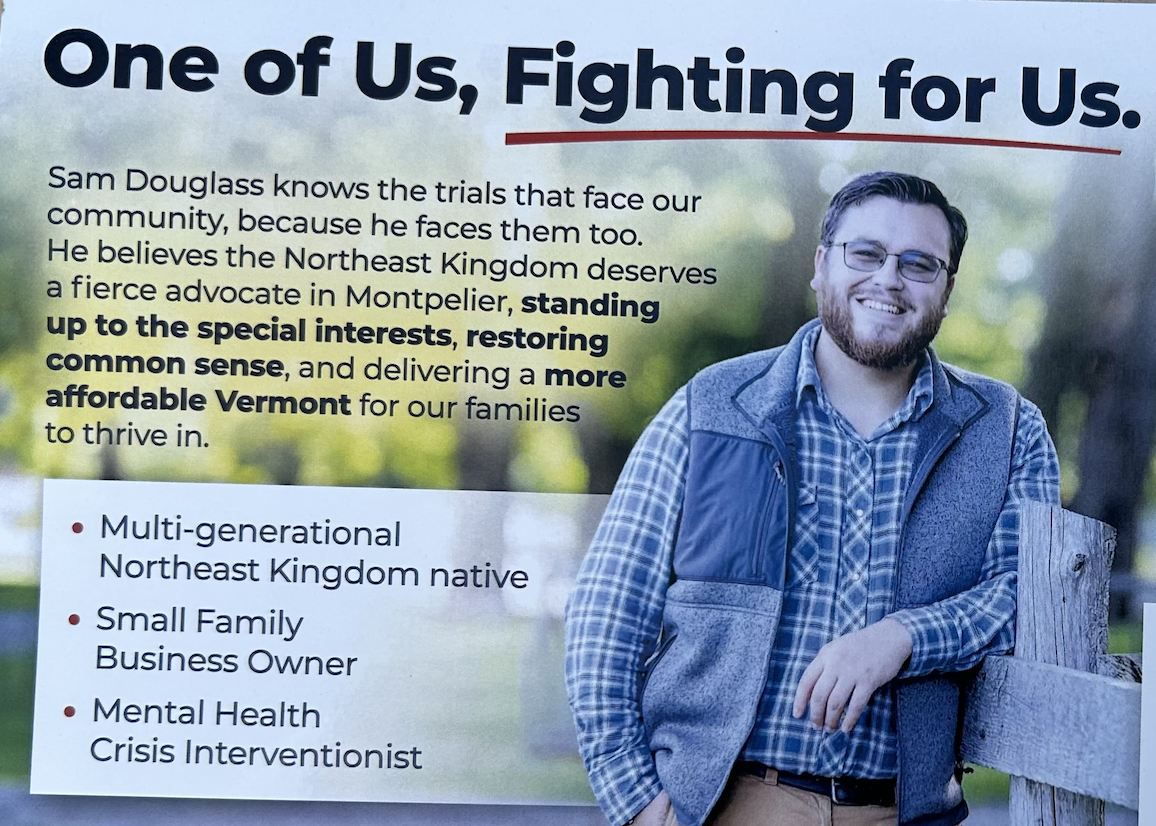
The folksy Son of the Soil pictured above is Sam Douglass, senator-elect from the Orleans district. Or, as I find myself thinking of him, Senator Scofflaw. Because while he claims to be a “fierce advocate,” he was shockingly blasé about his legal obligations to report campaign finances accurately and promptly. Makes you wonder about his fierceness, not to mention his devotion to fiscal responsibility.
Because his campaign finance filings are the opposite of “responsibility,” and include numerous violations of state law. Fortunately for him, the penalties are laughably small and rarely enforced. Otherwise he’d be in a heap of trouble. As it is, maybe some Concerned Citizen will see fit to file a complaint with the Attorney General’s Office, for all the good that will do.
Let’s start with the fact that Douglass has yet to file his Final Report, which was due on December 15. And there’s a real need for a final accounting, because his most recent report leaves many questions unanswered.
His post-election filing, submitted on November 19, shows a serious imbalance between income and outgo — and not in the way you’d expect. The Douglass campaign has reported raising nearly $41,000 and spending only $27,460. Did he really leave one-third of his bankroll on the table in a race against Democratic Rep. Katherine Sims, who raised more than $76,000? Or has he failed to fully report his expenditures?
Vermont’s campaign finance law and the Secretary of State’s reporting system can be a challenge, but when you run for public office you are obliged to follow the rules. Besides, Senator Douglass is going to be responsible for writing the laws. Shouldn’t he be capable of obeying them?
Many of Douglass’ campaign law violations have to do with mass media expenditures. As a reminder, expenditures of $500 or more made within 45 days of a primary or general election must be reported to the Secretary of State within 24 hours. The report must include a listing of all candidates mentioned in advertisements or literature, and the expenditure must be reported to any candidate mentioned in the material. (Mass media filings include TV, radio, and newspaper/periodical ads, mass mailings, mass electronic or digital communications, literature drops, robocalls, and phone banks.)
These requirements for timely and full disclosure are meant to limit the possibility of funny business such as last-minute attacks on an opponent or claiming the endorsement of someone who hasn’t actually given their consent.
Douglass filed six mass media reports. Four of them were for postcard design, printing and mailing through Manchester, NH-based Spectrum Marketing. The other two were for online ads in the Newport Dispatch and radio ads purchased through the Vermont Association of Broadcasters. Five of the six filings identified only Douglass himself as a mentioned candidate. The sixth identified Douglas and Rep. Allen “Penny” Demar.
Thanks to a source who lives in the district, I have seen not four, but seven Douglass mailers. He reported buying mailers on September 30 and October 12, 19 and 24. My source reported receiving Douglass mailers on October 1, 3, 11, 16, 21, 30, and November 1. It looks like the reports line up with some, but not all, of the received mailers:
- Report 9/30, delivered 10/1
- Report 10/12, delivered 10/16
- Report 10/19, delivered 10/21
- Report 10/24, delivered 10/30
The 10/19 report was the one mentioning Douglass and Demar. It was a much smaller expenditure than the other three postcard buys, which probably means it was sent only to voters in Demar’s district. Which seems to leave unreported the mailings received on October 3 and 11 and November 1.
So he apparently failed to report at least three mailers. And many of the mailers mentioned other candidates who went unreported in Douglass’ mass media filings. Two prominently featured the endorsement of Gov. Phil Scott. One mailer mentioned eight Republican lawmakers from the Kingdom as endorsing Douglass. I’m sure his fellow Republicans won’t mind, but three postcards featured harsh attacks against Sims as a tax-and-spender. How harsh? You make the call.
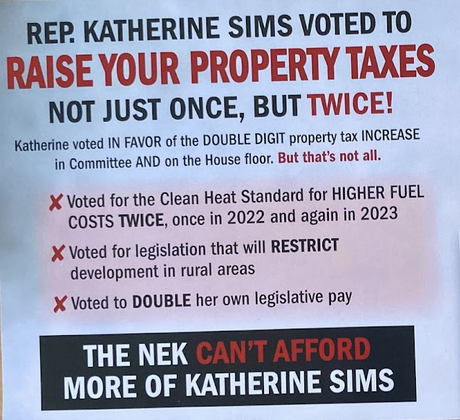
And you know, if he failed to report Sims on his mass media filings, I’ll bet you five bucks he failed to notify Sims herself. Which is, at the risk of repeating myself, illegal.
Another thing. Mass media expenditures must be reported within 24 hours in the closing weeks of a campaign, and they must also be reported on a candidate’s regularly filed campaign finance reports. Douglass’ regular reports don’t include all the mailers, which is the most likely explanation for the nearly $14,000 gap between income and expenditure on his November 19 report. Douglass simply hasn’t officially reported all his expenditures.
Again, illegal. And his Final Report is more than three months overdue.
Here’s a real stupid one. Denise Vallee, spouse of fuel magnate Skip Vallee, is listed as giving two donations of $1,680. If true, she exceeded the legal limit for individual gifts to a single candidate. What’s more likely is that the Douglas campaign double-reported her gift. Which would be pretty darn careless. I know everybody makes mistakes, but when submitting a legal document, perhaps a bit of proofreading is in order. I mean, hey somebody might read that and file a complaint against Vallee herself, which would be embarrassing.
Douglass’ campaign finance filings do not list any expenditures for staff or consultants, which may explain the slipshod approach to compliance. His campaign began as a very low-budget affair, but then the Barons of Burlington sensed opportunity and flooded his campaign with four-figure checks. Douglass accepted the loot and spent it, but didn’t try to upgrade his infrastructure to deal with the demands of what turned into (by Vermont standards) an expensive campaign.
This may not be a complete list of Douglass’ violations of campaign finance law, but it’s plenty long enough to raise questions about his personal fiscal responsibility. Seeing as how being tough on taxes and spending was the cornerstone of his campaign, that’s kind of a problem. In addition to being, you know, illegal.
And I haven’t even gotten to the massive internal contradictions in Douglass’ self-presentation. His campaign materials tout him as a fierce advocate who promises to “put the Northeast Kingdom FIRST, not party or special interests.” (Boldface and CAPS are his.) But he raised almost his entire campaign bankroll outside the Kingdom — with a heavy concentration of funds from the Barons of Burlington, who could serve as the dictionary definition of “special interests.”
Douglass raised a total of nearly $38,000 in donations of $100 or more, the threshold for naming donors and listing their addresses; a mere $4,253 — or 11% — came from within his district. Most of the rest came straight from Chittenden County. Sims, on the other hand, got 57% of her large donations within the district. Remember that when Republicans start talking about their connection to the beating heart of Real Vermont as opposed to the captive-of-Burlington-and-Montpelier Democrats. If anyone in that race was a captive of Burlington it was Douglass, not Sims.
Now, there’s no law against raising money outside your home turf. But when two lawmakers who endorsed Douglass are raising a stink about outside money, then I feel compelled to point out the hypocrisy. And I have to wonder if Douglass will truly represent the best interests of his constituents or those of his paymasters.
And I still wonder when, or whether, we’ll ever learn exactly how much of the Barons’ donations were spent on sending Sam Douglass to Montpelier.
 The Vermont Political Observer.
As in so many 2024 races, this candidate made false claims about the vote on legislative pay. Any legislator who voted in 2023 — a year before we saw large school tax increases coming — to raise legislative pay was voting for incremental changes in future years.
Each legislator would have needed to be re-elected TWICE MORE before receiving a near-doubling of pay, as of January 2027. Had it become law, which it did not.
In the meantime, consider why someone like Sims or I voted to raise legislative pay from $15,100.
Being a State Senator is a full-time job for at least five months each year, if one is responding to 22,000+ constituents’ communications, doing their homework, and showing up on time to meetings, both during and outside the session. In addition to filing reports on time!
Not everyone works that hard. But if we want to resolve the perpetual challenges faced by our state — like devising a better education funding formula — Vermonters may want to pay a living wage to legislators, so that they’re able to take this job as something more serious than a part-time hobby.
Otherwise, the revolving door will continue, as people get elected, realize it’s not really part-time job, and drop out in droves every two years.
I daresay, it’s hard to make forward progress as a state, when so many folks are starting from scratch every other January, attempting to become “part-time” experts in complex subject areas before making difficult decisions and even laws about them!
Sadly, false claims about a lawmaker’s votes are not unusual. He also slammed his opponent for voting in favor of a property tax hike. In fact, she voted for it on a preliminary vote but ultimately voted “no” because she thought the increase was too much. I didn’t include the distortions in my writeup because they’re not illegal, just unethical.
“But when two lawmakers who endorsed Douglass are raising a stink about outside money, then I feel compelled to point out the hypocrisy.”
Thanks much. Keep pointing out these hypocrisies.
Time for an update!
Already done! https://thevpo.org/2025/10/14/i-tried-to-tell-you-about-sam-douglass-and-theres-a-lot-more-like-him/