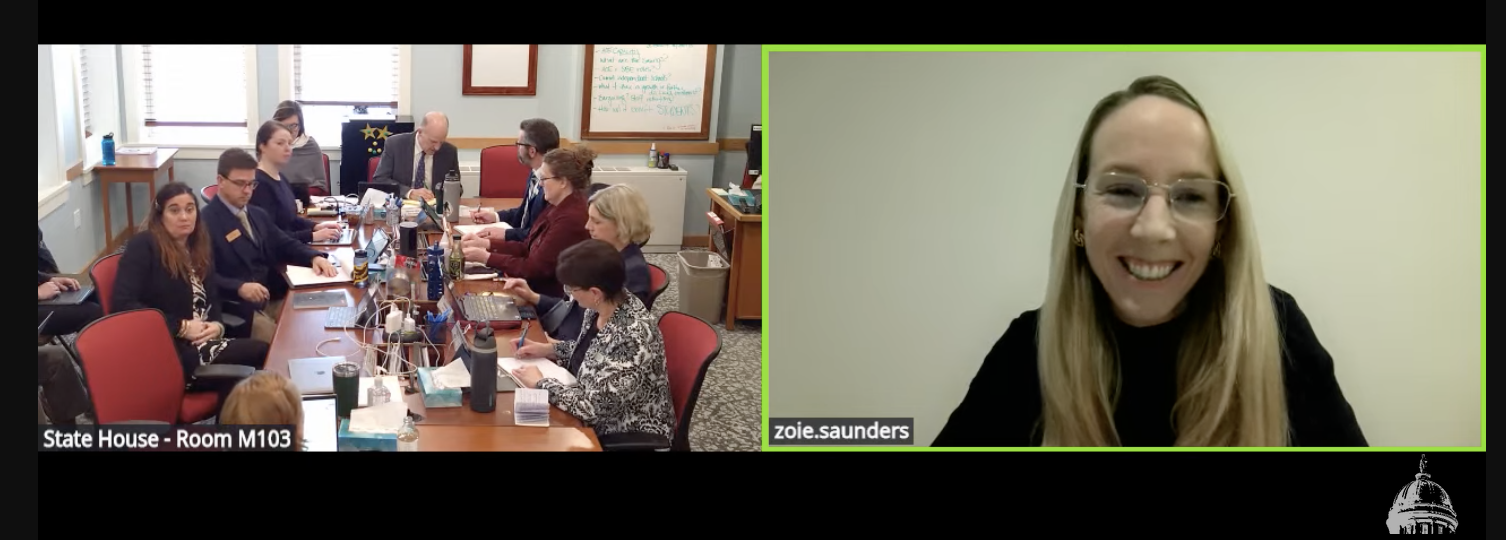
The long, slow rollout of Gov. Phil Scott’s education plan took another step yesterday, as Interim Education Secretary Zoie Saunders* testified before the House Education Committee about the governance portion of the plan. Her testimony was met with widespread befuddlement, as reflected in a series of “What the heck does this mean?” questions from majority Democrats on the committee.
*She dropped the “Interim” when she introduced herself to the committee**.
** It has been pointed out that Scott has appointed Saunders permanent secretary. Okay, but her entire appointment is still subject to a court ruling, so it remains to be seen whether she’s permanent or done.
Before we get to the sources of that befuddlement, we must mention the poison pills contained within Scott’s plan. First, it would implement statewide school choice and throw the doors open for unfettered expansion of the current “approved independent schools” system. Every public school student would have to be offered some measure of choice. That’s a nonstarter for Democrats, or it ought to be, because it poses a very real threat to the finances of actual public schools.
Second, it would centralize power over the education system to a remarkable degree. Local school boards would be gone. There would be only five large school districts. Each local school would have a “School Advisory Committee” with very little authority. Most of the state Board of Education’s powers would be assumed by the Agency of Education. And the current “boards of cooperative education services,” created and administered by school supervisory unions, would be replaced by “Education Service Agencies” controlled by the Agency of Education. According to the Scott plan, one of the purposes of this move is “to limit mixed messaging.” In other words, to stifle dissent.
One (anonymous) Democratic lawmaker suggested to me that House committees ought to just send this plan directly to the House floor and watch as Scott and Republican lawmakers — almost all of whom represent small, rural school districts at risk of disenfranchisement and school closures — try to explain themselves, or risk serious injury as they back away from the plan as quickly as possible.
To say this plan is doomed is to indulge in understatement. Besides the presence of poison pills, there are other signs that Scott doesn’t intend for this plan to be taken seriously. What he wants, I suspect, is for the Democrats to reject the plan so he can accuse them of refusing to face the issue. He has asked them to “come to the table,” but he has laid out a buffet of awfulness. It’s not an invitation; it’s a trap.
To me, the biggest tell that Scott is not serious about this is the painfully slow rollout it’s getting. I mean, it’s been a month since his inaugural address. The legislative session is almost a quarter of the way to adjournment, and we’re still waiting for crucial pieces of the plan to be unveiled.
Scott has been talking about this thing for quite a while. He has the entire executive branch at his beck and call. And they’re still figuring out the details of this plan, which is allegedly a top priority for the governor? There’s no excuse for not unveiling the whole enchilada on Day One, if not before.
At the beginning of her testimony, Saunders kinda-sorta apologized for delivering the governance plan to the Education Committee on the day of her scheduled testimony, depriving members of any real chance to review it in advance. During the hearing they spent a lot of time leafing through printed copies of her presentation, trying to absorb it in real time. There are two explanations for this: (1) The administration didn’t finish the plan until the last minute, or (2) They didn’t want anyone to have a chance to devise intelligent questions.
The question period was an exercise in frustration for members, as they asked very simple, straightforward questions and received deluges of jargon in response. Precious few straight answers were on offer. On multiple occasions, Saunders didn’t have key details to offer — apparently because those details hadn’t been clarified within the administration. More than once, Saunders referred to the plan’s two-year implementation phase as, I guess, a time when they’d work out the fine print.
Need I say, this is no way to reinvent a massive governmental system?
At one point, committee chair Rep. Peter Conlon asked when the administration would deliver actual legislative language his panel could work on. Saunders couldn’t specify.
Again, we’re almost one-fourth of the way through the 2025 session. And this plan would be a huge heavy political lift. That is, if the administration had any realistic hopes of getting its plan into law. At the end of the hearing, Conlon noted that Scott’s plan is “very provocative” and said that any such plan “needs a spokesperson and that has to be the governor. My question: Is the governor going to be out there talking to Vermonters? He has the political capital.”
Saunders responded by saying that the governor had talked about the plan at his Wednesday press conference, and ended with vague talk of gathering “additional feedback.”
So I ask. Do you see Phil Scott barnstorming around the state, trying to sell this plan to communities that would lose virtually all governing capacity over their public schools? This governor seems highly allergic to appearing in any public forum that doesn’t promise a friendly audience. Is he going to get out there and do the hard work of convincing the public to completely overhaul a beloved institution?
To judge by the plan’s rollout so far, there’s no way in hell he’s going to do that.
 The Vermont Political Observer.
So, by “hypocrisy” do you mean a single typo in a blogpost? Good grief. Stand down from your pedestal.
Not me. Been doing this blog off and on since 2014 and this is a new one — a commenter impersonating another commenter.
“It’s not an invitation; it’s a trap.”
The more I think about it, the more I think you’re right. I’ve had co-workers ask me if I could make sense of this plan for them and, of course, I could not. I told them that it was an underhanded way to expand private schools in the state at the expense of public schools and taxpayers, and that would help to break the teacher’s unions which are, usually, reliable democratic voters. But I think you’re right on here.
I also agree with that anonymous Democratic legislator who said that Scott and the supporters of this bill should be made to justify themselves with this.
This is no way to reinvent a massive governmental system.
Pardon me for turning my attention to other aspects of my life over the weekend, namely the ones that include my working-on-weekdays partner.