There was plenty of talk during the 2024 legislative session about housing, homelessness, Act 250, climate change, school funding, crime, opioids, and other big issues. I don’t recall health care occupying the spotlight at all.
And then last week, an outside consultant delivered a devastating assessment of our “badly broken” health care system and said that wide-ranging “structural reform” is needed as quickly as possible. Or, for those underwhelmed with what passes for leadership in our Brave Little StateTM, much quicker than seems plausible.
Maybe the only person who might feel a little bit good about the consultant’s report (downloadable here under the title “State-Level Recommendations for Hospital Transformation,” because the Green Mountain Care Board is all about that clickbait) is former governor Howard Dean. You may recall that when he dipped his toe, ever so briefly, into the political waters, health care was the only issue he spotlighted. I noted that it was kind of refreshing to hear someone focus on health care, which seemingly left the front burner after former governor Peter Shumlin abandoned single-payer health care.
That’s a bit unfair; a lot of work has been done, but the system is still an unholy mess. This we pretty much knew, but the presentation by consultant Bruce Hamory brought it all together in one depressing dumpster fire of badness.
Where do I even begin? You need to read the presentation or watch Hamory’s appearance before the GMCB (starts about one hour into this video) to get the full import. But I’ll try to hit some highlights.
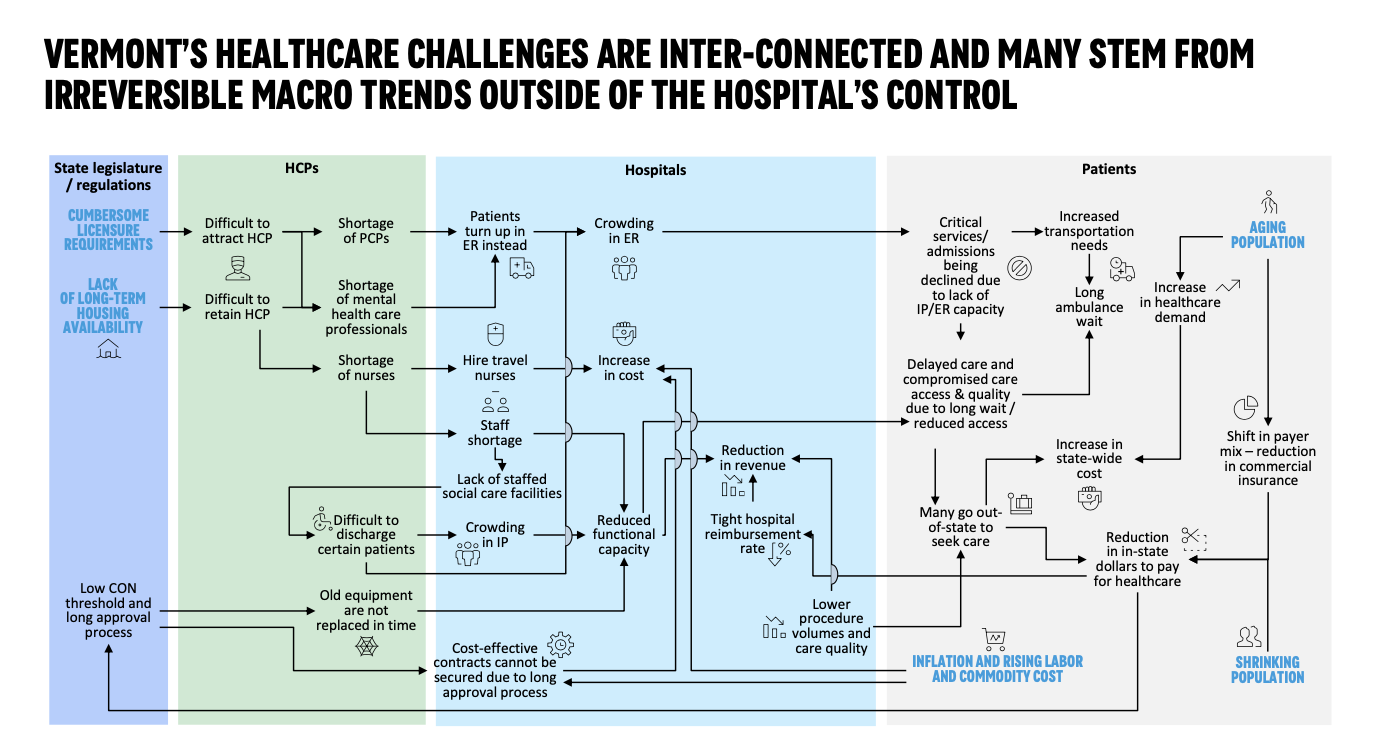
Rural health care is a mess nationally, Hamory said. But a couple of factors make Vermont’s situation especially dire: (1) Our aging population, which means fewer people on commercial health insurance (with its relatively healthy reimbursement rates) and more people on Medicare (with its unhealthy reimbursement rates), and (2) our shortage of housing in all economic sectors.
That’s right, our housing crisis turns a cameo into a star turn in this movie. Hamory spoke of health care workers taking jobs in Vermont, moving into motel rooms initially, failing to find any sort of suitable, affordable housing, and leaving their job — and the state — because they couldn’t find a place to live.
And when the entire nation has a shortage of health care workers, especially in primary care practices, Vermont can’t afford to be turning away good people who want to be here.
The result is hospitals spending big money on traveling nurses and patients dealing with long wait times to even be seen in primary care. And the result of that is more Vermonters getting health care services out of state. And the result of that is lost revenue for Vermont providers who are already dealing with populations too small to support their operations.
That’s just a sample of the bad news. The bottom line is that Hamory says we have to put our health care reform efforts into overdrive. “Time is not your friend,” he told the GMCB. “Many hospitals are already on the edge of financial unsustainability.” That, in spite of the fact that as he has traveled around the state, Hamory has been mightily impressed with the quality of Vermont’s hospital leadership, “an experienced and knowledgeable group… doing their best under trying circumstances.”
Now, let’s say we rise to the occasion and quickly enact the right kinds of changes — and engage in a rapid housing buildout. The result will be a landscape that will be uncomfortably unfamiliar in many ways.
For instance, major change will be coming for Vermont’s smaller hospitals. Our population, Hamory said, “may not support having every hospital able to provide full time, broad spectrum of specialties.” Also, our cutesy, Brave Little State-y volunteer EMS system is “outdated,” and needs to be replaced with “a full-time professional workforce,” consistently funded and paid a living wage. With what money, see second paragraph below.
And to address the housing shortage, Hamory touted the wonders of “modular homes.” Yeah, that’ll be a tough pill to swallow for those obsessed with preserving their community’s “character.” But if we’re going to seriously address the housing shortage, Hamory says, some of the construction will need to be done as quickly as possible.
“The easy solution, the one most often cited,” Hamory says, in his information-gathering, is “We need more money. But nobody has a printing press. This will require higher taxation or higher insurance rates or higher co-pays and deductibles.” Any of that, he concluded, is “very unlikely to happen.” Insurance costs, co-pays and deductibles are already making health care unaffordable for too many Vermonters.
Now, let’s put all of this together and hope for solutions from a government in the midst of a relationship crisis between the executive and legislative branches. Good luck with that.
The next step in Hamory’s process is a series of public meetings in July and early August, with one meeting in each hospital’s service area. First meeting July 9 in Newport; full schedule available here. If you care about your community and your local hospital, this will be your chance to have a say in what is certain to be a long and difficult process.
 The Vermont Political Observer.
Ironically, one factor in the housing crisis is the offering of short-term rentals to traveling nurses. If only we had a way to break that cruel cycle. I don’t *think* I need to draw the lines here, but as long as travelers are paid more than full-time nurses, and as long as their housing accommodation pays better than other short- or long-term renters, we will continue to tread just below the surface of the water.
Single-payer is the only way and we cannot stop fooling ourselves about it any longer.
So as it turns out Gov Scott was correct. Housing and demographics are Vermont’s biggest obstacles. What this site never understands is that an aging population with higher costs and less able bodied people in the private sector equals a disaster for the state. It all comes down to lack of labor, business, and housing.
“This site” understands the challenges of aging demographics and insufficient housing. We just differ on the solutions.