
Earlier this week I gave Gov. Phil Scott’s plan to address the housing crisis a failing grade. Today, two of his top officials briefed the House Appropriations Committee on a report (downloadable here) prepared by the administration’s Council on Housing & Homelessness.
It was useful and informative. A lot of good work has been done, and a lot of good ideas are included in the report. Which is not to say I was wrong in my earlier assessment; the report is lacking in two crucial ways.
First, it does little to address our current explosion of homelessness. Its focus is on “prevention,” which seems to mean preventing future unhousings while doing not much for those already without a dependable roof over their heads.
Second, virtually none of it is in Scott’s FY2025 budget, which means that all its recommendations are just that. Recommendations. There’s been no commitment to implementation, not even an actual proposal. That doesn’t mean the report will be memory-holed, but there’s no proof that it won’t be.
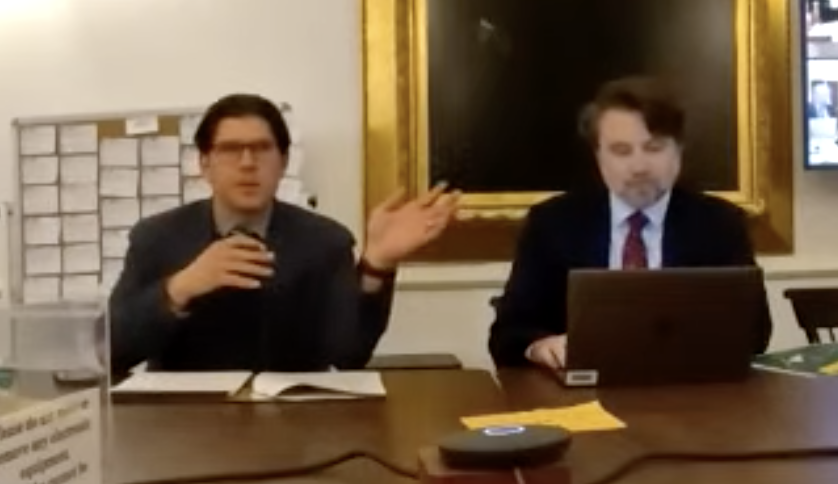
The report was delivered by the administration’s housing policy Glimmer Twins, Commissioner Alex Farrell of the Department of Housing and Community Development and Commissioner Chris Winters of the Department of Children and Families, pictured above in the best quality image I can screengrab off the Legislature’s YouTube archive.
Farrell took the lead for most of the presentation, which focused more on fixing our statewide housing shortage (his brief) than on addressing our epidemic of homelessness (Winters’). He described a “breakneck pace that you wouldn’t usually see with a council like this,” including monthly meetings of the full assembly, weekly meetings of subcommittees, and lots of work in between.
The result was a 19-page report delivered to the governor in December. It wasn’t given to the Legislature immediately because it was purely an executive branch thing. Farrell said that Scott “waived executive privilege so you’re seeing it now.”
Mighty white of him.
The December completion meant that the report came too late to be included in the FY2025 budget which, Farrell explained, was almost finished when the report landed on Scott’s desk. That’s understandable, but truly unfortunate. We’ll have to wait until the next fiscal year, which begins in July of 2025, before we see any broad effort to commit state funds on implementation.
The report does recommend zoning and permitting reforms that are already before the Legislature. As usual, Scott is quick to act when it doesn’t involve spending, and slow to respond when he might have to make a significant outlay of public funds.
Speaking of which, a chill went up my spine when Winters said there were “a lot of things in here that are ‘wish list’ without funding.” Farrell added, “Not to signal a lack of support, it’s where priorities fall.” You can almost hear Phil Scott’s shoulders shrugging.
The report comes across as an earnest effort to address all aspects of the housing crisis. It deserves your attention. But already there are worrying signs that it is fated to consignment in the Dustbin of Well-Intentioned Studies.
 The Vermont Political Observer.