There’s a great deal of desperate history-rewriting going on after the disheartening political debate over emergency housing. Everybody is shifting blame. No wonder; the outcome was not a solution to the crisis, but a patchwork of compromises intended to carefully balance the suffering of the unhoused against the comfort level of Our Political Betters. It’s nothing that anybody can take pride in.
The Scott administration is blaming the Legislature for, I don’t know, failing to defy the governor’s insistence on ending the program as scheduled. Legislative leaders who were happy to kill the program until it got too embarrassing are now blaming the administration for failing to plan a transition, which is true enough but doesn’t absolve Statehouse leadership from their failure to heed the warnings coming from housing advocates and, well, people like me.
There’s one thing both sides can agree on: The real villain is Brenda Siegel.
Just ask Rep. Caleb Elder, one of the good guys — the lawmakers who held out for an extension of the voucher program. He credited Siegel with forcing the Legislature to pay attention — while also blaming Siegel for forcing the Legislature to pay attention:
“There were certain people that didn’t want to do this because they were pissed off people like Brenda were calling them all sorts of things they didn’t think they earned,” he said.
Well, boo fuckin’ hoo.
Elder went on to say that Siegel didn’t act like traditional lobbyists, who are far more “polite” in their approach to the Legislature.
I’m sure Elder is right. Some lawmakers made no secret of their disdain for Siegel, and their feelings were doubtless magnified because of the singular effectiveness of her advocacy. But here’s the problem.
Housing advocates tried the polite approach.
It didn’t work.
Housing advocates dutifully lined up to testify. They brought professional presentations describing the disaster that would unfurl if the voucher program ended as planned. They brought affordable, manageable solutions.
And they were ignored.
Siegel, meanwhile, was nowhere near the Statehouse. Ask anyone who’s mounted a statewide campaign and lost. It’s a tough, grueling experience that leaves you exhausted and depleted of self-esteem. The last thing Siegel needed was to return to the scene of the crime. She did so after it became clear that the customary “polite” strategy was going nowhere. But while traditional advocates on other issues could afford to do the requisite bowing and scraping in defeat, those lobbying for the unhoused didn’t have that luxury. They were trying to prevent a looming humanitarian crisis, whether or not Our Betters wanted to realize it.
So, out of sheer necessity, Siegel acted. At first, she acted politely, signing up for committee hearings and bringing written testimony. She also got the brush-off. Then she turned to more direct means and made everyone realize that bad things were about to happen to a lot of living, breathing people. And that’s when the tide started to turn. The final outcome was far from satisfactory, but it was a hell of a lot better than it would have been if Siegel hadn’t entered the fray.
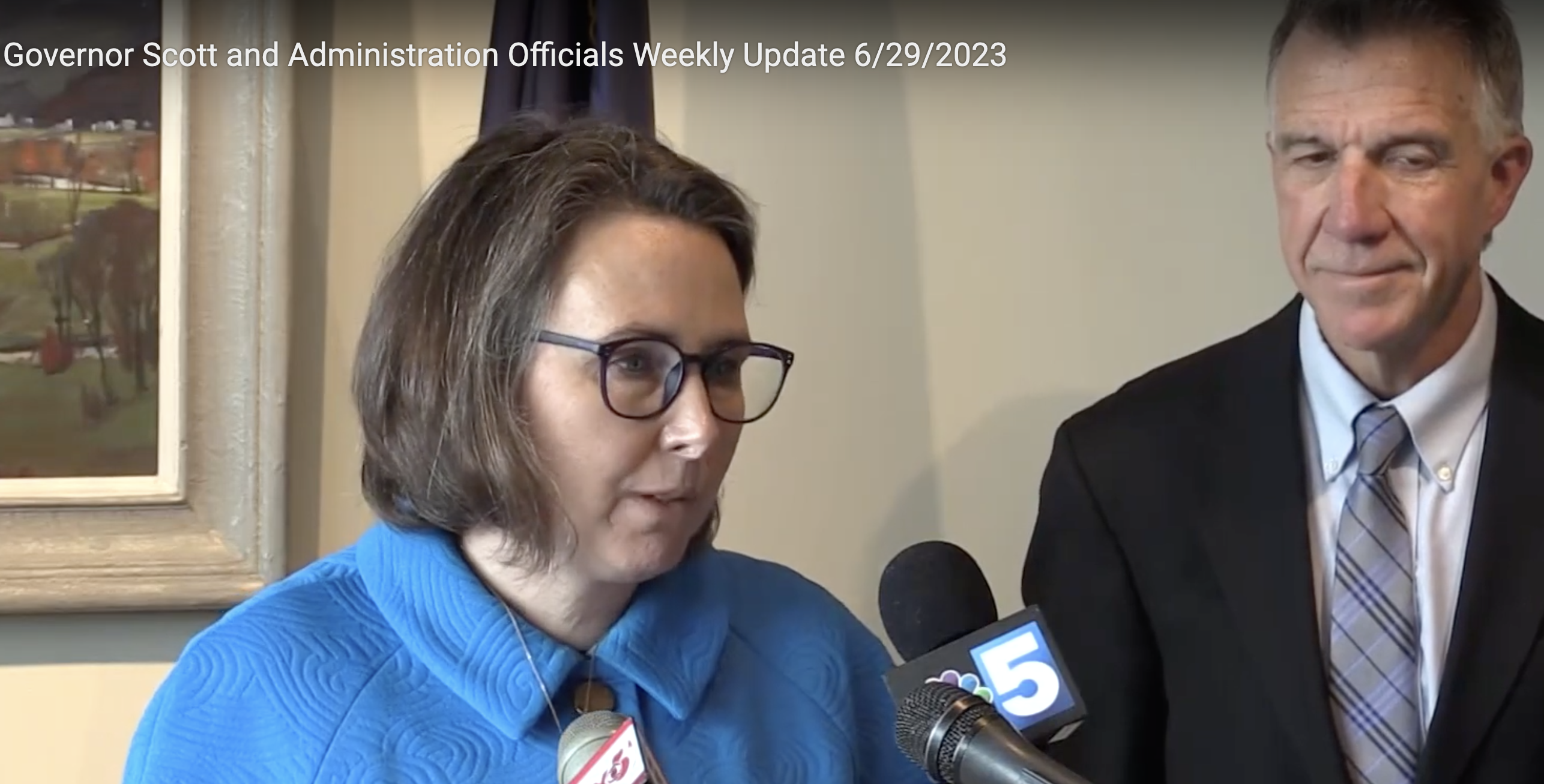
Now let’s turn to the scene pictured above, from Scott’s press conference last Thursday. Human Services Secretary Jenney Samuelson gave an overview of the situation — which was incomplete because the administration was still writing the emergency rules governing the program extension.
A mere two days before the extension would go live.
Which, in and of itself, is a product of managerial malpractice by the Scott administration exacerbated by the Legislature’s failure to act until the veto override session. Scott added to it by taking his customary time with the extension bill, which was, lest we forget, the product of negotiations between his officials and the Legislature. He knew what was in the bill. He must have agreed to the deal.
And yet, with the program’s expiry looming, he waited nine full days from passage to signature.
It was almost as if he didn’t want to sign the thing at all. Which might explain the face he pulled when the first question from the press was about the voucher program.

Happy place, Phil. Think of your happy place.
Anyway, Samuelson proceeded to dump all over Siegel without naming the object of her ire. “There’s a lot of information out there, and not all the information is true or accurate,” she said, and warned people to “rely on the written materials provided by the Agency of Human Services and DCF with the DCF logo on it” and to only contact appropriate officials from AHS and the Department for Children and Families (DCF). Information from anyone else, she said, “may not be correct or accurate.”
While polite advocates have returned to their offices for the offseason, Siegel has been pounding the pavement trying to contact as many voucher recipients as possible — especially those ejected from the program during June. She’s been informing them of their rights and guiding them through the process of applying for benefits or appealing denials.
She’s had to do this unpaid labor because of administration failures to (a) keep clients informed of changes in the program and (b) properly assess their eligibility to continue receiving vouchers. And also because the paperwork is so convoluted that one might reasonably conclude it was designed as a roadblock to potential recipients. Just ask Susan Ladmer, a voucher client profiled in a piece by VTDigger’s Lola Duffort. Ladmer used to work as a museum administrator and has plenty of experience with bureaucracy.
“God. You know, I used to write grant applications for the museum. And I swear they weren’t as involved as these applications are,” she said.
Given the administration’s track record throughout this process, it’s no wonder that Siegel feels obliged to reach out to people with information and guidance that might not precisely fit with Samuelson’s narrative. Or her desire to have a monopoly on interacting with voucher clients.
(By the way, Duffort’s story about Ladmer is highly recommended. It blows up all the stereotypes about shiftless, no-good voucher recipients who just need to clean up and find a damn job already. Ladmer’s long and successful career was cut short by health problems and her retirement security was undone by one of those damn reverse mortgage deals. It’s the way we blindly stomp our elders into the dirt that gave “Soylent Green” the ring of plausibility necessary to make its ending a real shock.)
Really, it’s understandable that people who might be feeling twinges of conscience about their role in the voucher debacle are looking for a scapegoat. And there’s Siegel, who remains an outsider despite being the Vermont Democratic Party’s standard bearer less than a year ago. She’s a safe target for people unaccustomed to having their performance or integrity called into question.
 The Vermont Political Observer.
The only time i am going to quote a republican and this goes out to the important assholes of both parties–
Fuck your feelings.
Actions/ inactions have consequences. You can retire at any time.
I won’t ever vote for a single politician that allowed this to happen and I am going to say it again.
Fuck your feelings.
Right on.
You said it all better than I could. Spot on!
More power to Siegel.
Meanwhile in in Morrisville https://vtdigger.org/2023/07/03/new-morrisville-apartments-defy-affordable-stigma/ !
$330,000 per rental unit build cost- assuming units average 500sqft that works out to over $600/sqft for typical shit box construction – but oh wait – its got a ‘hi-tech’ basement – oooooh wow man. The glowing review of bad architecture puts the icing on the whole vtdigger corporate ass kiss.
This is pure theft of public monies – the developer and contractors ripped off the public purse but Vermonters are just tooo mind-numbing f-ing dumb to understand the state is a racket – thinking some rich ass is doing them a favor.
Highly subsidized housing is not affordable housing – its another gambit in which Vermont’s ruling clique puts lipstick on the pig and makes a boat load of money for itself.
Someday, I hope we can kick all of these “political betters” out of our house and onto the streets like they did to us. It’s coming… someday soon.
Zim,
You forgot to mention the VTDigger political ass-kiss — such as editor Sarah Mearhoff’s review of the state house carpet patterns and statehouse staff comfort animals.
Disturbing – the personal and superficial familiarty that a so-called investigative reporter and editor has with the individual in control of power in Vermont the she herself purports to hold accountable and responsible.
Only in Vermont’s cultural sociopathy can such a pathocracy and self-serving agenda and conflicts of the greater community’s interest, exist.
“The glowing review of bad architecture puts the icing on the whole vtdigger corporate ass kiss.”