Monthly Archives: August 2021

The Best Indictment of the PSD/PUC Renewable Process Is Its Own Documentation

From the PSD Hearing Officer’s report on the Richville Road project

I’ve heard from several enewable energy developers that the Public Service Department and Public Utility Commission make it extremely difficult to site new energy projects in Vermont. The best evidence for this is a document from within the PSD itself. It shows a process that seems designed to stymie renewable energy development. Since climate change is no longer deniable, this is entirely backward and counterproductive.

The document is a Hearing Officer’s recommendation regarding a proposed 500 kW solar array that would be built by MHG Solar on Richville Road in Manchester Town. (There’s a good story about it in the Bennington Banner.) The Officer goes through page after page of project compliance with PUC standards… and then decides it shouldn’t be built, based solely on some remarkably flimsy esthetic considerations. This, despite the fact that an independent aesthetics consultant hired by the PSD found that the project would not have an undue adverse effect on aesthetics.

The MHG proposal is a textbook example of how to site and design a solar installation. The plan is well thought-out and takes into account every possible objection, and yet the Officer is recommending denial.

The PUC has yet to make its decision. In fact, the commission has scheduled a site visit for this Friday. It may be the developer’s last opportunity to overcome the Hearing Officer’s report.

The Officer’s entire 40-page report (downloadable from the PSD’s website) reveals an apparent bias against renewable energy. If this is typical of the PSD/PUC work product, it’s clear that a thorough reform needs to take place.

Continue reading

Hello Stupid, My Old Friend

Now that the Olympics are over, let us return to our regularly scheduled awards for stupidity and/or obtuseness in the public sphere. Unlike Olympic champions, you won’t see these honorees standing tall and proud while their national anthem is played.

In the leadoff spot we have the Remind Me, Whose House Is This Again? Award, which goes to State Rep. Alice Emmons, for publicly pondering whether reporters should be barred from the Statehouse.

Emmons, chair of the House Corrections & Institutions Committee, is the longest-serving state lawmaker, and has a prickly attitude toward the media. I once saw her berate a reporter in front of a couple dozen people, because the reporter dared to record a committee hearing on his phone. Technically, people are supposed to check with the chair before recording, but that rule is never, ever enforced. Except when Emmons gets a bee in her bonnet. So reading this passage in VTDigger wasn’t much of a surprise:

Rep. Alice Emmons, D-Springfield, told the Joint Legislative Management Committee that while “we want to make sure the press is available to our work,” she is unsure “how that happens on their end.” She said that while it’s possible the press will be allowed to cover the Legislature in person in 2022, “they could also do it by Zoom.”

Yes, they could. But c’mon, if you’re reopening the Statehouse, you’ve got to let the reporters in. It’s a little thing called “freedom of the press.”

After the jump: A doomed attack line, a twisting of history, and the flimsiest felony,

Continue reading

So, Why Doesn’t Climate Change Get Top Priority in Permitting New Energy Projects?

A lot of you probably know this already, but I just found out and frankly, I’m stupefied.

In the criteria for approving new energy projects, climate change is practically reduced to a footnote.

For those just joining us, here’s the process as I understand it. Let’s say a developer wants to build a ground-based solar array to produce clean energy. It applies to the Public Service Department for a “certificate of public good.” The PSD goes through a very complicated process to determine whether a CPG is in order. It reports to the Public Utility Commission, a three-member “quasi-judicial body” that decides to issue or deny the CPG.

In the process, the PSD and PUC consider numerous factors. And climate change merits nothing more than a kinda-sorta passing mention.

Can somebody explain that to me?

Because to my mind, there is no greater public good than mitigating climate change. Is that not patently obvious?

Continue reading

Vermont’s National Reputation Gets a Well-Earned Bruising

Might be time for Vermont Tourism & Marketing to hire a crisis communications specialist. Because two times in recent days, stories have appeared in national media outlets putting Vermont in a very bad light. Both times, the subject was Vermont officialdom’s passive response to white extremism.

First, a pair of pieces on public radio’s “This American Life” about the Slate Ridge militia “training center” in West Pawlet; second, an essay in USA TODAY by Michael Shank of Brandon, who says he is moving out because of white supremacist activity near his home. (And let’s not forget that earlier this year, the New York Times ran a long piece about the residents of West Pawlet “living in fear” because of Slate Ridge.)

The Slate Ridge saga is familiar ground for those who follow the news. Various legal actions are wending their way through the court system, while Slate Ridge continues to be a disruptive presence. Its owner Daniel Banyai is defiant toward local and state officials, and their response seems oddly muted. Meanwhile, the people of West Pawlet are just trying to get by.

For me, Shank’s essay really hit home. For starters, I’d never heard that white extremists were a problem in Brandon. That made me wonder how many other pockets of extremism are present in Vermont, particularly in rural Vermont where local regulations are lax and local officials lack the heft and/or willingness to tackle these situations.

But the heart of Shank’s message is that white extremism is on the rise, and official Vermont has failed to respond. I think he’s dead on.

Continue reading

The Soft Abuse of Redistricting Power

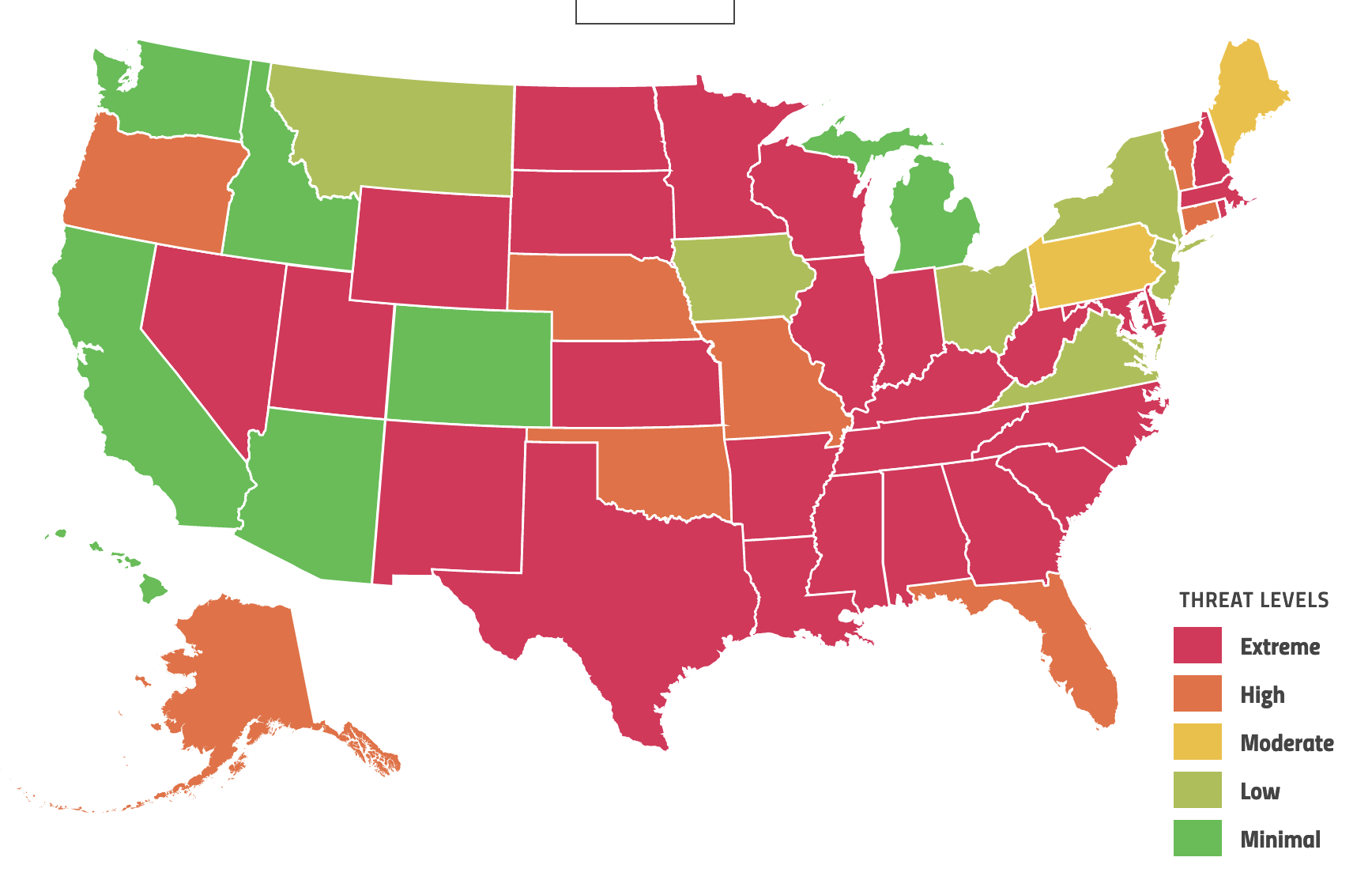
Here’s a little bad news for those who think Vermont’s political processes are above reproach. The nonpartisan group RepresentUs, which opposes political abuses of the redistricting process, has rated Vermont as at “high risk” for such abuse. Along with such bulwarks of clean politics as Missouri, Nebraska, Oklahoma and Florida. Not exactly stellar company.

To be clear, RepresentUs isn’t ranking states by the likelihood of gerrymandering or the historical record or the mendacity of a state’s politicians. It simply considers the legal framework of the process. In practice, Vermont’s redistricting process has been fairly clean. But state law leaves the door open to partisan abuse.

Vermont gets low grades on two points: Political officeholders have the final say on redistricting, and the law doesn’t require transparency. You can see how those points could allow politicians to game the system.

By and large, they don’t. Well, they don’t do outrageous things; they don’t create districts that look like abstract art or imaginary amphibians. But partisanship can, and sometimes does, affect the process.

In fact, we might see a more partisan flavor in Vermont’s 2022 redraw, especially in the Senate.

Continue reading