Monthly Archives: August 2016

Sausage Party II: I think We’re All Dicks on This Bus

Aw, fer the love of Mike. There goes the eyelid again.

The Vermont media corps followed up their reliance on a teeny-tiny (and entirely male) pool of pundits with a rousing encore this morning.

First, I come across an article by VTDigger’s Mike Polhamus* about the wind energy issue in the gubernatorial race. And there’s our man in Middlebury:

Eric Davis, a retired Middlebury College political science professor, said the voters most fired up on the wind turbine issue are people in rural areas who live near existing wind projects.

Now, that’s the kind of unfiltered conventional wisdom that money just can’t buy.

And then, just when my eyelid was settling down, I open up VPR’s webpage and find a piece by Bob Kinzel that not only quotes Davis at length, but throws in a healthy dose of Garrison Nelson for good measure.

Continue reading

The Punditry Sausage Party

Friday afternoon I was reading a report on vpr.net about young people entering politics after being inspired by Bernie Sanders. It was a perfectly cromulent time-filler, not particularly long on insight or depth  (quotes from only two candidates, no attempt to identify a larger trend).

Near the end came this passage:

Eric Davis, a professor emeritus of political science at Middlebury College, says it’s too soon to tell:

“In this year’s presidential cycle, Bernie Sanders’ presidential campaign has certainly inspired many young people to get involved in politics,” Davis said. “The question I have, and I believe it’s too early to provide an answer to this question, is whether these impacts of the Sanders’ campaign are going to continue beyond the end of 2016.”

… and my left eyelid started twitching.

I’ve got no beef with Davis, a reliable source for a useful bit of conventional wisdom. But what suddenly struck me and my eyelid is the absolute ubiquity of the same handful of pundits quoted endlessly by Vermont media.

Davis is far and away number one. If someone decides there’s been a little too much Davis, they might make a call to Garrison Nelson. Or Chris “Undiscolsed Conflict” Graff. Or, in the case of Channel 3, Mike Smith and Steve Terry.

(Not to mention VTDigger’s political columnist, Jon Margolis.)

It’s a small punditical pool. And there’s a distinct ball smell about it.

Continue reading

Oh, and about that other ubiquitous crime wave…

One of the most eye-opening resuls from last month’s VPR Poll concerned substance abuse. When respondents were asked to name “the most important problem facing Vermont,” 17 percent named “drugs.” The only other issue scoring higher than six percent was “economy/jobs/cost of living” at 28 percent. And when asked specifically if opiate addiction is a major problem, a massive 89 percent agreed.

Even more striking were the figures for personal connections to opioid abuse. 53 percent have been affected by opiate addiction or know someone who has. And 94 percent “personally know” someone who has struggled with addiction.

Practically the entire state.

If we needed convincing that opiate addiction is a serious problem, we shouldn’t anymore.

But let’s take another pervasive issue of a similar scope. An issue that’s usually lost in the white noise, that’s never been the subject of a State of the State address.

Continue reading

The Energy Rebellion is a fizzle

In the runup to Tuesday’s primary, I suggested that Peter Galbraith’s candidacy could backfire on his allies in the anti-renewable camp. I thought he was likely to finish a poor third, and that could damage the antis’ claim to represent a sizable and growing force in Vermont politics.

Turns out, they may be loud but they’re not terribly numerous. Galbraith did worse than I thought, finishing with a mere nine percent of the Democratic primary vote.

It remains to be seen if Galbraith’s poor showing diminishes the pull of groups like Vermonters for a Clean Environment and Energize Vermont; but it sure can’t help them.

I can almost hear them arguing that their numbers were split among Galbraith and Republicans Phil Scott and Bruce Lisman. But even if Scott wins the governorship, Democrats will hold the legislative power, and they should be unimpressed by the small number of anti-wind voters in Democratic ranks.

Continue reading

Arrivederci, Mitchells

Big splashy headline in my morning paper: “Mitchells Agree to Sell Times Argus.” Actually, they’re selling the whole megillah: the Times Argus, Rutland Herald and associated print and online media entities.

You see that headline and you fear the worst: a big national chain like Gannett that’d commodify and multiplatform the papers into mush, or a low-budget media outfit that would strip-mine the papers into irrelevance.

But no, the Mitchell Empire is being sold to a guy. One guy, not some faraway corporation. The guy is Reade Brower, who seemingly owns just about every newspaper in the state of Maine. From a 2015 account of his purchase of MaineToday Media, which cemented his dominant position in Maine journalism:

MaineToday Media publishes the print editions of the Maine Sunday Telegram, the Portland Press Herald, the Morning Sentinel in Waterville, the Kennebec Journal in Augusta, and The Coastal Journal in Bath. MaineToday Media also operates the news websites MaineToday.com, PressHerald.com, and CentralMaine.com.

Brower, a longtime resident of Camden, currently owns The Free Press and Courier Publications – which publishes the Courier-Gazette in Rockland, The Camden Herald, and The Republican Journal in Belfast.

That passage, you should know, appeared in The Free Press — owned by Reade Brower. And there’s the rub: when you do a Google search for “Reade Brower,” you get a whole lot of links to articles from Brower-owned media operations.

As far as I can tell, which isn’t far, Brower is no Sheldon Adelson. He didn’t wade into the newa business to further his own interests. He built his empire bit by bit, and his origins are in printing and marketing, not casinos or fossil fuels. He seems to have a legitimate desire to preserve print journalism and find ways for it to survive the modern era.

Continue reading

Geoffrey Norman is a bitter, fact-challenged man

See if you recognize this place.


It’s drug-infested and scandal-plagued; its only growth sector is “methadone clinics.” Government is bloated and ineffective; politicians offer tired bromides or worse. Its politics march to an “angry populist beat” but the electorate is “too old, too tired, and too disillusioned” to turn their anger into action. “Soaring” taxes bludgeon inhabitants into sullen beggary, stripped of the will to resist. Many believe that the place’s “moment has passed.” For-sale signs litter the neighborhoods, as multitudes seek desperately to escape.

In case you don’t recognize this hopeless wasteland or the aimlessly trudging zombie-eyed inhabitants wandering the land, yes, it’s Vermont, and those zombies are you and me.

At least it’s the Vermont that haunts the fever dreams of Geoffrey Norman, best known in Internet circles as the former operator of the late, great free-market blog, Vermont Tiger.

Well, Norman is still around, and is respected enough in conservative circles that he managed to sell an essay to the Wall Street Journal. It’s gloriously entitled “In Declining Vermont, the Mood Is More Resigned Than Angry.”

And if you want to know why some see Vermont as a bad place to relocate or do business, maybe it’s because the readers of the Wall Street Journal are being fed this kind of crapola.

I mean, thanks, Geoffrey, for doing your utmost to defame your home state.

Continue reading

Here comes the money

This one’s for Nick.

Yeah, the Vermont primary campaign blasted through all the old records for money spent. And now the real battle begins.

On the morning after the vote, the Republican Governors Association launched the first TV ad of the general election campaign. Shockingly, it’s pro-Phil Scott.

It may make his railings against outside money look a bit like the protestations of the painted lady under the lamppost, but at least it’s a positive ad. In fact, it’s so sticky-sweet, it ought to come with a warning: “You May Contract Diabetes While Watching This Advertisement.” Scenes of Phil’s appealingly craggy face on a summer day as he greets Real Vermonters, while a piano arpeggiates and an inviting, slightly MILFy voice extols his virtues. He will, Carol Brady assures us, “restore trust in state government, bring new jobs to Vermont, and focus on solving problems, not playing politics.”

I’m sure the next ad will include “heal the sick, raise the dead, cure those with leprosy, and cast out demons.” (Hey, I went to Sunday School*.)

Continue reading

@VTGOP: The King and no court

So the inevitable happened in the Republican gubernatorial primary. Phil Scott won.

The sad thing is, Bruce Lisman actually did pretty darn good. He got all the way from four percent in a February poll to 39 percent in the primary. That’s respectable, really.

But it leaves you wondering, again, what the hell? Why did Lisman challenge the widely-beloved Republican Great White Hope? Why did he pump two million Bruce Bucks into a doomed effort?

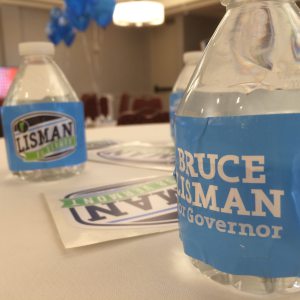
Mmm, smooth. (Photo by Mike Polhamus of VTDigger.)

Mmm, smooth. (Photo by Mike Polhamus of VTDigger.)

He does have some lovely bottled water to show for it. That’ll taste nice, as a visual reminder of the second-worst day of his life. (And a metaphorical reminder of how he flushed a fortune down the drain on a wasteful, futile candidacy.)

I’m assuming his worst day was when Bear Stearns collapsed, although this is a more directly personal ignominy. The Wall Street meltdown was merely a global calamity; this is the people of Vermont telling you to your face, “We don’t want you, now please go away.”

Continue reading

@VTDems: The Odd Couple, and other observations

Mixed bag on the Democratic ticket: Sue Minter for governor, David Zuckerman for Lite-Guv. Not that there’s usually much coordination between the #1 and #2 candidates, but I expect little to none from this pairing.

Indeed, one question worth asking: Now that Zuckerman is the Democratic nominee, will the party share its voter database with him?

But let’s take a step back and ponder tonight’s results and what they mean for Democratic politics. In no particular order:

A good night for the mainstream Democratic Party. I say so despite Zuckerman’s win; he took a plurality of the vote, nowhere near a majority. If he’d been matched up with Shap Smith alone, he would have lost badly. (Yes, I’m assuming that the bulk of Kesha Ram’s votes would have gone to Shap.)

And, of course, Minter had little trouble outpacing Matt Dunne. Some of this was due to Dunne’s Six Days of Hell, but it’s impossible to know how much.

Bernie’s coattails proved surprisingly short. Dunne believed that turning himself into Bernie Lite was the key to victory. We know how that turned out, don’t we?

Truth is, as we can see from the Lite-Guv totals, much of the Democratic electorate is moderate to liberal, not progressive. Bernie’s popularity is partly a matter of policy, but more a matter of persona. Bernie is extremely popular. It’s yet to be proven that his policies alone are a winning formula in Vermont.

Matt Dunne blew it. Last fall, he seemed the clear favorite. Minter was untested and tied directly to the Shumlin administration. Dunne was the more experienced candidate. He raced out to an early fundraising advantage.

He should have won the primary.

Why didn’t he?

Well, part of it was the Six Days of Hell — his position shift on renewable energy siting, his restatement/retraction of said shift, the blatant hypocrisy of his stand against self-funded campaigns even after he self-funded his own, the scorched-earth tactics of blaming the media and “the establishment” for problems of his own making.

But even before that, I’d argue he blew the primary by deciding not to be himself. There’s a Matt Dunne who could have won this race. It’s the plausibly liberal technocrat with high-tech chops who would have brought managerial know-how and broad experience in government and the private sector. That’s a pretty appealing candidate, especially after the administrative misfires of the Shumlin years.

But he simply wasn’t plausible as Bernie II. He had too much of a track record. His policies were part Bernie, part moderate Dem. His personality was a poor fit. And, to the extent that Bernie and the Vermont Democratic Party have a touchy relationship, his embrace of Berniedom did nothing for his own standing with party regulars.

His late-days mistakes only reinforced his reputation in many minds as an overly ambitious pol willing to say anything to become governor. He is now a three-time loser who burned quite a few bridges; a political comeback is possible but seems unlikely. He might have to be satisfied with being a well-paid Google executive. Such a burden.

Sue Minter has a lot of work to do. She’ll have to unify the party, which should be easier since Matt Dunne prioritized party unity in his concession speech. But she will be the underdog against Phil Scott. She spent heavily to fend off Dunne. She’s got some political seasoning in the primary, but now she’s in the spotlight. It’s a big step up for someone who hasn’t run a general election campaign outside of Waterbury.

I’m sure I will have some thoughts on possible strategy for Minter and the Democrats, but all in due time.

The VTGOP will use Zuckerman to attack Democrats. Actually, that’s not a prediction; it’s already begun.

//platform.twitter.com/widgets.js

Zuckerman’s nomination increases the chances that Randy Brock will be our next Lieutenant Governor. Zuckerman’s still the favorite, but he’ll be a weaker general-election candidate than Shap Smith would have been.

And the stakes are high in that race. The lieutenant governor presides over the Senate, sits on the influential Committee on Committees, and casts tie-breaking votes. Brock would be a strong conservative presence; On the other hand…

If Zuckerman does win, we could have a very different Senate. Zuckerman as presiding officer, potentially Tim Ashe as President Pro Tem, and Chris Pearson a very capable lawmaker. Although Zuckerman has been in the Senate for a while, I can’t see him supporting the status quo. He’d have very little patience for the niceties and obscure mores of the Senate.

And whither the omnipresent Dick Mazza? The perennial kingmaker will have to adapt to — or try to conquer — a changed landscape. Will he continue to serve on the influential Committee on Committees? How would he get along with Zuckerman and Ashe as the other two members?

I know one thing. I’m voting for Zuckerman, if only for the entertainment value.

No sign of the Energy Rebellion much touted by the likes of Annette Smith and Mark Whitworth. Peter Galbraith is pulling less than 10 percent of the vote. One might presume that some of Matt Dunne’s 37 percent was due to his last-days revision of his renewables siting policy, but that seems a stretch. Smith and Galbraith loudly denounced Dunne after he re-explained his revision. It’s unlikely that their core supporters would have stuck with Dunne.

Whither Shap? I have no idea, but I’d be shocked if this was the end of his political career. He entered the Lite-Guv race very late, and he was hampered by Kesha Ram’s presence in the race. She’d garnered quite a few endorsements from the House Dem caucus, and many of them stuck with her.

Shap’s young enough to regroup and restart. He remains very popular in Democratic circles. He is highly respected for his shepherding of the House caucus. I doubt he’ll be tagged as a loser; he finished a strong second after a late entry, and he’ll get a lot of credit for that.

If Phil Scott wins the governorship, Shap ’s the early favorite for the Democratic nomination in 2018 — or maybe he’d wait until 2020, a presidential year.

The question will be, what role does he play in the near future? I don’t know, and I doubt that he knows right now. If Minter wins, he could probably have his pick of cabinet posts. Otherwise, he could run silent, run deep: continue to build relationships across the state and prepare for his next political venture.

I think that’s about enough for primary night. I’l turn to the Republicans next.
Is this the most useless policy review ever?

Hey, here’s some good news. One of Vermont’s more problematic job-creation programs is getting a policy review.

Unfortunately, that’s where the good news ends.

The program is the Vermont Employment Growth Initiative, or VEGI for short. It provides incentives to employers who grow jobs in Vermont. The most frequent VEGI beneficiary is Keurig Green Mountain, which has raised eyebrows in some quarters, (“Fascinating,” I have found myself saying with left brow cocked, “but highly illogical.”) That’s because KGM’s rapid growth was fueled, not by the state’s generosity, but by its then patent-protected K-Cup brewing system.

Since its patents expired, it has struggled to maintain market share, bungled two key product rollouts, and — VEGI grants or no VEGI grants — laid off hundreds of Vermonters.

So yeah, I’m all for a review of this program. Unfortunately, this is a fox/henhouse situation. The people doing the review are members of the Vermont Economic Progress Council, the panel that awards the VEGI grants in the first place.

Uh-huh, they’re reviewing their own work.

That ought to go well.

But wait, there’s more!

Continue reading