Tag Archives: WDEV

Bill Sorrell willfully distorts the record

h/t to Fiona Apple.

h/t to Fiona Apple.

On Tuesday morning, our beloved Eternal General made an appearance on WDEV’s Mark Johnson Show. Unlike last week’s sad excuse of an interview on VPR, Johnson actually grilled him long and hard on the questions surrounding his campaign finances.

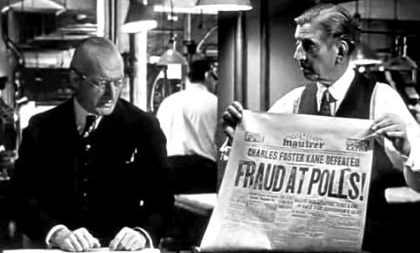
But Johnson missed a big fat whopper that Sorrell told right off the top, and later repeated. I don’t blame Johnson for this; he’d have to have an amazing memory for two-year-old court rulings to have caught Sorrell’s dissembling.

At issue was the 2012 Democratic primary, and whether there was improper collusion between the Sorrell campaign and the Committee for Justice and Fairness, a Washington-based PAC that spent big on Sorrell just before the primary, which he won by a razor-thin margin.

Sorrell’s opponent in the 2012 general election, Republican Jack McMullen, filed a complaint against Sorrell, alleging improper collusion in the primary. Here’s how Sorrell characterized the disposition of that case:

I’m not guilty. The coordination with the Democratic AG’s Association, that was the subject of a lawsuit in Chittenden Superior Court filed against me back in 2012; the judge ruled in my favor.

He later restated his reading of the decision:

There was no violation there, my Republican opponent sued me and had no evidence to support that there was illegal collusion, and the Chittenden Superior Court ruled in my favor. Case over.

Well, actually, case NOT over.

In fact, the case was never investigated. It still hasn’t been investigated.

Continue reading

Let’s go to the 990

Okay, so I spent part of Monday (maybe five, ten minutes all told) in a slow-motion Tweetchat with the fine folks at the Ethan Allen Institute. At one point, whoever Tweets on behalf of EAI accused me of lying about its connection with the Koch empire. And I pointed out that it wasn’t a lie, just a mistake.

Then came the following exchange:

Dunno what they mean by “solution” there, but the whole Tweet is kind of inartful. Anyway, @EAIVT asked if I had consulted its IRS Form 990, the annual filing required of nonprofit organizations.

Well, I hadn’t checked the 990 because I knew it was irrelevant to my assertion. Nonprofits aren’t required to disclose revenue sources, so nothing in EAI’s form would prove or disprove any Koch connection.

But hey, I’m open to suggestion, so I found EAI’s latest 990 — for tax year 2013 — as posted by the journalistic nonprofit ProPublica. (Where you can find the last several years’ worth, in fact.)

And as I thought, there’s no information about where the money comes from. But there are some interesting numbers to be found, and here’s a sampling.

In 2013, EAI took in $140,690 in “contributions, gifts, grants and similar amounts received,” plus another $60,000 in membership dues. Add in a bit here and there, and EAI revenue was $201,018.

Not bad, not bad. There’s no further information about the sources of that $201, 018, nothing to prove or disprove any financial dependence on the Kochs or the State Policy Network or other out-of-state corporate interests.

Unfortunately, EAI was a deficit spender in 2013. It racked up expenses of $224,290. Fortunately, it began the year with a positive balance of $43,021, so it ended the year in the black.

Yay!

On to Part III, “Statement of Program Service Accomplishments,” a.k.a. EAI’s nonprofit fig leaf. The IRS requires a list of the organization’s three primary programs. Here’s the EAI list:

— $72,200 for “Two daily radio programs on WDEV Radio Vermont.” This includes John McClaughry’s Daily Diatribe (I think that’s what they call it); and the hour-long “Common Sense Radio,” which causes massive tuneout at the end of the Mark Johnson Show every weekday at 11.

Well, now we know why the folks at WDEV put up with that drivel. They are well paid to put up with that drivel. And they get a better deal than we do; thanks to EAI’s tax-exempt status, we are all paying, indirectly, for the glories of “Common Sense Radio.”

— $44,205 for something called the Energy Education Project, which “promotes intelligent energy choices in Vermont through a daily blog, a website and educational events.” Gee, I’d never heard of this endeavor before. So I searched for “Energy Education Project Vermont,” and there it was.

However, it hasn’t been updated in a very long time. The top item on its homepage is entitled “Entergy Announces That Vermont Yankee Will Close in October 2014.” Checking the Google, I see that Entergy made that announcement in August of 2013.

Pretty sad, for EAI’s number-two Service Accomplishment.

— $47,000 for a variety of programs, not a single entry. These include the montlhly Ethan Allen Letter; a series of opinion pieces offered gratis to Vermont media outlets; “public meetings and educational seminars”; and a transparency website jointly maintained with the Public Assets Institute. Now there’s an odd couple.

On to Part IV, a list of officers and key employees. Oh boy, salary disclosure!

EAI President Rob Roper pulled down $50,000 last year, slightly under Vermont’s median income. Hey look, he’s middle class!

Vice President John McClaughry made $24,000 and his wife Anne made $18,000 as Secretary/Treasurer, plus another $5500 combined for “Health benefits, contributions to employee benefit plans, and deferred compensation.”

Bill Sayre, member of the Board of Directors, made $9600, presumably for hosting Common Sense Radio. None of the other directors (Wendy Wilton, Jack McMullen, Catherine Clark, John Cueman, Milt Eaton) was paid.

Finally, the caboose on EAI’s very short gravy train is occupied by Shayne Spence, who was paid $6000 to serve as “Outreach Coordinator.” I don’t know whether this includes the compensation he received as a Koch Summer Fellow in 2013, but that’s a thing that exists.

I’ll skip over several boring pages, which brings me to Schedule A, Part III, which lists total “Public Support” for the five preceding years. During that time, EAI took in a total of $784,910. The totals for 2009 through 2013 go:

$151,775; $155,225; $171,565; $105,345; and $201,000.

Don’t know what happened in 2012, but there you are. In addition to the “public support,” EAI has made a few hundred bucks every year from “interest, dividends” and other non-donor sources.

Well, that was fun. It did nothing to illuminate the sources of EAI’s money or to settle the question of whether it has financial ties to the State Policy Network and other Koch- and Koch-like operations, or whether its ties are purely ideological.

Too bad, as I wrote earlier: we really need more transparency in the nonprofit world. If EAI could show that it really is a home-grown organization that gets the bulk of its financing from Vermonters, that would lend it some credibility.

Oh, by the way… the carbon tax? It’s dead.

(Note: I’ve updated this post to include more quotes, because the interview is now available online.)

You may have missed the news amid all the hugger-mugger over the inaugural protest, but the Legislature’s top advocate for a carbon tax has already thrown in the towel.

Rep. Tony Klein (D-East Montpelier), chair of the House Energy and Natural Resources Committee, was one of the headliners at last November’s news conference announcing a broad-based push for a carbon tax. “I’m going to push really hard on this,” he said.

Well, that was then. This is now.

There’s not gonna be [a carbon tax] this year. It’s not gonna be passed out of my committee or any other committee.

Klein said those words on January 8, Inauguration Day, in an interview on WDEV’s Mark Johnson Show. I caught the interview when it aired, but it got lost in the Inaugural Shuffle. Sorry about that.

After Klein’s declaration, Johnson asked him why there would be no vote.

It will not pass because, one, the Speaker told me it won’t pass. [chuckle] And two, the way it came out to the public, with a real lack on our part of preparation, there was a pretty scary reaction to it. I accept that; that was a mistake.

That’s a reference to the immediate reaction to the November presser. I’m not sure how he would change the rollout; my own view is that it seemingly came out of nowhere. There wasn’t any build, just a big announcement. At the same time, I’m not sure if any other strategy would have made a difference; too many top Democrats simply don’t like the carbon tax. Well, put it this way: they don’t want Vermont to go it alone: they want a regional or national approach.

Klein concluded:

I’m certainly not going to ask the members of my committee to vote on something that may cause a lot of discomfort, especially if it’s not going to go anywhere.

Which is wise chairmanship. I can’t argue with it. I can’t even argue all that much with Shap Smith’s reputed diktat, because this is already shaping up to be one hell of a session without considering a tax on fossil fuels during home heating season.

It’s too bad, because with oil prices currently low, it’d be a great time to enact a carbon tax. After all, the price of gas is a buck and a half cheaper than it was nine months ago; as proposed in November, the carbon tax would add 45 cents to the price of a gallon of gas. And, lest we forget, 90% of the revenue would go into broad-based tax cuts and targeted rebates for low-income Vermonters.

Klein said his attention would turn toward “aggressive funding” of weatherization and other efficiency measures. Which would be great, except we’re in a budget situation that would seem to rule out “aggressive funding” of anything. If Klein’s committee passes a significant expansion of efficiency measures, we can expect to see it expire on the surgical table of House Ways and Means.

The carbon tax proposal was a carefully-crafted plan that would have minimized the pain on Vermonters, reflected the true cost of fossil fuels in their price, and made a huge dent in Vermont’s carbon footprint. I’m not surprised to see it fall in the face of unpleasant political realities; I’m just sad to see it happen so quickly. Not with a bang, but a whimper.

A passel o’ peevishness on Inauguration Day (Part One)

Many a knicker was tightly knotted yesterday, judging by some of the statements made and actions taken at the inaugural ceremony.

Most of the collywobbles arose from the protest by advocates of single-payer health care. Many politicians were vocally incensed at such goings-on. And some of the protesters were shocked — shocked — that they might be handled roughly by police.

The rest of the peevishness came from Republicans reacting, even more childishly than usual, to Gov. Shumlin’s inaugural address. I’ll cover that in a separate post.  Back to the demonstration.

The folks from the Vermont Workers Center went a bit too far when they disrupted the closing benediction. Otherwise their protest was peaceful if occasionally intrusive.

The assembled dignitaries, however, just couldn’t stomach this disturbance of their sacred space. Sen Dick McCormack wins the honor for Biggest Overreaction; he called the protest “fascist.” Protip for public figures: never ever ever ever ever use the word “fascist” unless you’re talking about a violent, oppressive, murderous regime.

Sen. Bobby Starr, D-Hicktown, resorted to the “You Kids Get Off My Lawn” meme: “I think they should get a job.” Dirty hippies!

Senate Penitent Pro Tem John Campbell was among several lawmakers who told protesters they were hurting their own cause.

Snort. As if.

Two points. First, single payer is dead for the foreseeable future. Second, any lawmaker who casts a future vote because of yesterday’s demonstration is failing his/her duty.

And the Governor, speaking today on WDEV’s Mark Johnson Show, said the protesters had “hurt the cause” by showing a “lack of respect for the process.”

Awww. Would that be the same process (and the same governor) who built up their hopes and expectations for years, only to dash them all in a single moment? Shumlin reaped the benefits of single-payer advocates’ support through three election cycles, and then abruptly trashed it all.

Advocates are understandably upset about that, and the inauguration of Peter Shumlin was an appropriate time to express their outrage. It was, in fact, the perfect time. The Governor shouldn’t play with people’s beliefs, and expect to be shielded from the consequences by his sense of decorum. As a Mark Johnson Show caller pointed out, disruption is the only way for people who feel disenfranchised to make their voices heard.

So, no sympathy for the hurt fee-fees of our distinguished leaders.

Not that the protesters are without blame. The single moment where things went too far was during the closing prayer. Protesters were outside, singing. One of them, Ki Walker, entered the balcony and continued to sing. A protest organizer later claimed that Walker thought the ceremony was over. But Walker was right there at center stage. He could see that the ceremony was continuing. And he kept on singing.

Afterward, he explained himself to Seven Days’ Paul Heintz:

 “Our tone was, like, nice or whatever,” Walker said.

Duuuuuuude. 

But the Whiniest Protester Award goes to Sheila Linton, who was part of the group occupying the House floor after the ceremony. When police began trying to remove the group, very politely, she refused to move or speak. When they tried to lift her arms, she began screaming as though they were using a chainsaw. (You can see the video on Seven Days’ website.)

Okay, here’s a lesson for Vermont’s Junior Gandhis. Your commitment to passive resistance  includes the possibility of what one trooper called “pain compliance” — the application of discomfort to those who resist police action. And this wasn’t Bull Connor with firehoses and Dobermans; these were state troopers acting with restraint and deliberation. Sorry, Ms. Linton, no sympathy here.

The demonstration itself was relatively mild, Mr. Walker being a notable exception. So was the police response. People on both sides got way more upset than they should have been.

The best reaction came from House Speaker Shap Smith, quoted by the Vermont Press Bureau’s Neal Goswami:

“I think this was an incredible example of the openness of our democracy,” he said. “In the people’s house, people are allowed to petition, and I would expect that over the coming weeks, we’ll talk with people about setting up hearings.”

Measured, reasonable, respectful. Just about perfect.

(Still to come: VTGOPeevishness.)


A slight but perceptible bend in the glass ceiling

The House and Senate Democrats will caucus tomorrow (Saturday) in Montpelier to choose their nominees for leadership positions. It’s been radio silence on the Senate side, which I take as a bad sign, but some news has come out of the House.

And for gender equity fans, the news is good.

As you may recall, Vermont does very well on gender equity in the House, less well in the Senate, and very poorly in statewide elective office and Congressional seats. Like, for instance, we’ve never sent a woman to Congress. Which is, well, shameful.

Back to the House, where Shap Smith will return as Speaker; but the new House Majority Leader, according to Seven Days’ Paul Heintz, will be Sarah Copeland Hanzas of Bradford. What’s even better for equity’s sake is that the other candidate for the post was also female: Kesha Ram of Burlington. Having two women in line for the House’s number-2 slot is a very good sign.

Ram dropped out, per Heintz, citing the need for geographic balance. She will apparently fill a new post, “caucus election chair,” which is being created to sharpen Democratic messaging and lend a hand to House candidates.

Those developments, plus Kate Webb returning as Whip, mean that women will be heavily represented on the House leadership team. And whenever Shap gets tired of herding cats, the next Speaker may well be a woman.

Over in the Old Farts’ Club, er, I mean the Senate, I’m not feeling the gender-equity love. I’d be very happy to be proven wrong, but I’m expecting the leadership in Vermont’s Most Stagnant Deliberative Body to remain pretty much the same.

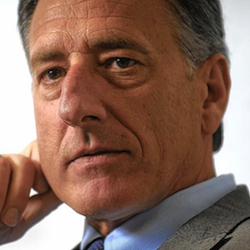
I love my little gavel, but this job is sooooo hard.

I love my little gavel, but this job is sooooo hard.

By all accounts, John Campbell will keep the job as President Pro Tem in spite of the fact that he isn’t very effective unless he has a nanny to keep him in line. After the disastrous 2012 session, he hired Rebecca Ramos as his chief of staff, and things improved. She’s now a lobbyist, and according (again) to Paul Heintz, Erika Wolffing will take the job.

Wolffing was a Shumlin administration fixture who went to the Democratic Governors Association when Shumlin became its chair. Now that Shumlin is out at the DGA, Wolffling will reportedly become the hand that rocks Campbell’s cradle.

Which leaves me wondering why we let him hang around when he (a) apparently can’t handle the job without a lot of help and (b) openly supported Republican Phil Scott and seized every opportunity to shit on Dean Corren. But maybe that’s just me.

I’m sure the status quo will remain in the Phil Scott Fan Club, er, I mean, the Committee on Committees, the body that makes all the committee assignments. Phil Scott himself is a member by law, as is Campbell. The third, elected by the full Senate, is, was, and ever shall be Dick Mazza, a putative Democrat who was extremely vociferous in his support for Phil Scott.

Which leaves me wondering why, when the Dems have a nearly 2-1 majority, we have to settle for nominal Democrats on that very powerful committee.

The Democratic caucus will see some change with the none-too-soon departures of Bob Hartwell and Peter Galbraith, but I’d be surprised to see much happen with the leadership. It’d be nice, but I ain’t holding my breath.

Finally, for those who think I’m too mean to Mr. Campbell, here’s a little tidbit from last March. Campbell had stuck his foot in his mouth by openly doubting the prospects for single payer health care and talking about pursuing some alternative plan. (Bear in mind that Shumlin was still riding high at that point.) This reportedly enraged the governor. And a few days later, Campbell appeared on WDEV”s Mark Johnson Show and tried to walk back his earlier statement.

It was a complete fiasco. At one point Johnson asked him this question: “You dropped something of a bombshell this week that you want to start pursuing an alternative to the Shumlin health care plan. Why?”

And here, really and truly, was his answer in all its obfuscatory glory.

First of all, I guess it’s a question of how you define what my “bombshell” is. I think some people have taken it to mean what they really, what they want to hear from what I said. And basically, my, uh, my position is this, is that we are headed right now as far as the Legislature, we are going to be focusing on making sure that we have a publicly-financed, universal access to health care in this state, and that’s known as Green Mountain Care. As far as I’m concerned, I consider it Green Mountain Care, it’s a universal access program. Um, um, I charged my, in fact we spoke about it here on this program at the beginning, I think at the beginning of the session, how I had asked all of my committees with jurisdiction to start doing their due diligence under Act 48, which was the, back in 2011, which actually started Green Mountain Care or our, ah, our, ah, move to that.  And so what I did was, I asked each one of the committees that would have jurisdiction, which were five of those committees, and they were to um look and see what exactly is in Act 48 and can we actually achieve what our goal is?

And if they found things that um, through their, uh, their research and through taking testimony, that could either change this into a direction and put us in a direction that we were going to uh have this Green Mountain Care would be sustainable, then I wanted to hear about it and I thought that’s really what the Senate is doing now. So uh the fact of the matter, uh, I believe there was a statement was, um, regarding the funding, and whether or not I believed that, I think I said that, uh, the $2.2 billion dollar package that’s been put on there right now, I said I do not think that that was sustainable or viable in this, uh, current legislative — uh, Legislature. And I stand by that.

And what it, what I’m talking about in that, and people always take that $2.2 billion dollar figure, and they believe that that’s all new money. And it’s not new money. What it is is partially savings that would be found, uh, by way of not having the premiums, um, by cost savings, and so I stand by the fact is that once we find out what this financing package is, which would also first identify what the product is gonna be, um, if we do not have sufficient — if that money, um, is new money, then there’s gonna be a problem. But if we show, and we’re able to demonstrate that the money in that $2.2 billion is currently already in the system, and that Vermonters are already paying, uh, and on top of that, that we find those costs for any new money that’s — cost savings for any new money that’s coming in, then we’re, we have, I think, ahh, what we envision, all of us envision, that is to make sure that every Vermonter has full access, or access to. uh, uh, to great health care here in the state.

Good God almighty. What a statesman.

David Mears seems like a nice guy

DEC Commissioner David Mears was on WDEV’s Mark Johnson Show this morning, mostly talking Lake Champlain cleanup. I’ve been, shall we say, somewhat critical of the Shumlin administration’s response to Champlain’s deteriorating water quality (recent post was entitled “At this rate, Lake Champlain will be cleaned up about the time the sun goes nova and the Earth becomes a cold, dead husk,” which I guess could be taken as critical). So I wanted to hear what he had to say.

The face of earnest concern.

The face of earnest concern.

And a lot of it sounded reasonable. He does, however, have a problem: the cynicism of people like me is based on decades of neglect and delay by multiple administrations — and the bare fact that the current Powers That Be are being forced to act by the feds. So pardon us if we don’t accept bland assurances at face value.

First, he made an important correction. Many news outlets reported (and I echoed the reports) that the Shumlin administration had proposed new levies on “impervious development” and agricultural fertilizers that would raise about $1 million per year for Champlain mitigation. Which is a drop in the bucket.

Well, according to Mears, the $1 million figure was a “for example” number, and the administration actually intendes to set the levies at rates that would produce $4 million to $6 million per year. Mears describes this as “seed money.” And while it still seems rather small, it’s a lot bigger than I thought. (See note at end of this post.)

Overall, Mears made a good case for the administration’s dedication to the issue. And at one point he said, “We’re used to fighting on this issue” in a way that seemed to lay the adversarial blame on both sides.

To which I’d point out that the last two administrations, at least, have been dragged kicking and screaming into taking any action whatsoever. The Conservation Law Foundation’s lawsuit against the state, for violating the Clean Water Act regarding Lake Champlain, was first filed in 2008. And that came after years of diligent efforts to convince state government to live up to its responsibilities without an expensive court battle. So if “we’re used to fighting,” it’s not because the environmental community is feeling a bit stroppy — it’s because they’ve been consistently stonewalled by state  government. There’s been little or no cooperation, at least as far as we can tell in public.

When such obstructionism is practiced by a Republican government, we’re disappointed but not terribly surprised. When it’s done by a Democratic administration that professes to hold a strong environmental ethic, it seems like a betrayal of shared ideals. And it’s the plain truth that the current administration has slow-played the issue to a crawl, even as Champlain’s quality continues to degrade.

Mears’ presentation fell short in some key areas. When Johnson (who did an excellent job holding Mears’ feet to the fire, by the way) asked about items like Ag Secretary Chuck Ross’ decision not to mandate “best practices” for farms near Mississquoi Bay and the potential laying of a natural gas pipeline under the lake, Mears ducked the questions, saying it wasn’t his responsibility.

Well, yes. But as Johnson pointed out, Lake Champlain is his responsibility. We should expect him to be fully informed on issues that affect water quality even if they’re not primarily in his bailiwick.

I came away from the interview with a greater appreciation for the nuances of the issue, and for the administration’s interest in addressing it. But there’s a whole lot of history to overcome regarding Lake Champlain — and regarding the administration’s often-slippery relationship with the truth.

In short, telling me about your plans and dedication isn’t enough. You’ve got to show me.


Postscript. In the interview, Mears noted that he’d been in contact with reporters to correct initial reporting that proposed levies on fertilizers and “impervious development” would raise $1 million per year, rather than the administration’s target of $4 million to $6 million per year. 

Well, Mr. Commissioner, nobody ever contacted me. I realize that I don’t know everything about state government, and my ignorance sometimes results in errors. I am always open to correcting any errors in the most transparent way possible. But rarely, if ever, do I get feedback from the administration. (Generally speaking, I get more feedback from Republicans than Democrats.) Now, I’m not as high on the pecking order as your established media, but I would rather be corrected than allow a mistake to remain in place. I may be a partisan blogger, but I do have a sense of responsibility. 

Sue Minter is building herself quite the resumé

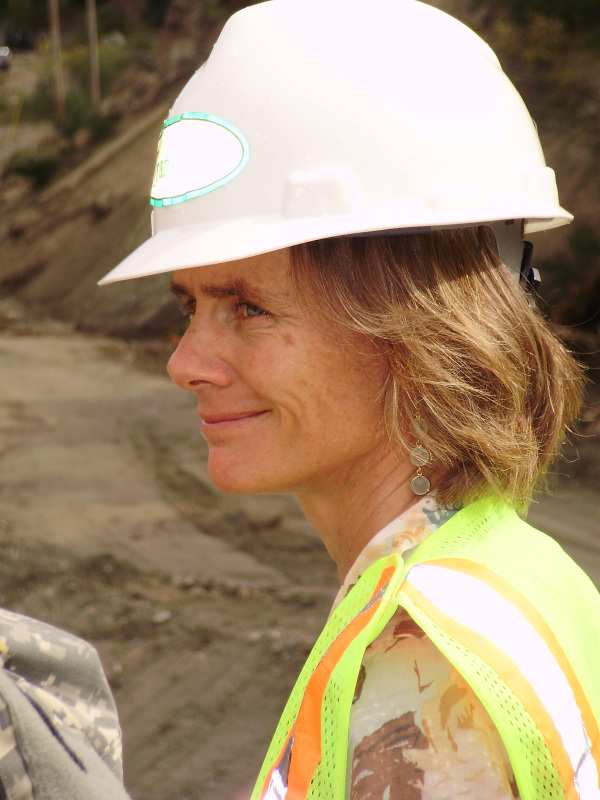
Rockin' the hard hat.

Rockin’ the hard hat.

Deputy Transportation Secretary Sue Minter is usually the first female in otherwise male-dominated lists of Democratic politicos on the rise. (ANR Secretary Deb Markowitz, who finished a strong #3 in the 2010 gubernatorial primary, deserves mention as well; but the grapevine says she’s unlikely to make another run for elective office. That could change, of course.) She briefly broke through the GruberGruberGruber wall of news noise this week, with the announcement that AOT Secretary Brian Searles is retiring and Minter will take his place.

This is notable enough. But what I hadn’t realized until I read media accounts of her promotion is that she is building a very strong political resumé, putting her in a good position for a future run at statewide or Congressional office. Let’s look at some highlights, and my apologies if I missed anything:

— Four-term state representative who served on the Appropriations Committee as well as the Transportation Committee. Generally considered a key member of the Democratic caucus. That’s eight years of legislative experience.

— Named Deputy Transportation Secretary at the onset of the Shumlin Administration, so there’s four years of administrative experience in a big, sprawling, crucial agency. Plus, since a lot of transportation funds come from the feds, four years of experience dealing with our Congressional delegation and the D.C. crowd.

— Named Irene Recovery Officer in December 2011, replacing Neale Lunderville. Had to deal with the tough slog of rebuilding infrastructure — which also involved a lot of work (and facetime) in Washington, D.C.

— Member of the White House Task Force on Climate Preparedness and Resilience. More credibility and connections in Washington.

— Now being elevated to full Cabinet status, and a high-profile Cabinet post at that. Speaking purely politically, lots of opportunities for ribbon-cutting and other feel-good news, making connections with local officeholders, and looking tough and managerial when something bad happens. (AOT is much better for this kind of stuff than, say, Human Services.) Nothing like wearing a hard hat and reflective vest to counteract stereotypes about women in politics.

Transportation’s mission also enjoys broad tripartisan support: nobody’s against roads and bridges.

— Married to David Goodman, writer, broadcaster, and brother of progressive radio icon Amy Goodman. I’m not falling back on the tired trope of defining a powerful woman by her marriage; in this case there’s some relevance.

(Also, her teenage son Jasper is a sportswriter for the Times Argus and sportscaster for WDEV Radio. Good grief.)

That’s an extremely impressive list in a period of about ten years. It’s a crying shame there aren’t more Vermont women moving upward in liberal politics, but if we only get one, Sue Minter’s a damn good one.

The limits of introspection

It sounds like Governor Shumlin has reached the end of his post-election navelgazing after ten entire days, and he has found that the reasons for his shocking near-defeat are largely external. Yes, he accepts responsibility for failing to listen to Vermonters and he promises to do better on that score. But as for the widely-held notion that there was a personal message in the election results? Not so much.

You talkin' to me?

You talkin’ to me?

Shumlin appeared on WDEV’s Mark Johnson Show this morning (podcast should be up shortly), and Mark opened the hour with a pretty solid grilling of the Governor about the whys and wherefores of the gubernatorial election.

When asked what messages he took from the returns, Shumlin named two:

— On policy, “there’s a feeling that folks are frustrated” on pocketbook issues, school spending, and continuing wage stagnation for middle- and working-class people. Which is not just a Vermont problem, he was quick to point out, but a national trend, for which he can bear no special responsibility.

— A vaguely-defined brace of regional and local issues. The Vermont Gas pipeline may have cost him votes in Addison County, and his support for ridgeline wind was a problem in the Kingdom. Aside from those two examples, no specifics.

I can accept that Shumlin was confronted by local concerns as he campaigned around the state, but I haven’t seen any evidence for a localized rejection of him. When I looked at four state senate districts, in different parts of the state, I saw a very clear trend: the Governor polled consistently behind Democratic senate candidates, by a similar margin in each of the four counties.

The general message, he said, was “You’ve got to listen more… Don’t get too far out in front of the troops.”

And then Mark tried to explore the personal dimension. Was the election about policies, or about Shumlin personally?

Safe to say he didn’t want to touch that with a ten-foot pole. “I’ll leave that to the pundits,” he said.

Mark followed up with a direct reference to the Jeremy Dodge land deal, which seemed to resonate with a lot of voters. And not in a good way. Shumlin pivoted immediately to generalities: “I’ve got to do my job better going forward.”

Mark: Was this all about policy, then?

Shumlin: I’ll  leave that to the pundits.

Earlier in the interview, Shumlin had said he fully expected a close election because of what he heard on the campaign trail, and his own campaign’s internal research (which he wouldn’t give any details about). At this point, Mark returned to that idea: Didn’t you hear anything from Vermonters about your own style, your personality? Why not talk about it?

Shumlin: “I have talked about it.” Back to generalities: “There were lots of messages in this election.” And then it was eyes forward to the “tough decisions” that lie ahead. “I’ve got to roll up my sleeves and get back to work.”

A bit later, Mark noted that while Vermont Gas might have cost him votes in Addison County, that didn’t explain Shumlin’s troubles in the Burlington suburbs, where he polled poorly and the Dems lost multiple House seats. His only response was another reference to general “economic frustration.”

All in all, he made it pretty clear that he’s closed the book on the past and is ready to “roll up his sleeves and get back to work.” Nothing more to see here folks, move it along.

I can’t say I’m surprised by the lack of personal introspection, but I am disappointed.

If this election was about policy not personality, then I’m left wondering why one individual so badly underperformed the rest of the Democratic ticket. Why the Governor was almost thrown out of office, while his party retained a strong grip on the legislature?

He did admit that he’d gotten a bit distant, that he was listening to the same small group of people too much. And he committed himself to getting around the state more, and holding open public events (of an unspecified kind) that would get him in touch with a broader variety of viewpoints. And that’s a good thing, as far as it goes (and if it really happens).

But clearly, there are dysfunctional elements in his administration and his own conduct, and it sounds like he’s unwilling to go there. Which, in my view, is a huge opportunity missed.

Dan, the man whose outer shell of principle conceals a melty nougat center

My man Mark Johnson hosted Dan Feliciano, Libertarian candidate for Governor, on his eponymous radio show Monday morning. And I have to say, it was a puzzling and underwhelming performance.

Feliciano proclaims himself as the candidate of principles. Those rock-solid beliefs include pulling the plug on single-payer health care, cutting state spending, and opening the public school system to competition and choice. Feliciano articulated those points clearly.

…………. But then, when it came down to details, Dan Feliciano revealed himself to be almost as soft and squishy as Scott Milne. On issue after issue, Feliciano punted on specifics. The details would be worked out later on, or he’d have to consult with these people or those people, or a new policy would be crafted through a collaborative process. It seemed to me that Feliciano was trying to preserve ties to his Libertarian/conservative base without closing the door to any centrist or independent voters.

A prime example: His two-faced response to a listener question about marijuana legalization. Feliciano began by saying “If a bill came across my desk, I would sign it.” But then he raised public-safety questions, claiming that there was no “appropriate test” for driving under the influence of marijuana.

So, he’d acquiesce to a bill that he sees as a threat to public safety. Hmm. How principled.

The question of legalizing heroin came up. This is a Libertarian principle, decriminalizing any “victimless crime.” Feliciano dodged, lamely offering that such a bill “wouldn’t pass the Legislature” and there are many other things higher on the priority list.

I am shocked, shocked, to hear such weasel words coming from a Libertarian.

Feliciano’s approach to health care reform didn’t stand up under scrutiny either. He wants to ease state regulations to entice more insurers to enter the marketplace, with the ensuing competition working its usual magic. But he’s surprisingly vague on how he’d attack the regulatory burden. He doesn’t call for the dismantling of the Green Mountain Care Board; he just wants it to be  “more of an overseer, less of a policymaker,” and that it needs to be “more accountable to the people.”

Including, perhaps, the popular election of its members.

That goes beyond lame, all the way to harebrained.

Feliciano was boxed into a corner on what regulations to cut, because he’s already been burned by questioning the community-rating system, which bars insurers from charging inflated prices to the old, sick, and high-risk. It’s a bete noire of the far right, but it’d be political poison to call for its repeal. So instead, he offers only the vague “our regulatory environment is too restrictive” and says he will “talk to insurance companies about what makes Vermont so onerous.”

Now, that’s right out of the Scott Milne playbook.

Johnson then reminded Feliciano that community rating was the single factor in driving many insurers out of Vermont. Feliciano’s response: if Vermonters want community rating we’ll keep it, but “I think there’s still opportunity — there must be something else that drove the companies out of the state.”

Oh, Dan, Dan. I thought you were a man of principle.

Later on, when the subject of health care returned, Feliciano tossed out a weak appeal to price advertising for medical services. He actually mentioned laser eye surgery as an example.

Do I have to enumerate the problems with that example? Perhaps I do. Well, laser eye surgery is a very specific and highly automated process. Unlike most medical procedures, your choice of practitioner doesn’t markedly change the odds of success.

When you get into the trenches of medical work, it’s not a matter of specific identifiable procedures; it’s a course of treatment, it’s an educated response to complications. It’s seeing the patient through to recovery. For many patients, it’s a multidisciplinary effort to combat a variety of different conditions in a single body. You can’t post that stuff on a billboard.

And Feliciano ought to know this. He’s got a special-needs daughter, and during the interview he talked about his family’s struggles to get her the best possible treatment. He praised his high-quality insurance coverage that allowed, among other things, a course of care at Johns Hopkins.

But when it comes to health care reform, he wants up-front pricing. And if you don’t want to settle for the cheapest provider, then he says, “If you want to pay a little more, you’ll have to pay something.” If I interpret that correctly, he means “you’ll pay for everything extra.”

Which doesn’t fit my definition of universal coverage, but I guess I’m just an old radical progressive softy. And to ask a hard-hearted question, if Feliciano had been seeking specialized care for his daughter under a Dan Feliciano health care system, would he have been willing to pay the extra freight? Including her treatment, fully covered by his insurance, at Johns Hopkins? That’d cost him a pretty penny under FelicianoCare.

There was also a dismal exchange on cutting the state budget. Johnson asked Feliciano for two or three examples of specific cuts.

Feliciano didn’t come up with any. He began by noting that the lion’s share of general fund spending is on Human Services and Education,  so that’s where he’d look for the biggest savings. But no specifics; just a call for a refocusing on “our core services.” As opposed to the Truffles ‘N Premium Cable Package we currently offer our welfare recipients.

And then he fell back on a truism from his days as a business turnaround specialist: “In my experience, in the private and public sectors, we can cut five to ten percent easily.”

Oh, really? He can’t offer a single line item, but it’d be easy to cut ten percent. Wow.

Things also got weird on school reform. Feliciano trotted out the school choice/voucher idea, in which “class sizes will get larger and outcomes will get bigger.” I think he meant “better,” but… how do larger class sizes, by themselves, lead to better outcomes?

But the real topper was when he said he’d “get everybody together to design a system, and if it didn’t work, we’d need an exit strategy.”

“If it didn’t work”?? You’re going to upend the entire public education system and you don’t know if it’s going to work? Good God.

In his closing response, Feliciano made a belated return to Libertarian dogma. Johnson asked him why the Democrats are so dominant in Vermont. After an unsettling series of nervous chuckles, he credited the Dems for “framing issues in terms of social problems, not individual responsibility,” and relying on “scare tactics” to induce a sense of “learned helplessness” in the hearts of We, The Sheeple.

Well, I, for one, am insulted. Am I a liberal because I’ve been brainwashed by the Democrats?  Have I abdicated my personal responsibility for some false promise of social equality?

Sorry, but no way, Jose. I am a liberal because I see the inequities and shortcomings of the free market system. And I see in government, as imperfect as it is, the only real counterweight to the raw power of capitalism. I don’t want to end capitalism, I just want to rein in its excesses. And there are lots of those.

So no, Dan, I am not a sheep. I am a person who, out of my own experience and knowledge, has freely chosen to believe in a robust role for government in our society. I’ll thank you to stop insulting me and all the other Vermonters who share my beliefs.

But I digress. Let’s just say that Dan Feliciano does best in small doses. When he has to talk at greater length, the many holes in his game become obvious. And the biggest one of all is that, when push comes to shove, he’s got the same basic ideas as Scott Milne: Elect me, and we’ll figure out the policies later.
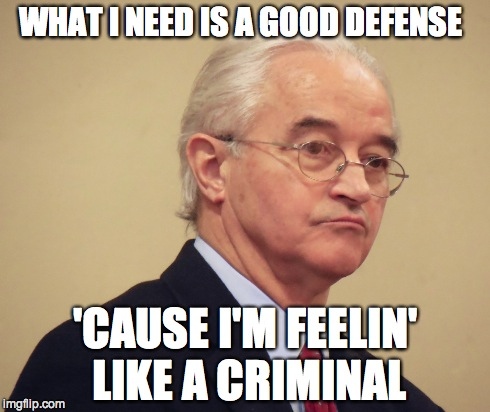
Mahatma’s meltdown

Scott Milne, the man who famously called himself “Gandhi-like,” is finding that it’s awfully hard being a pacifist when the bullets are flying. He made an unplanned call to WDEV’s Mark Johnson Show on Friday morning and… well… spent about 20 minutes ranting about the media’s unfair treatment of the Milne campaign. And specifically impugning the good name of Our State Pundit Laureate, Eric Davis. That will never do, Mr. Milne.

Davis had been a guest during the first hour of the program. He and Johnson discussed the gubernatorial race. The consensus was that Governor Shumlin had left himself vulnerable because of various scandals and issues. And that it’s too bad the Republicans didn’t have a better candidate, because Scott Milne had made a mess of things.

Apparently it was enough to make even a Gandhi-like person’s blood boil. A little while later in the show, Milne called in to rebut Davis’ analysis. Or to slap it around, anyway. At great length and in pretty extreme terms: at one point, he accused Davis of “laughing at me.” Sorry, Mahatma, I don’t think I’ve ever heard Eric Davis laugh at anyone. If he’s anything, he’s a straight arrow, cautious to a fault.

Here’s a sample of Mahatma’s Meltdown:

When you’re bringing people on the air that influence people with, ah, you know, tenured professorships from elite institutions, you need to ask the tough questions and bring out the contradictions in what they said. If you look back on Mr. Davis’ track record of picking things in Vermont over the last few elections, it’s not stellar. And I think it’s a form of, uh, you know, uh, you know, journalistic malpractice. You just let him get away with saying some of those things.

I’m sure the folks at Middlebury College are happy to be considered an “elite institution,” but otherwise, good God. Eric Davis’ track record hasn’t been perfect, but it’s been awfully good. That’s why he’s the go-to political analyst for Vermont media. He knows his stuff, he’s conscientious, he doesn’t take chances, and he certainly doesn’t engage in gratuitous attacks. He has earned the respect he is given by the media and by news consumers.

Milne railed against the notion that his campaign lacks ideas. Which isn’t accurate; what we say is that he lacks policy positions and proposals. Milne’s definition of “idea” includes such things as “Peter Shumlin spends too much time out of state” and “the economy isn’t growing quickly enough.” What Milne is criticized for is his real, true, honest-to-God lack of proposals. He tries to make this a virtue by saying, on issue after issue, that he’s going to get all parties together and work out the best solution.

That’s awfully thin gruel. And besides, his current definition of ideas is at odds with what he was saying earlier on: that he would spend August attacking Shumlin, and start rolling out his own proposals in September. He hasn’t delivered on Part 2. “Give me 30 days,” he said on July 25. It’s been 50 days since then.

Milne also repeated one of the more extraordinary statements he’s made during the campaign:

I am uncomfortable about calling people and asking them for money to support a public policy campaign, and feeling 100% like I don’t owe them something afterwards.

I guess you could say that has a certain freakish nobility. But it’s a fantasy: Politicians have to raise money. Yes, there’s too much money in politics. But Milne has raised a laughably small amount — and virtually all of it from his family, friends, and his own back pocket.

Now we know why. He doesn’t want to ask for money, and he doesn’t want to be obligated.

Somebody should. tell Phil Scott about this. He’s been raising money right and left from contractors and gas companies and rich Vermonters and his vast network of cronies, and insisting that it doesn’t make any difference in his politics. Scott Milne would beg to differ.

Somebody should also tell the Scott Milne of midsummer about this. At the time, he said he planned to raise and spend about $200,000, which would be enough to wage an “unconventional campaign.” As of early September, he’d raised about 20% of that total. And since then, his full-time professional campaign manager has resigned. And we haven’t seen any TV ads or mailings or yard signs or any other tangible measures of an adequately resourced organization.

Milne was upset Eric Davis’ characterization of his campaign as “running on fumes.” He said, “If [Davis] hasn’t talked to my bank, he has no way of saying that.” And he pointed to his paid staff of five people as evidence he had money.

And then he contradicted himself.

We’ve got a strategy. Granted, it’s not perfect. I’m going to make mistakes. But I think our strategy is, you know, we’re running an insurgent campaign. We’re going to use our lack of money as best we can as an asset.

“Our lack of money.” Yep, he said it.

And about this “insurgent campaign” stuff. Yes, Milne is running an unconventional campaign. And yes, Eric Davis and Mark Johnson and me and all the rest of the punditocracy are basing our judgments on political convention: you have to take time to build name recognition, you have to generate news coverage, you have to have a robust infrastructure from the central office to the grassroots, you have to have a decent amount of money to run advertisements and do mailings and staff phone banks and print signs and all that other stuff of retail politics. You have to have ideas and positions that give people positive reasons to vote for you. You need a certain capacity for public speaking and pressing the flesh and handling the media.

And, preferably, you need a track record of accomplishment in the public sector.

Scott Milne has none of that. And he’s made a bunch of obvious blunders.

And so, when measured against every available standard for judging a campaign, Milne comes up short.

Now, if his “insurgent campaign” taps into a vast unseen reservoir of support, then all us conventional thinkers will get our asses kicked on November 4.

And I, for one, will be more than willing to admit I was wrong.

But I am extremely confident that I’m not wrong.

Of course, if Milne loses it’ll be Eric Davis’ fault.

What I need are people who want change and balance in Montpelier, to be naive enough to believe that they can make a difference by voting. And having people like Eric Davis that don’t think that, there’s a  lot of that, but somebody like you giving him a microphone week after week, when he’s got a track record he has of saying things that are factually inaccurate, I believe he purports an awful lot of opinions like they’re facts and you let him get away with it, and I don’t think that’s fair.

He went off the rails in mid-sentence there, but his point was that Eric Davis’ negativity was going to keep him from building momentum, and cause him to lose the election.

Sigh.

Like I’ve said before, pundits and reporters and even little old partisan bloggers like me simply don’t have that kind of influence. The vast majority of voters have already made up their minds. And the rest of ’em won’t spend the next seven weeks poring over media coverage of the campaign. The crowd of political junkies who pay a lot of attention to this stuff is a very small crowd indeed.

No, Mahatma, Eric Davis won’t kill your insurgency by the power of his punditry. Peter Shumlin will kill it with his superior organization, warchest, and advantages of incumbency. The Vermont Republican Party will kill it with its nonexistent grassroots organization, lack of resources, and internal divisions. The voters will kill it because a solid majority of them are liberal or progressive, and the Democrats have a built-in advantage.

And Scott Milne will kill it with his lack of political experience and smarts, and his poor performance on the public stage.

By all conventional measures, Scott Milne has run a terrible campaign. And I’m a guy who, when Milne first came on the scene, had some hope that he’d turn out to be a solid representative of moderate Republicanism. If he were doing a good job, I’d be reporting as such. But he’s not.